
Category: AltFinLab
Environmental sustainability has become one of blockchain’s favorite talking points. Even so, carbon credits, drought insurance, climate adaptation loans, renewable energy certificates, and biodiversity finance do not usually occupy the same conversation for long. In the seventh Blockchain Talks, they did!
What held them together was neither a shared market nor a shared asset class, but a shared operational problem. In each case, money, claims and decisions depend on records that must be trusted across multiple actors, while the realities behind those records remain difficult to verify or audit. The session, then, was more about where the technology begins to matter once environmental work runs into questions of integrity, coordination and implementation.
Opening the session, Robert Pasicko situated the discussion within UNDP’s own pipeline. Environmental sustainability, he noted, is no longer a side strand in blockchain work. On the contrary, it has become one of the liveliest areas of experimentation, precisely because teams are testing whether the technology can solve something concrete. The real test, as he put it, is not whether blockchain sounds relevant, but “how do we actually make it work?”
That question found its clearest answer in the speakers’ experiences in their projects. In Adam Spiers’ account of Toucan Protocol, blockchain helps where carbon markets need traceability that can survive market activity. Toucan’s work brings carbon credits on-chain in a way that remains verifiable “to guard against double counting,” while also making it easier to build liquid instruments around assets that are otherwise slow and fragmented to manage. In that sense, blockchain is being applied as market infrastructure.
With Etherisc, the technology appeared in a different role. Christoph Mussenbrock showed how blockchain can help coordinate climate insurance across farmers, NGOs, governments, insurers, and reinsurers that do not naturally share a trusted system. When payouts depend on satellite data, sampling, and rapid execution rather than slow claims processing, that shared layer starts to matter. Just as importantly, he made clear where the technology should disappear from view: “No farmer should bother about wallets and private keys and cryptography.”
In the electricity market, the value proposition sharpened further. Gideon Maasz of Fuel Switch focused on renewable energy certification, where the issue is proving in auditable terms how much exported electricity is actually renewable. Once those claims begin carrying tax or trade consequences, credibility ceases to be a reporting preference and becomes a commercial requirement. Hence his insistence that environmental claims need “quantifiable data.”
Elsewhere, the same logic surfaced in climate adaptation finance and nature-based investment. Speaking about Cladfy’s work with UNDP Bangladesh, Ebby Gatamu described a system designed to move climate finance to rural women in ways that are more accessible, more trackable, and more dignified, allowing them to apply “from the comfort of their home.” From a different corner of the field, Juan Pedro Piñeirua showed how blockchain can help structure environmental value so that capital flows and ecological outcomes are easier to follow over time. In his words, the larger question is “How do we bridge the gap between the market and the protection of life-supporting systems?”
Taken together, the session gave a more grounded answer to its own title. Blockchain helped where environmental work needed claims, flows, and records to remain legible across many actors at once. That is a narrower answer than the hype usually offers, but a far more credible one.
Missed our talk? Watch the recording here.
You can also explore previous Blockchain Talks sessions in our YouTube Playlist.
Get involved
The UN Blockchain Community of Practice (CoP) works best when colleagues bring practical questions, field-tested lessons and cases that challenge easy assumptions.
For more details or suggestions, contact Ben Thompson Coon, UN Blockchain CoP Lead; ben.thompsoncoon@undp.org
In 2025, the SDG Blockchain Accelerator delivered 46 pilot- and implementation-ready solutions, with 12 already entering real-world testing. Developed across two global cohorts, 70% of these solutions are embedded within ongoing national and regional programmes – positioning them to move beyond standalone experiments and into active use.
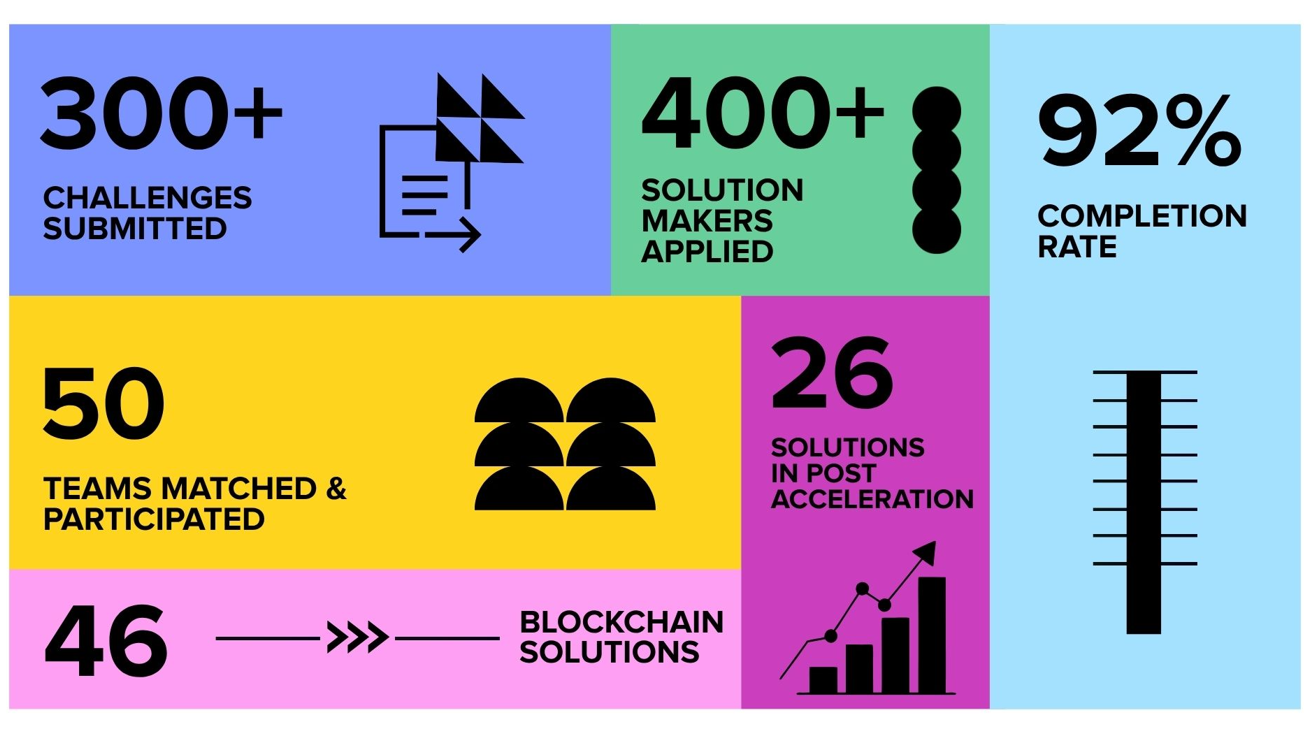
The SDG Blockchain Accelerator was created to connect innovators with development challenges and turn ideas into impact. While interest in blockchain has grown in recent years – from traceable transactions and auditable data to improvements in payments and service delivery – a persistent question has remained: how to design solutions that can operate within institutional, regulatory, and operational realities. To address this, the Accelerator brings together UNDP, technical partners, and innovators into a structured, multi-partner platform that supports solutions from concept to deployment.
Strategically led by the United Nations Development Programme’s Alternative Finance Lab (AltFinLab), in partnership with the Blockchain for Good Alliance (BGA), EMURGO Labs, FLock Technology Holdings, Stellar Development Foundation, and Sui Foundation, the global initiative helps scale blockchain and decentralized AI solutions to advance the Sustainable Development Goals (SDGs).
A structured pathway from demand to deployment
In many innovation efforts, the challenge is not generating ideas or prototypes, but ensuring that solutions can function within existing systems. The Accelerator links demand, solution development, and implementation planning into a single process, helping move ideas from exploration to practical application.
It is built around a demand-led model, where UNDP Country Offices define concrete development challenges grounded in ongoing programmes and national priorities. Across the portfolio, blockchain is being applied to address a consistent set of system-level issues – from inefficient financial flows and weak data integrity to fragmented supply chains and low-trust governance environments – where verification, transparency, and coordination are essential.
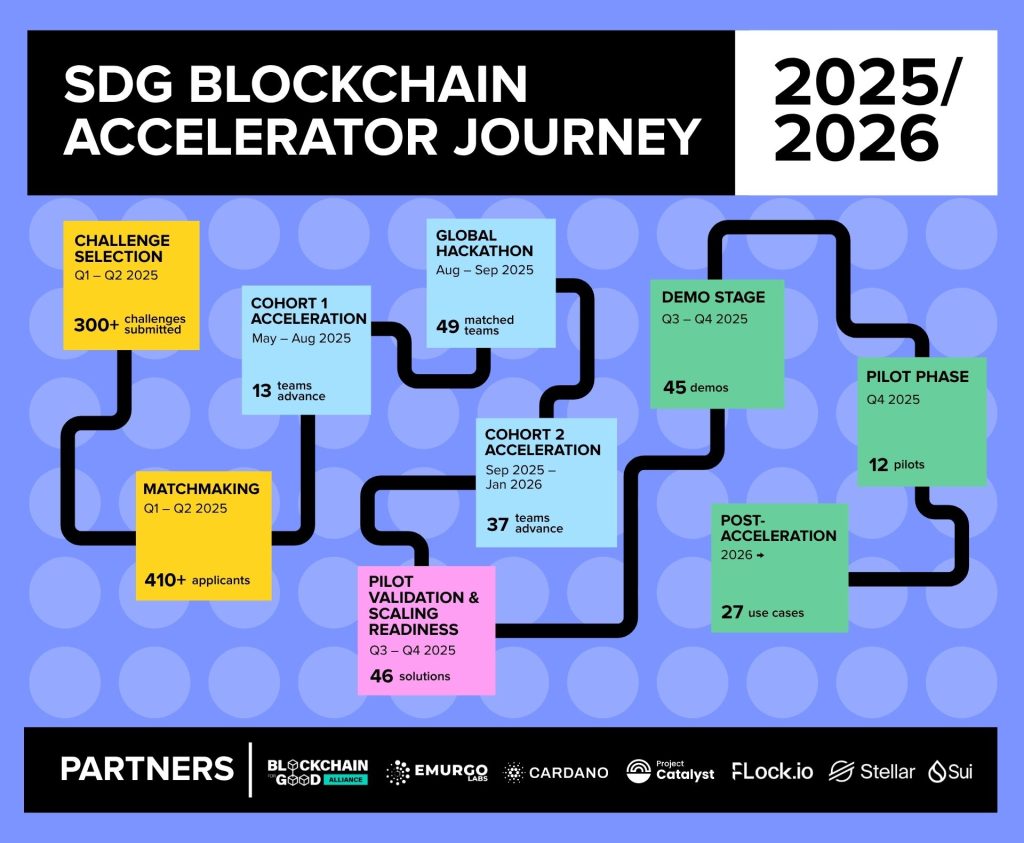
From there, UNDP AltFinLab matches challenge owners with solution makers and technical partners through a structured process – moving from problem definition to roadmap, and from roadmap to pilot readiness. Open calls and hackathons serve as mechanisms for aligning different actors around a shared problem, allowing ideas to be tested and refined before entering acceleration.
The programme operates through a multi-partner, track-based model that brings together multiple technical ecosystems while maintaining a coordinated and neutral approach. This allows challenges to be matched with the most suitable solutions and platforms. By working across multiple blockchain ecosystems, the Accelerator reduces dependency on any single technology stack and increases adaptability across different country contexts. Interoperability is also a defining feature of the portfolio, with nearly 90% of solutions either already supporting or planning cross-chain integration.
Crucially, teams are expected to define how solutions would function under real conditions, including governance, budgeting, and integration into existing processes. At the core of this process is the roadmap – a structured output that translates a development challenge into an implementable pathway, aligning stakeholders, technical design, governance, and financing considerations. This emphasis on operational readiness helps address a common point of friction in innovation efforts.
Where demand is consolidating
The portfolio of solutions that has emerged from this process also reveals where blockchain is beginning to demonstrate practical value.
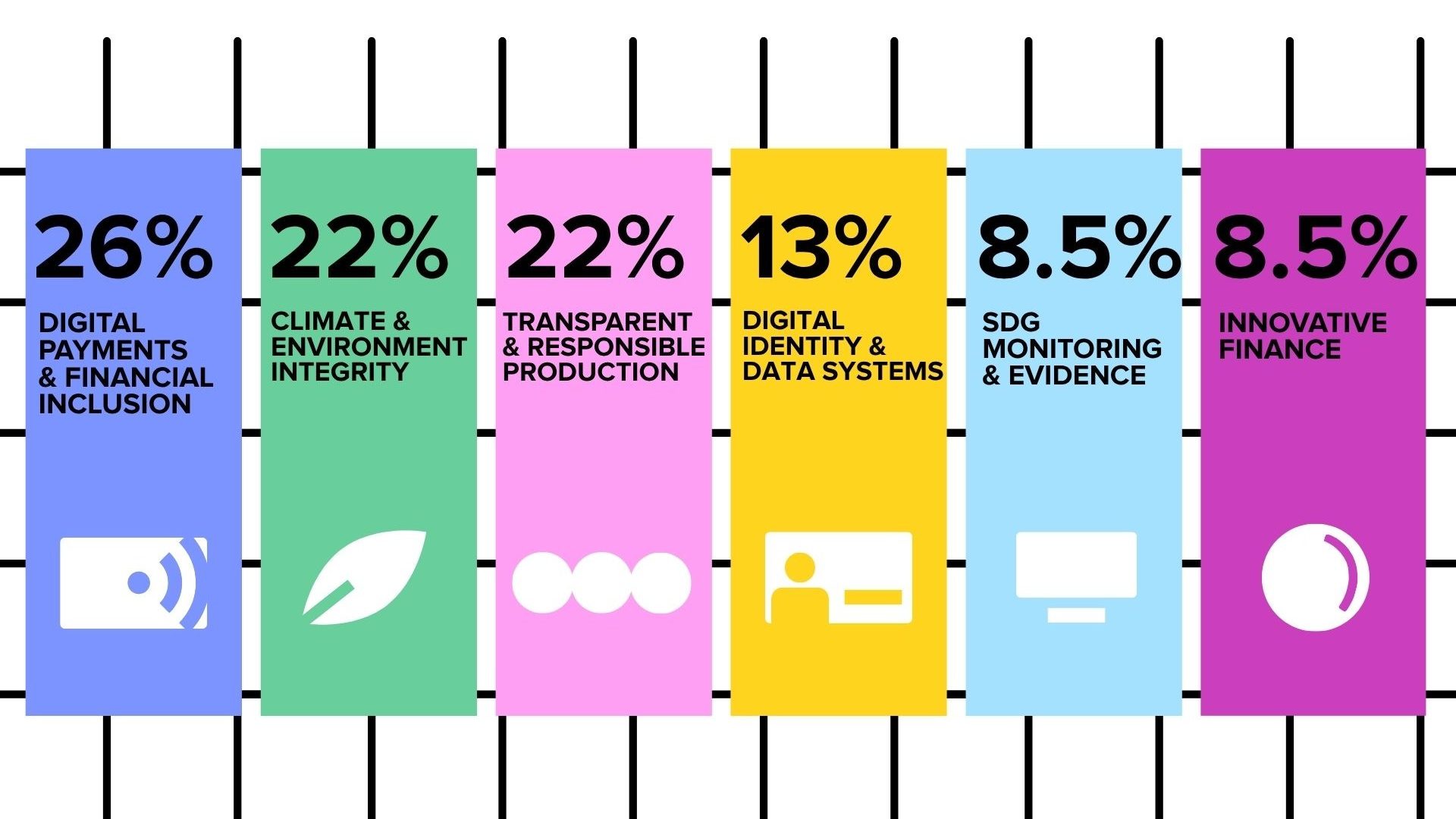
Digital payments and financial inclusion account for the largest share of solutions, followed by climate finance and environmental integrity, and transparent and responsible production. Together, these clusters make up the majority of the portfolio, pointing to areas where systems rely on trust, coordination, and shared data across multiple actors – and where existing approaches often struggle with fragmentation and limited transparency.
The portfolio spans a diverse set of solutions – from payment systems designed to improve last-mile delivery, to carbon registries that strengthen climate market integrity, supply chain platforms that enable traceability across production networks, and digital identity and credentialing tools for verifiable impact tracking.
For example, in contexts where financial systems rely on cash, manual processes, or fragmented infrastructure – as in Haiti and Syria – blockchain-based payment solutions are being designed to deliver funds directly to individuals. This reduces delays, improves traceability, and increases transparency in how resources are distributed. In one pilot, a government disbursement process that currently requires waiting up to six months for loan guarantee payments is being automated, helping small businesses – particularly women-led enterprises that are disproportionately affected by such delays – receive funds faster and more reliably.
Many of these are designed as components that can be integrated into broader public systems, strengthening core functions rather than operating in isolation.
From institutional readiness to public-sector engagement
Beyond solution development, the Accelerator is strengthening institutional readiness to engage with emerging technologies. For 82% of participating UNDP Country Offices, this was their first direct experience with blockchain or similar technologies. By the end of the programme, the share reporting high or very high understanding increased from 21% to 60%, indicating a clear progression from initial exposure to practical capability.
This growing readiness is reflected in how solutions are developed and adopted. UNDP Country Offices act as “challenge owners,” grounding each solution in national priorities and convening stakeholders around it. This ensures alignment with government strategies, regulatory environments, and operational realities from the outset.
Public-sector engagement is therefore built into the process. Government and public-sector entities are involved in 73% of solutions, with more than half engaging policymakers or regulators directly. This creates clearer pathways toward adoption, with solutions shaped in close interaction with the institutions expected to use them.
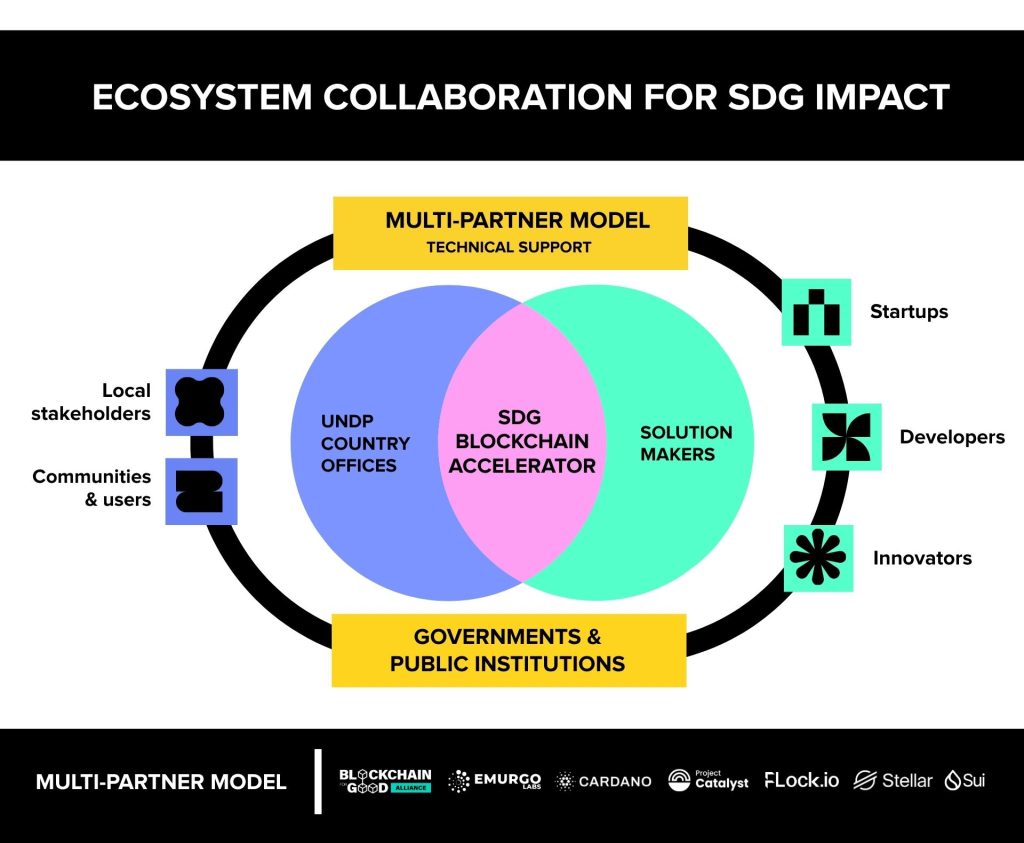
The model also expands the ecosystem around these efforts. More than 120 external partners contributed across the portfolio, with solution makers being able to work directly with public institutions – a connection that is often difficult to establish in practice. This strengthens the link between innovation and implementation environments.
Connecting to a broader blockchain practice
A selection of use cases and pilots developed through the Accelerator are featured in the newly released New Tech, New Partners publication, which brings together more than 40 blockchain applications across regions.
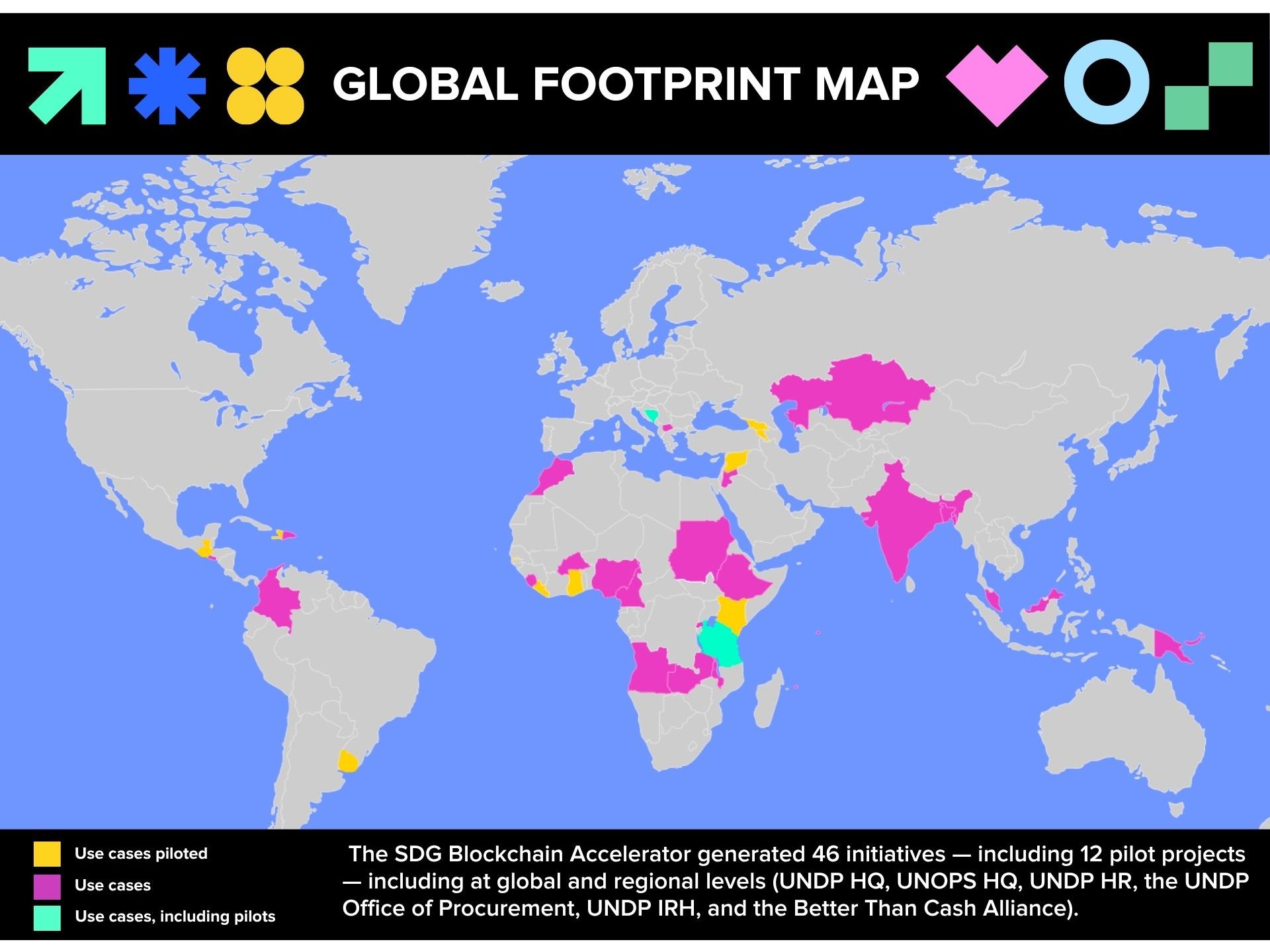
This report highlights the geographic spread and diversity of blockchain applications across development contexts. Across it, blockchain is increasingly used as a coordination and trust layer – supporting how data, payments, and decisions move across systems in more transparent and verifiable ways.
Together, these examples point to a growing body of practice around how blockchain can support digital public infrastructure and public-purpose systems in concrete, applied settings.
The remaining bottleneck: from pilot to scale
The main constraint is no longer whether these solutions work, but whether they can be sustained and scaled. Many are ready to move forward but lack the financing, partnerships, and operational support required to move beyond pilot stages. The challenge has shifted from designing viable solutions to ensuring they are taken up and maintained within public systems.
Building on these lessons, Cohort 3 of the Accelerator will aim to anchor each solution in an existing country programme or programmatic framework with at least one year of operational runway, and a clear implementation context. This shifts the centre of gravity from innovation showcase to institutional delivery: Country Offices and UN agency teams bring the development challenge and the programmatic home, Solution Makers bring production-ready technology, and the Accelerator provides the structure to connect the two. The opportunity now is to move from “proof that it works” to “proof that it scales”, embedding solutions within the programmes, partnerships, and budgets that already exist, so they can deliver tangible, sustained impact.
Stay tuned for our Cohort 3 open call!
The Accelerator is powered by catalytic funding from Cardano’s treasury via Project Catalyst, with support from other partners.
By the time a product or service reaches the end user, most of the difficult work has already been done elsewhere. Someone had to collect the right data and keep it attached to the right goods. Another person had to verify it and carry it through a chain involving tens of actors. Crucially, traceability only becomes relevant when records survive the chain itself – this was the real subject of the sixth UN Blockchain Talks.
This session was valuable because it remained grounded to that reality. Three industry leaders and practitioners — Sam Lambert of zenGate Global, Mark Kaplan of Wholechain, and André Vanyi-Robin of Plastiks — spoke about the conditions that make traceability work, or fail, once systems leave the slide deck and meet the field.
The session began with the challenging process of data capture in the upstream reality, then moved on to the middle of the chain, where records need to be transferred between different parties and systems. Later on, we moved on to plastic recovery, where weak records are becoming increasingly difficult to justify to auditors and regulators. By the end of the Talk, the audience had gained a more practical understanding of what trustworthy traceability actually demands than a general case for blockchain.
The first problem is rarely technical
Sam Lambert opened with a phrase that stayed with the rest of the session: “bush to boardroom.” His point was that the people setting the rules for compliance, risk and reporting are often far removed from the people expected to collect the first data.
In agricultural supply chains, for example, traceability often begins in places with poor connectivity and manual processes. These places also have limited training and strong local systems of trust that do not automatically align with the logic of a digital compliance framework. Sam put it bluntly: “Technology isn’t a silver bullet. In fact, I think it often just exposes where the issues are.”
He also made a point that deserves to be heard beyond this session: “We’re here to design systems around people.” This may sound obvious, but much of the traceability sector still operates in the opposite way. New systems are introduced and new reporting demands are added, placing the burden on communities that were not involved in the initial design process. Sam’s remarks brought the conversation back to the ground: consent, training, workable workflows, offline functionality and field conditions are all integral to the system.
Good records are not enough if they cannot move
Mark Kaplan continued the discussion at the point where products move beyond the first mile and enter a more crowded supply chain. Here, the focus shifts to whether that data can travel with the goods in a form that can be used by others.
Even if a supply chain has portals, dashboards, audits and QR codes, it may still fall short of real traceability if the records are not tied to actual lots and transformation events. Mark described Wholechain’s approach as event-based and grounded in GS1 standards, with records that remain linked to the movement of physical goods.
That is where his remarks on fatigue landed well. When Sam spoke about farmer fatigue, Mark added another phrase to the session: “Portal fatigue.” He used this term to describe the situation where people in the middle of the supply chain are forced to work across disconnected, non-interoperable proprietary systems. Traceability improves when data can be understood by different systems without losing meaning. This is why standards were so important in Mark’s discussion.
In waste recovery, weak proof is no longer enough
André Vanyi-Robin took the session into plastic recovery, where the pressure for stronger records is no longer theoretical. He stated clearly: “There is no traceable proof of recovery. The existing standard practice are spreadsheets, which obviously don’t survive the audits.”
He described a sector where data is fragmented among recyclers, producers, and regulators, and there is no shared connection strong enough to support compliance reporting. In that setting, blockchain technology is important because it provides a continuous record. It stores proof without exposing sensitive commercial data. As he explained, “You have verifiable proof of impact without exposing sensitive data.”
André also tied this back to everyday implementation. In his view, the answer is not to force companies into yet another cumbersome platform, but rather to integrate with existing ERP and product information systems, and “not force additional complexities at the level of verification”.
The stronger lesson sat between the talk
The value of the session came from how these three perspectives met. Sam dealt with first-mile reality and the human side of system design. Mark dealt with standards, interoperability and how records stay attached to goods. André dealt with compliance-grade proof and what happens once records carry legal and financial weight.
Seen together, the message was that blockchain becomes useful only when the rest of the system is already serious about data, process and trust.
Missed our talk? Watch the recording here.
You can also explore previous Blockchain Talks sessions in our YouTube Playlist.
Get involved
The UN Blockchain Community of Practice (CoP) works best when colleagues bring practical questions, field-tested lessons and cases that challenge easy assumptions.
For more details or suggestions, contact Ben Thompson Coon, UN Blockchain CoP Lead; ben.thompsoncoon@undp.org
During the fifth session of the UN Blockchain Talks series, the discussion moved beyond whether blockchain can support digital identity. A more useful examination was what kind of identity system would give people greater control over their data without making implementation harder for governments and service providers.
Hosted under the UN Blockchain Community of Practice, led by UNDP AltFinLab in collaboration with the UN Innovation Network, Blockchain Talks #5: Digital Identity, Privacy and Impact brought Aya Miyaguchi, President of the Ethereum Foundation, Jigme Tenzing, Secretary of GovTech Bhutan, and Peter Frandsen, Founding Partner of Partisia and the Partisia Foundation.
Together, they explored Bhutan’s national digital identity journey, the role of Ethereum in that architecture, and why privacy-enhancing technologies need to be part of the conversation if digital identity systems are to work in practice.
Bhutan’s starting point was privacy
Bhutan’s case stood out because the discussion began with a policy choice, not a technical one. As Jigme Tenzing explained, Bhutan’s move toward a decentralized, self-sovereign identity model was shaped by a concern many governments now face as they digitize services: efficiency can move faster than privacy protections when those protections are treated as secondary.
“In our hurry, we were kind of forgetting about privacy,” he said.
That concern pushed Bhutan away from the idea of a single centralized government database holding all citizen identity data. Instead, the country pursued a model in which verified information can be issued by the government, while remaining under the individual’s control.
In one of the clearest lines of the session, Tenzing described the shift this way: “The government functions more like a notary.” In other words, the role of government changes from holding and managing data to validating credentials that citizens can then use with explicit consent. That distinction gave the discussion real weight.
Why Ethereum fit Bhutan’s model
Aya Miyaguchi placed Bhutan’s approach within a broader set of design values that the Ethereum ecosystem seeks to protect: decentralization, open-source development, privacy, security, and resilience.
Bhutan’s digital identity system was not presented as an imported product, but as national infrastructure developed with external support and strong local ownership. “We are a supporter, not a builder,” Aya said, describing the Ethereum Foundation’s role in Bhutan’s process.
She also noted that Bhutan has become the first country to anchor national digital identity on Ethereum at national scale, with the current system supporting more than 30 government services.
Privacy cannot be solved by blockchain alone
If Bhutan’s case showed why decentralization and user control matter, Partisia’s contribution in the session clarified why privacy still needs additional tools. Peter Frandsen focused on Multi-Party Computation (MPC) and the role it can play alongside blockchain in identity systems.
“Everything on the blockchain is public, and everything in MPC is private.”
That line by Frandsen helped cut through a common confusion in digital identity discussions. Blockchain can provide integrity, immutability, and a shared trust layer. But when systems need to verify something sensitive without exposing the underlying data, privacy-enhancing technologies become essential.
Frandsen illustrated this through concrete examples. In one case, a person can prove they are allowed to access a building or collect a parcel without disclosing unnecessary personal information. The system confirms the right to act, rather than forcing the user to reveal more data than the transaction actually requires.
What this session clarified
Blockchain Talks #5 made clear that digital identity decisions are also decisions about trust, data control, legal readiness, and public understanding. Bhutan’s case made that visible. Ethereum’s role clarified the infrastructure logic behind it. Partisia’s contribution showed why privacy needs to be designed at the computational level, not simply promised at the policy level.
The session also served as a useful reminder that the hardest part of digital identity is rarely the interface. What matters most are the governance choices and technical architecture underneath.
Missed our talk? Watch the recording here.
You can also explore previous Blockchain Talks sessions in our YouTube Playlist.
Get involved
The UN Blockchain Community of Practice (CoP) works best when colleagues bring real examples, practical questions
For more details or suggestions, contact:
Ben Thompson Coon, UN Blockchain CoP Lead
ben.thompsoncoon@undp.org
Lisbon, 18 March 2026 – Goparity, a Portuguese impact investment platform, has collaborated with AltFinLab, a flagship United Nations Development Programme (UNDP) initiative, pioneering alternative and innovative finance solutions, to further develop and refine impact measurement approaches within the crowdlending sector.
As regulatory scrutiny and public expectations around ESG and impact claims continue to increase – including evolving guidance from the European Securities and Markets Authority – actors across the sustainable finance ecosystem are working to strengthen transparency, clarity and methodological consistency in impact reporting.
Through this collaboration, Goparity led a process to review and further strengthen elements of its impact management framework, with technical advisory support and mentorship from UNDP AltFinLab. The engagement focused on aligning long-term impact objectives with measurable indicators, reviewing project categorization methodologies, and enhancing internal data collection and management processes.
The work was structured in phases. It began with an assessment of the coherence between strategic impact objectives and existing monitoring practices. This was followed by updates to project categories and related indicators, resulting in a structured set of outcome and impact indicators contributing directly to relevant Sustainable Development Goals (SDGs). The final phase explored improvements to data management systems and processes to support consistent implementation and future scalability.
“As sustainable finance continues to evolve, strengthening transparency, accountability and methodological clarity becomes increasingly important,” said Teodor Petricevic, Accelerator Lead, UNDP AltFinLab. “Through AltFinLab, we support ecosystem actors so they can refine impact measurement approaches that align financial innovation with broader sustainable development objectives.”
“Impact cannot rely on intention alone, as it must be measurable, comparable and credible. This collaboration is an important step for Goparity, as it allows us to reinforce the methodological foundations of our impact framework and ensure that our growth is matched by equally robust impact standards,” says Iara Comunello Martins, Impact Manager and leader of this project at Goparity.
Following the UN’s 2025 International Conference on Financing for Development, where global leaders called for the creation of innovative financing schemes for development and the adoption of standards and terminology to facilitate measurement and comparable results, Goparity seeks to raise the bar in the crowdfunding sector. Through this partnership, it will outline standards in impact management, integrating indicators and benchmarks recommended by the international community – a clear position against “impact washing”.
In parallel, Goparity contributed to broader ecosystem knowledge exchange through initiatives such as the UNDP Crowdfunding Academy and BOOST, UNDP’s regional impact acceleration programme in Europe and Central Asia, sharing practical insights on crowdfunding and crowdlending models, financial and risk analysis, and regulatory considerations relevant to impact-driven organizations. The collaboration reflects ongoing efforts within the alternative finance sector to strengthen impact measurement practices and promote responsible innovation.
This collaboration does not constitute endorsement by UNDP of any specific platform, product or financial instrument.
About Goparity
Founded in 2017, Goparity’s main mission is to democratise access to sustainable finance by connecting companies and individuals who want to invest in projects with a positive impact on people and the planet. Since its inception, the platform’s more than 59,000 users have financed over 420 impact projects — aligned with the United Nations Sustainable Development Goals — across three continents, totalling more than €55 million invested. The projects financed have positively supported over 100,000 people, created more than 4,000 jobs, and help avoid the emission of over 30,000 tonnes of CO₂ into the atmosphere every year.
Blockchain work across the UN system has grown steadily, but not always in a coordinated manner. Some teams are piloting real solutions; others are still assessing whether the technology fits their operational reality. This creates momentum, but also fragmentation; lessons sit in separate corners, and colleagues often struggle to find the right use case, the right focal point, or the right evidence at the right time.
Between existing blockchain projects and use cases across the United Nations, the UN Blockchain Talks add the missing layer: a regular space to compare approaches and learn from cases that have faced real operating constraints. The series continues in 2026 with a monthly rhythm as topic-specific sessions designed to stay practical and collaborative.
Timeline and topics of upcoming UN Blockchain Talks:
- 12 March 2026 | Digital Identity → Watch the recording
National-scale digital identity on public blockchains - 9 April 2026 | Supply Chain → Watch the recording
Supply chains traceability and implementation - 23 April 2026 | Blockchain for Climate → Watch the recording
Environmental sustainability and blockchain: Where does it actually help? - 5 May 2026 | Digital Payments → Watch the recording
Money’s New Rails: Stablecoins and the last mile of financial inclusion - 11 June 2026 | AI on Blockchain → Watch the recording
AI Agents, federated learning and on-Chain alignment
Each talk is followed by shared materials and a lightweight prompt for participants to share interests and propose ideas to move beyond the talks into peer support, working groups and practical collaboration.
The UN Blockchain Community of Practice
Blockchain projects across UN agencies and regions tend to face the same early hurdles, such as finding the right partners, navigating governance and risk issues, or demonstrating that the approach improves delivery in real operating conditions. And when teams work in isolation, lessons travel slowly, and the same design mistakes repeat.
That’s why the UN Blockchain Community of Practice (CoP), hosted under the UN Innovation Network (UNIN) and managed by UNDP’s Alternative Finance Lab (AltFinLab), brings this work into one shared space with a focus on practical knowledge sharing – a regular learning series, a live repository of initiatives, and pathways that keep the work moving beyond the Talks.
COs, UN Agencies working in isolation/silos, the CoP creates a shared space where colleagues can find real examples, learn from what has already been tested, and connect with the right people. Through the Core Group, the live repository, and the Blockchain Talks and other activities, the CoP reduces duplication, helps avoid common mistakes, and improves the quality of new initiatives.
Journey and momentum
Since early 2025, the CoP has relaunched its learning cadence through the Blockchain Talks series, with the first set of sessions focusing on building a shared foundation while staying grounded in real implementation. Each talk was designed to be useful for both newcomers and practitioners, and featured expert speakers from across the UN system and external technical partners.
Those early sessions helped reset the community around a practical baseline: what kinds of problems blockchain has been used for inside the UN ecosystem, what enabling conditions matter (policy, partners, user adoption, and operational constraints), and what colleagues should ask before they commit time and resources to a pilot.
A living repository of UN blockchain initiatives
Aiming to build a reliable knowledge base of what has been tried, where, by whom, and for what purpose, a major workstream behind the CoP was building a live repository of UN blockchain initiatives that can serve as a working reference point. As part of this wider effort, 150+ blockchain-related initiatives were mapped across the UN ecosystem.
In parallel, 80+ cases were validated directly with project focal points (to correct details, add context, and confirm status), building toward a repository that is usable as a working tool for programme teams, innovation units, procurement colleagues, and policy teams alike.
What becomes easier
- Colleagues can quickly find relevant use cases instead of starting from scratch.
- Teams can identify who to contact and what supporting materials exist.
- Early design can improve when teams can see what others learned about governance, risk, and delivery constraints.
- Templates, partner models, and implementation patterns can travel across agencies more easily.
The repository also helps the community see patterns. Over time, it becomes a live tool that makes it easier to spot clusters of work in areas where the UN is already active, such as payments and financial inclusion, supply chain traceability, digital identity, climate-related applications, and new governance or fundraising models.
Get involved
What makes this CoP work is the people who show up with real examples and honest questions. If you are attending a Talk, your input is what makes it valuable. Registration links will be shared through the CoP space and mailing list.
For more details or suggestions, contact: Ben Thompson Coon, UN Blockchain CoP Lead
There’s a question that doesn’t get asked enough in digital finance: what does “working” actually mean when you’re operating at the last mile?
Digital payments solve obvious problems on paper: instant settlement, lower fees, and transparency. But the last mile doesn’t operate on paper. It operates with patchy connectivity, cash-based economies where trust is built face-to-face over years, and the weight of someone’s entire month’s survival sitting in a transaction that may or may not go through.
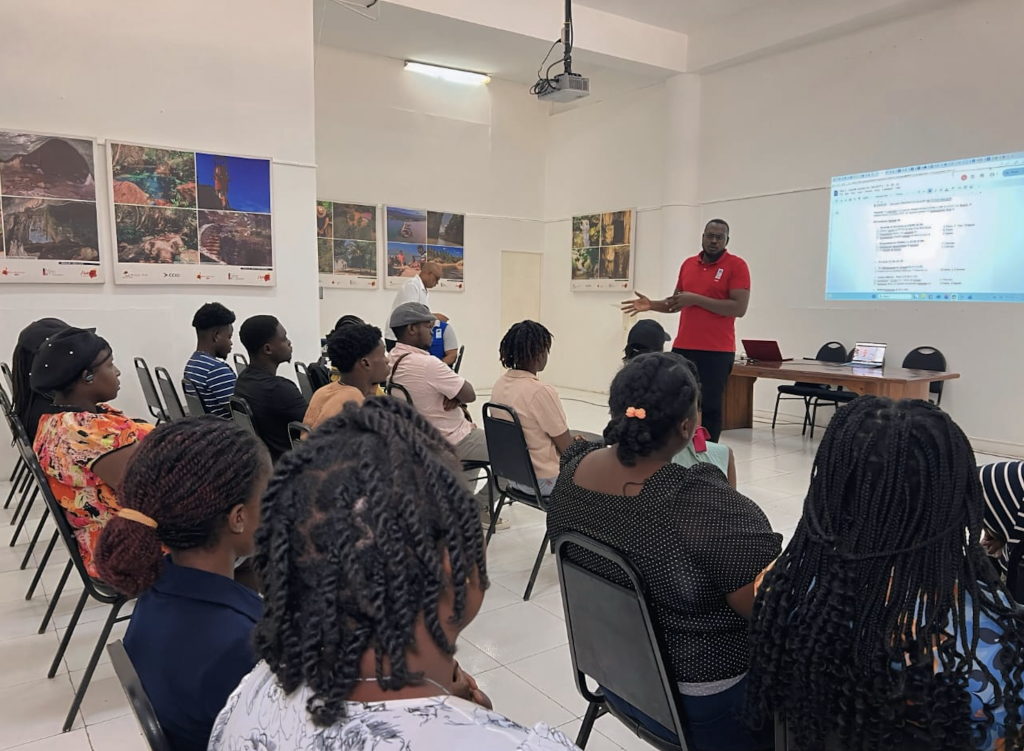
Across Haiti, Guatemala, and The Gambia, three teams from Cohort 2 of the SDG Blockchain Accelerator ran pilots testing whether blockchain-based digital payment flows could function under real operational constraints, not ideal conditions, in partnership with Stellar Development Foundation. What they found was more specific and more useful than a simple yes or no.
What were we actually testing?
For many households and microbusinesses, remittances and small transfers mean survival. Payment friction compounds at every step: transfer fees, currency exchange losses, physical distance to payout locations, and the opportunity cost of a day spent traveling to collect money. When people are forced to cash out immediately because holding digital value feels precarious, there’s no room for saving, building credit, or investing in community. When programmes can’t see where money actually goes, accountability becomes a reporting exercise rather than a feedback loop.
The question these pilots tested wasn’t whether blockchain can handle payments. It was narrower and more practical: can digital rails reduce friction while widening access to financial services in contexts where traditional banking infrastructure doesn’t reach, or doesn’t bother to reach, because the volumes don’t justify the cost?
This is fundamentally a design question, not a technology question.
Each pilot ran an end-to-end flow with bulk payments initiated by partners, received in participating wallets, and used in real economic activities like merchant payments, community fund governance, and informal business recordkeeping. In Haiti and the Gambia, two pilots used the Stellar Disbursement Platform to send bulk payments directly to end user wallets. UNDP Guatemala Country Office collaborated with Amero Exchange to test a community investment feature tied to remittances, with an interoperability roadmap outlined in their product plans.
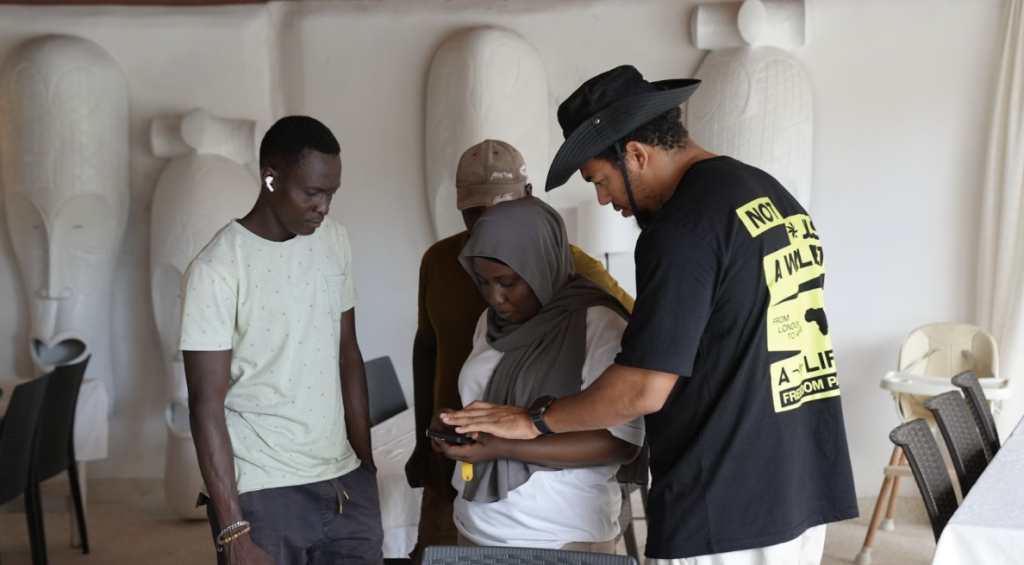
Proof-of-concept success meant demonstrating three things: funds could be delivered digitally to the last mile, users could transact in ways that reflect daily realities rather than ideal conditions, and partners could view a trustworthy record of what happened. Three different contexts, each on a different platform, revealed a shared signal.
Haiti: When the contingency plan becomes the test
In Haiti, most day-to-day transactions still happen in cash. ‘The Prosperity Loop’ pilot asked whether digital payments could function reliably when infrastructure fails, not just whether they could work in principle.
The pilot enabled households, merchants, microfinance institutions, and nonprofits to receive transfers in digital wallets from Kura and Bousol, make local payments, and build a trusted transaction record. The model combined these wallets with point-of-sale infrastructure designed for low connectivity, and those design choices got tested faster than anyone planned.
With flights disrupted, the UNDP Haiti team and the solution makers from Kura and Bousol reached Cap-Haïtien by last-minute helicopter. The next day, the cellular network went down completely. A Starlink Mini carried as a contingency plan became the only source of connectivity. What was supposed to be a controlled pilot became a stress test of whether “designed for low connectivity” was more than a feature claim, and the pilot recorded a 100% transaction success rate with near-instant performance across both wallets under the conditions that actually exist.
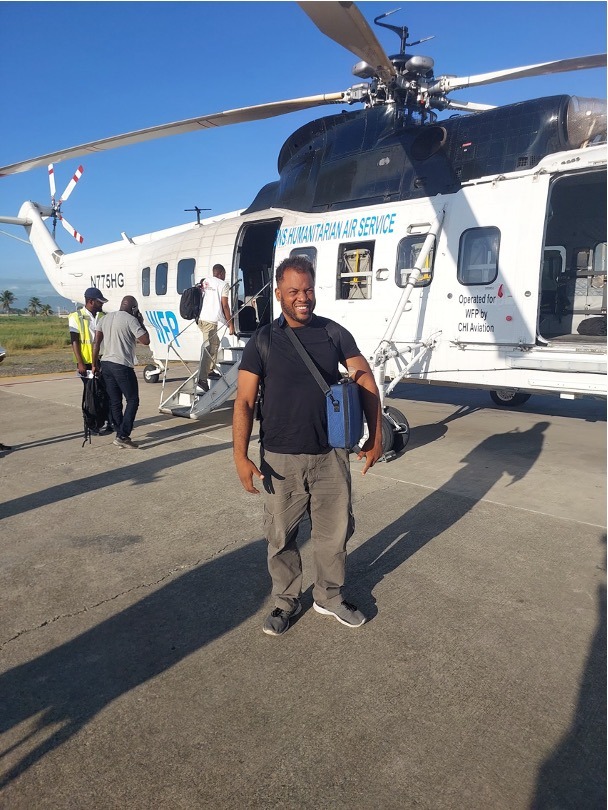
What made this more than a technical achievement was what happened next. Maxime, a monitoring and evaluation specialist for a national malaria project, initiated a live bulk disbursement through the Stellar Disbursement Platform during the test, sending payments directly to recipients’ wallets. He saw it work under constraint and is now exploring pathways for scale-up in Spring 2026. The signal here isn’t just that blockchain works, but that when you design for the constraints that exist rather than the infrastructure you wish existed, traditional program implementers start seeing how this fits into what they already do.
Guatemala: What gets designed out
In Guatemala, remittances from abroad are a key source of income that’s usually spent immediately, not because people don’t want to save or invest, but because the friction of doing anything else with that money is too high.
Blockchain-based digital payment tools can be laser-focused on specific populations with specific needs. The value isn’t in disrupting the entire financial system but in filling the gaps that the system can’t economically justify serving. When you design for simplicity, instant settlement, and visual clarity, you create pathways for populations that existing infrastructure excludes not by policy, but by design assumptions.
UNDP Guatemala partnered with Amero Exchange, whose platform was specifically created for Spanish speakers. Through the Stellar Development Foundation’s approach of matching solution makers to challenges presented by UNDP Country Offices, Amero’s remittance and community investment capabilities aligned with Guatemala’s particular context. This matching wasn’t accidental but reflected the reality that “the right tool” means linguistic fit, cultural context, and functional alignment, not just technical capability.
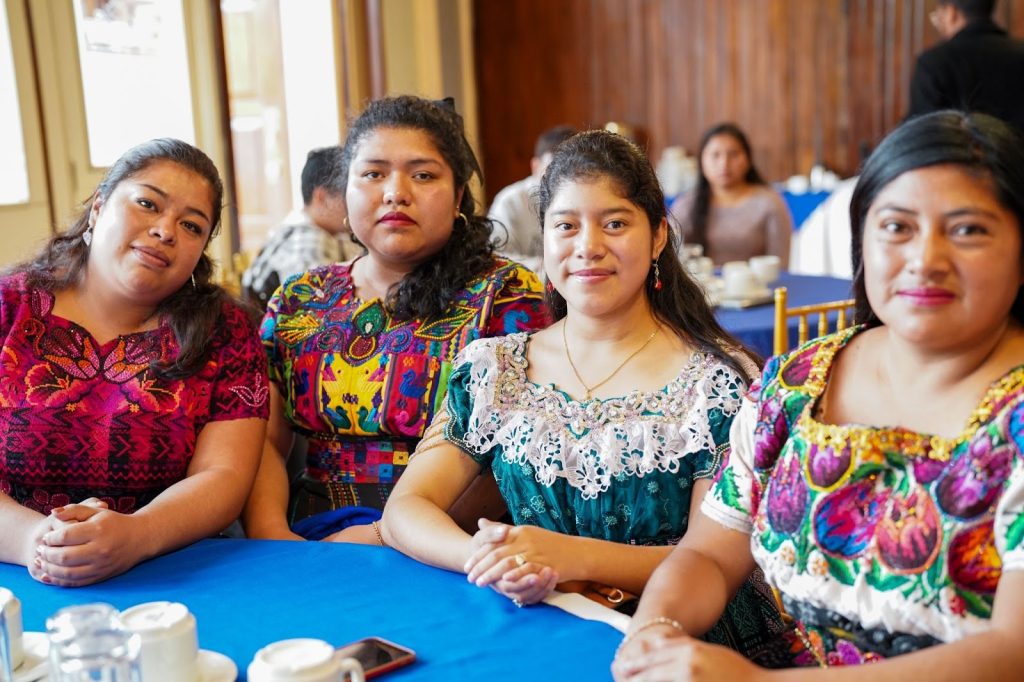
The pilot tested whether remittances could support longer-term community priorities without making people choose between immediate needs and collective investment. Families could direct a small percentage of each transfer to a community fund governed by community members back home, where members could propose and vote on local projects with all contributions and payouts recorded transparently.
During testing, both diaspora senders and receivers engaged quickly once they understood the model. But one interaction revealed something the team hadn’t explicitly designed for. A woman with a hearing and speaking disability was in the testing group. She’d used banking services before that required extensive verbal communication, follow-up visits to confirm transactions, and waiting periods with unclear resolution times. When she went through Amero‘s onboarding process, the visual interface was clear and the instant settlement meant no ambiguity about whether the money had arrived. She found sending money to loved ones more manageable, with less friction and more confidence.
This wasn’t a special accessibility feature but simply what happened when you designed for simplicity and clarity as defaults. Current banking solutions often overlook populations like women with dependencies in diaspora, people with disabilities, and people whose needs don’t generate sufficient volume to justify traditional banks’ infrastructure costs. Not because the need isn’t there, but because the business case isn’t there under existing models.
The broader value wasn’t just expanding what remittances could do but lowering barriers to participation in household and community-level financial decisions for people, particularly women and young people, who are often excluded from those conversations entirely.
The Gambia: Where flexibility actually lives
In The Gambia, “last mile” isn’t just about geography but about the gap between informal livelihoods and formal financial systems.
Women and youth entrepreneurs keep local markets moving, but many operate outside formal finance with no bank accounts, no collateral, and no credit histories. They track sales in notebooks and remain invisible to services that could help them grow, not because they’re not economically active, but because that activity doesn’t produce the data formal systems recognize.
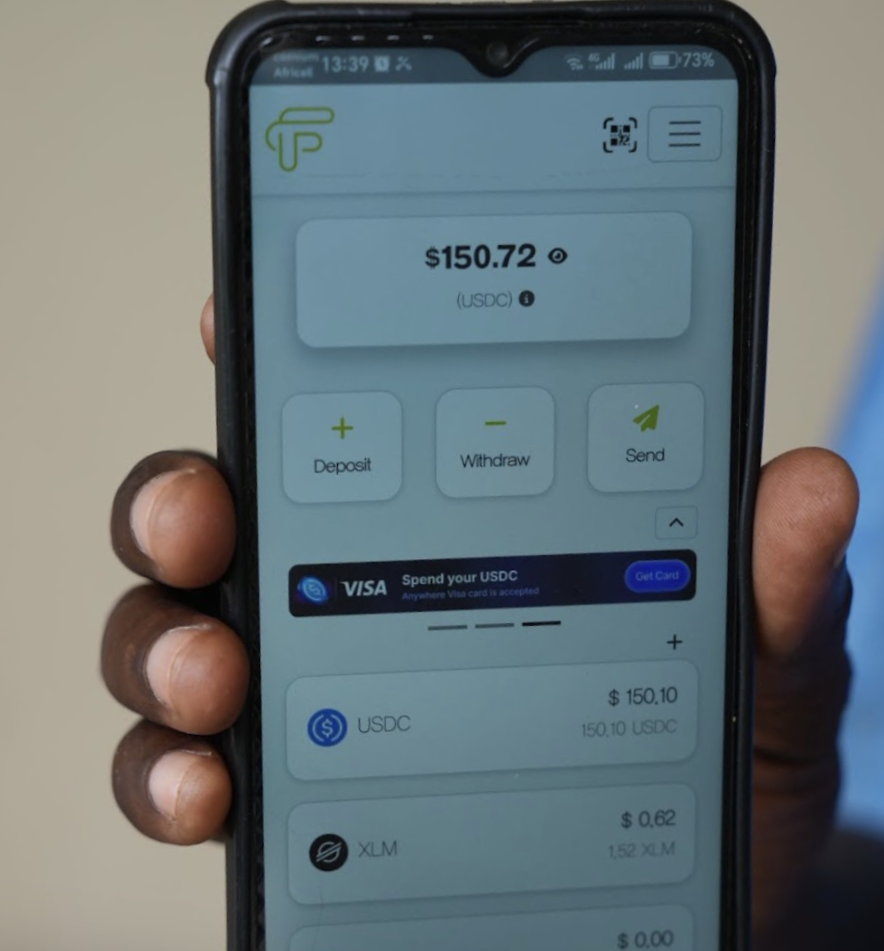
The pilot, led by UNDP staff from the Istanbul Regional Hub working with FreedomPay Wallet, paired a mobile-first wallet with simple digital recordkeeping to help entrepreneurs build usable business profiles and access fair microfinance over time. FreedomPay Wallet leverages Moneygram Access to provide cash-in and out options directly from the app interface, available in over 180 countries worldwide. During testing, something unexpected happened.
A MoneyGram agent noticed unusual, sustained demand for cash-outs in his area. After investigating, he discovered people were using FreedomPay Wallet. Rather than requiring people to travel to his established location, he closed his shop for the day and traveled with the team to a remote community. This wasn’t customer service but a traditional financial services provider recognizing value in an emerging tool and adapting his operations to meet people where they were.
Here’s what matters about that moment. We talk about legacy financial systems as if they’re monolithic and inflexible, but at the last-mile level, individual agents often have more discretion than the systems they represent. The agent’s decision to collaborate with FreedomPay Wallet showed that traditional players are ready to engage with emerging technologies when they see tangible demand from communities they serve.
The constraint isn’t technical compatibility but whether decision-makers higher up the chain will create frameworks that let last-mile providers collaborate across traditional and emerging systems without jeopardizing compliance and AML requirements. The infrastructure for reaching unbanked populations already exists. What’s needed is agile policy that empowers the people already embedded in those communities to use the tools that work. In this case, established cash-based systems and new digital tools worked together, demonstrating how collaboration rather than replacement can expand access for people who need better options.
What matching actually means
These three pilots used different platforms for specific reasons. The Stellar Disbursement Platform, leveraged by implementing organizations in Haiti and The Gambia, offers enterprise-grade ease of use for bulk transactions and provides transaction-level traceability for accountability purposes while limiting access to beneficiary personal data.
Amero, purpose-built for Spanish-speaking users, brought linguistic and cultural fit to Guatemala’s remittance-focused model. Language isn’t just translation but how financial concepts map to lived experience, which makes this choice more significant than it might initially sound.
Through the Stellar Development Foundation’s process of matching solution makers to specific challenges presented by UNDP Country Offices, each platform was aligned with context beyond just technical requirements. The real alignment happened around the actual shape of the problem: Who needs to use this? What literacy can we assume? What connectivity can we rely on? What does trust look like here? What does failure cost?
When those questions get answered honestly, you end up with different tools for different contexts because the people and places demand it, not because the technology does.
Incremental, not disruptive
There’s a narrative about blockchain that needs to be challenged: that it’s disruptive technology. It’s not. It’s incremental technology, and this distinction matters for how we invest and scale.
The value of these pilots isn’t that they replaced existing financial systems but that they filled specific gaps those systems either can’t or won’t address. The woman in Guatemala didn’t stop using other financial services but gained access to one that worked better for her particular need. The MoneyGram agent in The Gambia didn’t abandon his business model but extended it by collaborating with a tool that served demand he was already seeing.
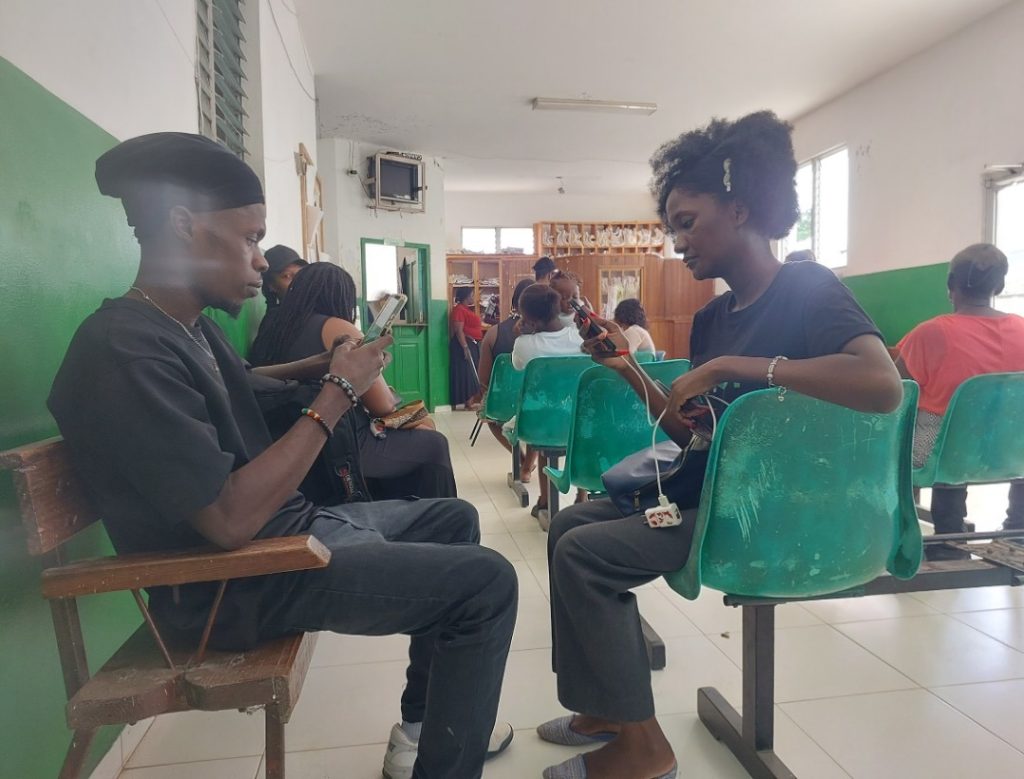
If blockchain is disruptive, the strategy is to build parallel infrastructure, wait for adoption tipping points, and replace incumbents. That’s expensive, slow, and in last-mile contexts it ignores the reality that existing infrastructure, however imperfect, is what people currently rely on. If blockchain is incremental, the strategy changes to identifying specific gaps in existing systems, building focused tools that integrate rather than replace, scaling gradually based on demonstrated demand, and allowing traditional and emerging systems to collaborate.
This requires different expectations: multiple innovation cycles, gradual volume increases, and patience for solutions to prove themselves in real conditions over time. It also requires something harder, which is a unified approach from blockchain partners in digital payments. Right now, not all wallet projects will succeed, and that’s fine because that’s how markets work. But the proliferation of incompatible solutions creates scattered efforts that make it harder for traditional implementers to understand what’s actually viable at scale.
What’s needed is clearer signaling around which use cases have demonstrated traction, what volumes are realistic in year one versus year three versus year five, and how solutions integrate with existing remittance channels, mobile money, and local finance partners. Matching supply to transaction demand matters, and that matching needs to happen incrementally with realistic volume expectations rather than with disruption narratives that promise transformation but deliver fragmentation.
What needs to happen
A successful pilot doesn’t mean the project is complete. The next phase is operational readiness, which involves aligning with financial institutions and program owners, ensuring compatibility with local cash and connectivity conditions, establishing user support and safeguarding, and clarifying how solutions adapt to regulation and market realities.
But operational readiness isn’t just technical. It’s strategic, and these three pilots demonstrated that digital payment rails can reduce friction and open pathways to financial inclusion in last-mile settings when designed around real constraints. The question now isn’t whether this works but whether the investment approach will support the incremental scaling that actually drives adoption.
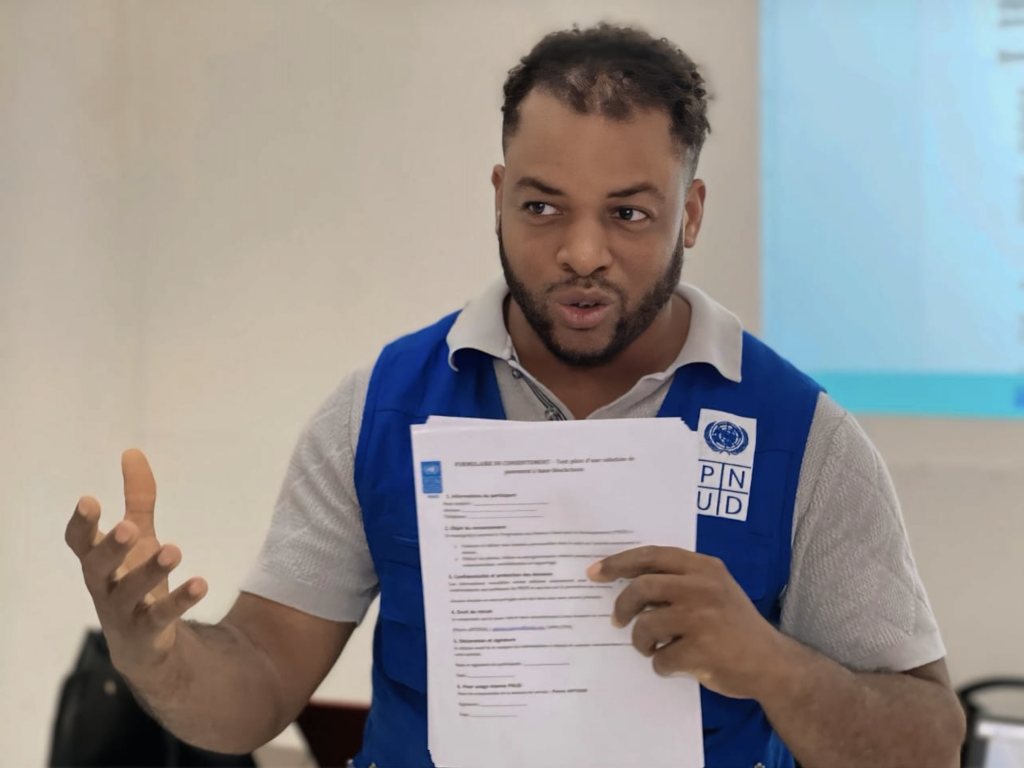
That means funding multiple innovation cycles rather than expecting immediate scale. It means supporting gradual volume increases that allow solutions to prove viability. It means enabling traditional and emerging systems to collaborate without prohibitive compliance barriers. It means creating frameworks that empower last-mile providers to adopt tools flexibly. And it means measuring success not by disruption metrics but by specific gap-filling outcomes.
These pilots aren’t standalone experiments but build the evidence base for what deployment readiness looks like: tested workflows, defined partner roles, proven performance under constraint. The UNDP SDG Blockchain Accelerator exists to move solutions from proof of concept to real-world adoption, and insights from these pilots feed directly into that mission by turning individual country experiences into transferable patterns other teams can apply.
The infrastructure is emerging and the use cases are clarifying. What’s needed now is an investment strategy that matches the technology’s actual shape: incremental, context-specific, and designed to integrate rather than replace.
UNDP has released a new publication, “New Tech, New Partners: Transforming development in the digital era – A snapshot of UNDP’s blockchain practice,” offering a practical look at how blockchain technologies are being tested and applied across development contexts to strengthen public systems.
The publication addresses a growing knowledge gap regarding the responsible use of rapidly evolving digital technologies. Drawing on more than 40 real-world pilots implemented with governments and partners globally, it demonstrates how blockchain can support more transparent, inclusive, and trusted methods for managing payments, data, and shared rules.
Rather than focusing on technology in isolation, the publication examines how blockchain is being used as part of broader digital transformation efforts – complementing public institutions, policy frameworks, and existing infrastructure. The cases explore applications across several key areas, including:
- Digital payments and financial inclusion
- Climate and nature finance
- Digital identity and data governance
- Community-driven and alternative finance models
- Supply-chain transparency and public accountability
The publication does not present a single model or blueprint. Instead, it captures an emerging practice, documenting lessons from early experimentation and pilot deployments. Each case highlights the specific development challenge being addressed, the scale of the pilot, the technology stack involved, and the partnerships that make these initiatives work in real-world conditions. Together, the cases illustrate how blockchain – when designed with safeguards and public purpose in mind – can help improve transparency, reduce fragmentation, and build trust in public systems, while also surfacing risks, trade-offs, and governance considerations.
Policymakers, development practitioners, and innovators will find this snapshot particularly useful for understanding where blockchain may add value to future-ready public systems, and where careful design, regulation, and institutional capacity remain essential.
Find the full publication on UNDP global website.
This publication was prepared by UNDP’s Alternative Finance Lab, part of the Innovation and Digital Team at UNDP Europe and Central Asia, with contributions from UNDP Country Offices, the Bureau of Policy and Programme Support, and the Istanbul Regional Hub. UNDP acknowledges the partners supporting the pilots featured in the publication, including Algorand Foundation, Blockchain for Good Alliance, EMURGO Labs, Cardano Foundation, Project Catalyst, FLock.io, Stellar Development Foundation, and Sui Foundation.
The UNDP Alternative Finance Lab (AltFinLab), in partnership with the Algorand Foundation, has launched the second global cohort of the Blockchain Academy, drawing unprecedented interest from across the UN system. Designed to strengthen practical understanding of responsible blockchain use for sustainable development, the call attracted strong engagement from colleagues across UNDP, UNCDF, and UNV (within UNDP), signalling growing interest in applied learning on emerging technologies.
The second global cohort attracted 533 applications from 111 countries. Following the eligibility screening process, 497 participants were selected, including 416 colleagues from UNDP, 69 from UNCDF, and 12 from UNV (within UNDP), spanning diverse functions, regions, and levels of seniority.
Learning profile of the cohort
The composition of the cohort underscores the Academy’s role as an entry point for learning as well as a space for deeper exploration. More than 80 percent of participants self-identified as newcomers or beginners in blockchain, while a smaller share reported intermediate or advanced familiarity. This mix reinforces the Academy’s design philosophy: meeting colleagues where they are, while building a shared baseline for responsible use.
Participants’ stated interests point to concrete delivery challenges rather than abstract technology. The most common areas of interest include decentralized finance (DeFi), blockchain for donors, supply-chain traceability, decentralized digital identity, payments, and carbon credit markets, alongside growing curiosity around tokenization and NFTs for impact. Together, these priorities reflect where blockchain is increasingly intersecting with development practice – from financial flows and trust in aid delivery to climate-linked systems and accountability.
The academy programme at a glance
Building on the experiences of Cohort 1, the learning journey is structured and designed to adapt to the participants’ schedules. Running from January to May 2026, the Academy incorporates self-paced modules with live expert sessions, case studies, and workshops. Four core modules cover blockchain fundamentals, responsible use, governance, and sustainability, followed by optional deep dives into areas such as digital identity, digital payments, carbon markets, tokenization, and supply-chain traceability. Live sessions and office hours create a collaborative environment where participants can test assumptions, ask foundational questions, and receive practical guidance.
Delivered in English and Spanish, the Academy is intentionally accessible to colleagues at different starting points – particularly those seeking to explore how blockchain might apply to real development challenges. Participants engage directly with practitioners and experts from a growing network of blockchain-for-good organizations, while peer exchange remains central to the learning experience. Beyond the formal programme, participants stay connected through the Academy forum, the UNIN Blockchain Community of Practice, and post-Academy pathways designed to support further exploration and implementation.
A growing ecosystem of responsible practice
The Blockchain Academy is designed to build practical, long-term capacity for engaging with emerging technologies such as blockchain across the UN system. Learning is anchored in real delivery contexts, with attention to governance, safeguards, and public-interest considerations. The Academy helps connect colleagues working across payments, identity, traceability, and climate-linked systems – supporting a shared understanding of what responsible experimentation requires and how early ideas can progress toward well-governed pilots and implementation.
Follow UNDP AltFinLab on LinkedIn (and X/Twitter) for Academy highlights and more.
As the world moves closer to 2030, achieving the Sustainable Development Goals (SDGs) requires not just new resources and tools, but new forms of collaboration. UNDP’s most recent Strategic Plan recognizes digital transformation as a key accelerator for progress, with up to 70 percent of SDG targets potentially advanced through technologies. Against this backdrop, blockchain technology is emerging as a potential enabler of greater transparency, accountability and trust in development systems.
Over the past months, UNDP has brought together key partners from across the blockchain ecosystem to explore how this technology can help deliver fairer, more inclusive and more sustainable outcomes, and to identify which development goals could be accelerated with blockchain-powered innovation. Through a series of dialogues – from high-level discussions to hands-on workshops,these efforts are helping to shape a shared vision for using blockchain to advance the public good.
Building common ground
In September 2025, on the sidelines of the UN General Assembly, UNDP convened the High-Level Strategic Dialogue on Blockchain for Development. It brought together more than 25 leaders from major blockchain organizations and foundations to discuss a simple but urgent question: How can blockchain’s strengths in transparency and traceability accelerate progress on the SDGs?
What emerged was a strong call for coordination and to move from experimentation and pilots to shared missions. The conversation marked the first step toward creating a UNDP Blockchain Advisory Group – a platform for ongoing exchange, shared standards, and joint innovation.
“It is important to build a common understanding of where blockchain can meaningfully contribute to sustainable development. Technology should save people and institutions, not the other way around, and responsible innovation depends on open dialogue and cooperation.” – Haoliang Xu, UNDP Associate Administrator
Turning principles into practice
In November at UN City in Copenhagen, UNDP’s Alternative Finance Lab (AltFinLab), a flagship programme pioneering new ways to fund sustainable development at the intersection of innovation, technology, and finance, hosted the first technical working meeting to refine the advisory group’s structure and identify key areas for collaboration. Participants worked across five thematic areas: public trust and digital governance, inclusive society and legal identity, financial inclusion and digital financial services, sustainability and traceable responsibility, and digital labor and future skills.
Building on experience of implementing a Blockchain Accelerator with 50 different experiments, UNDP’s approach goes beyond standalone pilots. Early experiments showed how transparency can strengthen markets and improve livelihoods. The next step is applying these lessons at scale and systematically. This means supporting the development of interoperable, ethical digital public infrastructure rooted in local ownership. In practice, UNDP aims to “wire” innovation directly into institutions, policies, and delivery systems, ensuring blockchain is used responsibly and sustainably, not as an isolated add-on.
Several cross-cutting themes emerged: overcoming institutional risk aversion; mapping and building on existing pilots, protocols, and standards; and ensuring that new tools strengthen rather than replace current systems. Financial inclusion remains a central focus, with existing use cases such as blockchain-enabled cash transfers in crises or low-cost cross-border remittances showing promising results, while also revealing fragmentation and regulatory uncertainty. The groups will continue working to identify where blockchain can support broader systemic reforms aligned with UNDP’s strategic priorities.
To expand our capacity to work with digital assets, UNDP is also exploring a dedicated digital wallet through partner banks, enabling us to receive stable coins and digital assets. In parallel, we are assessing with partners how digital assets and blockchain could strengthen transparency and efficiency across selected UNDP financial processes.
Aligning innovation and investment
Also in November, the conversation expanded to a broader stage at the Cardano Summit in Berlin, where UNDP joined WFP and UNHCR for a panel on Harnessing Blockchain for Sustainable Development. The session highlighted how blockchain is already transforming humanitarian and development efforts, from aid delivery and financial inclusion to digital identity and new funding models.
United Nations High Commissioner for Refugees (UNHCR) has gained experience through initiatives such as cash-based intervention using stablecoins and Impact Staking for Refugees and associated ETP, the first regulated exchange-traded product that converts blockchain staking rewards into continuous funding for humanitarian relief. In addition, UNHCR with United Nations International Computing Centre have established a Digital Hub of Treasury Solutions where other UN agencies participate; while UNDP has been coordinating UN Blockchain Core Group and UN Innovation Network for blockchain technology. WFP has been using pioneering blockchain-based innovative financing for several years through Building Blocks, fundraising with cryptocurrencies and NFTs and staking digital assets.
In UNDP, we would like to see this going further as we continue investing in local capabilities, identifying use cases across different areas of work, and exploring how digital assets can modernize our own operations, our goal is to use innovation and technology to transform systems. This will mean more focused collaboration across the UN, emerging tech ecosystems, and governments. We are designing integrity and new rails that allow remittances, climate funds, public budgets and private capital to reach thousands of community-level actions with clear rules and verifiable performance. At the Cardano Summit, we invited the blockchain community to engage more with international development partners and ensure technology is designed for context, built for human needs and embedded in transformative interventions.
As the Cardano Foundation explores new funding mechanisms co-led by UN agencies that could channel part of Cardano’s community-governed treasury toward development and humanitarian impact, UNDP can contribute to such initiatives by connecting partners to development expertise and networks on the ground.
Such partnerships go beyond technology, reimagining both how innovation is financed, and how to scale pilots so that the benefits of technology can reach those most often left behind.
Building a framework for the future
Today, we are experimenting with new approaches, we are prototyping how payments and investment are taking place, building transaction systems from the first to the last miles; and quickly learning in the process. As blockchain moves from experimentation to real-world use, the challenge is now how it can work responsibly, inclusively, and at scale, focusing efforts where the impact will be highest.
UNDP sees its role as a bridge between blockchain innovators, governments, UN agencies, and communities – aligning new financing models with real development needs and ensuring that technology delivers measurable public value.
The UNDP Blockchain Advisory Group is being developed as a multi-stakeholder forum to help make this possible: ensuring that blockchain solutions are ethical, interoperable, and practical, and supporting their integration into public systems such as climate and nature finance, digital identity, transparent aid delivery and inclusive financial services. It will also promote shared learning and capacity-building, so that countries can harness blockchain for the public good.
Through the UNDP Blockchain Advisory Group, we also want to understand and manage risks from this emerging technology. Risks like interoperability issues, or how to keep accountability while working across different jurisdictions; legal/regulatory frameworks on blockchain, and on maintaining public interest and a technology agnostic viewpoint while working with the private sector.
For UNDP, this effort is about utilizing efficient tools and tactics amid a rapidly changing world to uphold our “leave no one behind” mandate – ensuring that innovation translates into more transparent, inclusive, and effective systems that deliver tangible benefits.
Originally posted on UNDP.org.
Electronic waste, or e-waste, is one of the fastest-growing environmental and economic challenges of our time. According to the UN’s Global E-waste Monitor, more than 62 million tonnes of discarded devices were generated in 2022 alone, a figure expected to surge by a third, reaching 82 million tonnes by 2030. Less than a quarter of this valuable strategic resource is properly collected and recycled. As a result, only 1% of global demand for rare earth elements is met through e-waste recycling, while an estimated US$62 billion worth of recoverable resources simply go to waste each year. [Source: World Bank 2021]
Georgia faces similar pressures. The country generates from 900,000 to 1.1 million tonnes of waste annually. Its domestic material consumption (DMC) is close to the EU average, but the circularity rate remains just 1.48%, far below the EU’s 11.5%. Inadequate infrastructure, low public awareness, and limited investment in recycling technologies are key barriers holding back progress. [Source: Circularity Gap Report 2023]
Important reforms have laid the groundwork for change. The 2020 adoption of extended producer responsibility (EPR), the Waste Management Code, and commitments under the EU Association Agreement represent crucial steps towards a more circular economy. But e-waste management on the ground remains wholly insufficient. No official data exists on e-waste volumes or recycling rates, making it difficult to establish baselines and track progress. Municipalities lack formal collection systems, forcing residents to rely on unsafe, informal disposal methods that expose communities to toxic substances such as lead and mercury.
Meanwhile, weak enforcement of EPR means companies face little pressure to take responsibility for the products they put on the market. The result is a growing mountain of hazardous waste—one that communities are left to handle alone.
To understand why recycling policies weren’t translating into real action and how this gap was shaped by people’s attitudes and behaviours, UNDP, through our Accelerator Lab (AccLab), launched a behavioural experiment in the Zugdidi municipality.
The findings were striking. As we studied how residents handled e-waste, institutional gaps and economic barriers became clear, and one unexpected solution emerged: harnessing technology to rebuild trust and create a transparent, community-driven e-waste system.
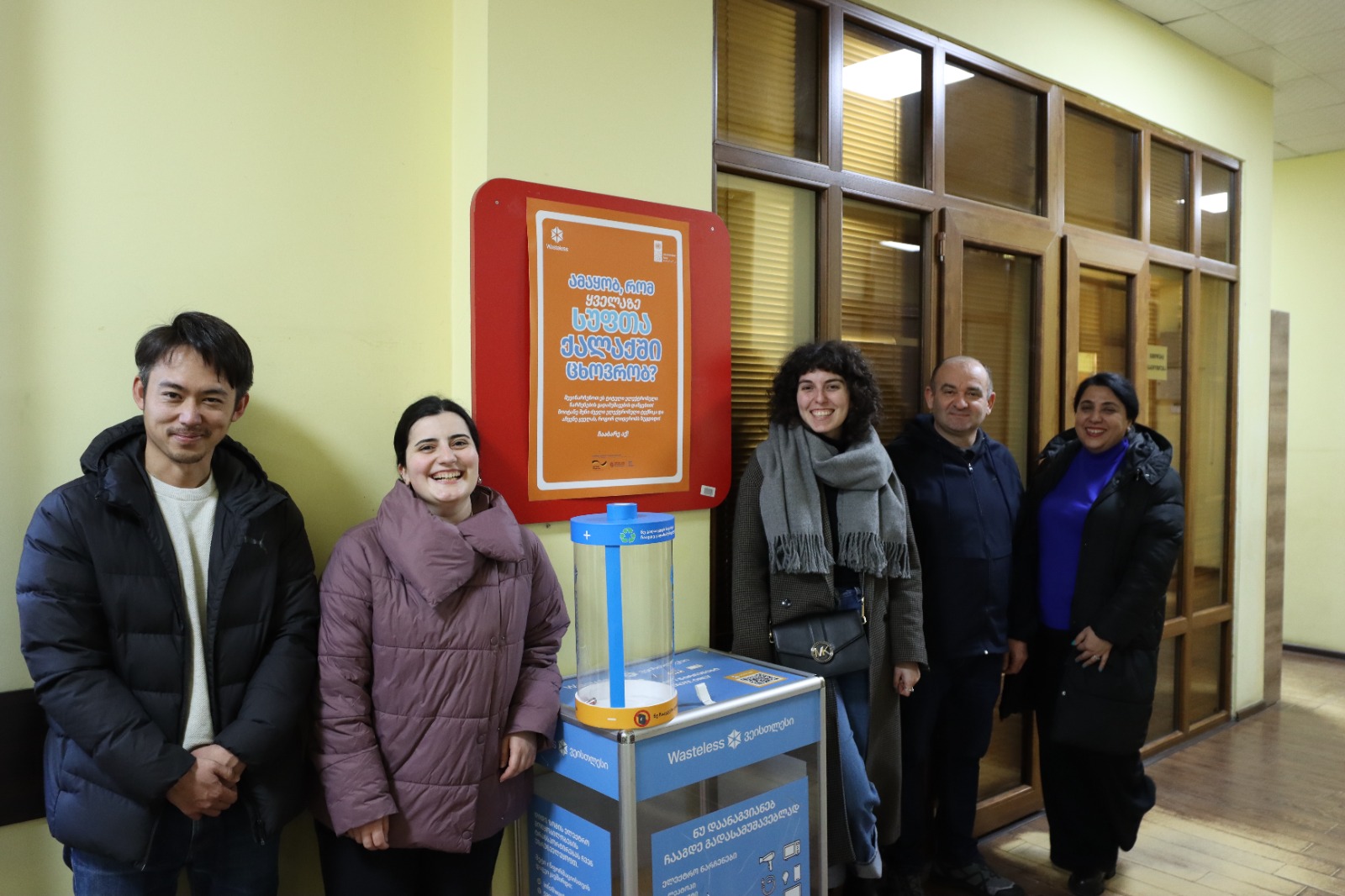
Understanding bins and behaviours
Our initial goal was simple: to test whether more collection bins and basic awareness could encourage safer e-waste disposal. Between June and October 2024, we reached out directly to the community, holding interviews and workshops with more than twenty stakeholders, including internally displaced persons (IDPs), women, youth, civil society representatives, electronics retailers, schools, academia, and local authorities. We listened to their experiences and mapped the factors shaping their decisions around e-waste. What emerged was a deeper challenge: not a lack of willingness to act, but a gap between intention and action.
People wanted to recycle but didn’t know where or how, and many doubted that collected waste would be handled properly. So, we reframed our question: how might we change behaviours and social norms, not just build infrastructure?
Together with the IDP Women’s Association ’Consent’, ‘Behaviour Science For Social Impact’ (BISC Partners), and the producer responsibility organisation Wasteless, we designed a set of behavioural experiments:
- In retail stores, we tested whether visible bins and positive social-norm messages could encourage more e-waste drop-offs.
- In the settlements of people displaced by conflict, we compared different messages – environmental, health-related, and community-driven – to see which resonated most.
- In schools, we explored whether learning sessions and student-led collection points could mobilise families and neighbours.
Over three weeks, 436 e-waste items – mostly small electronics such as phones, chargers, and batteries – were collected across eleven sites. The results were revealing:
- Environmental messages worked best.
- Awareness sessions helped, but one-off actions weren’t enough.
- Leadership mattered; community champions, like teachers, civil society representatives, and Zugdidi Central Library’s leadership, made a real difference.
Still, it was clear that behavioural nudges alone couldn’t fix an e-waste system, which continued to struggle with limited infrastructure, missing data, low public participation, and weak private sector engagement, hampered by minimal environmental commitment and few financial incentives.
Sustainable change would require stronger incentives, more transparency, and a management model that communities could truly trust.
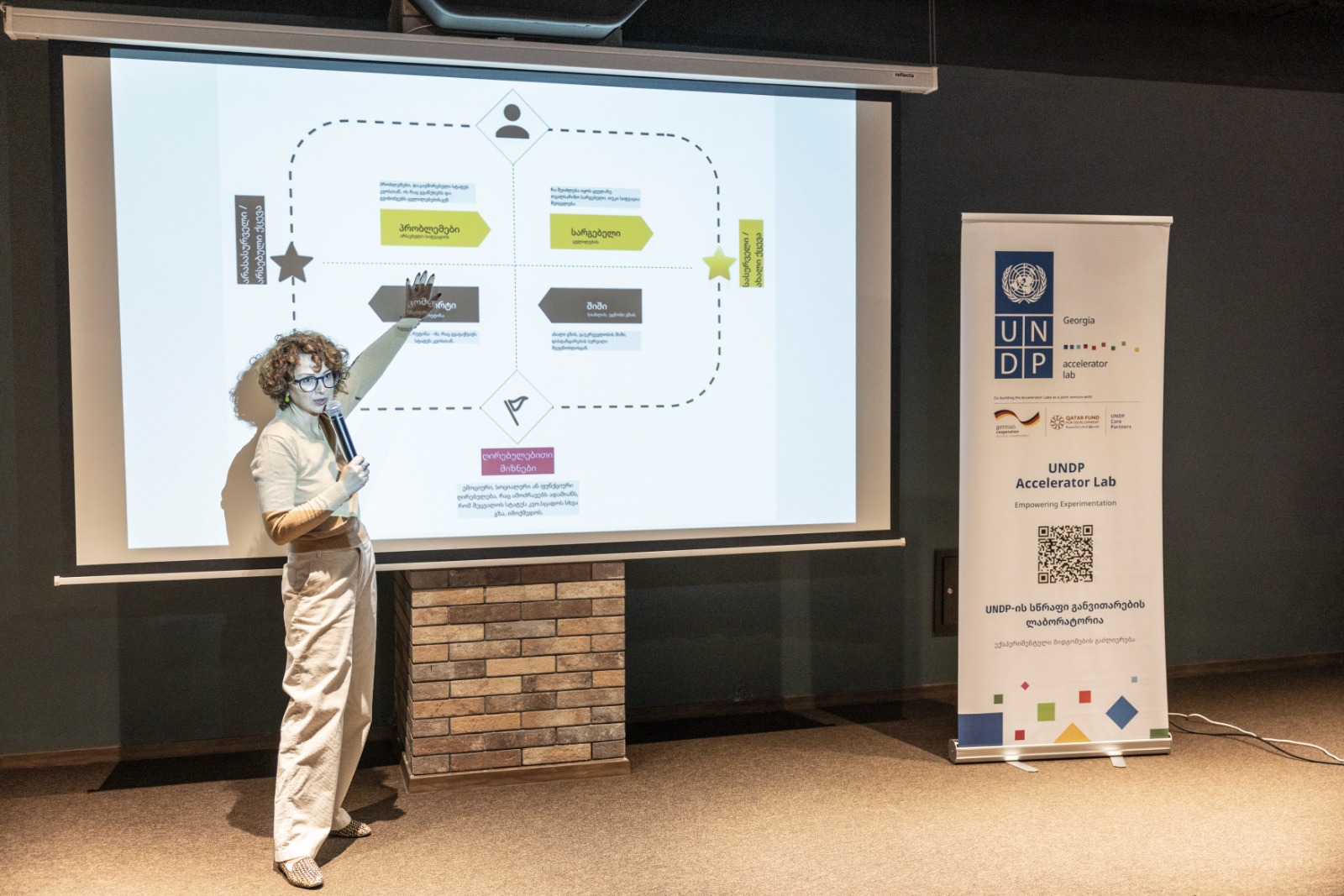
From behaviour to blockchain
That insight led us to our next big idea: could technology help build trust and offer incentives to make circular waste systems truly work at the local level?
In 2025, the Zugdidi experiment evolved into a blockchain-powered model through the SDG Blockchain Accelerator, UNDP’s global innovation platform that helps promising ideas grow through potential targeted funding, mentorship, and technical expertise. Zugdidi’s pilot was selected as one of the programme’s challenges, developed in partnership with Creative Operations (Kenya) and Wasteless (Georgia) to test how blockchain-powered tools can transform community-based e-waste management.
The concept is simple but powerful:
- Track every item of e-waste through a secure, transparent blockchain system.
- Reward users with digital ‘Eco-Tokens’ redeemable in local shops.
- Involve retailers through trade-in schemes and tokenised gift cards.
- Empower the community through a digital cooperative, a flexible platform where residents, businesses, and producer responsibility organisations (PROs) can pool resources, vote on decisions, and earn incentives while tackling local challenges transparently.
By combining behavioural insights with technology, we are testing a new model of community governance that can align incentives, build trust, and grow sustainably.
Looking ahead
From June to October 2025, we built a blockchain platform demo and tested it across the Zugdidi municipality, engaging a focus group of up to 15 individual users and partners from the Zugdidi Central Library and a local retail store.
As this pilot initiative nears completion, we aim to take it to a new level – expand e-waste tokenisation, onboard more retailers, and test a digital cooperative model in Zugdidi. If successful – with residents using the platform, retailers engaged, and blockchain ensuring transparency and incentives – the system could be replicated across Georgia and beyond, offering the scalable, transparent, community-based solutions to one of today’s toughest environmental challenges.
When in doubt, innovate! Because the boldest ideas often begin as experiments. Sometimes, the reward is not just in the outcome, but also in the courage to try.
Background information
Established in 2019, UNDP’s Accelerator Labs serve as agile incubators for bold ideas that tackle some of the world’s toughest sustainable development challenges. Co-created with the Federal Ministry for Economic Cooperation and Development of Germany and the Qatar Fund for Development, the network connects 90 Labs worldwide, a global community of innovators, “the fast and the curious,” working together to turn local insights into transformative change.
In Georgia, the Accelerator Lab drives innovation across green transition, climate action, circular economy, and community resilience. Through its experimental mindset and pioneering spirit, the Lab helps UNDP discover, test, and scale new solutions, bringing our work ever closer to the realities and opportunities of the 21st century.
Published originally on UNDP Georgia’s website.
Transform the future of the SDGs with hands-on blockchain skills
Are you ready to harness the power of blockchain to accelerate innovation and solve real-world challenges? If you’re part of UNDP, UNCDF, or UNV (within UNDP), this is your opportunity to be at the forefront of digital transformation in development.
The Blockchain Academy, powered by UNDP’s Alternative Finance Lab (AltFinLab) in partnership with the Algorand Foundation, invites you to embark on a learning journey that demystifies blockchain and equips you with the skills to apply it for social impact.
From advancing financial inclusion and climate action to strengthening transparency and accountability, the Academy explores how blockchain can transform the way we deliver on the Sustainable Development Goals (SDGs) – creating more inclusive, trusted, and sustainable systems for all.
Our programme
The Academy runs for approximately three to four months, combining hands-on learning, and a strong community network to help participants understand how to apply blockchain for sustainable development. It includes recorded lectures, interactive live discussions, case studies, and workshops. As part of Blockchain Academy, you will be invited to other events and opportunities in the blockchain space.
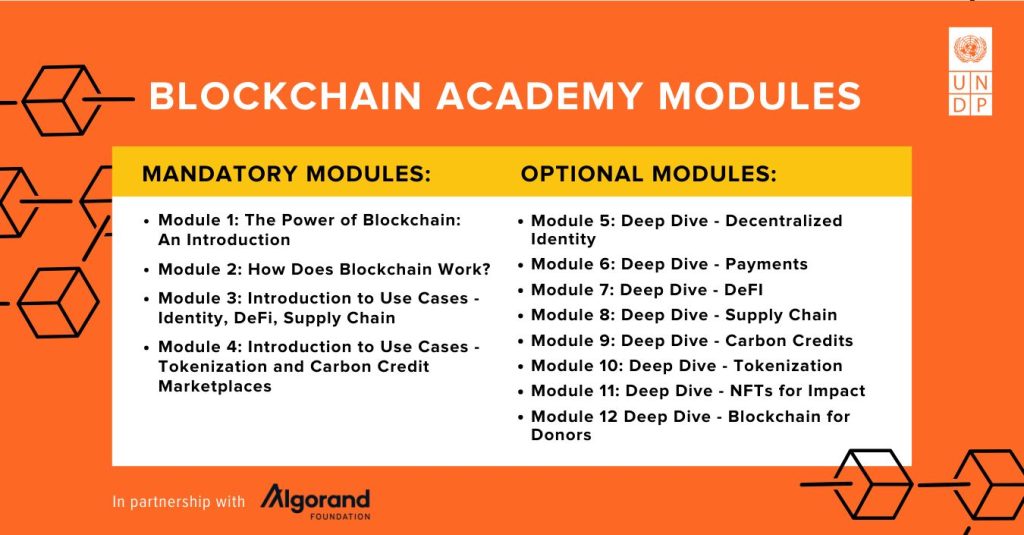
Participants complete four mandatory modules followed by optional deep dives on specialized topics. To receive certification, participants must successfully finish all mandatory modules, assignments, and at least two optional modules.
What we offer
- Interactive learning modules – combining self-paced and live sessions on blockchain fundamentals, real-world use cases, and policy frameworks.
- Hands-on projects – participants work on the ideation of their blockchain-based solutions addressing concrete development challenges.
- Expert guidance – access to leading blockchain professionals, UNDP specialists, and innovation experts.
- Tailored sessions and workshops – practical deep-dives on areas such as digital identity, climate action, and inclusive finance.
- Community engagement – join a growing global network of peers advancing blockchain for sustainable development.
Post-Academy opportunities
Top-performing projects from the Blockchain Academy can gain entry to the SDG Blockchain Accelerator – a programme designed to provide hands-on mentorship and access to partners and resources needed to move promising ideas toward real-world deployment.
Participants also join the broader UN Blockchain Community of Practice, gaining access to ongoing learning opportunities, peer exchange, and collaboration across the UN system.
Eligibility criteria:
No prior knowledge of blockchain is required – just curiosity and a desire to learn.
- You are personnel of UNDP, UNCDF or UNV (within UNDP).
- You are passionate about exploring new technologies for social impact.
- You commit to spending at least 3 hours per week on the programme over 12-16 weeks.
- You have the support and approval of your supervisor.
Meet our cohort
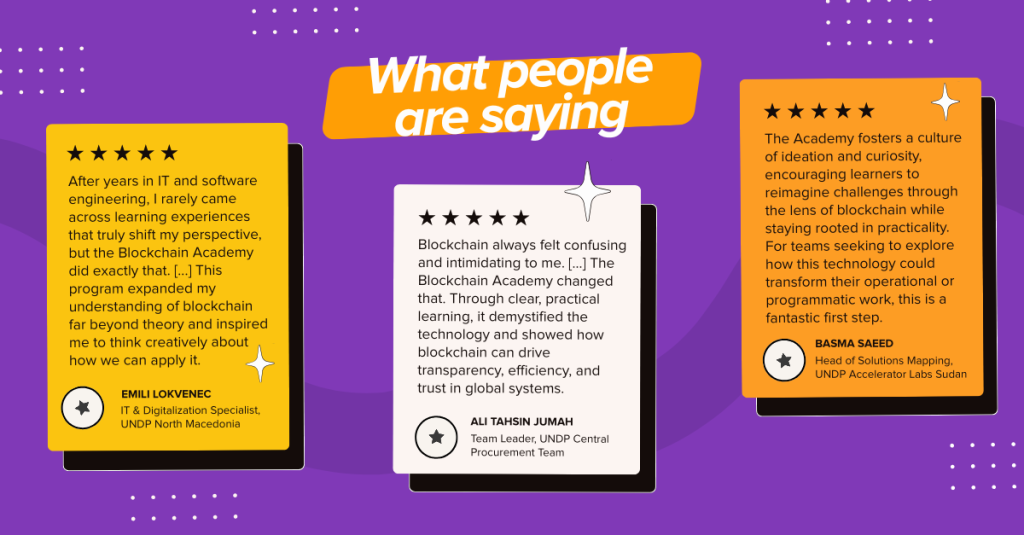
Since its launch in 2024, the Academy has trained 500+ participants from 134 countries across the UN system. Each cohort brings together diverse participants united by a mission: using technology to create a fairer, greener, and more inclusive world.
How to apply:
To apply, please fill out the application form by Monday, December 22 (APPLICATIONS CLOSED). We will notify you of your acceptance by January 13, 2026. The Academy onboarding will take place in mid-January, with further details to be included in your acceptance email.
To find out more about the Academy and the application process, watch the recordings from our recently held information sessions:
If you have any questions, do not hesitate to contact us via burcu.mavis@undp.org.
We are happy to explore further collaborations with other UN agencies and partners. For inquiries, please contact: burcu.mavis@undp.org or teodor.petricevic@undp.org.