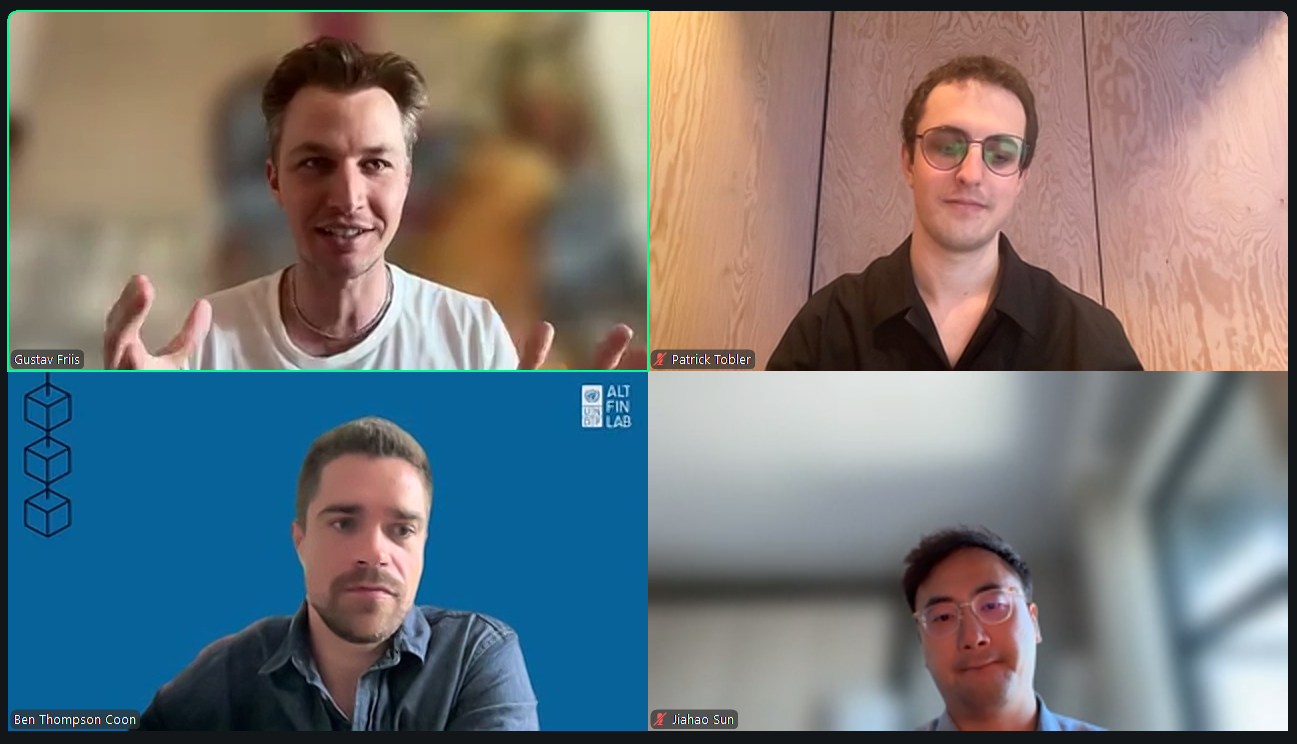
The ninth and closing session of the spring UN Blockchain Talks handed the floor to three private-sector builders working at the edge of AI and blockchain, and asked them a blunt question: what do you actually need from an organization like the UN if AI agents, federated learning, and on-chain accountability are going to work at scale?
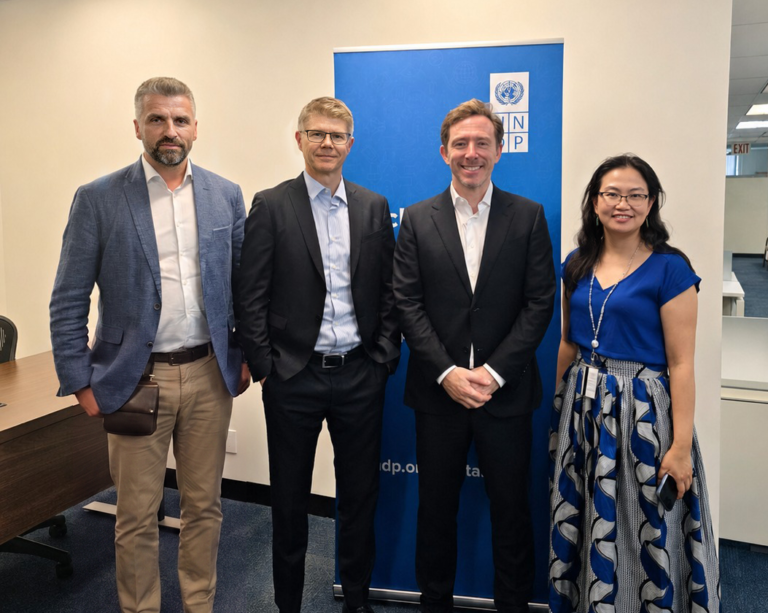
The conversation brought together Jiahao Sun, founder and CEO of FLock.io and former Director of AI at the Royal Bank of Canada, Patrick Tobler, co-founder of Masumi Network and creator of NMKR, and Gustav Friis, co-founder of NEARWEEK, with moderation by Ben Thompson Coon of the UNDP Alternative Finance Lab.
Your AI is only as good as the data it’s allowed to see
Jiahao Sun opened with the problem federated learning was built to solve. Good models need a lot of data, but in any large organisation, that data sits in silos for good reason. Hospitals, country offices, and banks can’t simply pool everything into one place.
FLock’s answer is to train models locally and only aggregate the learnings – never the raw data – across a network with no single controlling node, federated learning plus blockchain for open coordination. Is it as efficient as centralised training? Not historically, Sun admitted. But the field has moved to a hybrid model by training a strong foundation model centrally, then fine-tune it on sensitive local data in a federated way getting most of the privacy benefit without the old efficiency penalty.
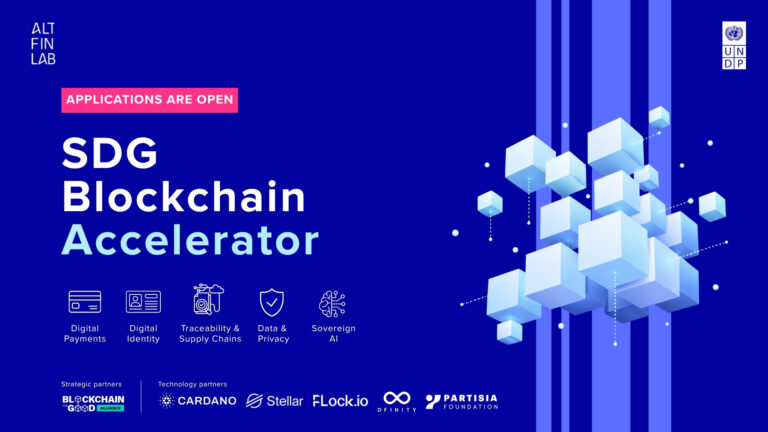
His ask for UNDP heading into Cohort 3 of the SDG Blockchain Accelerator is to keep the country-office “wish list” coming, but push for requests written with an engineering mindset, clear inputs and outputs, so the private sector can match problems to solutions faster.
Giving AI agents a wallet, an ID and a paper trail
Patrick Tobler’s starting point was a thought experiment that Masumi Network was built to answer: if your personal AI agent asks a Booking.com agent to book a flight, and that agent talks to airline agents, and you end up at the airport with no ticket whose fault was it? He laid out four problems that have to be solved before enterprises will trust agents to act on their own:
- How agents pay each other – a wallet, not a credit card.
- How an agent proves it’s really who it claims to be!
- How agents find each other without one company controlling the app store.
- How every decision gets logged immutably so it can be audited later.
Masumi’s approach takes the result of an agent’s action, hashes it, and puts it on-chain so disputes can be traced back to the agent that actually got it wrong. When asked what he’d want from large institutions, Tobler answered, “don’t get locked into one big AI provider’s. Push toward open-source, decentralised infrastructure that no single company can gatekeep or tax.“
What a sovereign AI stack actually looks like
Gustav Friis took the conversation from agent-to-agent plumbing to government strategy. NEAR has been working with small, fast-moving states like Bermuda’s work on confidential AI for public services. A question every public institution now faces: staff want to use tools like OpenAI or Claude, but how do they do that and stay compliant?
His framing for a “sovereign stack” is avoid lock-in to any single technology, keep transparency where it builds trust (budgets, audits) but confidentiality where it’s needed. Above all, verifiable execution like cryptographic proof that a system did what it claims is still missing in most AI deployments, and it’s exactly the gap that caused Patrick’s flight-booking failure.
His last recommendation to the UN is to build on existing frameworks like GovStack and the Blockchain Advisory Group, and create a shared, open, cross-agency knowledge base that multiple AI systems can independently inspect and verify so good practice doesn’t stay locked inside individual pilots.
Is the UN too slow for AI?
Ben put the hardest question to the panel directly: at last month’s Proof of Talk event in Paris, more than one person told him the UN moves too slowly to matter on AI governance. Was that fair?
All three speakers pushed back! Sun pointed out that UNDP’s Blockchain Advisory Group is already moving faster than many national regulators but the gap is internal literacy on how to translate real-world problems into AI-ready requests. Tobler called the panel itself “proof the UN can act,” even if coordination across such a large system is inevitably harder. Friis added, “the UN reflects the average of its member states, and what looks slow from one country looks like real progress from another.”
The session closed on a phrase Sun used to describe what FLock and others are building: a “third species” of AI that is neither closed-source US models nor open-source Chinese ones, but decentralised models nobody fully owns or controls. Whether that third option becomes real, the panel agreed, will depend on exactly the kind of infrastructure like wallets, identity, verifiable logs, federated training that was discussed throughout the session.
Missed our talk? You can check out the recording here.
Get involved
The UN Blockchain Community of Practice (CoP) works best when colleagues bring practical questions, field-tested lessons and cases that challenge easy assumptions. UNDP’s third SDG Blockchain Accelerator cohort is launching soon, if any of the work from FLock, Masumi, or NEAR resonates with a challenge in your office, reach out!
For more details or suggestions, contact Ben Thompson Coon, UN Blockchain CoP Lead; ben.thompsoncoon@undp.org