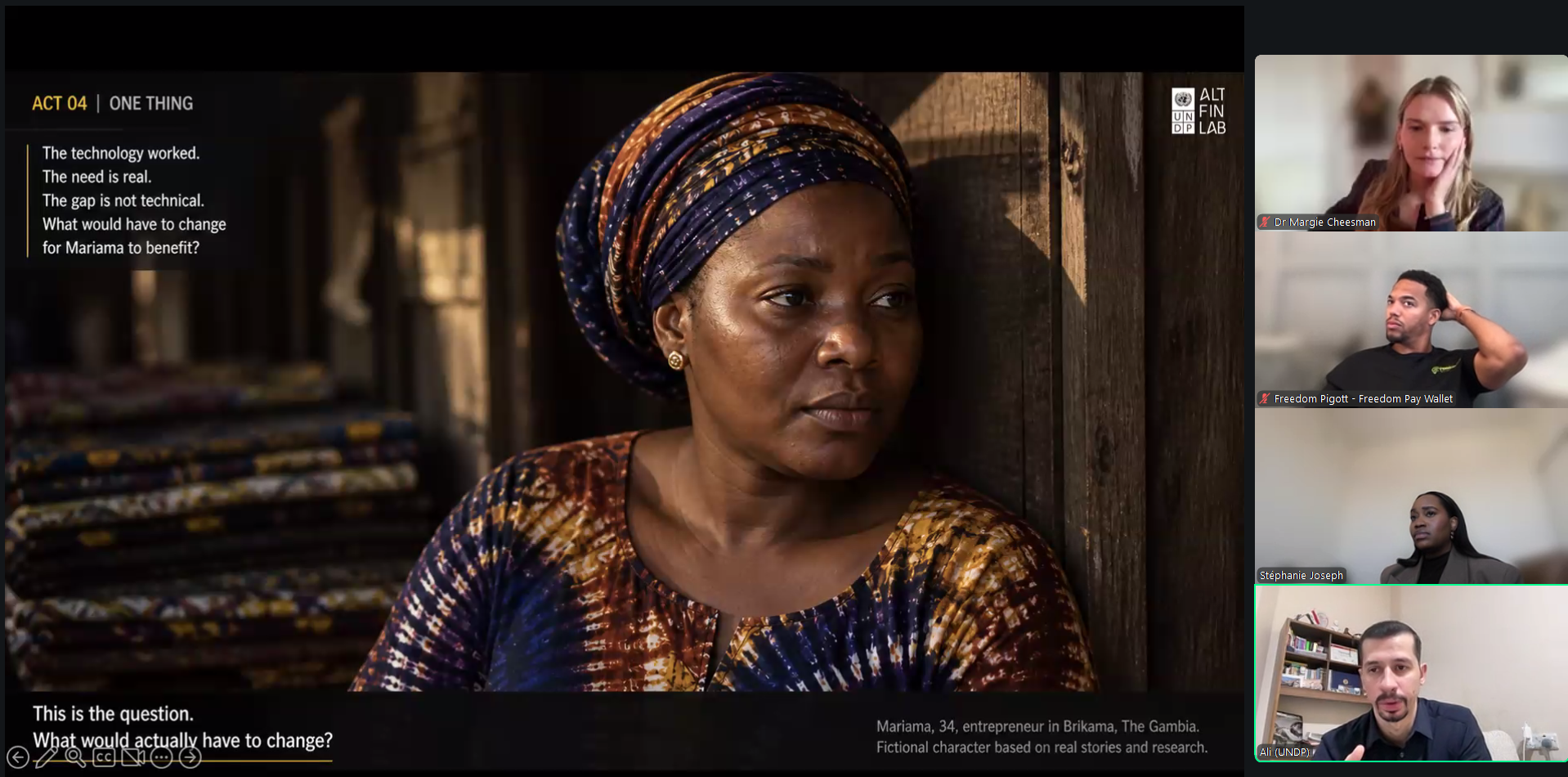
The eighth session of the UN Blockchain Talks used the story of Mariama, a fictional trader in The Gambia, to bring the discussion on stablecoins closer to the realities of last-mile financial inclusion. Mariama runs a small business, depends on family remittances, manages customer debts, and needs money to arrive in a form she can use immediately.
Her situation gave the session its practical anchor! A transfer may arrive faster through digital rails, but speed alone does not settle the matter. The real question is whether the money can be converted, spent, trusted, and supported by people and systems nearby.
The discussion brought together Dr. Margie Cheesman of King’s College London, Stephanie Joseph of Citi, and Freedom Pigott of FreedomPay Wallet, with moderation by Ali Al-Zuhairi of UNDP Alternative Finance Lab.
The cost of being financially invisible
At the start of the session, the speakers looked at Mariama’s financial life before any new payment tool entered the picture. She already has a financial system, built through informal savings groups, family support, customer relationships, receipts, WhatsApp records, and daily judgment.
Dr. Margie Cheesman pointed to the structural disadvantages faced by people outside formal banking systems. Their financial lives are often active and complex, yet formal institutions may fail to recognize that activity as proof of reliability. Freedom Pigott brought that point into the experience of small traders, many of whom manage credit, repayments, sales, and supplier relationships with discipline.
At the receiving end, Stephanie Joseph pointed to another gap: a sender may have access to digital payment tools, while the receiver still depends on limited local options!
When money arrives late
As the scenario developed, Mariama needed to restock her business. A relative sends money, but the transfer is slowed by fees, exchange rates, and delays. For a trader, waiting can mean missing stock, losing a customer, or buying less than planned.
This is where stablecoins can help! In corridors where traditional transfers are slow or expensive, digital dollars can move value in minutes and reduce the cost of sending. In Mariama’s case, that speed could help her respond before a business opportunity disappears.
Still, the discussion kept returning to the same practical point: Mariama’s supplier wants dalasi. Her customers pay locally. Her business needs liquidity. A wallet balance is useful only when it can be converted, spent, or accepted nearby.
Where the system is tested
At the last mile, the quality of the system depends on what surrounds the transfer. Agents, merchants, cash-out points, liquidity, user support, and trust determine whether the money becomes part of daily business or stays trapped inside an app.
Freedom shared experience from implementation in The Gambia, including the challenge of building agent networks and maintaining liquidity. For development programmes, this is where design has to be tested honestly. A pilot can record successful transactions while the user still carries the hardest work.
The same issue applies to financial records! Blockchain-based tools may help small traders build a record of activity that can later support credit, microloans, or working capital. Yet that record must be understandable and safe for the person whose activity created it.
Faster rails, slower institutions
The final part of the session turned to institutional adoption. Participants were asked why someone like Mariama may still be waiting for payment when faster technology already exists. The strongest response pointed to slow institutional processes, followed by the lack of local infrastructure.
Compliance, procurement, data protection, and risk management protect people and institutions. In urgent contexts, however, long processes can make support arrive too late. Startups need better internal controls and clearer regulatory pathways. Institutions need safer ways to test payment models without slowing them down until they lose their purpose.
By the end, the session treated stablecoins as one layer in a wider system that still has to earn trust through local use. For Mariama, the value of the transfer depends on what happens after it arrives: whether she can spend it, convert it, understand it, and get help if something goes wrong.
Missed our talk? Watch the recording here.
You can also explore previous Blockchain Talks sessions in our YouTube Playlist.
Get involved
The UN Blockchain Community of Practice (CoP) works best when colleagues bring practical questions, field-tested lessons and cases that challenge easy assumptions.
For more details or suggestions, contact Ben Thompson Coon, UN Blockchain CoP Lead; ben.thompsoncoon@undp.org