During the fifth session of the UN Blockchain Talks series, the discussion moved beyond whether blockchain can support digital identity. A more useful examination was what kind of identity system would give people greater control over their data without making implementation harder for governments and service providers.
Hosted under the UN Blockchain Community of Practice, led by UNDP AltFinLab in collaboration with the UN Innovation Network, Blockchain Talks #5: Digital Identity, Privacy and Impact brought Aya Miyaguchi, President of the Ethereum Foundation, Jigme Tenzing, Secretary of GovTech Bhutan, and Peter Frandsen, Founding Partner of Partisia and the Partisia Foundation.
Together, they explored Bhutan’s national digital identity journey, the role of Ethereum in that architecture, and why privacy-enhancing technologies need to be part of the conversation if digital identity systems are to work in practice.
Bhutan’s starting point was privacy
Bhutan’s case stood out because the discussion began with a policy choice, not a technical one. As Jigme Tenzing explained, Bhutan’s move toward a decentralized, self-sovereign identity model was shaped by a concern many governments now face as they digitize services: efficiency can move faster than privacy protections when those protections are treated as secondary.
“In our hurry, we were kind of forgetting about privacy,” he said.
That concern pushed Bhutan away from the idea of a single centralized government database holding all citizen identity data. Instead, the country pursued a model in which verified information can be issued by the government, while remaining under the individual’s control.
In one of the clearest lines of the session, Tenzing described the shift this way: “The government functions more like a notary.” In other words, the role of government changes from holding and managing data to validating credentials that citizens can then use with explicit consent. That distinction gave the discussion real weight.
Why Ethereum fit Bhutan’s model
Aya Miyaguchi placed Bhutan’s approach within a broader set of design values that the Ethereum ecosystem seeks to protect: decentralization, open-source development, privacy, security, and resilience.
Bhutan’s digital identity system was not presented as an imported product, but as national infrastructure developed with external support and strong local ownership. “We are a supporter, not a builder,” Aya said, describing the Ethereum Foundation’s role in Bhutan’s process.
She also noted that Bhutan has become the first country to anchor national digital identity on Ethereum at national scale, with the current system supporting more than 30 government services.
Privacy cannot be solved by blockchain alone
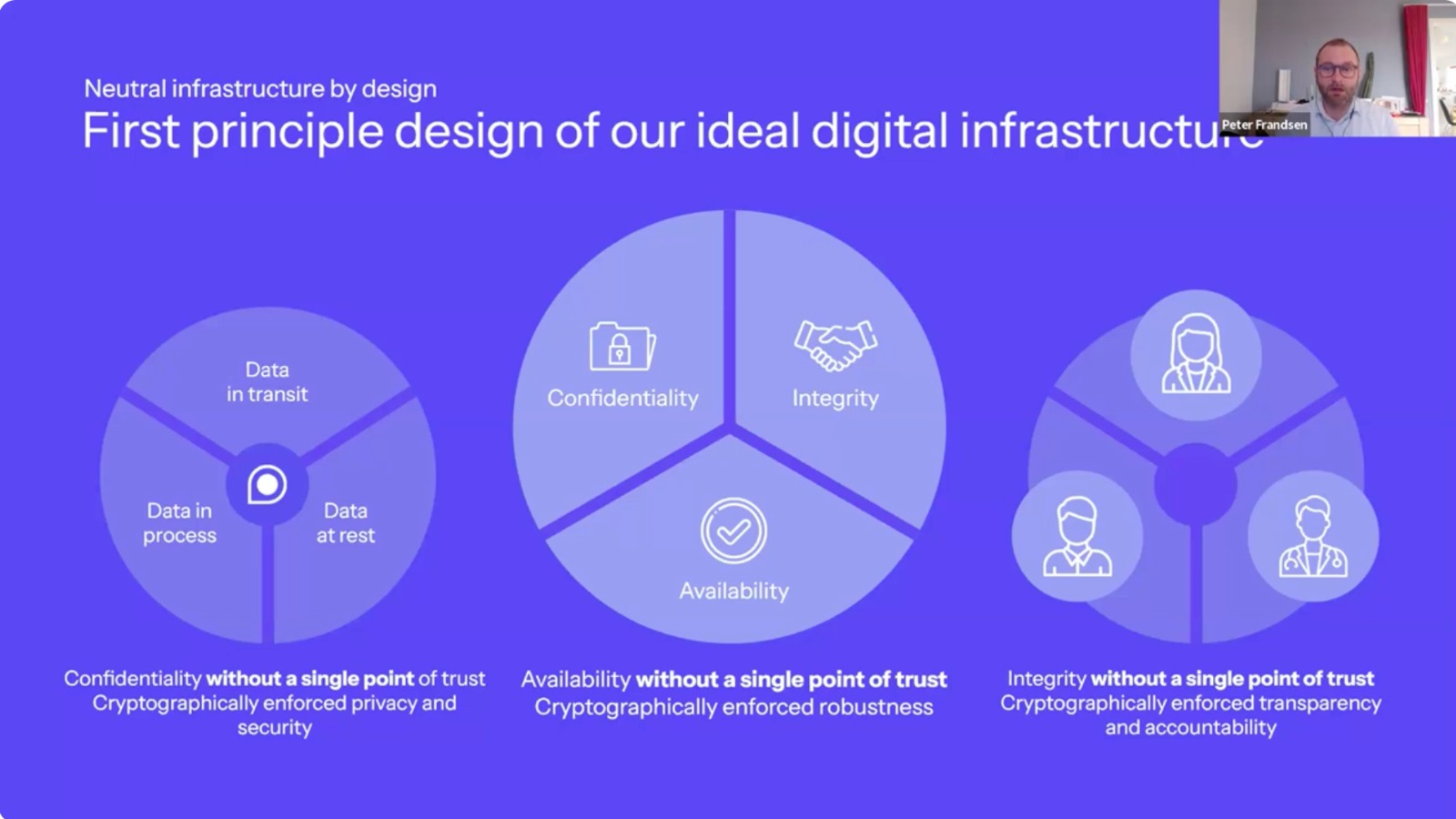
If Bhutan’s case showed why decentralization and user control matter, Partisia’s contribution in the session clarified why privacy still needs additional tools. Peter Frandsen focused on Multi-Party Computation (MPC) and the role it can play alongside blockchain in identity systems.
“Everything on the blockchain is public, and everything in MPC is private.”
That line by Frandsen helped cut through a common confusion in digital identity discussions. Blockchain can provide integrity, immutability, and a shared trust layer. But when systems need to verify something sensitive without exposing the underlying data, privacy-enhancing technologies become essential.
Frandsen illustrated this through concrete examples. In one case, a person can prove they are allowed to access a building or collect a parcel without disclosing unnecessary personal information. The system confirms the right to act, rather than forcing the user to reveal more data than the transaction actually requires.
What this session clarified
Blockchain Talks #5 made clear that digital identity decisions are also decisions about trust, data control, legal readiness, and public understanding. Bhutan’s case made that visible. Ethereum’s role clarified the infrastructure logic behind it. Partisia’s contribution showed why privacy needs to be designed at the computational level, not simply promised at the policy level.
The session also served as a useful reminder that the hardest part of digital identity is rarely the interface. What matters most are the governance choices and technical architecture underneath.
Missed our talk? Watch the recording here.
You can also explore previous Blockchain Talks sessions in our YouTube Playlist.
Get involved
The UN Blockchain Community of Practice (CoP) works best when colleagues bring real examples, practical questions
For more details or suggestions, contact:
Ben Thompson Coon, UN Blockchain CoP Lead
ben.thompsoncoon@undp.org