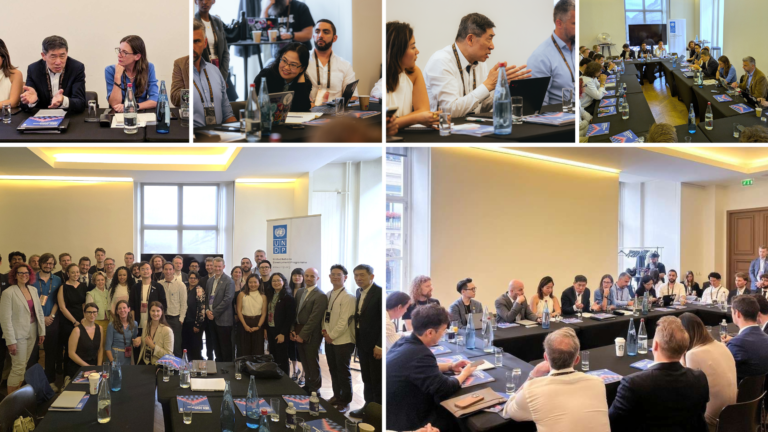
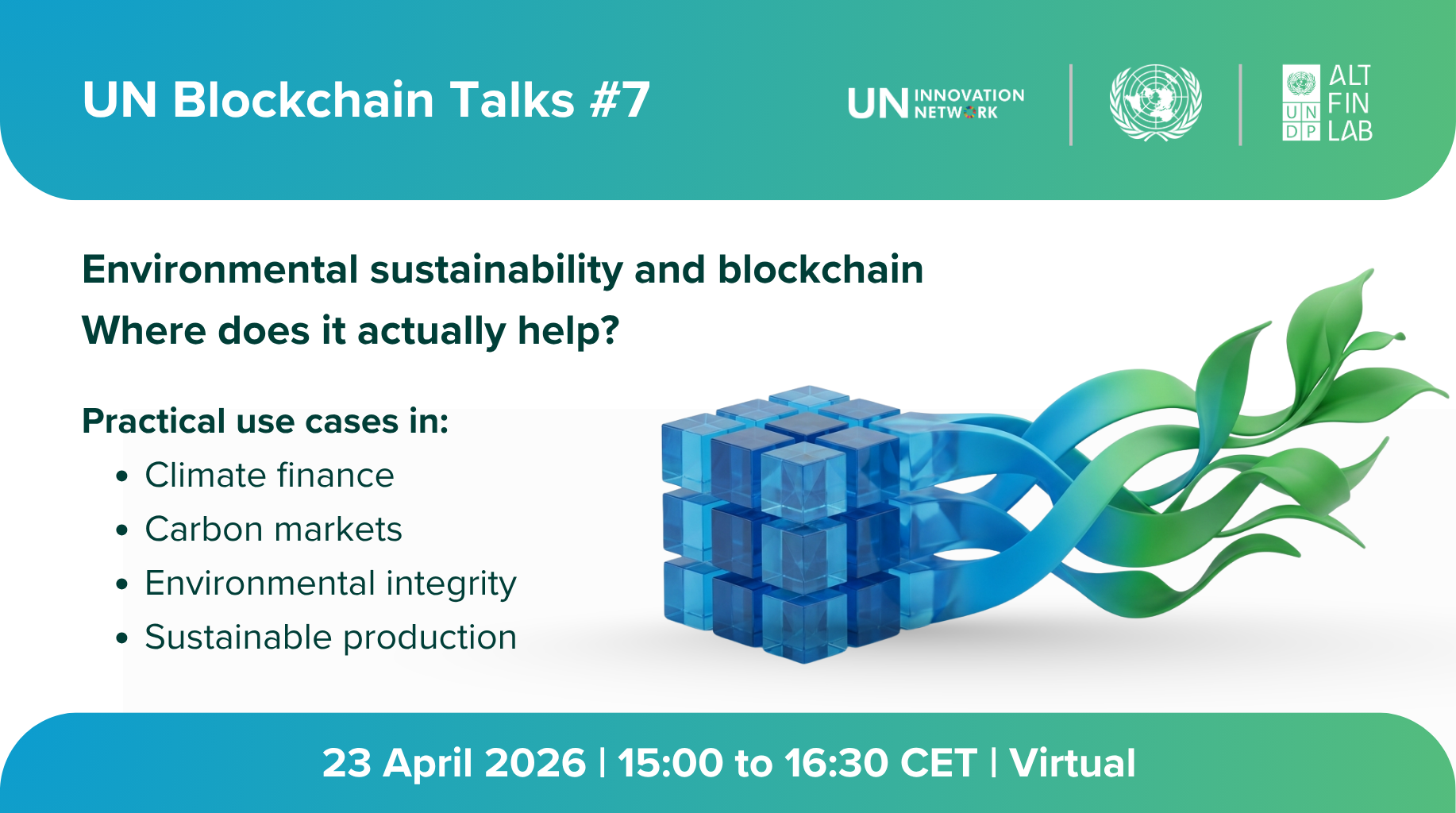
Environmental sustainability has become one of blockchain’s favorite talking points. Even so, carbon credits, drought insurance, climate adaptation loans, renewable energy certificates, and biodiversity finance do not usually occupy the same conversation for long. In the seventh Blockchain Talks, they did!
What held them together was neither a shared market nor a shared asset class, but a shared operational problem. In each case, money, claims and decisions depend on records that must be trusted across multiple actors, while the realities behind those records remain difficult to verify or audit. The session, then, was more about where the technology begins to matter once environmental work runs into questions of integrity, coordination and implementation.
Opening the session, Robert Pasicko situated the discussion within UNDP’s own pipeline. Environmental sustainability, he noted, is no longer a side strand in blockchain work. On the contrary, it has become one of the liveliest areas of experimentation, precisely because teams are testing whether the technology can solve something concrete. The real test, as he put it, is not whether blockchain sounds relevant, but “how do we actually make it work?”
That question found its clearest answer in the speakers’ experiences in their projects. In Adam Spiers’ account of Toucan Protocol, blockchain helps where carbon markets need traceability that can survive market activity. Toucan’s work brings carbon credits on-chain in a way that remains verifiable “to guard against double counting,” while also making it easier to build liquid instruments around assets that are otherwise slow and fragmented to manage. In that sense, blockchain is being applied as market infrastructure.
With Etherisc, the technology appeared in a different role. Christoph Mussenbrock showed how blockchain can help coordinate climate insurance across farmers, NGOs, governments, insurers, and reinsurers that do not naturally share a trusted system. When payouts depend on satellite data, sampling, and rapid execution rather than slow claims processing, that shared layer starts to matter. Just as importantly, he made clear where the technology should disappear from view: “No farmer should bother about wallets and private keys and cryptography.”
In the electricity market, the value proposition sharpened further. Gideon Maasz of Fuel Switch focused on renewable energy certification, where the issue is proving in auditable terms how much exported electricity is actually renewable. Once those claims begin carrying tax or trade consequences, credibility ceases to be a reporting preference and becomes a commercial requirement. Hence his insistence that environmental claims need “quantifiable data.”
Elsewhere, the same logic surfaced in climate adaptation finance and nature-based investment. Speaking about Cladfy’s work with UNDP Bangladesh, Ebby Gatamu described a system designed to move climate finance to rural women in ways that are more accessible, more trackable, and more dignified, allowing them to apply “from the comfort of their home.” From a different corner of the field, Juan Pedro Piñeirua showed how blockchain can help structure environmental value so that capital flows and ecological outcomes are easier to follow over time. In his words, the larger question is “How do we bridge the gap between the market and the protection of life-supporting systems?”
Taken together, the session gave a more grounded answer to its own title. Blockchain helped where environmental work needed claims, flows, and records to remain legible across many actors at once. That is a narrower answer than the hype usually offers, but a far more credible one.
Missed our talk? Watch the recording here.
You can also explore previous Blockchain Talks sessions in our YouTube Playlist.
Get involved
The UN Blockchain Community of Practice (CoP) works best when colleagues bring practical questions, field-tested lessons and cases that challenge easy assumptions.
For more details or suggestions, contact Ben Thompson Coon, UN Blockchain CoP Lead; ben.thompsoncoon@undp.org