
Category: Digital transformation and emerging tech
UNDP teams are increasingly being asked to make sense of fast-changing digital systems before the institutional playbook is fully written. As part of this shift, blockchain is entering more practical development conversations, and UNDP’s ability to engage well depends on colleagues who can look beyond the technology and assess the operational and public-interest conditions around it.
The Virtual Development Assignment Programme (VDAP) offers a structured approach to build this kind of judgement as a UNDP people-development modality. Hosted by the Talent Development Unit under the Office of Human Resources and accessed through Fuel50, VDAP allows colleagues to take on assignments outside their usual office or bureau and contribute to live areas of work to build skills through applied exposure rather than detached training.
For blockchain, UNDP AltFinLab has been using this modality to bring colleagues closer to active workstreams while drawing on their regional and operational experience. A digital payment system needs liquidity, compliance, reporting and user trust; a credentialing tool needs legal recognition and data protection; a traceability system needs reliable actors across the chain. And through VDAP, AltFinLab brings colleagues into this practical layer, where technical promise is tested against operational reality.
A pathway into live blockchain work
VDAPs have grown alongside AltFinLab’s portfolio as it moved from building internal learning through the Blockchain Academy, to strengthening exchange through the UN Blockchain Community of Practice, to developing a pipeline of use cases through the SDG Blockchain Accelerator, and now to supporting implementation and scale-up. Participants have entered this pathway through practical assignments that help translate the portfolio into usable knowledge and more grounded programme design with stronger country-office links.
The same direction is reflected in New Tech, New Partners, which shows how UNDP’s blockchain practice is moving closer to public systems where payments, records, finance, trust and evidence need to work across many actors.
This is why VDAP is becoming an important channel for strengthening blockchain capacity within UNDP. Participants contribute directly to live work while developing a sharper understanding of how blockchain can be assessed in relation to operations, partnerships, safeguards and country-level delivery. In return, UNDP gains colleagues who can bring knowledge of local systems, institutional constraints and programme realities into portfolio discussions.
What blockchain-linked VDAP opens
For upcoming cohorts, the strongest argument may be the kind of work alumni were able to enter, and the value of this model is visible through the people who have passed through it. Some worked on learning systems; others moved closer to digital payments and pilots, AI, operations, credentials or regional digital work.
Earlier VDAP participants helped shape parts of the foundation that AltFinLab’s blockchain work still draws on. Dzenan Buzadzic, Digital Governance and AI Specialist, brought a digital perspective into early mapping and knowledge work, helping review the Tadamon Web3.0 platform and Blockchain Academy content, and developing an opportunity analysis for blockchain-based certification. Jenny Ensi, then Head of Experimentation at UNDP Accelerator Labs, connected her experience in innovation, acceleration and STEM education to early thinking on blockchain education for girls and women in the RBEC region, while also supporting engagement with learning platforms.
McDonald Nyoni, AI Policy Analyst, brought a strategic and implementation-focused perspective to the VDAP work, helping shape tokenization use cases, explore partnerships, and connect alternative finance with emerging opportunities in artificial intelligence. From UNCDF Tanzania, Country Coordinator Tian Zhang, added a UNCDF perspective to the Academy’s content review and beta testing, which shows us how blockchain learning benefits when it draws on experience beyond one office or function.
These contributions show how VDAP can turn internal expertise into institutional assets that others can build on.
Applied learning that travelled further
The value also appears in what participants were able to carry into later work. For Ana M. Grijalva, then Innovation and Digital Lead with UNDP Ecuador, VDAP created a route into AltFinLab’s blockchain portfolio that later developed into direct coordination of digital payments work. As Coordinator of Blockchain Digital Payments and Digital Institutional Strengthening, Ana coordinated a global team across three regions to support five blockchain-based digital payment pilots.
Her work also included developing an engagement strategy with eight government counterparts, helping position blockchain-based payment approaches around financial inclusion and security in government-to-person transfers. Her story shows how VDAP can move colleagues closer to live portfolio work, where country-office experience, cross-regional coordination and government engagement become part of implementation.
“One of the aspects I appreciated most about the VDAP was how the Innovation Team truly made us feel like part of their team. They fostered a collaborative environment by maintaining a well-structured working routine, actively engaging with us, and transparently sharing ongoing initiatives.” Ana M. Grijalva
Another form of value came through colleagues who connected the assignment to wider digital strategy. Enrique Crespo, Regional Digital Specialist for Latin America and the Caribbean, saw value in connecting blockchain with broader digital transformation and regional digital strategies. For him, working in an environment of AI and blockchain learning opened space to think about how these technologies could inform regional strategies and practical applications.
Closer to delivery, knowledge and operations
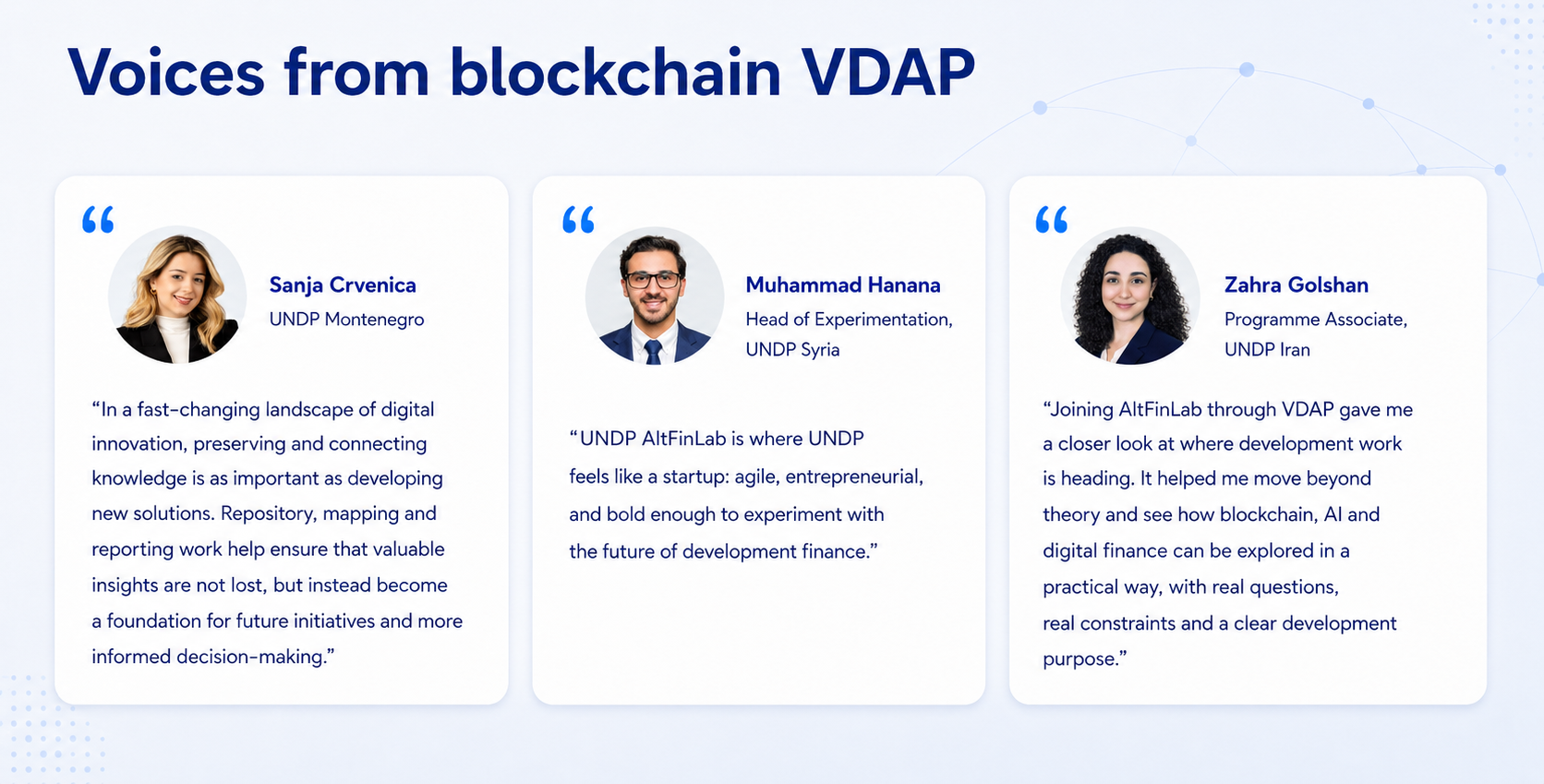
VDAP also helped bring blockchain closer to the systems and operations that make development work possible. Muhammad Hanana, Head of Experimentation in UNDP Syria, brought country-office experience into digital payments work, where the real questions are not limited to the payment rail itself, but include liquidity, regulation, cash-out options, reporting and user trust. Additionally, Sanja Crvenica, a Legal Specialist working with financial institutions at UNDP Montenegro on the development of an EU-ready financial sector, has been involved in knowledge infrastructure work, including repository development, mapping and blockchain reporting, helping turn scattered experience into something the wider system can use.
Marina Storgaard, Human Resources Associate, brought an operational lens to the VDAP experience. Her reflections connected blockchain learning to internal systems, including smart contracts, HR processes, credential verification and tokenization as possible ways to improve transparency and efficiency inside institutional workflows.
“Participating in this VDAP project has significantly enhanced both my technical and interpersonal skills. I developed stronger project management skills, particularly in collaborating across diverse teams and regions, navigating complex decision-making processes, and ensuring smooth communication.” Marina Storgaard
What links them all is the ability to bring their own professional setting into the assignment, and then carry new questions, contacts and practical judgement back into their work.
Why this matters for Country Offices
For Country Offices, this kind of internal capacity changes the starting point of a blockchain conversation. Instead of receiving a proposal and reacting to the technology, colleagues who have worked through VDAP can help ask the earlier questions: what problem is being solved, who needs to be involved, what risks need to be managed, and whether blockchain is actually the right tool.
This is the network effect UNDP AltFinLab is trying to build. VDAP alumni can become connectors inside their offices and teams, linking programme needs with the right expertise and keeping blockchain discussions close to delivery. They can also help maintain relationships between Country Offices and the wider UNDP innovation ecosystem, so emerging ideas are assessed with institutional memory, technical support and a clearer view of public value.
Join the next blockchain VDAP!
The fifth cohort arrives at a time when UNDP is engaging more systematically with the blockchain ecosystem, as evidenced by the recent establishment of the Blockchain Advisory Group in Paris, which is exploring the potential of this technology to support public-purpose digital transformation and financial inclusion.
In light of this, Cohort 5 will adopt a more intentional approach, seeking out colleagues already close to the right ecosystems, countries, functions and thematic areas, and who can help unlock meaningful opportunities for UNDP’s innovation pipeline.
Participants do not need to arrive as emerging tech experts. What matters is curiosity, judgement, initiative and a close understanding of how development work is designed and delivered. The strongest candidates will be those who can bring practical experience into live workstreams, engage with specialists and partners, and return to their offices with sharper questions about where blockchain and AI belong in development practice.
Cohort 5 at a glance
Opportunity title
Scaling Blockchain & AI for Development – SDG Accelerator, Digital Payments & Government Engagement
Available roles
6 positions across 4 roles
Eligibility
UNDP, UNCDF and UNV colleagues
Application channel
Fuel50 >>> search for the opportunity title and indicate which role you are applying for
Deadline
24 July 2026
Contact
Teodor Petricevic, teodor.petricevic@undp.org
The ninth and closing session of the spring UN Blockchain Talks handed the floor to three private-sector builders working at the edge of AI and blockchain, and asked them a blunt question: what do you actually need from an organization like the UN if AI agents, federated learning, and on-chain accountability are going to work at scale?
The conversation brought together Jiahao Sun, founder and CEO of FLock.io and former Director of AI at the Royal Bank of Canada, Patrick Tobler, co-founder of Masumi Network and creator of NMKR, and Gustav Friis, co-founder of NEARWEEK, with moderation by Ben Thompson Coon of the UNDP Alternative Finance Lab.
Your AI is only as good as the data it’s allowed to see
Jiahao Sun opened with the problem federated learning was built to solve. Good models need a lot of data, but in any large organisation, that data sits in silos for good reason. Hospitals, country offices, and banks can’t simply pool everything into one place.
FLock’s answer is to train models locally and only aggregate the learnings – never the raw data – across a network with no single controlling node, federated learning plus blockchain for open coordination. Is it as efficient as centralised training? Not historically, Sun admitted. But the field has moved to a hybrid model by training a strong foundation model centrally, then fine-tune it on sensitive local data in a federated way getting most of the privacy benefit without the old efficiency penalty.
His ask for UNDP heading into Cohort 3 of the SDG Blockchain Accelerator is to keep the country-office “wish list” coming, but push for requests written with an engineering mindset, clear inputs and outputs, so the private sector can match problems to solutions faster.
Giving AI agents a wallet, an ID and a paper trail
Patrick Tobler’s starting point was a thought experiment that Masumi Network was built to answer: if your personal AI agent asks a Booking.com agent to book a flight, and that agent talks to airline agents, and you end up at the airport with no ticket whose fault was it? He laid out four problems that have to be solved before enterprises will trust agents to act on their own:
- How agents pay each other – a wallet, not a credit card.
- How an agent proves it’s really who it claims to be!
- How agents find each other without one company controlling the app store.
- How every decision gets logged immutably so it can be audited later.
Masumi’s approach takes the result of an agent’s action, hashes it, and puts it on-chain so disputes can be traced back to the agent that actually got it wrong. When asked what he’d want from large institutions, Tobler answered, “don’t get locked into one big AI provider’s. Push toward open-source, decentralised infrastructure that no single company can gatekeep or tax.“
What a sovereign AI stack actually looks like
Gustav Friis took the conversation from agent-to-agent plumbing to government strategy. NEAR has been working with small, fast-moving states like Bermuda’s work on confidential AI for public services. A question every public institution now faces: staff want to use tools like OpenAI or Claude, but how do they do that and stay compliant?
His framing for a “sovereign stack” is avoid lock-in to any single technology, keep transparency where it builds trust (budgets, audits) but confidentiality where it’s needed. Above all, verifiable execution like cryptographic proof that a system did what it claims is still missing in most AI deployments, and it’s exactly the gap that caused Patrick’s flight-booking failure.
His last recommendation to the UN is to build on existing frameworks like GovStack and the Blockchain Advisory Group, and create a shared, open, cross-agency knowledge base that multiple AI systems can independently inspect and verify so good practice doesn’t stay locked inside individual pilots.
Is the UN too slow for AI?
Ben put the hardest question to the panel directly: at last month’s Proof of Talk event in Paris, more than one person told him the UN moves too slowly to matter on AI governance. Was that fair?
All three speakers pushed back! Sun pointed out that UNDP’s Blockchain Advisory Group is already moving faster than many national regulators but the gap is internal literacy on how to translate real-world problems into AI-ready requests. Tobler called the panel itself “proof the UN can act,” even if coordination across such a large system is inevitably harder. Friis added, “the UN reflects the average of its member states, and what looks slow from one country looks like real progress from another.”
The session closed on a phrase Sun used to describe what FLock and others are building: a “third species” of AI that is neither closed-source US models nor open-source Chinese ones, but decentralised models nobody fully owns or controls. Whether that third option becomes real, the panel agreed, will depend on exactly the kind of infrastructure like wallets, identity, verifiable logs, federated training that was discussed throughout the session.
Missed our talk? You can check out the recording here.
Get involved
The UN Blockchain Community of Practice (CoP) works best when colleagues bring practical questions, field-tested lessons and cases that challenge easy assumptions. UNDP’s third SDG Blockchain Accelerator cohort is launching soon, if any of the work from FLock, Masumi, or NEAR resonates with a challenge in your office, reach out!
For more details or suggestions, contact Ben Thompson Coon, UN Blockchain CoP Lead; ben.thompsoncoon@undp.org
Artificial intelligence (AI) is increasingly shaping how cities deliver services, manage infrastructure, and make decisions. For many municipalities across Europe and Central Asia, the challenge is not simply adopting AI, but understanding where it genuinely fits their institutional context, what it demands in terms of readiness, and how to engage with it in a way that is grounded, responsible, and connected to their existing priorities.
To support this work, the United Nations Development Programme (UNDP) in Europe and Central Asia is convening the CEF × AI Bootcamp in Podgorica, Montenegro, from 23 to 25 June 2026.
The bootcamp marks the first milestone of the newly launched CEF × AI programme, part of the City Experiment Fund (CEF), bringing together municipalities from the region to explore how AI can support their green and digital priorities. Over three days, city teams will work through their own challenges, assess their readiness for AI, and identify practical opportunities for experimentation and implementation.
Selected municipalities have been invited to the bootcamp following an Expression of Interest process and completion of an online AI Foundations for Municipalities course to help public servants build a shared understanding of AI, its applications in urban contexts, and what responsible engagement with it looks like in practice.
The following municipalities have been selected to participate in the CEF x AI Bootcamp in Podgorica: Yerevan, Armenia; Kavadarci, North Macedonia; Skopje, North Macedonia; Podgorica, Montenegro; Pluzine, Montenegro; Rivne, Ukraine; Mykolaiv, Ukraine; Kharkiv, Ukraine; Pristina, Kosovo [1].
What cities will work on
Participating municipalities will work through a structured process designed to take them from a broad understanding of AI to clear, actionable directions grounded in their specific contexts.
Cities will begin by mapping their AI ecosystem, examining what data, infrastructure, governance structures, and actor networks they already have, what is missing, and what is already in motion. Building on this, they will move into problem framing, identifying which challenges are most worth pursuing and how AI could meaningfully support their twin transition priorities. Cities will then assess the feasibility of their proposed directions and examine questions of responsibility: who could be affected, where accountability gaps exist, and what governance would be needed.
By the end of the bootcamp, each participating city will have developed its own AI pathway, identifying at least two concrete directions for exploring how AI could support its work. These pathways will also consider the surrounding building blocks required for responsible adoption, including governance, ethics, privacy, partnerships, and institutional capacity, informed by what cities have mapped and learned throughout the three days.
Throughout the sessions, cities will hear from experts and practitioners working at the intersection of AI and urban transformation, exchange perspectives with peers from across the region, and receive structured guidance and one-to-one mentorship from the facilitation team.
Cities as active participants, not passive adopters
A core principle of the bootcamp is that cities engage as active shapers of how AI is integrated into municipal services and processes. Rather than promoting AI as a solution in every situation, the programme encourages cities to critically assess where it can create meaningful value and where other approaches may be more appropriate. The bootcamp is therefore designed around the cities’ own priorities, submissions, and questions.
The bootcamp also addresses the conditions that make AI engagement sustainable over time: institutional readiness, coordination across teams, data and infrastructure requirements, and the governance frameworks that responsible AI adoption demands.
What’s next
Following the bootcamp, cities will be invited submit proposals to continue into one of two supported pathways: the CEF × AI Demonstrator track, focused on building longer-term institutional AI capacity, or the GenAI Challenge track, which matches cities with external innovation teams to co-design and pilot targeted AI solutions.
The programme is implemented by UNDP through the City Experiment Fund (CEF) with the financial support of the Ministry of Finance of the Slovak Republic. CEF collaborates with cities across Europe and Central Asia to tackle complex urban challenges through strategic innovation and experimentation.
[1] References to Kosovo shall be understood to be in the context of United Nations Security Council resolution 1244 (1999).
Artificial intelligence (AI) is opening new possibilities for how cities deliver services, make decisions, and manage complex systems. For municipalities, the question is no longer whether AI will play a role, but how to engage with it in a way that is useful, responsible, and aligned with their existing priorities.
To support this shift, the United Nations Development Programme (UNDP) in Europe and Central Asia is launching CEF x AI, a new programme, part of the City Experiment Fund, focused on helping cities build the capability to work with AI in practice.
The City Experiment Fund (CEF) collaborates with cities across Europe and Central Asia to tackle complex urban challenges through strategic innovation and experimentation. Rather than supporting isolated projects, it helps cities develop portfolios – sets of connected actions and interventions that can be tested, adapted, and improved over time.
CEF x AI extends this approach into the field of AI. The programme is designed to help municipalities integrate AI into their ongoing green and digital priorities through practical exploration, experimentation, and capability building.
Building foundations for municipalities
The programme begins with AI Foundations for Municipalities, an online course developed by CEF and the EU-funded Mayors for Economic Growth (M4EG) initiative. The course was co-created with the City of Bratislava and experts in AI and urban transformation to help municipalities build a foundational understanding of artificial intelligence, governance, risks, and practical urban applications.
The course will be made publicly available and is designed for public servants and city teams who are increasingly engaging with AI-related systems and decisions, regardless of technical background.
From learning to experimentation
Following an Expression of Interest process among municipalities in the CEF network, selected municipalities are invited to join the CEF x AI programme and participate in an intensive in-person bootcamp in Podgorica, Montenegro, in June 2026.
The bootcamp is designed as a working space for cities to explore how AI could support their priorities in areas such as service delivery, planning, operations, participation, and urban management. Working alongside UNDP, experts, and partners, municipalities will identify practical pathways for how AI could support municipal priorities, while mapping the institutional, technical, and ecosystem conditions needed to work with AI effectively.
Cities will also examine questions around feasibility, governance, institutional readiness, inclusion, and long-term sustainability – including where AI may not be the right tool and where simpler approaches may be more effective.
The following municipalities have been selected to participate in the CEF x AI Bootcamp in Podgorica: Yerevan, Armenia; Kavadarci, North Macedonia; Skopje, North Macedonia; Podgorica, Montenegro; Pluzine, Montenegro; Rivne, Ukraine; Mykolaiv, Ukraine; Kharkiv, Ukraine; Prishtina, Kosovo [1].
Two pathways for continued support
Following the bootcamp and an application process, a selected cohort of municipalities will continue into two supported pathways focused on experimentation, capability building, and piloting AI interventions.
- The first pathway, CEF × AI Demonstrator, supports municipalities that want to build longer-term institutional capacity to work with AI. These cities will test and apply AI across different areas of city administration while strengthening internal systems, coordination, governance, and practical capabilities over time.
- The second pathway, GenAI Challenge, is designed for municipalities with a specific, well-defined urban challenge. Implemented through UNDP’s BOOST impact acceleration programme, the challenge will match cities with external innovation teams to co-design and pilot targeted AI solutions within a shorter implementation period.
Across both pathways, the programme combines technical expertise, structured methodologies, peer learning, and funding support, while requiring active involvement from municipal teams throughout the process.
The programme is implemented by UNDP through the City Experiment Fund with the financial support of the Ministry of Finance of the Slovak Republic.
[1] References to Kosovo shall be understood to be in the context of United Nations Security Council resolution 1244 (1999).
The United Nations Development Programme (UNDP) will convene Scaling Blockchain for Public Good, a two-day high-level event bringing together blockchain ecosystem leaders, governments, development organizations, and academic institutions to explore the practical pathways through which blockchain technologies can strengthen public systems and support sustainable development. The programme is organized by UNDP’s Alternative Finance Lab (AltFinLab), a flagship initiative focused on exploring and scaling innovative financing and technology solutions for sustainable development.
The programme will take place across two days in Paris. On 3 June, UNDP will participate in Proof of Talk 2026 at the Louvre Palace (Musée des Arts Décoratifs) – one of Europe’s leading blockchain gatherings – to advance the conversation on blockchain for development with ecosystem leaders. On 4 June, the programme will continue at Sciences Po, co-organized with the Sciences Po Tech & Global Affairs Innovation Hub, with a focus on government engagement and responsible blockchain adoption in public systems.
Blockchain technologies are increasingly demonstrating their potential to foster cooperation in low-trust environments, strengthen digital public infrastructure, and expand access to financial and non-financial services for those furthest behind. Yet developing and scaling these solutions where they are most needed remains a challenge. Closing that gap requires new partnership models that connect technical innovation, development experience, and public sector engagement to deliver development outcomes at scale.
3 June | Proof of Talk, Louvre Palace
UNDP will host two sessions at Proof of Talk – one of Europe’s leading gatherings in the blockchain and digital asset space, with approximately 2,500 senior decision-makers from across the ecosystem.
UNDP will formally launch the Blockchain Advisory Group (BAG) – a senior-level advisory mechanism convening leading blockchain organizations to inform how blockchain technologies can support sustainable development and public-purpose digital transformation. The BAG formalizes UNDP’s engagement with the blockchain ecosystem into a structured, ongoing advisory relationship, designed to explore what partnering differently for development at scale can look like in practice. The inaugural, closed session will focus on financial inclusion and digital finance – where the need is most urgent. Despite significant progress, 1.3 billion adults worldwide remain without access to formal financial services, and close to one billion lack the digital identity needed to access them.
The second is the SDG Blockchain Accelerator Impact Showcase – an open session part of the Proof of Talk programme. The SDG Blockchain Accelerator is UNDP’s global initiative to scale blockchain and AI solutions in support of the Sustainable Development Goals. Selected solution teams will present on-the-ground work across financial inclusion, digital identity, climate resilience, and public service delivery, in a demonstration and networking session. The session will also preview the upcoming launch of Cohort 3 of the Accelerator – an opportunity for solution makers, technical partners, and ecosystem actors to explore collaboration with UNDP on scaling blockchain solutions for development.
Registration for the Impact Showcase is available here.
4 June | Sciences Po, Paris
Co-organized by UNDP AltFinLab and the Sciences Po Tech & Global Affairs Innovation Hub, in partnership with Exponential Science Foundations and Stellar Development Foundation, the half-day programme at Sciences Po brings together academics, policymakers, senior government representatives, and practitioners for a focused dialogue on responsible blockchain adoption in public systems.
The programme addresses two interconnected themes: first, how governments are building the institutional capacity, regulatory frameworks, and implementation pathways needed to adopt blockchain-based solutions within public systems – including an introduction to the Government Blockchain Academy, UNDP AltFinLab’s new capacity-building initiative for public-sector blockchain adoption; and second, how blockchain-enabled financial tools are being used to reach people excluded from conventional financial systems, drawing on active deployments in humanitarian and development settings.
The full programme and registration are available here.
About the programme
Across both days, Scaling Blockchain for Public Good is intended to support practical exchange and advance the conversation on where blockchain can deliver public value – what conditions are needed for responsible and inclusive implementation, and how development actors, governments, and the blockchain ecosystem can work together in support of public purpose digital transformation at scale.
The eighth session of the UN Blockchain Talks used the story of Mariama, a fictional trader in The Gambia, to bring the discussion on stablecoins closer to the realities of last-mile financial inclusion. Mariama runs a small business, depends on family remittances, manages customer debts, and needs money to arrive in a form she can use immediately.
Her situation gave the session its practical anchor! A transfer may arrive faster through digital rails, but speed alone does not settle the matter. The real question is whether the money can be converted, spent, trusted, and supported by people and systems nearby.
The discussion brought together Dr. Margie Cheesman of King’s College London, Stephanie Joseph of Citi, and Freedom Pigott of FreedomPay Wallet, with moderation by Ali Al-Zuhairi of UNDP Alternative Finance Lab.
The cost of being financially invisible
At the start of the session, the speakers looked at Mariama’s financial life before any new payment tool entered the picture. She already has a financial system, built through informal savings groups, family support, customer relationships, receipts, WhatsApp records, and daily judgment.
Dr. Margie Cheesman pointed to the structural disadvantages faced by people outside formal banking systems. Their financial lives are often active and complex, yet formal institutions may fail to recognize that activity as proof of reliability. Freedom Pigott brought that point into the experience of small traders, many of whom manage credit, repayments, sales, and supplier relationships with discipline.
At the receiving end, Stephanie Joseph pointed to another gap: a sender may have access to digital payment tools, while the receiver still depends on limited local options!
When money arrives late
As the scenario developed, Mariama needed to restock her business. A relative sends money, but the transfer is slowed by fees, exchange rates, and delays. For a trader, waiting can mean missing stock, losing a customer, or buying less than planned.
This is where stablecoins can help! In corridors where traditional transfers are slow or expensive, digital dollars can move value in minutes and reduce the cost of sending. In Mariama’s case, that speed could help her respond before a business opportunity disappears.
Still, the discussion kept returning to the same practical point: Mariama’s supplier wants dalasi. Her customers pay locally. Her business needs liquidity. A wallet balance is useful only when it can be converted, spent, or accepted nearby.
Where the system is tested
At the last mile, the quality of the system depends on what surrounds the transfer. Agents, merchants, cash-out points, liquidity, user support, and trust determine whether the money becomes part of daily business or stays trapped inside an app.
Freedom shared experience from implementation in The Gambia, including the challenge of building agent networks and maintaining liquidity. For development programmes, this is where design has to be tested honestly. A pilot can record successful transactions while the user still carries the hardest work.
The same issue applies to financial records! Blockchain-based tools may help small traders build a record of activity that can later support credit, microloans, or working capital. Yet that record must be understandable and safe for the person whose activity created it.
Faster rails, slower institutions
The final part of the session turned to institutional adoption. Participants were asked why someone like Mariama may still be waiting for payment when faster technology already exists. The strongest response pointed to slow institutional processes, followed by the lack of local infrastructure.
Compliance, procurement, data protection, and risk management protect people and institutions. In urgent contexts, however, long processes can make support arrive too late. Startups need better internal controls and clearer regulatory pathways. Institutions need safer ways to test payment models without slowing them down until they lose their purpose.
By the end, the session treated stablecoins as one layer in a wider system that still has to earn trust through local use. For Mariama, the value of the transfer depends on what happens after it arrives: whether she can spend it, convert it, understand it, and get help if something goes wrong.
Missed our talk? Watch the recording here.
You can also explore previous Blockchain Talks sessions in our YouTube Playlist.
Get involved
The UN Blockchain Community of Practice (CoP) works best when colleagues bring practical questions, field-tested lessons and cases that challenge easy assumptions.
For more details or suggestions, contact Ben Thompson Coon, UN Blockchain CoP Lead; ben.thompsoncoon@undp.org
Environmental sustainability has become one of blockchain’s favorite talking points. Even so, carbon credits, drought insurance, climate adaptation loans, renewable energy certificates, and biodiversity finance do not usually occupy the same conversation for long. In the seventh Blockchain Talks, they did!
What held them together was neither a shared market nor a shared asset class, but a shared operational problem. In each case, money, claims and decisions depend on records that must be trusted across multiple actors, while the realities behind those records remain difficult to verify or audit. The session, then, was more about where the technology begins to matter once environmental work runs into questions of integrity, coordination and implementation.
Opening the session, Robert Pasicko situated the discussion within UNDP’s own pipeline. Environmental sustainability, he noted, is no longer a side strand in blockchain work. On the contrary, it has become one of the liveliest areas of experimentation, precisely because teams are testing whether the technology can solve something concrete. The real test, as he put it, is not whether blockchain sounds relevant, but “how do we actually make it work?”
That question found its clearest answer in the speakers’ experiences in their projects. In Adam Spiers’ account of Toucan Protocol, blockchain helps where carbon markets need traceability that can survive market activity. Toucan’s work brings carbon credits on-chain in a way that remains verifiable “to guard against double counting,” while also making it easier to build liquid instruments around assets that are otherwise slow and fragmented to manage. In that sense, blockchain is being applied as market infrastructure.
With Etherisc, the technology appeared in a different role. Christoph Mussenbrock showed how blockchain can help coordinate climate insurance across farmers, NGOs, governments, insurers, and reinsurers that do not naturally share a trusted system. When payouts depend on satellite data, sampling, and rapid execution rather than slow claims processing, that shared layer starts to matter. Just as importantly, he made clear where the technology should disappear from view: “No farmer should bother about wallets and private keys and cryptography.”
In the electricity market, the value proposition sharpened further. Gideon Maasz of Fuel Switch focused on renewable energy certification, where the issue is proving in auditable terms how much exported electricity is actually renewable. Once those claims begin carrying tax or trade consequences, credibility ceases to be a reporting preference and becomes a commercial requirement. Hence his insistence that environmental claims need “quantifiable data.”
Elsewhere, the same logic surfaced in climate adaptation finance and nature-based investment. Speaking about Cladfy’s work with UNDP Bangladesh, Ebby Gatamu described a system designed to move climate finance to rural women in ways that are more accessible, more trackable, and more dignified, allowing them to apply “from the comfort of their home.” From a different corner of the field, Juan Pedro Piñeirua showed how blockchain can help structure environmental value so that capital flows and ecological outcomes are easier to follow over time. In his words, the larger question is “How do we bridge the gap between the market and the protection of life-supporting systems?”
Taken together, the session gave a more grounded answer to its own title. Blockchain helped where environmental work needed claims, flows, and records to remain legible across many actors at once. That is a narrower answer than the hype usually offers, but a far more credible one.
Missed our talk? Watch the recording here.
You can also explore previous Blockchain Talks sessions in our YouTube Playlist.
Get involved
The UN Blockchain Community of Practice (CoP) works best when colleagues bring practical questions, field-tested lessons and cases that challenge easy assumptions.
For more details or suggestions, contact Ben Thompson Coon, UN Blockchain CoP Lead; ben.thompsoncoon@undp.org
In 2025, the SDG Blockchain Accelerator delivered 46 pilot- and implementation-ready solutions, with 12 already entering real-world testing. Developed across two global cohorts, 70% of these solutions are embedded within ongoing national and regional programmes – positioning them to move beyond standalone experiments and into active use.
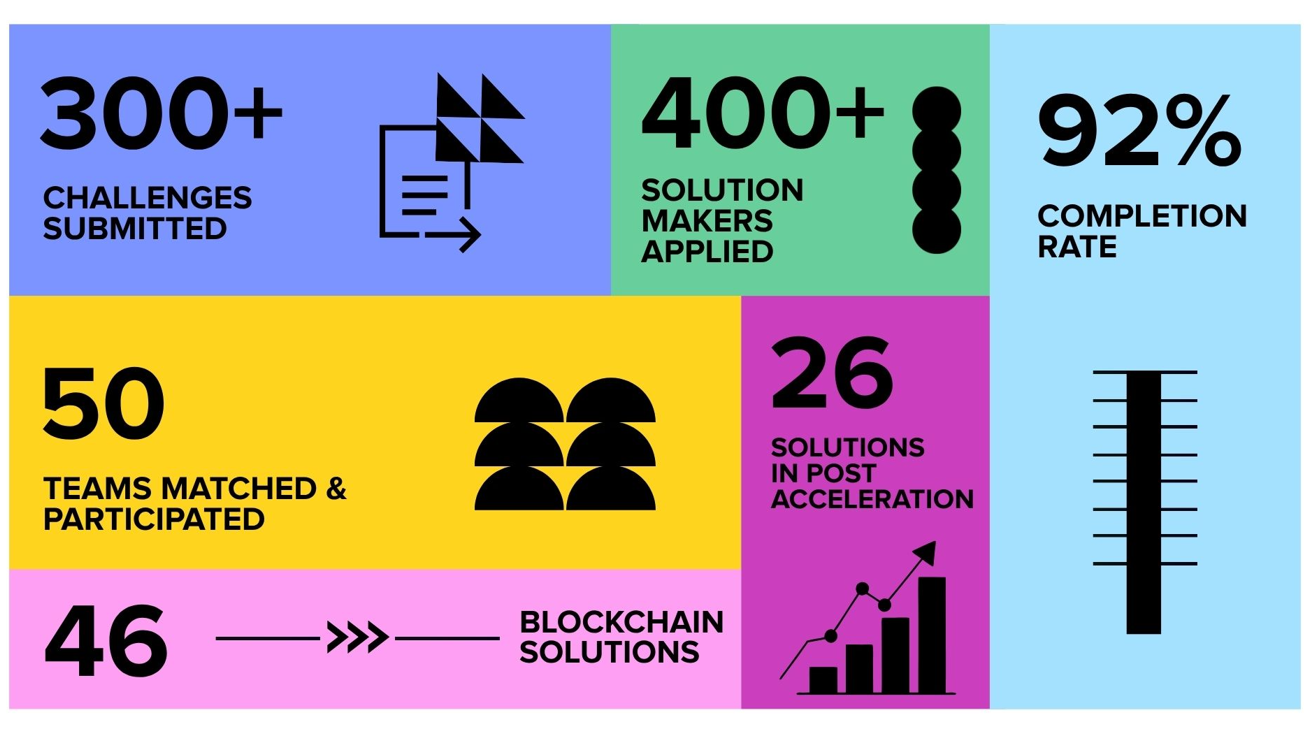
The SDG Blockchain Accelerator was created to connect innovators with development challenges and turn ideas into impact. While interest in blockchain has grown in recent years – from traceable transactions and auditable data to improvements in payments and service delivery – a persistent question has remained: how to design solutions that can operate within institutional, regulatory, and operational realities. To address this, the Accelerator brings together UNDP, technical partners, and innovators into a structured, multi-partner platform that supports solutions from concept to deployment.
Strategically led by the United Nations Development Programme’s Alternative Finance Lab (AltFinLab), in partnership with the Blockchain for Good Alliance (BGA), EMURGO Labs, FLock Technology Holdings, Stellar Development Foundation, and Sui Foundation, the global initiative helps scale blockchain and decentralized AI solutions to advance the Sustainable Development Goals (SDGs).
A structured pathway from demand to deployment
In many innovation efforts, the challenge is not generating ideas or prototypes, but ensuring that solutions can function within existing systems. The Accelerator links demand, solution development, and implementation planning into a single process, helping move ideas from exploration to practical application.
It is built around a demand-led model, where UNDP Country Offices define concrete development challenges grounded in ongoing programmes and national priorities. Across the portfolio, blockchain is being applied to address a consistent set of system-level issues – from inefficient financial flows and weak data integrity to fragmented supply chains and low-trust governance environments – where verification, transparency, and coordination are essential.
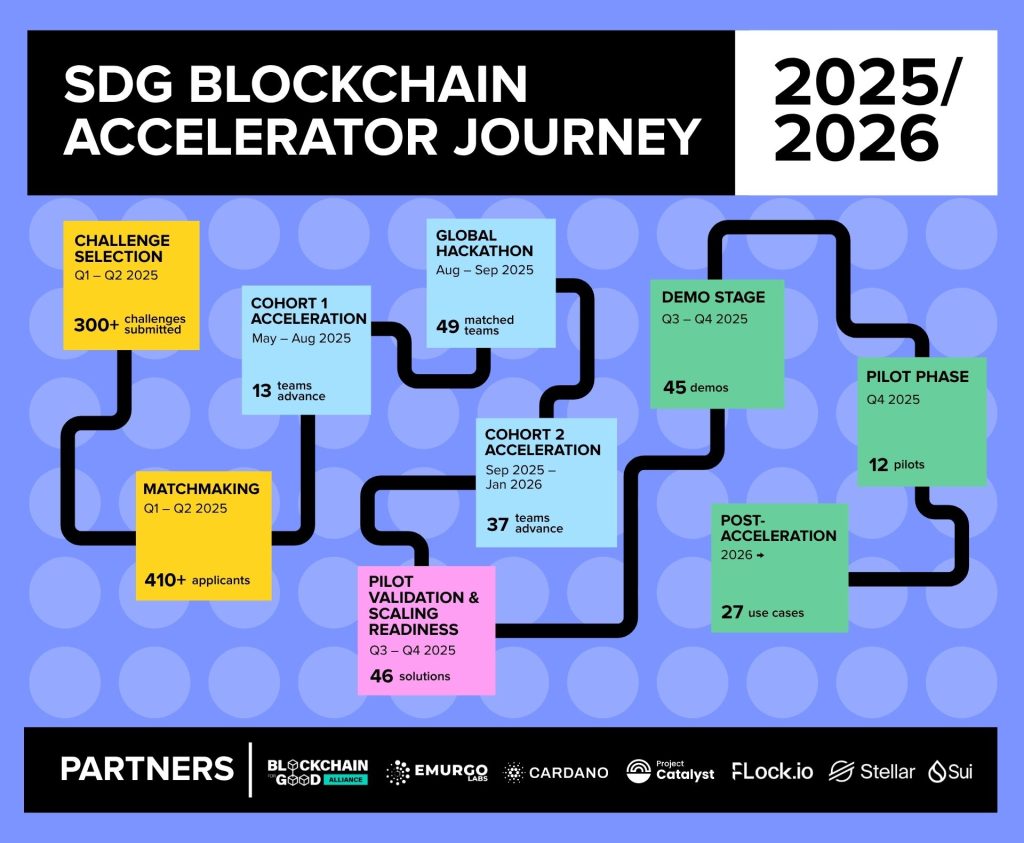
From there, UNDP AltFinLab matches challenge owners with solution makers and technical partners through a structured process – moving from problem definition to roadmap, and from roadmap to pilot readiness. Open calls and hackathons serve as mechanisms for aligning different actors around a shared problem, allowing ideas to be tested and refined before entering acceleration.
The programme operates through a multi-partner, track-based model that brings together multiple technical ecosystems while maintaining a coordinated and neutral approach. This allows challenges to be matched with the most suitable solutions and platforms. By working across multiple blockchain ecosystems, the Accelerator reduces dependency on any single technology stack and increases adaptability across different country contexts. Interoperability is also a defining feature of the portfolio, with nearly 90% of solutions either already supporting or planning cross-chain integration.
Crucially, teams are expected to define how solutions would function under real conditions, including governance, budgeting, and integration into existing processes. At the core of this process is the roadmap – a structured output that translates a development challenge into an implementable pathway, aligning stakeholders, technical design, governance, and financing considerations. This emphasis on operational readiness helps address a common point of friction in innovation efforts.
Where demand is consolidating
The portfolio of solutions that has emerged from this process also reveals where blockchain is beginning to demonstrate practical value.
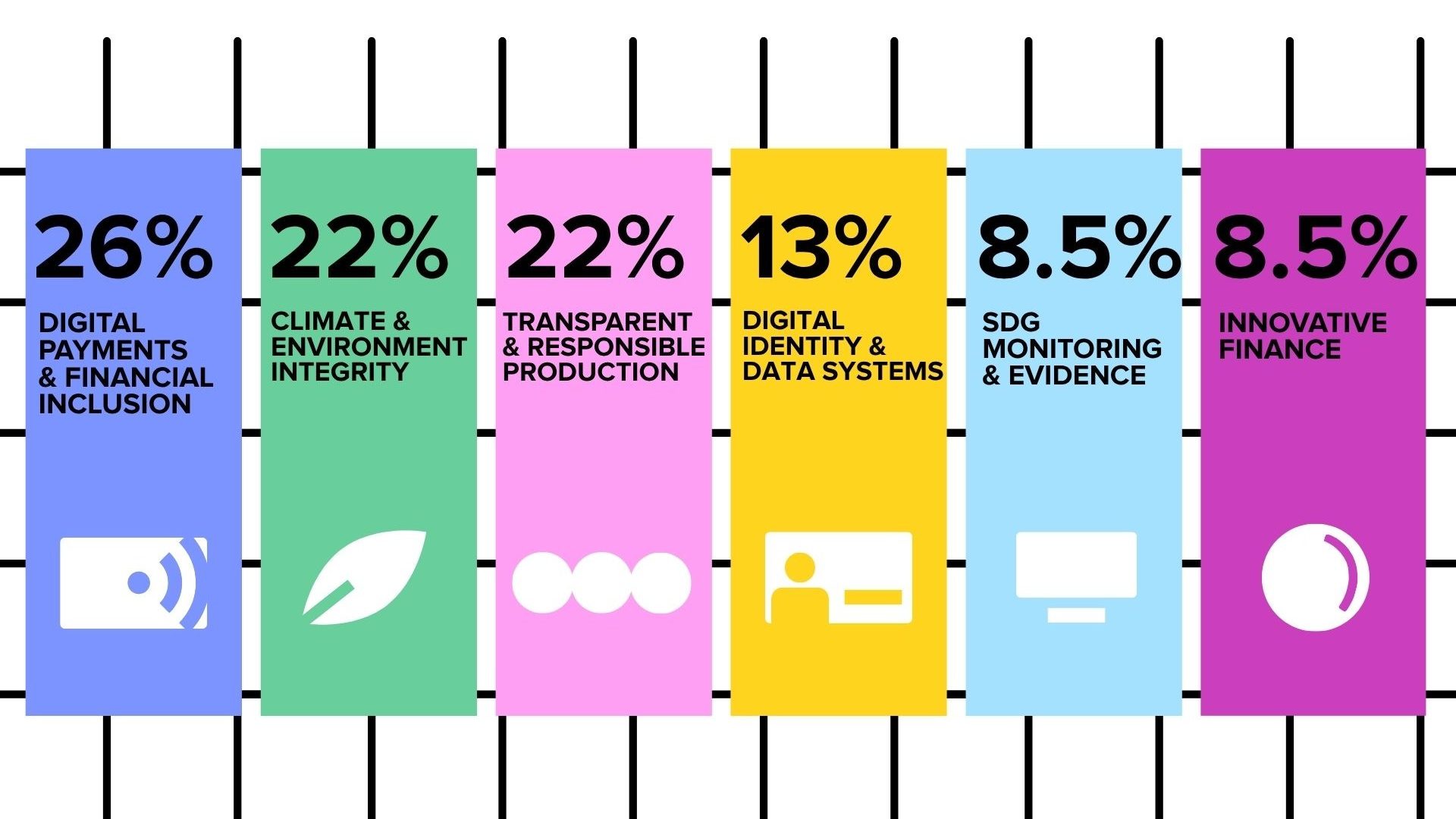
Digital payments and financial inclusion account for the largest share of solutions, followed by climate finance and environmental integrity, and transparent and responsible production. Together, these clusters make up the majority of the portfolio, pointing to areas where systems rely on trust, coordination, and shared data across multiple actors – and where existing approaches often struggle with fragmentation and limited transparency.
The portfolio spans a diverse set of solutions – from payment systems designed to improve last-mile delivery, to carbon registries that strengthen climate market integrity, supply chain platforms that enable traceability across production networks, and digital identity and credentialing tools for verifiable impact tracking.
For example, in contexts where financial systems rely on cash, manual processes, or fragmented infrastructure – as in Haiti and Syria – blockchain-based payment solutions are being designed to deliver funds directly to individuals. This reduces delays, improves traceability, and increases transparency in how resources are distributed. In one pilot, a government disbursement process that currently requires waiting up to six months for loan guarantee payments is being automated, helping small businesses – particularly women-led enterprises that are disproportionately affected by such delays – receive funds faster and more reliably.
Many of these are designed as components that can be integrated into broader public systems, strengthening core functions rather than operating in isolation.
From institutional readiness to public-sector engagement
Beyond solution development, the Accelerator is strengthening institutional readiness to engage with emerging technologies. For 82% of participating UNDP Country Offices, this was their first direct experience with blockchain or similar technologies. By the end of the programme, the share reporting high or very high understanding increased from 21% to 60%, indicating a clear progression from initial exposure to practical capability.
This growing readiness is reflected in how solutions are developed and adopted. UNDP Country Offices act as “challenge owners,” grounding each solution in national priorities and convening stakeholders around it. This ensures alignment with government strategies, regulatory environments, and operational realities from the outset.
Public-sector engagement is therefore built into the process. Government and public-sector entities are involved in 73% of solutions, with more than half engaging policymakers or regulators directly. This creates clearer pathways toward adoption, with solutions shaped in close interaction with the institutions expected to use them.
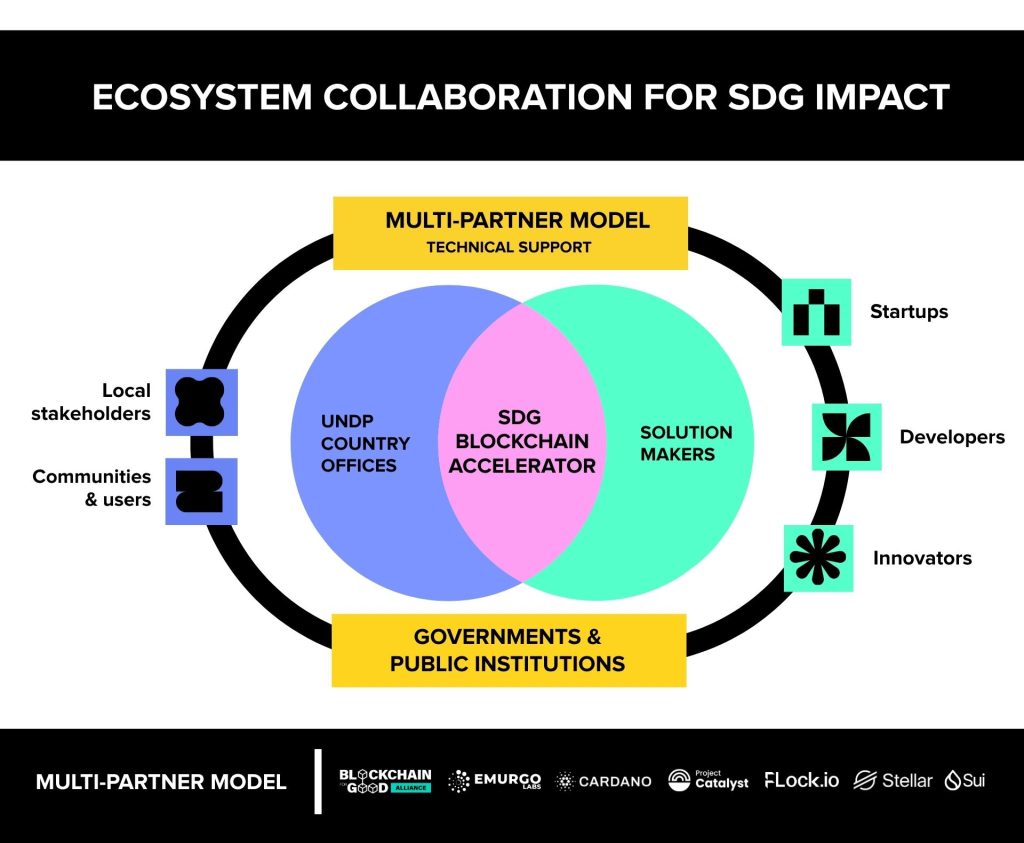
The model also expands the ecosystem around these efforts. More than 120 external partners contributed across the portfolio, with solution makers being able to work directly with public institutions – a connection that is often difficult to establish in practice. This strengthens the link between innovation and implementation environments.
Connecting to a broader blockchain practice
A selection of use cases and pilots developed through the Accelerator are featured in the newly released New Tech, New Partners publication, which brings together more than 40 blockchain applications across regions.
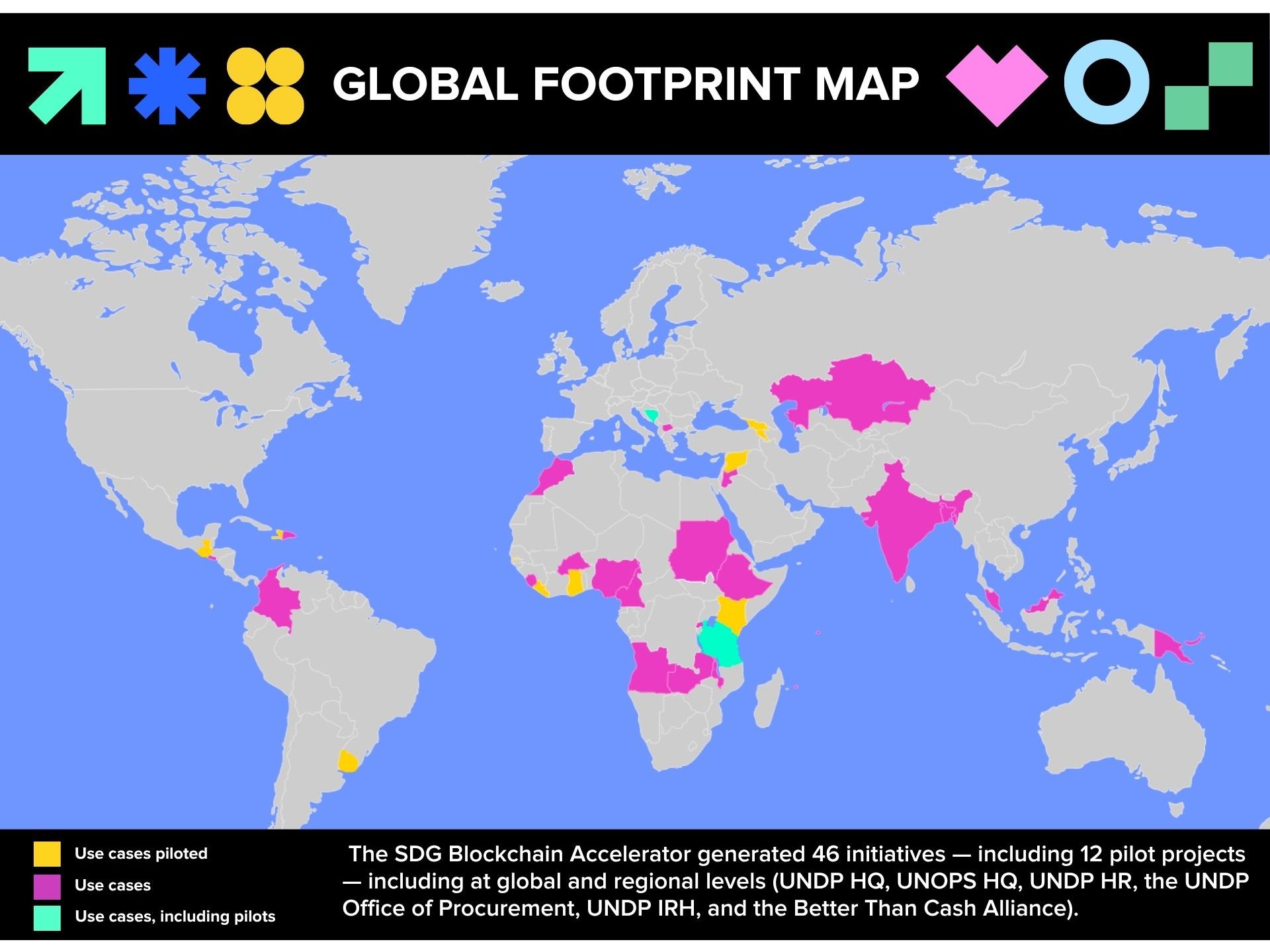
This report highlights the geographic spread and diversity of blockchain applications across development contexts. Across it, blockchain is increasingly used as a coordination and trust layer – supporting how data, payments, and decisions move across systems in more transparent and verifiable ways.
Together, these examples point to a growing body of practice around how blockchain can support digital public infrastructure and public-purpose systems in concrete, applied settings.
The remaining bottleneck: from pilot to scale
The main constraint is no longer whether these solutions work, but whether they can be sustained and scaled. Many are ready to move forward but lack the financing, partnerships, and operational support required to move beyond pilot stages. The challenge has shifted from designing viable solutions to ensuring they are taken up and maintained within public systems.
Building on these lessons, Cohort 3 of the Accelerator will aim to anchor each solution in an existing country programme or programmatic framework with at least one year of operational runway, and a clear implementation context. This shifts the centre of gravity from innovation showcase to institutional delivery: Country Offices and UN agency teams bring the development challenge and the programmatic home, Solution Makers bring production-ready technology, and the Accelerator provides the structure to connect the two. The opportunity now is to move from “proof that it works” to “proof that it scales”, embedding solutions within the programmes, partnerships, and budgets that already exist, so they can deliver tangible, sustained impact.
Stay tuned for our Cohort 3 open call!
The Accelerator is powered by catalytic funding from Cardano’s treasury via Project Catalyst, with support from other partners.
By the time a product or service reaches the end user, most of the difficult work has already been done elsewhere. Someone had to collect the right data and keep it attached to the right goods. Another person had to verify it and carry it through a chain involving tens of actors. Crucially, traceability only becomes relevant when records survive the chain itself – this was the real subject of the sixth UN Blockchain Talks.
This session was valuable because it remained grounded to that reality. Three industry leaders and practitioners — Sam Lambert of zenGate Global, Mark Kaplan of Wholechain, and André Vanyi-Robin of Plastiks — spoke about the conditions that make traceability work, or fail, once systems leave the slide deck and meet the field.
The session began with the challenging process of data capture in the upstream reality, then moved on to the middle of the chain, where records need to be transferred between different parties and systems. Later on, we moved on to plastic recovery, where weak records are becoming increasingly difficult to justify to auditors and regulators. By the end of the Talk, the audience had gained a more practical understanding of what trustworthy traceability actually demands than a general case for blockchain.
The first problem is rarely technical
Sam Lambert opened with a phrase that stayed with the rest of the session: “bush to boardroom.” His point was that the people setting the rules for compliance, risk and reporting are often far removed from the people expected to collect the first data.
In agricultural supply chains, for example, traceability often begins in places with poor connectivity and manual processes. These places also have limited training and strong local systems of trust that do not automatically align with the logic of a digital compliance framework. Sam put it bluntly: “Technology isn’t a silver bullet. In fact, I think it often just exposes where the issues are.”
He also made a point that deserves to be heard beyond this session: “We’re here to design systems around people.” This may sound obvious, but much of the traceability sector still operates in the opposite way. New systems are introduced and new reporting demands are added, placing the burden on communities that were not involved in the initial design process. Sam’s remarks brought the conversation back to the ground: consent, training, workable workflows, offline functionality and field conditions are all integral to the system.
Good records are not enough if they cannot move
Mark Kaplan continued the discussion at the point where products move beyond the first mile and enter a more crowded supply chain. Here, the focus shifts to whether that data can travel with the goods in a form that can be used by others.
Even if a supply chain has portals, dashboards, audits and QR codes, it may still fall short of real traceability if the records are not tied to actual lots and transformation events. Mark described Wholechain’s approach as event-based and grounded in GS1 standards, with records that remain linked to the movement of physical goods.
That is where his remarks on fatigue landed well. When Sam spoke about farmer fatigue, Mark added another phrase to the session: “Portal fatigue.” He used this term to describe the situation where people in the middle of the supply chain are forced to work across disconnected, non-interoperable proprietary systems. Traceability improves when data can be understood by different systems without losing meaning. This is why standards were so important in Mark’s discussion.
In waste recovery, weak proof is no longer enough
André Vanyi-Robin took the session into plastic recovery, where the pressure for stronger records is no longer theoretical. He stated clearly: “There is no traceable proof of recovery. The existing standard practice are spreadsheets, which obviously don’t survive the audits.”
He described a sector where data is fragmented among recyclers, producers, and regulators, and there is no shared connection strong enough to support compliance reporting. In that setting, blockchain technology is important because it provides a continuous record. It stores proof without exposing sensitive commercial data. As he explained, “You have verifiable proof of impact without exposing sensitive data.”
André also tied this back to everyday implementation. In his view, the answer is not to force companies into yet another cumbersome platform, but rather to integrate with existing ERP and product information systems, and “not force additional complexities at the level of verification”.
The stronger lesson sat between the talk
The value of the session came from how these three perspectives met. Sam dealt with first-mile reality and the human side of system design. Mark dealt with standards, interoperability and how records stay attached to goods. André dealt with compliance-grade proof and what happens once records carry legal and financial weight.
Seen together, the message was that blockchain becomes useful only when the rest of the system is already serious about data, process and trust.
Missed our talk? Watch the recording here.
You can also explore previous Blockchain Talks sessions in our YouTube Playlist.
Get involved
The UN Blockchain Community of Practice (CoP) works best when colleagues bring practical questions, field-tested lessons and cases that challenge easy assumptions.
For more details or suggestions, contact Ben Thompson Coon, UN Blockchain CoP Lead; ben.thompsoncoon@undp.org
During the fifth session of the UN Blockchain Talks series, the discussion moved beyond whether blockchain can support digital identity. A more useful examination was what kind of identity system would give people greater control over their data without making implementation harder for governments and service providers.
Hosted under the UN Blockchain Community of Practice, led by UNDP AltFinLab in collaboration with the UN Innovation Network, Blockchain Talks #5: Digital Identity, Privacy and Impact brought Aya Miyaguchi, President of the Ethereum Foundation, Jigme Tenzing, Secretary of GovTech Bhutan, and Peter Frandsen, Founding Partner of Partisia and the Partisia Foundation.
Together, they explored Bhutan’s national digital identity journey, the role of Ethereum in that architecture, and why privacy-enhancing technologies need to be part of the conversation if digital identity systems are to work in practice.
Bhutan’s starting point was privacy
Bhutan’s case stood out because the discussion began with a policy choice, not a technical one. As Jigme Tenzing explained, Bhutan’s move toward a decentralized, self-sovereign identity model was shaped by a concern many governments now face as they digitize services: efficiency can move faster than privacy protections when those protections are treated as secondary.
“In our hurry, we were kind of forgetting about privacy,” he said.
That concern pushed Bhutan away from the idea of a single centralized government database holding all citizen identity data. Instead, the country pursued a model in which verified information can be issued by the government, while remaining under the individual’s control.
In one of the clearest lines of the session, Tenzing described the shift this way: “The government functions more like a notary.” In other words, the role of government changes from holding and managing data to validating credentials that citizens can then use with explicit consent. That distinction gave the discussion real weight.
Why Ethereum fit Bhutan’s model
Aya Miyaguchi placed Bhutan’s approach within a broader set of design values that the Ethereum ecosystem seeks to protect: decentralization, open-source development, privacy, security, and resilience.
Bhutan’s digital identity system was not presented as an imported product, but as national infrastructure developed with external support and strong local ownership. “We are a supporter, not a builder,” Aya said, describing the Ethereum Foundation’s role in Bhutan’s process.
She also noted that Bhutan has become the first country to anchor national digital identity on Ethereum at national scale, with the current system supporting more than 30 government services.
Privacy cannot be solved by blockchain alone
If Bhutan’s case showed why decentralization and user control matter, Partisia’s contribution in the session clarified why privacy still needs additional tools. Peter Frandsen focused on Multi-Party Computation (MPC) and the role it can play alongside blockchain in identity systems.
“Everything on the blockchain is public, and everything in MPC is private.”
That line by Frandsen helped cut through a common confusion in digital identity discussions. Blockchain can provide integrity, immutability, and a shared trust layer. But when systems need to verify something sensitive without exposing the underlying data, privacy-enhancing technologies become essential.
Frandsen illustrated this through concrete examples. In one case, a person can prove they are allowed to access a building or collect a parcel without disclosing unnecessary personal information. The system confirms the right to act, rather than forcing the user to reveal more data than the transaction actually requires.
What this session clarified
Blockchain Talks #5 made clear that digital identity decisions are also decisions about trust, data control, legal readiness, and public understanding. Bhutan’s case made that visible. Ethereum’s role clarified the infrastructure logic behind it. Partisia’s contribution showed why privacy needs to be designed at the computational level, not simply promised at the policy level.
The session also served as a useful reminder that the hardest part of digital identity is rarely the interface. What matters most are the governance choices and technical architecture underneath.
Missed our talk? Watch the recording here.
You can also explore previous Blockchain Talks sessions in our YouTube Playlist.
Get involved
The UN Blockchain Community of Practice (CoP) works best when colleagues bring real examples, practical questions
For more details or suggestions, contact:
Ben Thompson Coon, UN Blockchain CoP Lead
ben.thompsoncoon@undp.org
Lisbon, 18 March 2026 – Goparity, a Portuguese impact investment platform, has collaborated with AltFinLab, a flagship United Nations Development Programme (UNDP) initiative, pioneering alternative and innovative finance solutions, to further develop and refine impact measurement approaches within the crowdlending sector.
As regulatory scrutiny and public expectations around ESG and impact claims continue to increase – including evolving guidance from the European Securities and Markets Authority – actors across the sustainable finance ecosystem are working to strengthen transparency, clarity and methodological consistency in impact reporting.
Through this collaboration, Goparity led a process to review and further strengthen elements of its impact management framework, with technical advisory support and mentorship from UNDP AltFinLab. The engagement focused on aligning long-term impact objectives with measurable indicators, reviewing project categorization methodologies, and enhancing internal data collection and management processes.
The work was structured in phases. It began with an assessment of the coherence between strategic impact objectives and existing monitoring practices. This was followed by updates to project categories and related indicators, resulting in a structured set of outcome and impact indicators contributing directly to relevant Sustainable Development Goals (SDGs). The final phase explored improvements to data management systems and processes to support consistent implementation and future scalability.
“As sustainable finance continues to evolve, strengthening transparency, accountability and methodological clarity becomes increasingly important,” said Teodor Petricevic, Accelerator Lead, UNDP AltFinLab. “Through AltFinLab, we support ecosystem actors so they can refine impact measurement approaches that align financial innovation with broader sustainable development objectives.”
“Impact cannot rely on intention alone, as it must be measurable, comparable and credible. This collaboration is an important step for Goparity, as it allows us to reinforce the methodological foundations of our impact framework and ensure that our growth is matched by equally robust impact standards,” says Iara Comunello Martins, Impact Manager and leader of this project at Goparity.
Following the UN’s 2025 International Conference on Financing for Development, where global leaders called for the creation of innovative financing schemes for development and the adoption of standards and terminology to facilitate measurement and comparable results, Goparity seeks to raise the bar in the crowdfunding sector. Through this partnership, it will outline standards in impact management, integrating indicators and benchmarks recommended by the international community – a clear position against “impact washing”.
In parallel, Goparity contributed to broader ecosystem knowledge exchange through initiatives such as the UNDP Crowdfunding Academy and BOOST, UNDP’s regional impact acceleration programme in Europe and Central Asia, sharing practical insights on crowdfunding and crowdlending models, financial and risk analysis, and regulatory considerations relevant to impact-driven organizations. The collaboration reflects ongoing efforts within the alternative finance sector to strengthen impact measurement practices and promote responsible innovation.
This collaboration does not constitute endorsement by UNDP of any specific platform, product or financial instrument.
About Goparity
Founded in 2017, Goparity’s main mission is to democratise access to sustainable finance by connecting companies and individuals who want to invest in projects with a positive impact on people and the planet. Since its inception, the platform’s more than 59,000 users have financed over 420 impact projects — aligned with the United Nations Sustainable Development Goals — across three continents, totalling more than €55 million invested. The projects financed have positively supported over 100,000 people, created more than 4,000 jobs, and help avoid the emission of over 30,000 tonnes of CO₂ into the atmosphere every year.
Blockchain work across the UN system has grown steadily, but not always in a coordinated manner. Some teams are piloting real solutions; others are still assessing whether the technology fits their operational reality. This creates momentum, but also fragmentation; lessons sit in separate corners, and colleagues often struggle to find the right use case, the right focal point, or the right evidence at the right time.
Between existing blockchain projects and use cases across the United Nations, the UN Blockchain Talks add the missing layer: a regular space to compare approaches and learn from cases that have faced real operating constraints. The series continues in 2026 with a monthly rhythm as topic-specific sessions designed to stay practical and collaborative.
Timeline and topics of upcoming UN Blockchain Talks:
- 12 March 2026 | Digital Identity → Watch the recording
National-scale digital identity on public blockchains - 9 April 2026 | Supply Chain → Watch the recording
Supply chains traceability and implementation - 23 April 2026 | Blockchain for Climate → Watch the recording
Environmental sustainability and blockchain: Where does it actually help? - 5 May 2026 | Digital Payments → Watch the recording
Money’s New Rails: Stablecoins and the last mile of financial inclusion - 11 June 2026 | AI on Blockchain → Watch the recording
AI Agents, federated learning and on-Chain alignment
Each talk is followed by shared materials and a lightweight prompt for participants to share interests and propose ideas to move beyond the talks into peer support, working groups and practical collaboration.
The UN Blockchain Community of Practice
Blockchain projects across UN agencies and regions tend to face the same early hurdles, such as finding the right partners, navigating governance and risk issues, or demonstrating that the approach improves delivery in real operating conditions. And when teams work in isolation, lessons travel slowly, and the same design mistakes repeat.
That’s why the UN Blockchain Community of Practice (CoP), hosted under the UN Innovation Network (UNIN) and managed by UNDP’s Alternative Finance Lab (AltFinLab), brings this work into one shared space with a focus on practical knowledge sharing – a regular learning series, a live repository of initiatives, and pathways that keep the work moving beyond the Talks.
COs, UN Agencies working in isolation/silos, the CoP creates a shared space where colleagues can find real examples, learn from what has already been tested, and connect with the right people. Through the Core Group, the live repository, and the Blockchain Talks and other activities, the CoP reduces duplication, helps avoid common mistakes, and improves the quality of new initiatives.
Journey and momentum
Since early 2025, the CoP has relaunched its learning cadence through the Blockchain Talks series, with the first set of sessions focusing on building a shared foundation while staying grounded in real implementation. Each talk was designed to be useful for both newcomers and practitioners, and featured expert speakers from across the UN system and external technical partners.
Those early sessions helped reset the community around a practical baseline: what kinds of problems blockchain has been used for inside the UN ecosystem, what enabling conditions matter (policy, partners, user adoption, and operational constraints), and what colleagues should ask before they commit time and resources to a pilot.
A living repository of UN blockchain initiatives
Aiming to build a reliable knowledge base of what has been tried, where, by whom, and for what purpose, a major workstream behind the CoP was building a live repository of UN blockchain initiatives that can serve as a working reference point. As part of this wider effort, 150+ blockchain-related initiatives were mapped across the UN ecosystem.
In parallel, 80+ cases were validated directly with project focal points (to correct details, add context, and confirm status), building toward a repository that is usable as a working tool for programme teams, innovation units, procurement colleagues, and policy teams alike.
What becomes easier
- Colleagues can quickly find relevant use cases instead of starting from scratch.
- Teams can identify who to contact and what supporting materials exist.
- Early design can improve when teams can see what others learned about governance, risk, and delivery constraints.
- Templates, partner models, and implementation patterns can travel across agencies more easily.
The repository also helps the community see patterns. Over time, it becomes a live tool that makes it easier to spot clusters of work in areas where the UN is already active, such as payments and financial inclusion, supply chain traceability, digital identity, climate-related applications, and new governance or fundraising models.
Get involved
What makes this CoP work is the people who show up with real examples and honest questions. If you are attending a Talk, your input is what makes it valuable. Registration links will be shared through the CoP space and mailing list.
For more details or suggestions, contact: Ben Thompson Coon, UN Blockchain CoP Lead