
Category: Digital transformation and emerging tech
The United Nations Development Programme (UNDP) and IEEE Humanitarian Technologies, part of the Institute of Electrical and Electronics Engineers (IEEE), are inviting teams of technologists and innovators worldwide to help three cities in Europe and Central Asia improve public transport planning, support energy efficiency investments and protect green spaces.
The GenAI for Good Challenge: Cities Edition will connect teams with municipal governments to co-develop and test responsible, open-source generative artificial intelligence (GenAI) solutions. Applications close on 13 December 2026.
Municipalities face complex challenges with limited resources. AI offers new possibilities, but many cities lack the staff, reliable data and technical expertise to identify where it can help and how to use it responsibly. The Challenge brings innovators and municipal teams together, with funding and expert support to turn ideas into prototypes and test them in practice.
Three cities, three challenges
Teams will develop solutions for urban challenges shaped by the green and digital transition:
- Pristina, Kosovo[1]: improving public transport planning. Develop a multilingual generative AI assistant to help municipal planners identify service gaps, improve connectivity and plan routes that respond to the city’s rapid urban growth.
- Rivne, Ukraine: supporting energy efficiency investments. Build an assistant that uses a building profile to guide users through cost estimates and financing options, and generate a shareable report to support investment decisions.
- Skopje, North Macedonia: safeguarding green infrastructure. Develop a solution that connects scattered records with the city’s digital Green Cadastre to inform decisions about urban green spaces.
The three cities were selected through CEF × AI, UNDP’s programme in Europe and Central Asia supporting municipalities to test, adopt and govern AI.
Support to build, test and deploy
The Challenge offers a structured pathway from an open call through a use case sprint, prototype development and piloting.
Nine teams selected for prototyping will receive US$10,000, with up to US$30,000 in additional funding for those chosen to pilot their solutions with a city. Participants will collaborate directly with city stakeholders, supported by technical mentorship from IEEE’s global network of engineers and experts, and UNDP’s development and public-sector expertise.
The initiative draws on UNDP’s City Experiment Fund (CEF), which works with cities across Europe and Central Asia to tackle complex urban challenges through strategic innovation, and BOOST, its regional impact acceleration programme supporting innovators. Up to three solutions will advance to city pilots, with open-source code and documentation to support municipal use and enable other cities to adapt and reuse them.
Part of a wider collaboration on responsible AI
The Challenge is one of the first initiatives under a wider collaboration between UNDP and IEEE Humanitarian Technologies on responsible, inclusive and human-centred approaches to digital transformation and AI. Beyond the Challenge, UNDP and IEEE will also explore cooperation on policy dialogue, capacity-building and institutional readiness for the responsible adoption, governance and use of digital technologies and AI. Areas of cooperation include technical cooperation and peer learning; engagement with technical experts, professional networks, academia, industry and civil society; and joint consultations, publications, learning products and knowledge exchange.
How to apply
Applications close on 13 December 2026. Teams must complete all required application components, including a technical assessment and a narrative proposal.
Explore the city challenges, eligibility requirements, upcoming Q&A sessions and apply: https://bit.ly/47XulHK
The CEF and BOOST are funded by the Ministry of Finance of the Slovak Republic through the Slovak Transformation Fund.
[1] References to Kosovo shall be understood to be in the context of United Nations Security Council resolution 1244 (1999).
The United Nations Development Programme (UNDP) has launched AI Foundations for Municipalities, a self-paced online course open to municipal staff and public servants worldwide, regardless of their role, technical background or prior knowledge of artificial intelligence (AI).
Artificial intelligence is rapidly changing how cities deliver services, engage residents, manage data and make decisions. For local governments, engaging with AI requires understanding where it can add value, what risks it may introduce, and what capabilities and safeguards need to be in place.
The course provides a practical starting point for municipal teams to responsibly navigate these questions and make informed decisions grounded in local needs.
A practical foundation for public servants
Designed for staff across municipal functions – from planning and service delivery to procurement, communications and institutional oversight – the course explores the different roles municipalities play as users, enablers, governors and shapers of AI.
Participants will examine:
- Where AI can support municipal work and where it may introduce risks or unintended consequences.
- What data, governance and organizational conditions are needed for responsible use.
- What responsibilities public institutions carry when using or overseeing AI systems.
Through practical city examples, explanatory content, reflections and interactive exercises, participants will build a shared understanding of AI and its implications for their work.
From regional experience to a global learning resource
The course is a global learning resource developed by UNDP in collaboration with the City of Bratislava and experts in AI, governance and urban transformation. It builds on insights from UNDP’s work with municipalities in Europe and Central Asia through the City Experiment Fund (CEF) and the EU-funded Mayors for Economic Growth (M4EG), where a need emerged to help municipal teams understand AI before pursuing specific tools or investments. Contributions from UNDP’s Local Action Team brought additional perspectives and city examples from around the world, making the learning relevant across different municipal contexts.
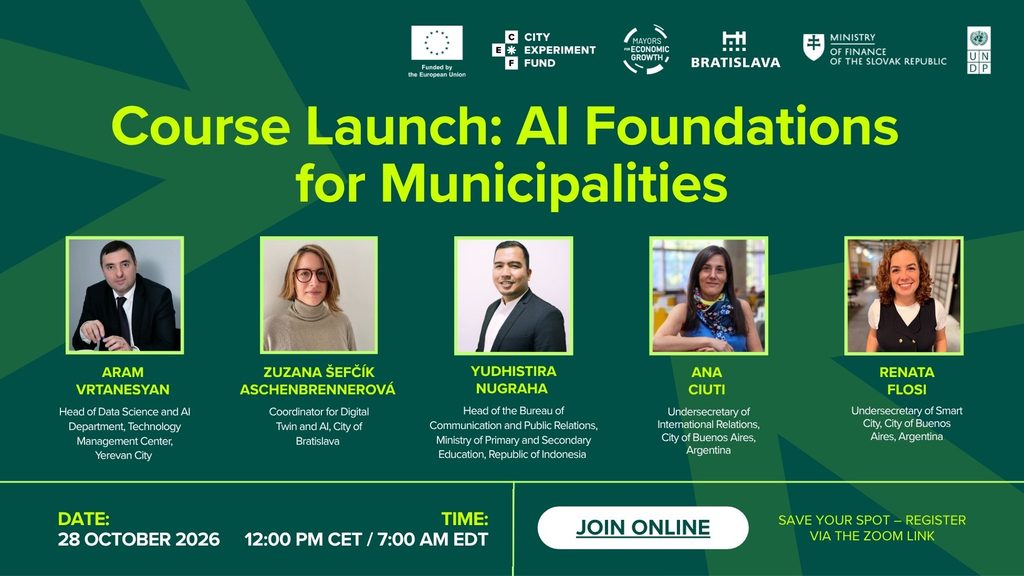
Launched on 28 October 2026 during Urban October, the course was introduced through a webinar featuring perspectives from Bratislava, Jakarta, Yerevan and Buenos Aires. City representatives and practitioners shared experiences of AI adoption, discussing practical opportunities, challenges and the capabilities and safeguards municipalities need to engage with AI responsibly. Watch the recording from the launch webinar.
Access the course
AI Foundations for Municipalities is publicly available through UNDP’s Urban Learning Center, a learning platform for municipalities developed by M4EG. The course takes approximately 4–6 hours to complete and can be followed at each participant’s own pace.
The course was developed with support from UNDP’s City Experiment Fund, which helps cities across Europe and Central Asia address complex urban challenges through strategic innovation and experimentation, with funding from the Ministry of Finance of the Slovak Republic; and Mayors for Economic Growth, an EU-funded initiative implemented by UNDP that supports local authorities in advancing inclusive and sustainable economic development.
Istanbul, Lugano, 26 October 2026 — The United Nations Development Programme (UNDP), through its Alternative Finance Lab (AltFinLab), and the Exponential Science Foundation (ESF) have launched the Government Blockchain Academy in El Salvador, the Dominican Republic and Argentina. Public officials in all three countries have begun the Academy’s learning programme, designed to strengthen their ability to assess where blockchain and other emerging technologies could address institutional needs and improve public services.
Building on the partnership announced in 2025, more than 1,600 public officials from over 130 institutions have now joined the Academy across its first three country programmes, with more countries expected to follow. The launches also convened senior government representatives and UNDP leadership, showing strong institutional commitment to the initiative.
Country launches and national priorities
In El Salvador, more than 300 public officials are participating in a programme that builds on the country’s Digital Readiness Assessment and ongoing work on digital inclusion and emerging technologies. At the country launch, UNDP El Salvador’s Resident Representative Jairo Acuña-Alfaro joined senior institutional representatives in person, while other participants connected online. The in-person panel included Fernando Velasco, National Registrar and Executive Director of the National Registry of Natural Persons (RNPN); Alexander Gil, Director of the National Solid Waste Authority (ANDRES); and Karla Majano de Palma, Director of the El Salvador Agency for International Cooperation (ESCO).
More than 120 public officials from a range of institutions have joined the Academy in Argentina to build a shared understanding of blockchain and explore its relevance to public-sector priorities. The launch opened with remarks from Carlos Arboleda, Deputy Resident Representative of UNDP Argentina, who stressed that emerging technologies should not be adopted for their own sake, but explored responsibly where they can strengthen public institutions and help them respond to people’s needs with better services.
In the Dominican Republic, the Ministry of Public Administration has played a central role in bringing nearly 1200 public officials into the programme, with institutions ranging from the Ministry of Public Administration and the Ministry of Environment and Natural Resources to the Ministry of the Presidency and the Ministry of Justice. During the launch, Armando Manzueta, Vice-Minister of Innovation and Technology at the Ministry of Public Administration, stressed the importance of identifying public-sector needs before choosing technologies to address them.
Learning and practical applications
Each programme will run for two to three months, combining self-paced online learning with live sessions led by international experts and discussions of practical government use cases. Officials have already begun the online modules, with schedules tailored to participants in each country. The curriculum covers issues such as digital identity, digital payments and financial inclusion, governance, supply chains and climate resilience. Participants will also examine the potential relevance of artificial intelligence and other emerging technologies, alongside considerations of privacy, security and compatibility with existing public systems.
The programme aims to equip government teams with the knowledge to assess whether blockchain is appropriate for a particular challenge, including when another approach may be better suited. For participating officials, use-case discussions and solution facilitation will provide opportunities to define institutional challenges more precisely and examine potential applications to explore pathways for future pilots.
“Government teams need the skills and confidence to drive public-sector innovation and weigh different technologies against the challenges they face. Through the Academy, officials learn from relevant blockchain applications, assessing where the technology could create public value and understanding what responsible use would require,” said Burcu Mavis, Government Blockchain Academy Lead, UNDP AltFinLab.
“Preparing governments for the next era of digital transformation requires more than technology; it requires a fundamental investment in knowledge, expertise, and human potential,” said Prof. Paolo Tasca, President of the Exponential Science Foundation. “In alignment with ESF’s purpose of advancing research and education for the public good, our partnership with UNDP AltFinLab brings together world-class expertise and practical learning to help governments harness emerging technologies for institutional progress and societal benefit.”
UNDP works with countries to align the Academy’s learning programme with national priorities and existing public service needs, while ESF contributes expertise in research, curriculum development and education. The Academy also draws on AltFinLab’s experience with the UNDP Blockchain Academy and SDG Blockchain Accelerator, connecting foundational learning with opportunities to explore practical applications.
About UNDP
The United Nations Development Programme (UNDP) is the leading United Nations organization fighting to end the injustice of poverty, inequality and climate change. Working with a broad network of experts and partners in 170 countries, UNDP helps nations build integrated, lasting solutions for people and the planet. UNDP AltFinLab is a global initiative that connects innovation, alternative finance and emerging technologies to explore, test and scale new approaches for sustainable development.
About the Exponential Science Foundation
The Exponential Science Foundation (ESF) is a Swiss-based global nonprofit organization led by academic leaders Prof. Paolo Tasca and Prof. Nikhil Vadgama. Through research, education and open-source innovation, ESF advances the responsible adoption of blockchain, artificial intelligence and other emerging digital technologies across business and society. Working with governments, academia, international organisations and industry, the Foundation builds the knowledge, skills and partnerships needed to translate scientific advances into practical solutions for public benefit.
GrantsFund4Aid, an on-chain grant management platform developed by Innofund, has concluded a pilot testing how blockchain technology can support more transparent, traceable and efficient grant management. It successfully disbursed test grants to ten teams participating in a United Nations Development Programme (UNDP) global initiative, the SDG Blockchain Accelerator, that helps develop and scale practical solutions powered by emerging tech to advance the SDGs.
The pilot explored the potential of on-chain grant management to increase visibility over funding flows, strengthen accountability and reduce some of the administrative burden associated with traditional grant processes among international organizations.
Test pilot grants were successfully disbursed to ten participating teams under the EMURGO track of the Accelerator led by UNDP Alternative Finance Lab (AltFinLab), which connects emerging tech, innovation and finance, to explore, test and scale new approaches for sustainable development.
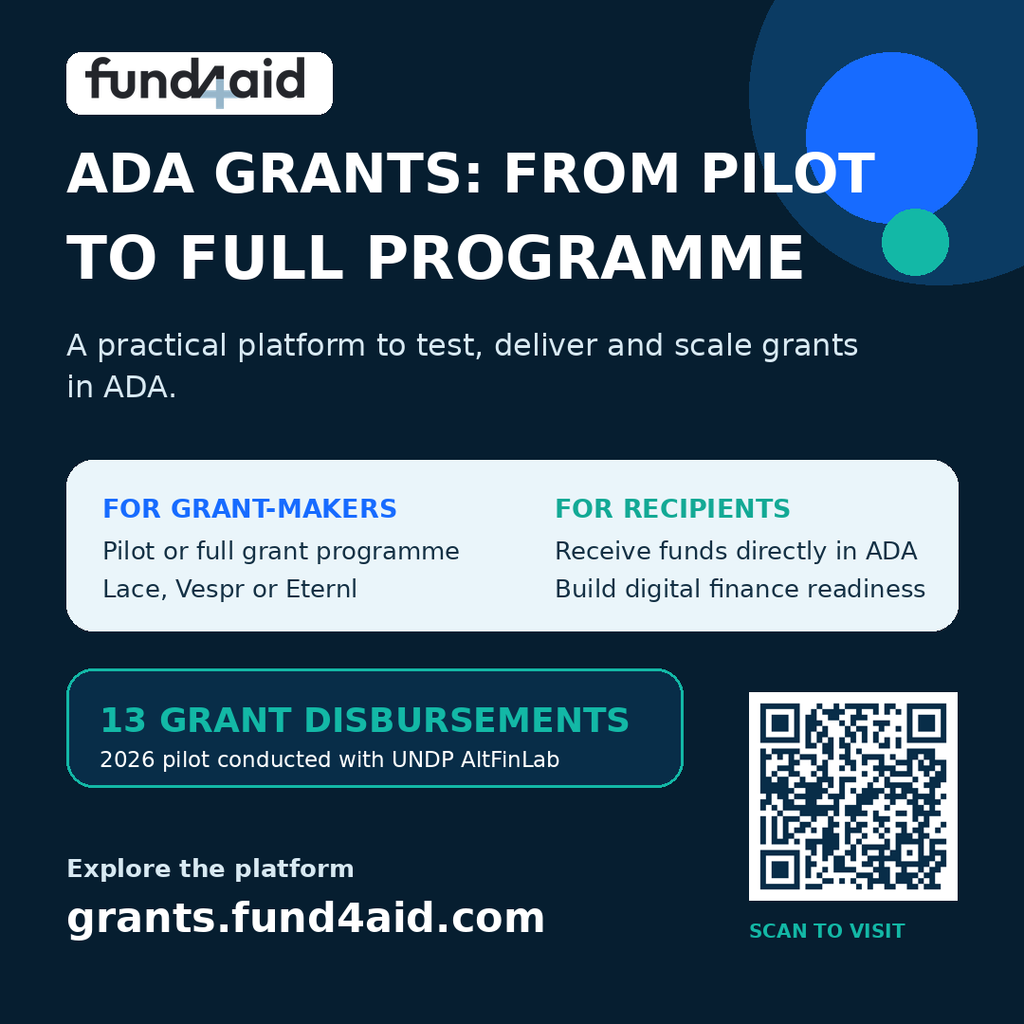
“We were interested in testing whether an on-chain grant management platform could make grants to civil society organizations (CSOs) and solution makers in the SDG Blockchain Accelerator more transparent, efficient and easier to track,” said Teodor Petricevic, Accelerator Lead, UNDP AltFinLab. “The objective was to test whether blockchain could provide better traceability and accountability while simplifying the overall grant management process.”
Alongside the grant disbursements, feedback was also gathered from UNDP AltFinLab teams and participating organizations to assess the pilot and help strengthen the next stage of the GrantsFund4Aid MVP.
The feedback provided encouraging early indications of support for the approach. All surveyed UNDP respondents said they would share their experience with colleagues and encourage others to try GrantsFund4Aid, while all surveyed participating organizations said they would use the platform to apply for grants again and share their experience with peers.
Feedback also identified priorities for the platform’s next phase, including simpler onboarding, improved wallet integration, grant tracking and notifications, and easier fiat off-ramping. Participants also highlighted the potential to connect CSOs with a wider range of funders.
“The platform could evolve beyond grant management into more of a matchmaking platform, connecting CSOs looking for funding with grant givers looking for relevant projects and partners,” added Petricevic.
The findings from the pilot will now inform the next stage of development of GrantsFund4Aid, with a focus on improving the user experience and exploring how on-chain technology can help connect funders, CSOs and solution makers through more transparent and traceable funding mechanisms.
Photo credit: Shubham Dhage / Unsplash
The United Nations Development programme (UNDP) and Blockchain for Good Alliance (BGA), the global non-profit initiative founded by Bybit, dedicated to leveraging blockchain for societal impact, have signed an agreement to launch a two-year programme to strengthen cybersecurity knowledge and capacity for the responsible use of digital technologies in development.
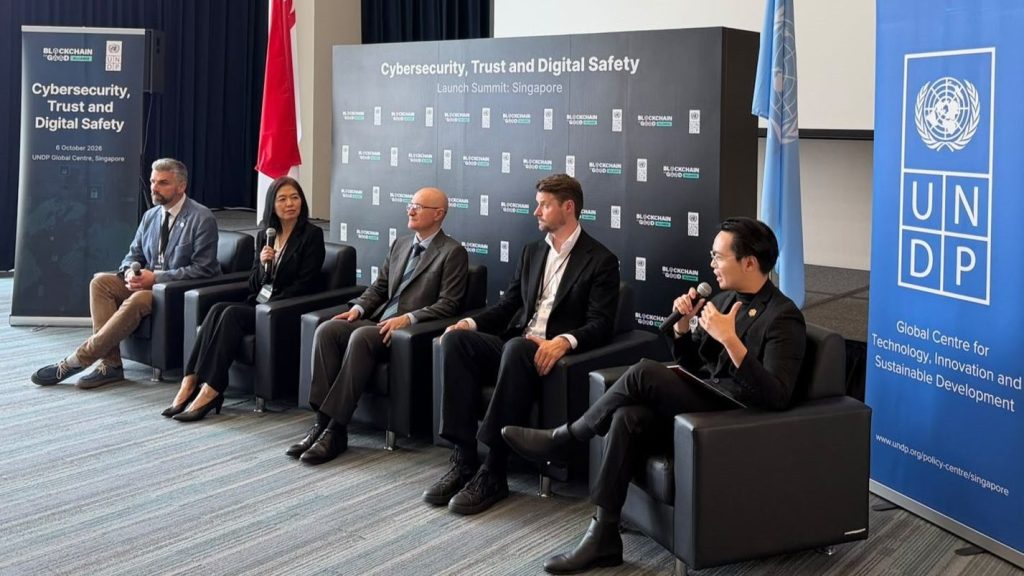
The agreement was signed by Edward Vrkić, UNDP’s Resident Representative to Malaysia, Singapore and Brunei Darussalam, and Helen Liu, Founder of BGA at the Cybersecurity, Trust and Digital Safety Launch Summit in Singapore. The signing was followed by a panel discussion on securing digital trust and the role of public-private partnerships in strengthening cybersecurity.
“The governments we support are facing growing and increasingly complex cybersecurity challenges, driven by ongoing conflicts, AI-enabled fraud, and more sophisticated cyberattacks,” said Robert Pasicko, UNDP Alternative Finance Lab (AltFinLab) Team Lead. “Strengthening cybersecurity capacities and building resilient, trusted digital systems are essential to addressing these risks. We welcome the opportunity to deepen our collaboration with the BGA, drawing on its expertise and experience.”
A critical time for collaboration
As public institutions rely more on digital systems, including blockchain technology, cybersecurity is critical to protecting services, public funds and trust. Rapid advances in artificial intelligence are making cyber threats more sophisticated and systems more complex. The partnership will help public institutions strengthen the technical, governance and response capabilities needed to manage cyber risks and safeguard essential public services.
The programme will be implemented by UNDP’s AltFinLab in collaboration with BGA. Over two years, it will draw on the cybersecurity expertise of BGA’s global ecosystem to provide hands-on learning and advisory support. Capacity-building activities will be delivered through three channels: the SDG Blockchain Accelerator, which supports emerging technology solutions for the Sustainable Development Goals; the Government Blockchain Academy for public officials; and dedicated training sessions for UNDP Country Offices and government partners. The programme will focus on topics such as data protection, secure digital payments and the security of public digital services.
“Prevention, response and recovery are the three pillars of cybersecurity, and public institutions need all three,” said Glenn Tan, Director of Global Affairs at the Blockchain for Good Alliance. “The private sector holds much of the expertise across these areas, yet public institutions and international organizations with pressing needs often lack direct channels to access it and collaborate. This partnership opens that door.”
The partnership builds on BGA’s role as Strategic Partner of the UNDP SDG Blockchain Accelerator, now entering its third cohort, and its participation in the Blockchain Advisory Group (BAG). Convened by UNDP, BAG brings together ecosystem leaders to explore how blockchain can contribute to sustainable development and strengthen digital public systems.
NEW YORK — [September 25, 2026] — Circle Foundation, a philanthropic initiative supported by Circle Internet Group, Inc.’s (NYSE: CRCL) 1% equity commitment, the United Nations Development Programme (UNDP) and the World Food Programme (WFP), today announced two initiatives to improve digital payments for development and humanitarian action.
The initiatives will explore how digital payments and improved digital financial infrastructure can help international organizations move resources, deliver support more efficiently and advance financial resilience and inclusion.
“Around the world, the need for humanitarian aid keeps growing while the resources to meet it are stretched thinner than ever,” said Elisabeth Carpenter, Chief Strategic Engagement Officer, Circle, and Founding Chair, Circle Foundation. “If we can help humanitarian and development institutions move value faster, more transparently, and at lower cost, we can ensure more of every aid dollar actually reaches the people who need it. Circle Foundation’s support for UNDP and WFP is about strengthening the shared infrastructure powering these organizations so that life-saving and life-sustaining aid reaches people in crisis faster, without the delays and costs of outdated systems.”
Enabling UNDP to move from pilots to programme delivery
Circle Foundation’s grant will enable UNDP to establish and operate the Digital Asset Innovation Pool, a new mechanism designed for the responsible use of digital assets via regulated payment stablecoins in development programmes to accelerate delivery.
The work builds on digital payment solutions piloted through UNDP’s Sustainable Development Goals (SDG) Blockchain Accelerator, a global initiative led by the Alternative Finance Lab that develops and scales practical solutions using blockchain, AI and other emerging technologies to advance the SDGs. The pilots tested digital Cash-for-Work payments in Aleppo, Syria; disbursements designed for low-connectivity conditions in Haiti; a remittance-linked community investment model in Guatemala; and mobile wallets connected to existing cash-agent networks in The Gambia. The Digital Asset Innovation Pool will build on these lessons by helping Country Offices move from individual pilots to regular programme delivery, with structured implementation support, regulatory and operational guidance, beneficiary safeguards, and tools to track delivery time, cost and reach.
“Getting resources to people should not be the most difficult or expensive part of delivering a programme. The Digital Asset Innovation Pool will support UNDP in using digital payments responsibly to make last-mile programme payments faster, more affordable and easier to access – especially for people underserved by conventional banking. We want to make sure more of every dollar reaches the people and communities it is meant to support,” said Robert Pasicko, Team Lead, UNDP Alternative Finance Lab.
The Pool is not intended to replace established banking channels. It will provide an additional option for contexts in which conventional payment systems create significant costs, delays or barriers to access.
Supporting WFP’s shared humanitarian payment infrastructure
A separate grant from Circle Foundation to World Food Program USA will support WFP and the WFP Innovation Accelerator in building the institutional infrastructure needed to deploy and scale regulated, stablecoin-enabled payments.
The funding will support the underlying systems that make stablecoin adoption sustainable: governance and risk frameworks, treasury and reconciliation systems, and compliance tools built to hold up across multiple country operations. It will also fund local fintech and mobile money integration, along with independent, sector-wide research on cost, speed and operational feasibility – giving the broader humanitarian sector its first real benchmarks on stablecoin-enabled payments.
Over the next three years, WFP will test two to three country corridors connecting WFP payments with local financial providers and markets, generating evidence on efficiency, transparency and resilience for WFP and the wider humanitarian sector.
“Digital payments have the potential to make humanitarian assistance faster, more efficient, and more resilient, while also fostering greater financial inclusion for the people we serve. Circle Foundation’s support enables us to explore regulated stablecoin-enabled payment solutions in real-world contexts and build the evidence, partnerships, and infrastructure needed to scale responsibly,” said Bernhard Kowatsch, Director, WFP Global Accelerator and Ventures.
The new contributions expand Circle Foundation’s support for digital financial infrastructure across the UN system. In 2021, the Digital Hub of Treasury Solutions (DHoTS) was launched by UNHCR as a shared platform to modernize financial infrastructure across the UN system, bringing together 15 participating organizations, including UNDP and WFP. In January 2026, Circle Foundation announced its first international grant in support of DHoTS to streamline financial transfers, reduce costs and improve transparency.
About Circle Foundation
Established by Circle Internet Group in 2025, Circle Foundation is a donor-advised fund managed by Fidelity Charitable. It advances financial resilience and inclusion through strategic grantmaking and systems-level investments. Seeded by Circle’s Pledge 1% equity commitment, the Foundation directs financial resources and expertise toward creating lasting economic impact.
About the United Nations Development Programme
UNDP is the leading United Nations organisation fighting to end the injustice of poverty, inequality and climate change. Working with our broad network of experts and partners in 170 countries, we help nations to build integrated, lasting solutions for people and the planet. UNDP Alternative Finance Lab is a UNDP initiative that connects finance, innovation, and emerging technologies to explore, test, and scale new approaches for sustainable development.
About the World Food Program USA and the WFP Innovation Accelerator
World Food Program USA, World Food Program USA, a 501(c)(3) organization based in Washington, D.C., proudly supports the mission of the World Food Programme (WFP) by mobilizing American policymakers, businesses and individuals to advance the global movement to end hunger. The WFP Innovation Accelerator was launched by WFP in 2015 to source, implement and scale high-impact innovations. From its base in Munich, Germany, the WFP Innovation Accelerator has grown to become one of the world’s leading social impact startup accelerators. In 2025, the WFP Innovation Accelerator ran 14 programmes addressing a wide range of social impact and sustainability issues. Its portfolio, comprising over 85 innovations and 29 alumni projects, reached 132.5 million individuals across 75 countries and territories. In total, WFP Innovation Accelerator supported ventures have catalysed over USD 383 million in funding since 2015.
New York, Istanbul, Zurich, 25 August — The United Nations Development Programme (UNDP) and the DFINITY Foundation today announced a new partnership to explore the deployment of sovereign cloud infrastructure and decentralized artificial intelligence to support public-purpose digital transformation across governments, civil society organizations, and UNDP initiatives.
Initial activities will span three complementary workstreams in partnership with UNDP Alternative Finance Lab (AltFinLab), a global initiative connecting finance, innovation, and emerging technologies to explore, test, and scale new approaches for sustainable development. They include supporting UNDP Country Offices through the SDG Blockchain Accelerator to pilot sovereign cloud, AI-enabled software development and decentralized AI applications that address specific development and programme challenges; supporting civil society organizations through UNDP’s Future of Work Academy to build their capacity and test their own applications; and working through the Government Blockchain Academy with governments and public institutions to co-design decentralized AI and cloud pilot frameworks tailored to national and local development priorities.
“At UNDP, our focus is on helping countries understand, test, and responsibly adopt emerging technologies in ways that serve people, strengthen public systems, and advance sustainable development,” said Robert Opp, UNDP Chief Digital Officer. Robert Pasicko, who leads UNDP Alternative Finance Lab, added: “Our collaboration with DFINITY gives us an opportunity to explore how decentralized AI and cloud infrastructure can be applied to real development challenges, with appropriate safeguards, governance, and public-purpose outcomes at the center.”
“AI is changing not only how software is built, but how institutions operate, protect data, and deliver services,” said Dominic Williams, Founder and Chief Scientist of the DFINITY Foundation. “Together with UNDP, we have an opportunity to help governments, public institutions, and civil society organizations explore sovereign cloud infrastructure that is secure, resilient, and designed to keep control in the hands of the institutions and communities it serves. By reducing the installation and maintenance of complex software to something as simple as installing a phone app, it also lets institutions in lower-capacity settings stand up their own sovereign digital services without large technical teams, helping countries leapfrog traditional infrastructure constraints.”
The collaboration will focus on practical, responsible adoption of emerging technologies in development settings, including the use of DFINITY’s Cloud Engines and Caffeine AI platform to help different stakeholders and institutions test, build, and maintain applications within secure, interoperable, and locally governed digital environments.
This would support UNDP’s broader work with governments and partners to help countries navigate digital transformation while strengthening public systems, improving trust, and ensuring that technology adoption remains people-centered. UNDP’s recent work in emerging technologies emphasizes responsible adoption, privacy, safeguards, interoperability, and public-purpose value across areas including payments, identity, climate finance, social protection, and transparent production systems.
The parties expect the work to generate practical lessons on how sovereign cloud infrastructure and decentralized AI can be responsibly deployed in development contexts, including how public institutions and civil society organizations can build digital tools, protect sensitive data, improve resilience, and strengthen local capacity.
About UNDP
UNDP is the leading United Nations organization fighting to end the injustice of poverty, inequality, and climate change. Working with its broad network of experts and partners across 170 countries and territories, UNDP helps nations build integrated, lasting solutions for people and the planet.
About DFINITY
DFINITY is a not-for-profit organization dedicated to researching and developing the Internet Computer, a network that transforms the internet into a public sovereign cloud capable of hosting the next generation of software and services. Since 2016, DFINITY has grown into a leading technology R&D organization, employing computer scientists, cryptographers, and engineers in Zurich and San Francisco.
The UNDP Alternative Finance Lab (AltFinLab) has launched an open call for the third edition of the SDG Blockchain Accelerator, inviting UNDP Country Offices and other UN entities to submit development challenges linked to active programmes and portfolios by 30 September 2026.
The global initiative helps develop and scale practical solutions powered by blockchain, AI and other emerging technologies to advance the Sustainable Development Goals (SDGs). It connects UN teams facing concrete development challenges with vetted technology partners who can help them explore, develop and implement practical solutions with the potential for development impact.
AltFinLab leads the Accelerator in strategic partnership with the Blockchain for Good Alliance, alongside leading technology partners across the blockchain and AI ecosystems, including the Cardano Foundation, Stellar Development Foundation, Partisia Foundation, DFINITY Foundation, and FLock.io. Together, they bring expertise from across the blockchain and AI ecosystems and connect participating teams with technical guidance, mentorship and wider partner networks.
The 2026 edition welcomes applications from UNDP Country Offices, global teams and other UN entities that have an active programme, institutional backing and a credible pathway to take a solution forward. Applicants do not need prior blockchain or AI expertise, nor are they expected to identify the type of solution needed before applying.
Applicants should start with a concrete delivery challenge within an active programme, clearly identifying who it affects, what needs to change and why it matters. For examples of how UNDP teams have translated programme challenges into practical solutions, explore New Tech, New Partners: Transforming Development in the Digital Era, which features more than 40 solutions developed through the Accelerator.
The third edition will offer two technology tracks: blockchain, and decentralized AI & cloud. Across both tracks, the Accelerator will support development challenges in four key areas such as digital payments, digital identity, traceability and supply chains, and data and privacy.
The new cohort edition builds on the results of the Accelerator’s first two global cohorts. Fifty teams participated, producing 46 implementation-ready solutions. Seventy percent are now embedded within ongoing national and regional programmes, while 12 progressed into piloting in country contexts. These results have informed a more selective model centred on strong programme ownership and a practical pathway towards implementation.
Once UN teams are matched with technology partners, they will then move through a structured acceleration process combining technical mentorship, solution development, implementation planning, business and communications support, post-acceleration support, and access to international technology ecosystems. They will also receive continued guidance on partnerships, procurement and resource mobilization after the programme.
This model helps teams move viable solutions beyond stand-alone technology concepts and integrate them into ongoing programme delivery, strengthening services and contributing to greater transparency, efficiency, inclusion and accountability.
Learn more about the SDG Blockchain Accelerator and apply by September 30, 2026!
Contact
Ben Thomson Coon
SDG Blockchain Accelerator Lead
ben.thompsoncoon@undp.org
Governments around the world are accelerating their digital transformation efforts. As they do, blockchain has gained attention as one of several technologies that can help strengthen public systems, from digital payments and identity to climate finance, supply chains, and public service delivery. Governments are now less focused on proving blockchain can work than on exploring where it can bring the greatest value, integrating it into public systems and sustaining it over time.
These questions shaped Scaling Blockchain for Public Good, a two-day series of events organized by the UNDP Alternative Finance Lab (AltFinLab) alongside Proof of Talk 2026 in Paris. The programme included the launch of the UNDP Blockchain Advisory Group (BAG), a platform for strategic dialogue between UNDP and leaders from across the blockchain ecosystem; a public dialogue co-organized with the Sciences Po Tech & Global Affairs Innovation Hub on the institutional and policy dimensions of blockchain adoption; and the SDG Blockchain Accelerator Impact Showcase, highlighting implementation-ready blockchain solutions developed through UNDP’s global accelerator.
From experimentation to implementation
The discussions reflected a broader shift in how blockchain is being approached. Rather than asking where blockchain can be applied, attention is increasingly turning to how it can help solve concrete public challenges and where it offers a clear advantage over existing approaches. Speakers shared examples from governments and development programmes around the world, including blockchain-verified academic credentials in Dubai and humanitarian payments in fragile contexts. Despite their different contexts, each initiative responded to a clearly defined development challenge rather than starting from the technology and looking for a problem to solve.
Participants also pointed to a common set of barriers. Governance, regulatory clarity, interoperability, institutional capacity, and public trust increasingly determine whether innovative solutions move beyond pilots and become part of long-term public systems.
Building government readiness
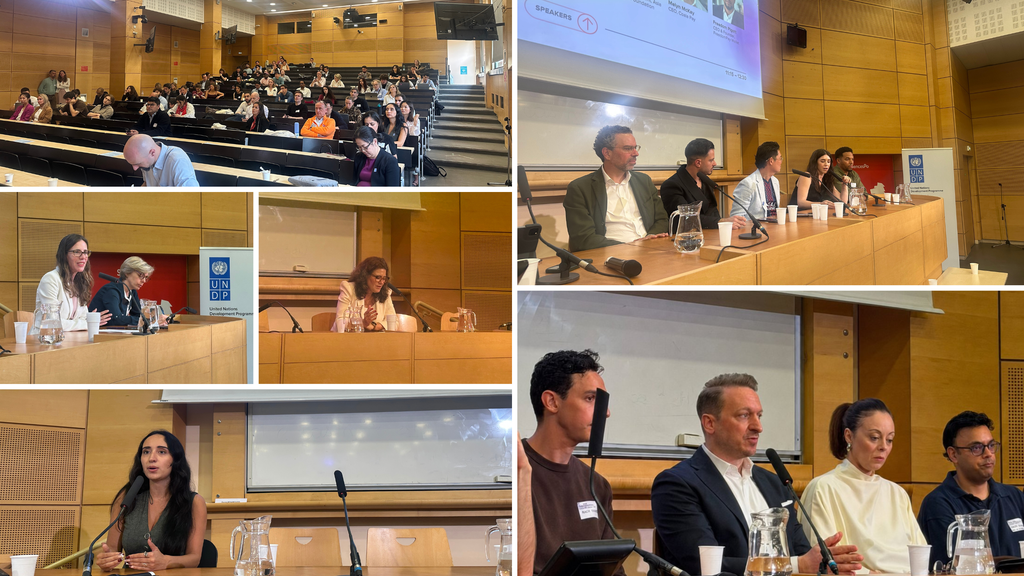
Moving funds through blockchain-based systems can be relatively straightforward. Ensuring that people can access, use, and benefit from those funds is not. The Sciences Po dialogue highlighted the importance of the “last mile” of public service delivery, where digital identity, payment infrastructure, regulatory frameworks, and local institutions all shape whether innovation reaches the people it is intended to serve. The challenge, participants argued, is often less technological than institutional.
The conversations also highlighted the importance of institutional continuity. Successful initiatives need to outlast individual projects, funding cycles, and changes in leadership if they are to become sustainable public systems.
This thinking informed the launch of the Government Blockchain Academy, developed by UNDP in partnership with the Exponential Science Foundation. The Academy will equip government officials with the knowledge, practical skills, and institutional capabilities needed to assess blockchain technologies, identify where they create value, and support their responsible adoption as part of broader digital transformation strategies.
Collaboration for implementation
Scaling blockchain for public good depends on collaboration across governments, development organizations, academia, and the private sector.
More than 30 senior representatives from across the blockchain ecosystem gathered for the inaugural meeting of the UNDP Blockchain Advisory Group, creating a new platform for strategic dialogue on the responsible application of blockchain for sustainable development. Beyond providing strategic advice to UNDP, the Group creates space to exchange knowledge, identify emerging opportunities, and strengthen collaboration around shared development priorities.
Its first discussion focused on digital finance and financial inclusion. Globally, 1.3 billion adults remain without access to formal financial services, and close to one billion lack the digital identity needed to access them. The discussion examined how blockchain-enabled approaches can help address these persistent challenges and what is required to support implementation at scale. Participants emphasized that financial inclusion is not simply about moving money more efficiently. It is about enabling people to participate more fully in the economy by building trusted financial histories, accessing savings and credit, and connecting to formal financial systems. Blockchain can support that transition, but only when it is integrated with existing financial infrastructure and supported by appropriate governance, regulation, and partnerships.
Showcasing implementation-ready solutions

The SDG Blockchain Accelerator Impact Showcase demonstrated how these ideas are already being put into practice through partnerships between UNDP and technology innovators. The Showcase introduced the SDG Blockchain Accelerator to a wider blockchain audience, presenting UNDP’s challenge-led approach to innovation. Rather than starting with technology and searching for a use case, the Accelerator begins with development challenges identified by UNDP Country Offices and institutional partners, then matches them with technology organizations capable of designing and implementing a solution. This helps ensure that innovation responds to real needs while creating practical pathways towards implementation.
Among the projects presented, FreedomPay Wallet is working with UNDP The Gambia to strengthen transparent and accountable digital payments, while Plastiks is partnering with UNDP in Armenia, India, El Salvador, and Zambia to create verifiable records of plastic recovery that support circular economy value chains. Other teams showcased solutions focused on programmable funding, supply chain traceability, and digital finance, showcasing how blockchain can strengthen transparency, efficiency, and accountability when embedded within broader public systems rather than deployed as a standalone technology.
Blockchain for good at scale
“The future of blockchain for development will depend not only on innovation, but on the institutions, partnerships, and public trust needed to apply it responsibly,” said Robert Pasicko, Lead, Alternative Finance Lab (AltFinLab), UNDP Europe and Central Asia.
Putting blockchain to work for sustainable development requires more than technology. It requires capable institutions, trusted partnerships, and the confidence to adopt new approaches responsibly. Achieving this requires new models of collaboration that bring governments, development institutions, and the blockchain ecosystem into sustained, structured dialogue rather than one-off engagement.
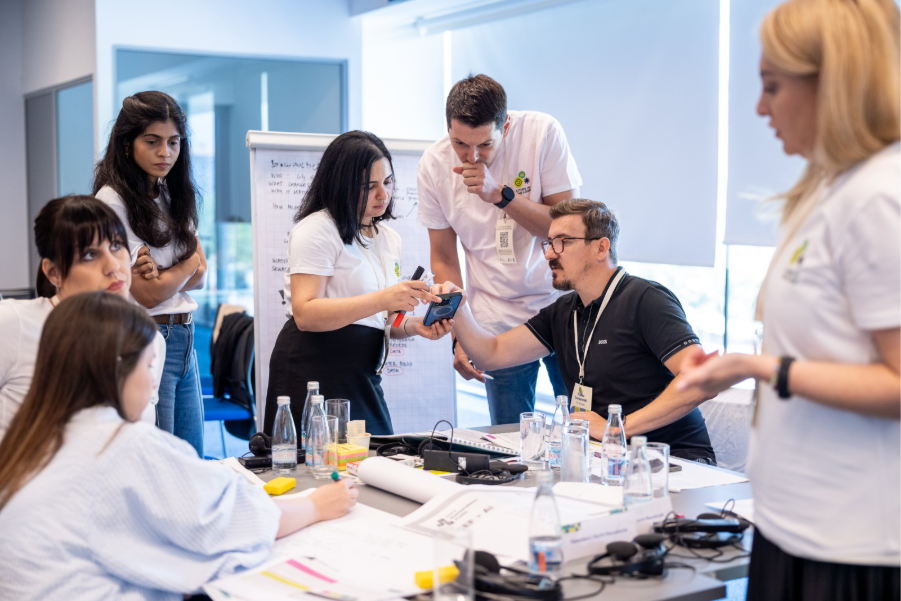
The CEF x AI Bootcamp, held on 23–25 June under UNDP’s City Experiment Fund (CEF) with the support of the Ministry of Finance of the Slovak Republic, brought together some thirty participants from ten municipalities – from capital cities to small towns, some of them rebuilding through crisis. In the course of three days, cities from Armenia, Kosovo1, Montenegro, North Macedonia and Ukraine worked on exploring where – and whether – AI belongs in their city.
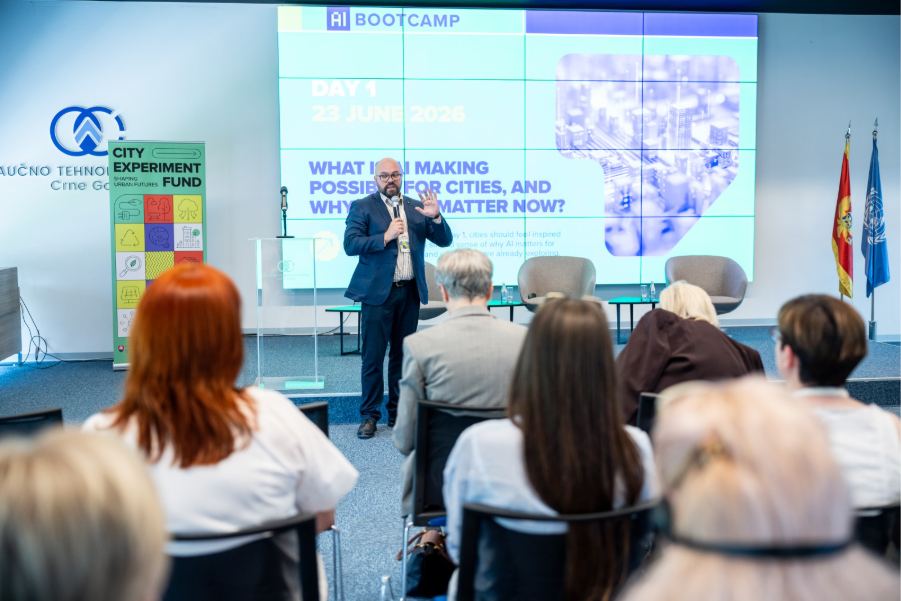
Their starting points differed widely, but the challenges they brought clustered around a handful of shared themes: energy resilience and resource monitoring; water management; waste collection and recycling; air quality and environmental prediction; making sense of citizen requests and complaints; and planning – from circular economy to sustainable tourism. Several teams are also grappling with the underlying data challenge: fragmented systems, scattered records, and information that exists but cannot yet be used.
Why a bootcamp, and why now
Cities are already encountering AI whether they choose to or not – it is reshaping how services are delivered and decisions are made, while the capacity gap between what the technology demands and what most municipalities have kept widening. Cities that engage early get to shape how AI is adopted: which problems it solves, and which safeguards are built in.
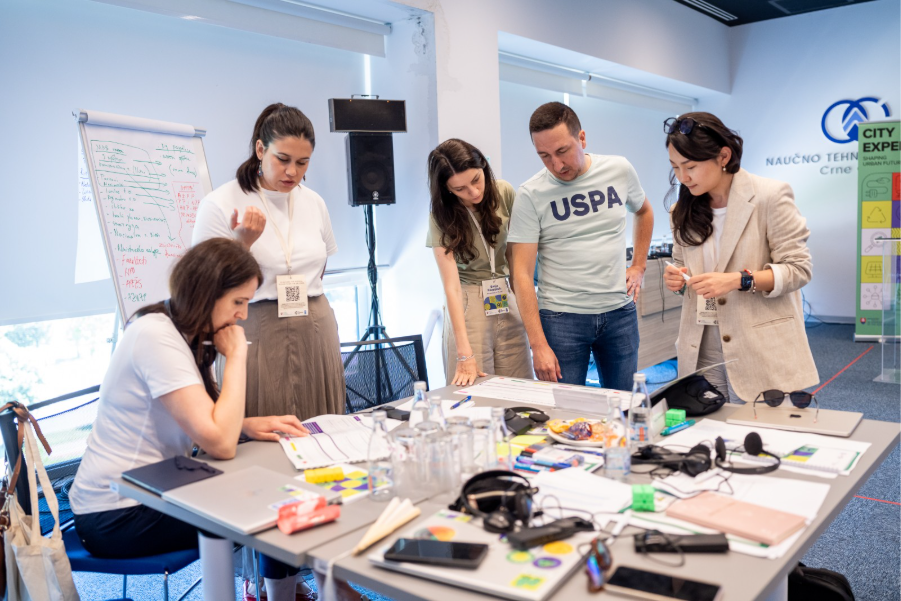
Yet most AI training for governments stays abstract – a tour of the technology, disconnected from any decision a city actually has to make. CEF takes a different starting point: AI is not a tool to procure but a capability to build. The bootcamp was designed as the pivotal middle step of a longer journey that runs from foundational learning to funded experimentation as part of the new CEF x AI programme.
How we designed it
Three design choices shaped the experience.
Fundamentals moved online, before the event. All participants completed a self-paced AI Foundations course and a set of preparatory canvases in advance. That freed the three days in Podgorica for the only thing that cannot be done remotely: teams working through the challenges facing their own cities alongside peers and experts in the room.
A workbook, not a lecture series. The heart of the bootcamp was a single workbook of seven canvases, each producing one concrete output that feeds the next: an ecosystem map, a problem statement, a responsibility check, a feasibility check, peer feedback, entry points, and reflections. By the final afternoon, every city had at least two concrete AI entry points – the substrate of their funding proposal. One instruction was printed into the method itself: “‘AI is not the answer’ is a valid finding.”
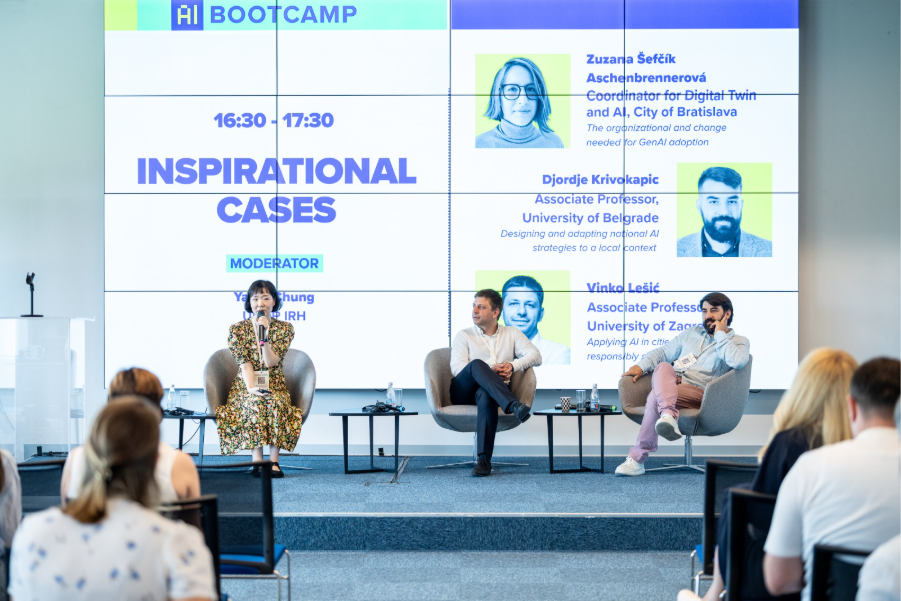
Three days, three questions. Day 1 asked what AI is making possible for cities and why it matters now – inspiration, provocations, and real cases from Bratislava, Montenegro’s national AI strategy and the IEEE’s GenAI for Good work. Day 2 asked what each city’s AI landscape looks like, and which challenge is most worth pursuing. Day 3 focused on implementation: do we have what it takes, and where do we begin?
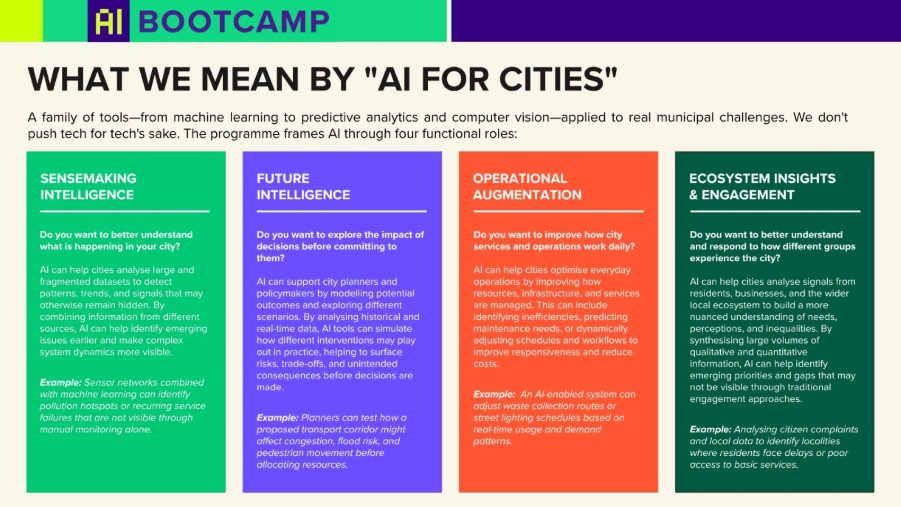
Instead of a taxonomy of algorithms, cities worked with four functional pathways, each phrased as a question a public servant can answer: Do you want to understand what is happening in your city (sensemaking intelligence)? How to explore the impact of decisions before committing them (future intelligence)? Improve daily operations (operational augmentation)? How to better understand how different groups experience the city (ecosystem insights and engagement)?

What we learned
Problem framing is the hardest and most valuable step. Cities tend to arrive with solutions, rather than problems. Many of the biggest breakthroughs came from refining the “How might we” statement. Teams were challenged to clearly define who is affected, what needs to change for them, and why it matters – without jumping to a solution or embedding a technology in the question.
Permission to say no to AI builds trust. Making “AI may not be the answer” an explicitly valid outcome changed the tone of the room. Teams became more candid about fragmented data, missing skills and weak enabling conditions, which is exactly the honesty a credible proposal needs.
Peers are the real curriculum. One participant named their key takeaway from Day 1 simply as a “feeling of alignment.” Whether rebuilding through crisis or planning for long-term transformation, small towns and capital cities found themselves asking many of the same questions. Structured peer feedback in country groups helped teams refine those shared challenges into sharper problem statements.
Responsibility works as a design step, not a lecture. Rather than an ethics session bolted at the end, every team worked through a responsibility canvas while their AI direction was still taking shape – asking who could be harmed or excluded, whose privacy and rights are at stake, and what safeguards would need to be in place. While the cities are still exploring how AI might be applied, it also makes the right moment for cities to reflect on ethics, privacy and rights from the very beginning – where the responsibility becomes part of the design rather than an afterthought.
Real-time sentiment is a facilitation tool, and occasionally a mirror. The daily Menti meter pulse lets the team adjust pacing and energy between sessions. It also gave participants a place to leave the harder, anonymous questions. A room that steps back from process to ask about purpose is a room that has understood the assignment.
What happens next
The bootcamp is a beginning, not an end. Cities are now refining their entry points into proposals along two tracks for CEF x AI Programme. Track 1 – the CEF x AI Demonstrator – will support selected cities with US$200,000 over roughly two years to build and test AI pathways embedded in their ongoing portfolios. Track 2 – the BOOST x GenAI for Good Challenge – will match city-owned use cases with global innovator teams to co-design responsible, open-source GenAI solutions, with cities staying owners of the problem throughout. Selection will take place over the summer; and the activation begins in September 2026.
The question these ten municipalities are taking home is no longer: “What can AI do?” It is the one that emerged during the bootcamp: Will this actually benefit the citizens of our town? The fact that teams are asking this before a single line of code is written may be the bootcamp’s most important outcome.
[1] References to Kosovo shall be understood to be in the context of United Nations Security Council resolution 1244 (1999).
While information about AI is abundant, space to make sense of what it means in practice is not. That gap between the global AI conversation and where cities in our region actually stand is the focus of the first session of the AI in Development Practice series. Hosted by the United Nations Development Programme’s (UNDP) Regional Bureau for Europe and Central Asia, the series aims to create space for practitioners, researchers, and policymakers to work through how AI is reshaping development work.
Urban governance is one of the places where AI’s effects are most concrete and most uneven, and where the stakes of getting it wrong are hardest to ignore. Two speakers anchored the conversation, each approaching the same problem from a different angle: Gesa Ziemer, Academic Lead at UNITAC and Director of the City Science Lab in Hamburg, and Yoonjin Yoon, Founder and Director of the Urban AI Institute and Chair Professor at KAIST in South Korea.
Gesa Zeimer: Leveraging existing ecosystems in cities to enable AI and digital transformation
Gesa pointed out that there is a widening gap between how fast urban AI is developing and how ready cities actually are to use it. Data is often outdated, fragmented across authorities, civil society, and private companies, and rarely interoperable enough to feed into an AI system.
Most cities her team works with lack a centralized data management system altogether, and where one exists, it’s often built on a single proprietary platform leaving the city dependent on that company rather than in control of its own data.
On where cities should start, her clearest answer was prioritization: connect civil society and government first. Activists, artists, and community groups are doing real work that’s disconnected from government, and government holds laws and strategies disconnected from what’s happening on the ground.
Her example of an ecosystem approach in practice came from Windhoek, Namibia. The national statistics agency had a solid centralized data platform, but the column for informal settlements was essentially empty, left blank for political reasons. Rather than build a new tool, her team’s actual work focused on relationship-building connecting local NGOs who already held the data, building enough trust to get it included.
Yoonjin Yoon: How cities could apply AI – what the KAIST Urban AI Lab has been testing in cities
Yoonjin opened with a conceptual distinction that anchored her entire talk:
- AI of Cities – how can AI help cities work better?
- Cities of AI – how will cities evolve because of AI?
The purpose of urban AI is not technology. It is to enable better decisions, improve day-to-day operations and services, strengthen engagement with communities, and help cities achieve more with fewer resources, less budget, less staff. Every city, regardless of wealth or geography, is wrestling with the same three challenges: how people move, how the city responds to external stress, and how it manages growth. AI doesn’t resolve those challenges. It helps leaders see them more clearly, understand them more deeply, and act more confidently. This is what decision support actually means, not automation, not replacing planners or policymakers, but giving them better tools to understand what is actually happening in their city.
Two Seoul projects illustrated what using AI looks like in practice and what it can reveal unexpectedly. In the first, using daily credit card data across all 422 Seoul neighbourhoods, the team found that 80% of neighbourhoods see retail sales decline on extreme heat days. Commercial centres drawing commuters and visitors saw the sharpest drops simply because those people stopped coming, while residential neighbourhoods serving local daily needs were largely unaffected. Neighbourhoods that looked identical in official statistics functioned completely differently in reality – invisible in aggregate data but made visible through AI. A second Seoul project used an AI agent built on the open-source SUMO traffic simulator to let non-expert city officials test scheduling decisions – such as the best 30-minute window for road maintenance – using plain-language prompts that anyone can understand.
For cities that find themselves earlier in this journey, her advice was to flip the usual instinct: define the real problem first, rather than starting from what AI can do. She pointed to her institute’s current project near Ho Chi Minh City, where data exists but is scattered, as a close parallel to where many cities in our region are starting from, and noted that a small or imperfect dataset is still worth using, since working with what’s available tends to reveal what the next data investment should be. Asked separately about open datasets, she pointed to satellite imagery as the most universal starting point regardless of income level, alongside anonymized mobile movement data for understanding human dynamics that built-environment data alone can’t capture.
Both speakers, in different ways, pointed to the same underlying urgency. The window for shaping AI adoption is now. Cities that engage with AI early (even if modestly) can shape how it is introduced: which problems it addresses, whose interests it serves, and what safeguards are built in.
Putting AI to work in cities: The CEF × AI programme
The webinar coincides with the launch of the AI Foundations course for municipalities and the launching of CEF x AI, a new programme, part of the City Experiment Fund, focused on helping cities build the capability to work with AI in practice.
CEF × AI frames AI not as a technology agenda but as a set of functional capabilities cities can put to work. The programme organizes these around four pathways:
- Sensemaking Intelligence: AI can help cities analyze large and fragmented datasets to detect patterns, trends, and signals that may otherwise remain hidden;
- Future Intelligence: AI can support city planners and policymakers by modelling potential outcomes and exploring different scenarios;
- Operational Augmentation: AI can help cities optimize everyday operations by improving how resources, infrastructure, and services are managed;
- Ecosystem Insights & Engagement: AI can help cities analyze signals from residents, businesses, and the wider local ecosystem to build a more nuanced understanding of needs, perceptions, and inequalities.
Together, these four pathways reflect a single underlying idea: AI is most useful when it starts from a real municipal problem, not from the technology itself. To support this work, UNDP organized a CEF × AI Bootcamp in Podgorica, Montenegro in June 2026 bringing together municipalities from the region to explore how AI can support their green and digital priorities. Over three days, city teams worked through their own challenges, assessed their readiness for AI, and identified practical opportunities for experimentation and implementation.
Stay tuned for our next webinar sessions!
Istanbul, 06 July 2026. The United Nations Development Programme and the Stellar Development Foundation have signed a new agreement that carries their joint work on blockchain-based digital payments into its next phase, moving from a set of proven pilots toward a standing capability that UNDP country offices can draw on as a regular part of how they deliver programmes. Coordinated by the UNDP Alternative Finance Lab (AltFinLab) at the Istanbul Regional Hub, the agreement shifts the focus from testing the technology in specific contexts to putting in place the institutional conditions under which it can be used at scale.
The decision to scale follows sixteen months of joint work, during which the two partners researched the use of digital payments across seventeen countries, consulted UNDP country offices and stakeholders, and implemented live pilots in Haiti, Syria, Kenya, Guatemala, and The Gambia, with two further solutions developed to a working prototype in Colombia and Papua New Guinea. In parallel, the Sustainable Development Goals Blockchain Accelerator, strategically led by UNDP AltFinLab, matched a cohort of payment solutions built on the Stellar network with real UNDP programme challenges, producing a portfolio of graduated solutions with documented pathways to scale within existing country office programmes.
These pilots produced concrete evidence rather than promising projections. In Aleppo, UNDP delivered Cash for Work stipends to beneficiaries digitally and recorded every transaction on-chain, which reduced the estimated cost of distribution from about 10 percent of funds under conventional methods to about two percent, with every participant receiving and cashing out their payment. In Haiti, a pilot built for low connectivity continued to function with a 100 percent success rate, even when the cellular network failed entirely during testing, settling payments almost instantly under the conditions that communities actually face. Across all of the pilots, programmes gained something they had not had before, which is a traceable record of where money went.
Earlier in 2026, UNDP featured part of this work in the report New Tech, New Partners: Transforming Development in the Digital Era, which set out why reliable digital payment infrastructure matters for financial inclusion, for remittances, and for reaching people in fragile and conflict-affected settings that traditional financial systems sometimes fail to reach.
The new agreement turns these results into a capability that does not depend on any single project or funding cycle. Over the coming period the two partners will establish the governance, onboarding, and safeguards that allow UNDP to adopt digital payments responsibly, move validated solutions from the existing pipeline into active use, extend the same infrastructure across different categories of UNDP programming – from humanitarian response to social protection and financial inclusion – and consolidate the evidence and operating guidance that the service needs to continue and grow within the development system.
Throughout this phase, the Stellar Development Foundation will provide technical advisory support and coordination across the Stellar ecosystem, including expertise on the network and its protocols, and engagement with the solution providers operating within the UNDP pipeline, while UNDP will retain responsibility for delivery and implementation.
Robert Pasicko, UNDP Alternative Finance Lab, said: “We have shown that digital payments can reach the people that conventional systems miss, and in some of the hardest places to operate. The work now is to make that capability ordinary, so that a country office can use it with confidence as part of how it already works, rather than treating each deployment as an experiment.”
Candace Kelly, Chief Legal Officer, Stellar Development Foundation, said: “These pilots showed what open, public blockchain infrastructure can do when it is built around the realities of the last mile. We are proud to continue this work with UNDP and to help turn a set of successful pilots into a durable part of how development and humanitarian finance is delivered.”
The agreement runs through 2027 and will conclude with a consolidated evidence base, a scaling playbook, and a formal handover, so that the capability outlasts the partnership that created it.
About the United Nations Development Programme
The United Nations Development Programme (UNDP) is the leading United Nations organization fighting to end the injustice of poverty, inequality, and climate change. Working with our broad network of experts and partners in 170 countries and territories, we help nations to build integrated, lasting solutions for people and planet. Learn more at undp.org or follow at @UNDP.
About UNDP Alternative Finance Lab
UNDP Alternative Finance Lab develops new financial approaches, instruments, and partnerships that expand the resources available for sustainable development. Its work on blockchain based digital payments is part of a wider effort to make development and humanitarian finance faster, more transparent, and more inclusive. The Lab is hosted at the UNDP Istanbul Regional Hub.
About the Stellar Development Foundation
The Stellar Development Foundation (SDF) is a non-profit organization that supports the development and growth of Stellar, an open-source network that connects the world’s financial infrastructure. Founded in 2014, the Foundation helps maintain Stellar’s codebase, supports the technical and business communities building on the network, and serves as a voice to regulators and institutions. The Foundation seeks to create equitable access to the global financial system, using the Stellar network to unlock the world’s economic potential through blockchain technology.