Category: Systems and portfolios
When you talk to urban development practitioners, they seem to agree that there are no silver bullet solutions to the challenges cities face. What is even more difficult is that the number, scale and complexity of these challenges keeps increasing. Simultaneously, our cities do not have the resources to ‘fix it all’. They never will. So where does that leave us?
Less than a year ago, five cities from across the Europe and Central Asian region embarked on an exploration of a new approach to problem solving, which is rooted in systems thinking. Stepanavan (Armenia), Almaty (Kazakhstan), Prizren (Kosovo), Pljevlja (Montenegro) and Skopje (North Macedonia) began designing what we call portfolios of options. ‘Portfolios’ because there are no simple, singular solutions to complex problems. ‘Options’ because addressing complexity (esp. If it’s wicked problems [1]) requires an approach based on experimentation, learning, and dynamic management.
The process of portfolio design
During the first phase, the UNDP Country Office teams spent several months going through the processes of portfolio design and deep listening to be able to implement and test out the first iteration of their sets of interventions. Part of the teams used the Agora Urban Transformation Stencil, while others applied strategic risk analysis and solution design. Overall, the key phases were similar for all.
Teams began their work by unpacking the complexity of the challenges they initially selected. This phase included deep listening, which is a process of identifying local narratives that surround both the challenge at hand, but also, more importantly, the city and its future in general. Once the teams developed a deep understanding of the issues they were attempting to tackle, they established their intent – what is it exactly that they want to change, who are they to change it, and what resources would they tap into? For some of the teams it meant reframing the entire challenge altogether, like shifting the focus from air pollution to alternative job opportunities for vulnerable groups, like in Pljevlja. For others it meant moving from a broader scope to a very specific challenge – like in the case of North Macedonia, where the team shifted from green growth to circularity in biowaste.
With a clearly defined intent, each team then moved on to identifying the best places in selected systems to intervene. This sounds abstract, but in practice it is about noticing levers, bottlenecks, elements of the system that either attract the most or the least attention and that – when interacted with – can generate the biggest impact. This is what you design options for. And that’s what the teams did.
From July to August 2021, the teams went into experimentation mode and began implementing their portfolios of options. What is critical to remember, though, is that the first iteration of an option is merely a beginning. It should never be the end (or the goal in itself, for that matter). Working with complex challenges requires continuous learning. Each implemented option provides new insights and allows us to keep developing more impactful interventions with consecutive iterations of a portfolio.
[1] Quoting SpringerLink Design Dictionary: “Wicked problems” is a phrase first coined by Horst Rittel and Melvin Webber, theorists of design and social planning respectively, at the University of California, Berkeley, in 1973. A wicked problem defies any standard attempt to find a solution because it is a symptom or result of multiple, contingent, and conflicting issues.
As part of the Joint EU & UNDP Virtual Forum on Urban Transformations, we interviewed two thought leaders on how to radically change our urban spaces to become more resilient, inclusive and sustainable, and what new ways of looking at our future(s) along with new approaches, narratives and tools are needed.
Gabriella Gómez-Mont is the founder and director of Experimentalista, a novel type of nomadic and creative office specialized in cities, with high-level, transdisciplinary collaborations across the world. She is the former chief creative officer of Mexico City, and founder of Laboratorio para la Ciudad (2013-2018), the award-winning experimental arm and creative think-tank of the Mexico City government, reporting to the mayor.
Urban transformation is in the hearth of the conversations happening
nowadays. Cities are the best engines for transformation where we can
see different types of urban social realities.
Nicolay Boyadjiev is an architect, strategic designer and creative director working between Montreal and Moscow. He is currently the co-director of Strelka Institute’s post graduate education program, where he co-leads “The Terraforming” interdisciplinary design-research think-tank. He is also the co-author and editor of “The New Normal” (2020, Strelka Press + Park Books): a comprehensive record of the projects and insights developed during the 2017-19 design-research cycle at Strelka which set out to develop and prototype new models for urban design practice at the intersection of software, cinema, strategy, and planning.
We should rethink the standards needed for design, long-term building,
and infrastructure, and how culture is reflected, created, maintained at city scale.
See the full recording from our virtual event.
Browse the list of speakers.
A large and diverse group of municipalities, research institutions and think tanks has kicked off a promising dialogue on how to radically change cities and help them become more resilient, inclusive and sustainable at the first public forum of the Mayors for Economic Growth (M4EG) Facility.
Brussels/Istanbul, 19 November 2021 – The 2021 Virtual Forum on Urban Transformation focused on system transformation in urban settings and working in complexity throughout the European Partnership region.
Jointly organised by the EU and UNDP, the Forum showcased emergent practice on urban transformation among the M4EG network of municipalities as well as the civic and private sector.
Diana Jabłońska, DG NEAR Head of Unit C1 ‘Georgia, Moldova, Economic Investment Plan’, stressed the importance of the EU-UNDP partnership to tackle local economic development challenges in a more innovative, inclusive and sustainable way, by relying on portfolios of interventions. She also recalled that the EU has designed an ambitious agenda and economic investment plan for supporting resilience, recovery and reform as well as harnessing the green and digital transition in the Eastern Partnership region.
Gerd Trogemann, Manager of the UNDP Istanbul Regional Hub, said that the demand for new approaches is tremendous, given the fact that municipalities are at the forefront of addressing systemic risks. He encouraged the Mayors network to lead by example vis-à-vis building partnerships based on trust, honesty, and openness, learning and iterating together.
During the Forum, M4EG municipalities joined in a discussion between various actors, exploring how to move from visions to actions. Panelists from Bilbao, Bologna, Lviv, and Vienna shared best practice on inclusive concepts implemented at the local level, including gender mainstreaming, civic imagination, adaptive city planning and portfolio approaches to tackle complex challenges.
Oleksandr Syenkevych, Mayor of Mykolaiv, Ukraine, said that the pandemic outbreak has surfaced municipalities’ vulnerabilities. Recent and protracted challenges outlined the need to apply new tools and visions to address complex issues like inequality and economic development.
This is one session of many that will come where participants get a chance to engage with a growing network of municipalities and partners to build a space for a community of innovators at the regional level.
Watch the recording of the forum here.
Background:
The joint EU-UNDP Virtual Forum on Urban Transformation is part of a series of strategic dialogues organised by the EU and UNDP on working in complexity in February and May 2020, as well as during the Partnership Forum on system transformation in November 2021. In December 2020, the EU and UNDP signed an agreement to apply portfolio approaches as a way to accelerate system transformation and build resilience at the local level under the initiative Mayors for Economic Growth. These dialogues have highlighted the speed of change and the need for development institutions to adapt their ways of working to allow for testing and discovery, while maintaining a high level of rigor.
For media enquiries:
For the European Commission/DG NEAR:
- Mr. Thibault Charlet, Programme Manager, Digital and Local Economic Development, DG NEAR Unit C1, thibault.charlet@ec.europa.eu
For UNDP:
- Mrs. Laurence Lessire, Regional Communications Specialist, laurence.lessire@undp.org
- Ms. Svetla Baeva, Communications Lead, Innovation Team Istanbul Regional Hub, svetla.baeva@undp.org
- Mr. Anton Sydorenko, M4EG Facility Communications Lead, anton.sydorenko@undp.org
EU & UNDP organized a joint forum on “Embracing Complexity & System Innovation, and its Implications,” on 28 October 2021. The purpose of the forum was to continue to have a shared space on learning about system transformation, bridging theory and practice.
The forum was opened by Ben Slay, Acting Deputy Regional Director, and Mathieu Bousquet, Acting Director DG NEAR A: Thematic Support, Coordination of Policy and Financial Instruments.
The event brought together practitioners and thinkers working on complexity and system transformation. The first discussion focused on how change happens, moderated by Hoa-Binh Adjemian, Deputy Head of Unit, DG NEAR. Speakers discussed how to build strategies that allow adaptiveness, as well as rules of thumb and practices which can aide decision-makers.
Deputy Prime Minister of the Republic of North Macedonia, Fatmir Bytyqi, shared the innovative framework for the National Development Strategy, which is described as living document. The CEO of Climate-KIC, Kirsten Dunlop, called the portfolio a framework for learning – enabling to plug in and activate multiple points at the same time. Duncan Green, Oxfam Senior Strategic Advisor, shared three rules of thumb for working in complexity: 1) real time feedback and adaptation, 2) planning for uncertainty and 3) thinking about ecosystems and not projects. Garo Armen, Founder and CEO of Agenus,said it was necessary to respond to needs & enable customization.
The second panel was on the practice of working on system transformation, and was moderated by Francine Pickup, Resident Representative in Serbia. She highlighted the need to work within an ecosystem and explore what might work. Indy Johar, CEO and Founder of DML, said the transition required learning institutions. Giulio Quaggiotto, Head of Strategic Innovation Unit, highlighted that there was a need to move beyond linear planning and embracing the unknown. Answering what the public sector could learn from the private sector, Ines Rocha, Director for Financial Products at EBRD, said in the private sector adaptiveness was an essential feature.
A joint statement between EU and UNDP on the shared intent to work in complexity is available here.
The joint EU and UNDP Partner Forum discussed how to address today’s dynamic challenges through new approaches that embrace uncertainty and discovery.
Brussels/ New York/ Istanbul/ Skopje, 28 October 2021 – The joint European Union (EU) and the United Nations Development Programme (UNDP) internal Partner Forum sought to provoke new ways of looking at our possible futures, with approaches that enable building fresh lenses, new narratives and adaptiveness when working in a highly uncertain and changing world.
Co-organised by the European Commission’s Directorate-General for Neighbourhood and Enlargement Negotiations (DG NEAR) and the UNDP’s Istanbul Regional Hub, the event brought together world-class change-makers and policy makers, biotech executives and civil society leaders.
Mathieu Bousquet, DG NEAR acting Director A “Thematic Support, Coordination of Policy and Financial Instruments” stressed that the EU has designed ambitious agendas and economic investment plans to support resilience, recovery and reform as well as harnessing the green and digital transitions in enlargement and neighbourhood countries. He called on UNDP and EU to support breakthrough innovation to ensure that our enlargement and neighbourhood partners develop resilient economies that work for people.
Ben Slay, Acting Deputy Regional Director for UNDP Europe and Central Asia said that development agents, including the EU and UNDP, are coping with the emerging crisis in times of uncertainty when agile approaches are needed to address fragility and complexity of new challenges. The nexus of systems thinking coupled with holistic partnership and strategic innovations should bring partners closer to a stronger basis for accelerating learning, adaptation and provoking new ways of looking at the future.
Building on this, the Forum fostered a partnership dialogue on embracing systems thinking and exploring new approaches to tackling complex challenges. The “new normal” reality has shown the limitations of linear planning and single-point solutions, and is now urging key actors to seek new solutions in the region and worldwide. Development agents have called for integrating complexity in development strategies by looking into the cross-cutting drivers, in order to avoid facing often intractable confluences of difficult problems.
In the Eastern Partnership countries, Mathieu Bousquet and Ben Slay also highlighted the opportunity of relying on a network of 350 local authorities under the new EU-funded Mayors for Economic Growth Facility as a key element to introduce new approaches and accelerate systemic transformation while boosting resilience and recovery at the local level.
In this context, the Partnership Forum underlined the EU and UNDP’s commitment to continue this joint learning journey of dialogues and exploration together, for a stronger neighbourhood and a better world.
Background:
The Partnership Forum is part of a series of strategic dialogues between the two partners on working in complexity in February and May 2020. In December 2020, the EU and UNDP signed an agreement to apply portfolio approaches as a way to accelerate system transformation and build resilience at the local level under the initiative Mayors for Economic Growth. These dialogues have highlighted the speed of change and the need for development institutions to adapt their ways of working to allow for testing and discovery, while maintaining a high level of rigor.
For media enquiries:
For the European Commission/DG NEAR:
- Mr. Thibault Charlet, Programme Manager, Digital and Local Economic Development, DG NEAR Unit C1, thibault.charlet@ec.europa.eu
For UNDP:
- Mrs. Laurence Lessire, Regional Communications Specialist, laurence.lessire@undp.org
- Ms. Svetla Baeva, Communications Lead, Innovation Team Istanbul Regional Hub, svetla.baeva@undp.org
- Mr. Anton Sydorenko, M4EG Facility Communications Lead, anton.sydorenko@undp.org
To celebrate the International Day of the Girl Child, we at UNDP Kyrgyzstan are reaching out to innovators across Europe and Central Asia to promote our mission to achieve gender equality in science, technology, engineering and mathematics (STEM) and honor the STEM champions, leading an inclusive digital transformation.
Why STEM matter for gender equality?
Despite the job losses resulting from the COVID-19 pandemic crisis, demand for workers in STEM fields has increased, and it is expected to grow even faster in the near future. Recently Mirjana Spoljaric Egger, the Assistant Secretary-General of the United Nations and Director of the UNDP Regional Bureau for Europe and the CIS, announced in her keynote speech at the UNDP regional conference on STEM and gender equality, that “an increase in STEM employment would help reduce labour market shortages – in the EU, for example, closing the gender gap in STEM could lead to an additional 1.2 million jobs. The higher productivity of STEM jobs can lead to higher wages. […] More women graduating in STEM subjects and choosing careers in higher-wage sectors can gradually increase their average earnings, helping to close the gender wage gap”.
According to the “Jobs Landscape 2022” study conducted by the World Economic Forum (2018), the future of work in the Industry 4.0 (referring to the fourth industrial revolution) will be STEM-heavy. It is estimated that there will be 133 million new jobs emerging based on the growing demand (data analysts, AI and machine learning specialists, Big Data specialists, etc.). Nevertheless, these fields are still primarily dominated by men.
“Leaving behind women, who are significantly underrepresented in STEM occupations, means denying half of humanity the opportunity to enter and succeed in this high-growth sector that powers the green and digital transformation in COVID-19 response.”
Mirjana Spoljaric Egger,
What have we done in Central Asia and the CIS region?
UNDP Kyrgyzstan together with the UNDP Istanbul Regional Office and the STEM4ALL platform organized a successful Regional Conference: STEM4ALL Accelerating gender equality in September 2021. UNDP’s Accelerator Labs in Azerbaijan, Belarus, Kazakhstan, and Kyrgyzstan actively participated with a series of presentations. We were honored to have the opening remarks from Asel Kenenbaeva, the Deputy Minister of the Digital Development in Kyrgyzstan, as well as the keynote speeches delivered by Dr. Julia Lee, Lecturer of Harvard University, and Mirjana Spoljaric Egger, Director of the UNDP Regional Bureau for Europe and the CIS. We are also thrilled to report a high-level of engagement – 196 people participated in the conference (70% from the public; 30% from UNDP) and 19 speakers delivered talks on their best practices.
The conference agenda was designed in such a way as to include a diverse group of stakeholders to capture different perspectives (global, regional, national, and grassroots ones). As for UNDP, we took on an observer role – practicing deep listening to take stock of the various voices and stories.
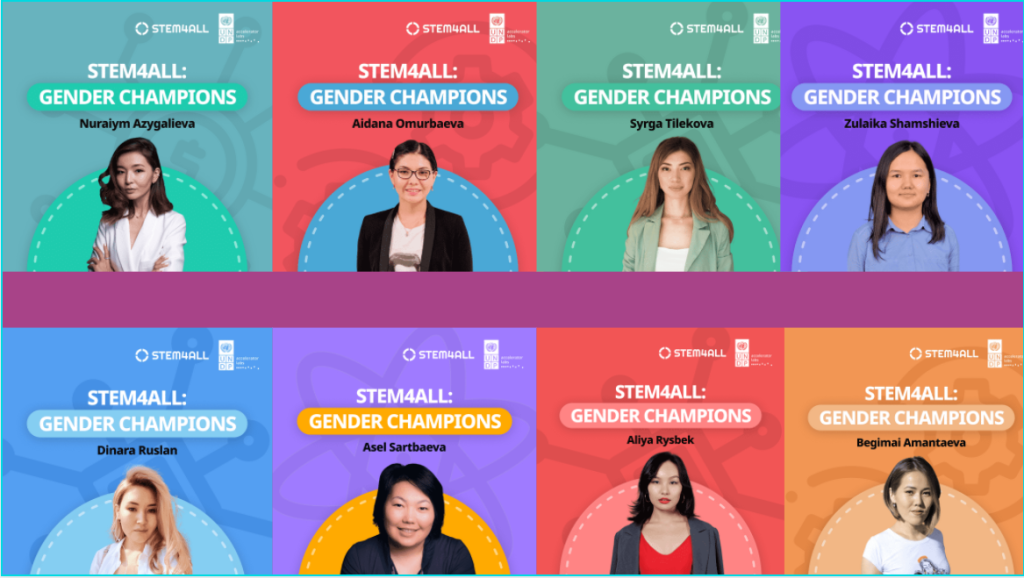
Following the conference, the Accelerator Lab at UNDP Kyrgyzstan conducted a storytelling campaign with gender champions as a tribute to the International Day of the Girl Child. Our gender champions shared their inspiring stories to empower more women and girls to realize their STEM potential. I personally believe that storytelling can be a powerful tool to inspire more women and girls, whom we can touch emotionally. The ultimate goal of such storytelling campaigns is not about UNDP telling stories, but about women sharing their own stories with each other. Continuing this discussion and raising public awareness through innovative communication is vital.
What have we learnt so far?
Thanks to our regional conference, we learned about the phenomenon of the “leaky pipeline,” described by Dr. Julia Lee. She noted that we cannot simply encourage more women and girls to join STEM fields unless we address the systemic problems at each stage of their journey (along the “pipeline”). Thus, we can only address gender equality issues by using a systems approach. We heard from Tara Chklovski, CEO of Technovation, about what it means to empower girls to become technology leaders, based on her 15 years of experience. Another speaker Dr. Radenka Krsmanovic Whiffen shared best practices on how to build a regional network of women in STEM. We also learned about different best practices at the country level (mentorship, behavioural insights, etc.). Most importantly, we learned about both the struggles and opportunities shared by our champions working on a grassroots level. Bringing all these stakeholders to the table and practicing deep-listening (empathetic learning) was critical for UNDP to tap into the root of the problems.
You can listen to all the talks on UNDP Kyrgyzstan’s YouTube channel.
What are we doing right now?
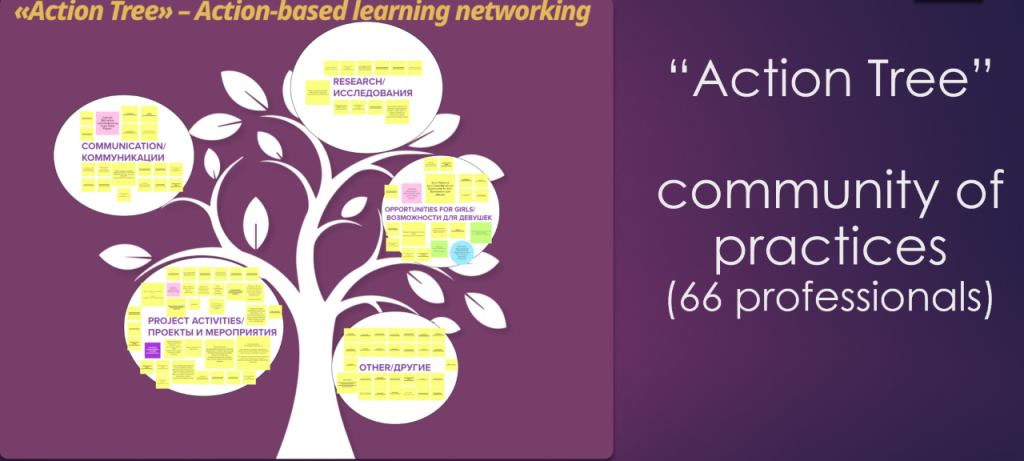
Moving forward, we want to continue the momentum for change. The “Action Tree” [1] I designed and experimented with during the conference was deployed as a tool to involve the conference participants in future collaborations. In this way, we’ve engaged nearly 70 professionals to kick start our Community of Practices (CoP), a growing network for collaboration. The Accelerator Labs are truly accelerating UNDP’s regional platform STEM4ALL through leveraging collective intelligence.
We encourage any professionals, who are interested in STEM4ALL, to join our network of CoP. The purpose of this network is to provide the space for collaboration across the Europe and Central Asia region to pool ideas and resources to promote the participation of girls and women in STEM. To move this initiative forward, we are planning a series of working groups that fall under the four pillars presented at the conference: Communications, Research, Project Activities and Opportunities for Girls.
If you’d like to join, please complete this form, and we will be in touch with details regarding the next steps to continue advocating for STEM4ALL.
Furthermore, we are also looking for professionals who would also be interested in (co-)chairing our upcoming four working groups on a volunteer basis until June 30, 2022. Please indicate your interest by sending your resume along with your field of interest to Tiffany Sprague, STEM4ALL platform coordinator, by October 25, 2021.
——
For inquiries and partnership opportunities, please contact focal points of the organizing team:
- Tiffany Sprague, STEM4ALL platform coordinator: tiffany.sprague@undp.org
- Jenny Jenish kyzy (Ensi Tszie), Accelerator Lab UNDP: ensi.tszie@undp.org.
Strategic documents set out the foundations and key priorities for organizations. They provide planning and a long-term vision that can then be dissected into more concrete road maps or action plans. These documents require a lot of effort, but once completed they often end up sitting on a shelf or website, waiting for someone to remember them.
One reason that these important documents become obsolete almost immediately is because they’re written for a five or even ten-year period, which is at odds with the realities of a dynamic and fast-changing context. It is crucial to be able to adapt to constant changes and to make sure that suggested avenues for solutions are relevant and timely.
At UNDP Kazakhstan, we decided to experiment with a new approach to organizational strategies and ‘hack’ our own Country Programme Document (CPD), a strategy document that each UNDP country office submits every five years. Our Accelerator Lab team started the hacking process in each of the priority areas identified in the CPD, in order to introduce new ideas for experimentation that are timely, innovative, and impactful.
Whatever strategic document you have, the goal of introducing an experimentation mindset is to breathe new life into strategies, and make a greater impact, by utilizing novel instruments and approaches. This process is applicable to any organization working to stay relevant and accomplish their strategy and vision in a rapidly changing context.
Benefits of hacking your strategy
Strategic documents are often based on robust research, the identification of problems and recommendations for solutions. Experts in the fields contribute to developing strategic documents, using official statistical analysis, global benchmarks and recommendations for actions. Yet despite all the available information, problems may continue to persist, strategies may not be fully implemented or may even be neglected. This is because these documents answer the ‘WHAT’ question – through descriptions of current and desired situations – but they do not tell you HOW to implement these recommendations.
An important part of any strategy is to know how to use the developed analysis and strategies, how to address problems and how to implement solutions in our complex system. To help answer these questions, innovative and relevant instruments can be introduced through creative exercises which will help generate ideas and consultations within and outside the organization.
The hacking process
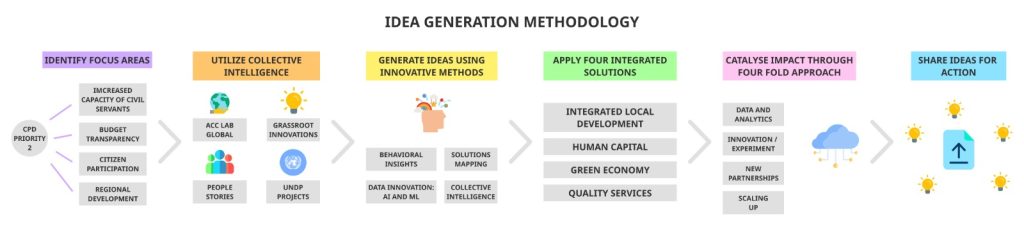
In the UNDP Kazakhstan Accelerator Lab, we asked ourselves the following guiding questions throughout the hacking process to help us find entry points for innovation in our strategic document:
- What are the new instruments that could make an impact?
- How can we work with a diverse range of partners to address social vulnerabilities?
- What existing local solutions can we learn from?
- How can we leverage existing relationships and make them more mutually beneficial?
- What development trends are emerging that need to be accounted for?
The hacking process can be explained in three steps:
- Dissecting the existing strategy document: The first step is to understand what is already there. Give yourself enough (but not too much!) time to approach each priority from your strategy separately. The Accelerator Lab team achieved this by brainstorming as a team on what was missing in each of the priorities in our CPD document, and reaching out to colleagues (topic experts) to get their input and insights. The key here is to initiate a wider dialogue with the entire team so that they feel confident in the hacking process and are ready to contribute bold ideas.
- Connecting with the broader ecosystem: Tapping into the collective intelligence of your organization is excellent, but it is also important to engage external stakeholders. In our case, for each of the strategic priorities, we reached out to activists, NGOs, and startups – people closest to the needs and solutions. These individuals shared their experience and perspectives on relevant issues which allowed us to complement official data sources with community insights. These insights helped us to better understand the context and gave us innovative ideas for experimentation that complimented our strategy.
- Making it participatory and actionable: Next, follow the example of ‘ideas empowerment’ – share the results of the insights gathered and ideas for implementation with members of the community for their feedback on the new solutions. In our case, the highlight of the hacking process was a “Pitch Day” event where our team presented the 12 ideas for experimentation that we had collected. The goal of this event was to spark excitement and fuel participation in this dynamic long-term document and suggest ways for it to be refreshed with actionable ideas. An important element of the “Pitch Day” was having the audience vote for the best ideas. Introducing this small engagement tool brought participants together to share creative additions to the strategy document.

In summary, the hacking process is an innovative way to identify and add ideas for experimentation in order to achieve more efficient, responsive, and relevant impact. As organizations, we often already have sufficient information. It’s now a matter of tapping into the collective intelligence of our ecosystem to accelerate our progress towards a sustainable future.
This article was first published on UNDP Kazakhstan and was originally published on February 17, 2021.
Identifying effective means of increasing citizen participation in decision making is timely and relevant considering the impact of the pandemic on populations and governments preparing to lead their people through post-pandemic recoveries. In 2019, Kazakhstan introduced the “Listening State” concept, a constructive dialogue between the state/ government and its citizens as a key principle for public services delivery. UNDP Kazakhstan also stresses the importance of supporting the government in building effective and accountable institutions that will foster public trust. So, what are the effective ways of increasing citizen participation in the country, taking into account the current situation?

One of the key means of doing so is acceleration of global trends/ global solutions in digitization of public services as they present the potential for facilitating greater citizen participation in decision-making. More people are now digitally literate and can access services online than ever before. From the supply-side, the Government is also moving into a digital space, meaning that now is the perfect time to integrate the much-needed participatory component to its digital public service delivery.
We at the Accelerator Lab team in Kazakhstan, envision this period of increased digital services delivery as an exciting opportunity to strengthen ties between the state and its people, making collective intelligence and inclusive decision-making a new norm. Our goal is to move the perception of citizens as the final users to citizens as co-designers of public services.
Our team has recently held sessions with the Ministry of Digital Development who is currently creating a map of all life situations in which citizens require a public service. There are numerous situations throughout a citizen’s life in which this applies, and the analysis needed to map them all will take a considerable amount of time. Our plan is to first work on this integration for one specific life situation, and from this the same mechanism can possibly be replicated across all other life situations and services.
Overall, we will aim to achieve better delivery of public services through including the voices of those most in need – the people themselves. Once they see that services are designed to address their concerns, it will create a reciprocal effect: better services will lead to more satisfied citizens, which in turn will lead to their continuous engagement in decision-making, informing public policies. This feedback loop of citizens to government and back to citizens will also contribute to a higher trust among citizens, encouraging greater public support of government policies, such as directives during and after the
COVID-19 pandemic. Research shows that a significant predictor of a country’s efficiency in dealing with the pandemic is conditioned not only on the state of the health system, but on the level of citizen trust in the government.
The Accelerator Lab plans to accomplish this by using real-time citizen-generated data to inform the government’s decisions. This follows the pattern of data empowerment, when information is not extracted for the benefit of the third party, but for the benefit of those who generate this data – citizens. The Lab will use innovative tools such as citizen science, collective intelligence, ethnography, positive deviance, solutions mapping, systems thinking and experimentation. We will utilize the Accelerator Lab’s core learning cycle:
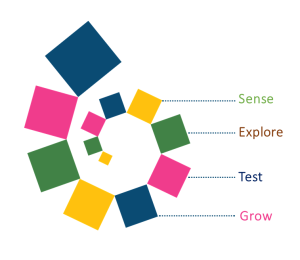
- Sense: We will identify early signals – emerging trends and patterns in the area of citizen participation in Kazakhstan.
- Explore: We will tap into uncommon data sources, such as people’s stories, social media, video analytics. Our Solutions Mapper will immerse into communities, investigate existing practices in Kazakhstan and see what solutions we can test further. One of existing national efforts to bring citizens’ opinions has been the National Council of Public Trust.
We will identify what solutions are there that we can bring to Kazakhstan. For example, Citizen Lab and Decide Madrid are international platforms that include citizens in the policy-making processes.
- Test: Our experimenter will identify potential prototypes or projects that can be tested at a smaller scale. We want to work with a wide range of partners, so if you think you are working on a similar topic – reach out to us! The goal of an experimenter is to test new ideas, knowing that not all will be successful, and then identify the best grassroots solutions that can be scaled up.
- Grow: Finally, our goal is to use a new framework for citizen participation to different processes and find a steward of this process – an organization that will carry on the work that we initiated.
We plan to use the experience of other Accelerator Labs that worked or are working on similar matters (e.g. citizen engagement in Argentina or Bhutan). We will also look into public innovation tools, such as Digital Democracy, Collective Intelligence, developed by Nesta – the Accelerator Lab’s strategic partner. Lastly, we will utilize existing UNDP efforts on improving public services driven by Astana Civil Service Hub to complement their work.
As we commence this learning cycle, we expect to, at first, have more questions rather than answers which is a unique way of working in development. Our next steps are to narrow down the focus to a specific life situation of a citizen needing a public service and to explore what has already been tried, what worked, and what did not. We want the system to recognize and empower the source of data that has the most say in public policies – people who use public services.
If you are working in the area of citizen participation in decision-making or have ideas what experiments we should run, reach out to the Accelerator Lab team by sending an e-mail to undp.kz.acclab@undp.org.
If you are into fashion or art & culture, you might have heard that Martin Margiela is arguably one of the most influential designers of our times. Margiela subverted norms in the fashion industry in the late 80s, challenged every form that was widely accepted and continues to be a massive influence on young designers. Margiela started his first collection in the Spring/Summer of 1988, communicating to the world a set of principles and values that the Maison would stand for in the next decades. Mysterious, coherent and subversive by design, Margiela’s success carries parallels and lessons for strategic innovation.
Having become more curious about Margiela and more ingrained in the world of strategic innovation, I started to see parallels (something I recognize as a professional distortion of continuously trying to abstract) – the role of our identity, the need to have a direction and clearly conceptualized design principles, the audacity to repeatedly press the system & deconstruct openly.
Here’s my readout:
- A clear definition of identity – who we are, what we bring to this space, and who we are in relation to others. Throughout our work on portfolios, one of the most difficult questions to answer has been who holds the portfolio. In typical project management, this is easily addressed and agreed between parties at the outset. But when we started dabbling in system transformation, we quickly found ourselves questioning who we are in this system, what is our right to intervene here, what we bring to it that adds value to other activities and who we are accountable to. We accept humbly that we are not relevant enough to transform the system, but we can merely be present, ‘probe’ it, and ideally learn from those experiences. In the latest module we ran on portfolio induction, our EU partners said that the role of international organizations like UNDP and the EU should be to de-risk innovation by designing, implementing and generating learnings for the government on where they should be channeling public finance. That type of clarity is something to aspire to.
- A shared direction (intent) – this is relevant to who we are and why we’re here. For the artist, it is the subject of their life’s work. For UNDP, it’s a function of our capability, identity and the assets, which we bring into the system. Accepting that the answer to that may be fuzzy and knowing that it can change (because the world is changing), the direction should be in line with the principles, values and the identity that we have. That intent can be shared at multiple levels – having a common mental model of our direction within an organization or team, or an intent that is shared amongst actors in the system. Intent communicates a will, which influences action, distribution of resources and leads to discovery. Whether between different actors or within an office, having that shared intent requires negotiation, discussion, openness and trust – in a never-ending cycle of recalibration and mindfulness.
- In Uzbekistan, we worked with the AccLab team to design a portfolio on the future of work. By stepping out of projects, and marrying our assets and capabilities to the needs in the system, we determined that UNDP’s intent in Uzbekistan would be to attract resources, develop policies, model actions, and induce system-wide propensities towards responsive labor market, social resilience and green transition.
- Probing the boundaries, discovering the possible, reframing identities, learning from experiences – Margiela challenged who fashion was accessible to, the beauty standards in the industry, who gets the attention, and the celebrity of the designer. He never stopped exploring ways in which to manifest those values. We increasingly experience uncertainty and complexity, the pandemic being a perfect example, therefore the need to probe, make sense and adapt grows. For humans, this is a part of the evolutionary process and our own adaptation. Think about how we learned to distinguish between the 10,000 types of mushrooms that exist out there – which ones can kill us, which ones have hallucinogenic effects and which ones are nutritious. To apply some of this thinking to development, we produced Agora together with the CHORA Foundation – a meta-model for urban transformation, which functions like a water-pump, accelerating the generation of probes and enabling faster adaptation. The water-pump generates continuous options, when needed, which are coherent with the direction of the portfolio.
- Deconstruction & making the invisible visible – Margiela deconstructed the process of designing and creating clothing, and highlighted the beauty in the process, making the internal – seams and patterns – visible. In sensemaking, we take a deep dive into projects, deconstructing their elements by asking: what is it they are made of, what type of knowledge or other resources are they generating, what are the needs that exist or are emerging, how are we responding to those, and how are we set-up to respond? Instead of looking at projects as a single unit, we look at the relational aspect between what they generate and what they respond to, making the project frame almost obsolete.
- Through our practice, emergent as is, we are challenging established ways of doing things. Our relationships with partners are based on trust, openness and shared intent. The portfolio is a decision-making tool – what emerges out of it is accessible to all, and what we make sense of we hope to expand over time, opening the space to all with a shared intent.
Did Margiela intend to be subversive, or was this an unintended consequence of staying true to embodied values and principles? Maybe, but maybe not. In the end it doesn’t matter because human survival is a result of continuous adaptation and learning, and our role has changed and evolved over time to respond to how the context has changed. How can we expect anything less or simpler of a system that has been designed to work on some of humanity’s most complex challenges?
This blog has benefited from conversations and work with Luca Gatti (CHORA Foundation), Indy Johar (DML), Gorka Espiau (ALC), Giulio Quagiotto, as well as designer Venera Mustafa, and photographer Stella Schwendner.
Together with the EU, we are kicking off an online course on portfolio thinking. We will be updating this blog with weekly live entries, snippets and insights from the course designers, facilitators, speakers and participants following each session. The goal is to open a space outside the online classroom to speak about portfolio thinking, the challenges in applying it, the course creation and journey, and link up with other practitioners working to apply this approach. Check back to this article to see the latest updates.
The journey ahead of us
9 August | Yaera Chung
As we wrapped up our portfolio induction course with our colleagues from the EU and UNDP, who are part of the Mayors for Economic Growth initiative, our very last session specifically focused on what we mean by operationalizing the portfolios through dynamic management and how we pitch our thinking to our partners. We were joined by Luca Gatti from the Chora foundation, who explained the overall principles of how we dynamically manage portfolios through sensemaking, and Agnes Chimbiri from UNDP Malawi, who shared the country office’s experience on dynamically managing their governance portfolio. Here are several key takeaways from the session.
Dynamic management of portfolios occurs through iterative sensemaking. As we have repeatedly highlighted, the importance of having “learning portfolios” means that we are not implementing a basket of solutions to a problem, but rather embedding a strategic decision-making mechanism to understand the relationships and intervene. The dynamic management of portfolios requires an iterative sensemaking process that supplies constant learning. A well-designed learning portfolio will be constantly in need of knowledge and resources, and the iterative sensemaking of a portfolio will enable such knowledge creations and resource allocations through a constant flow of extracting data and information. Therefore, the sensemaking mechanism serves as part of the portfolio ‘brain’, whereby the thinking occurs across the activities and stakeholders, and recommendations are formulated to inform decision-makers.
Provide baseline conditions and build capabilities for dynamic portfolio management. Sensemaking of a portfolio is not an easy task, especially for the newcomers to the portfolio process and systems thinking. The example from Malawi could help us find an entry point for system change – identify baseline indicators of the system that would trigger the need for change and then, keep track of these changes in order to further expand our knowledge throughout the process. When UNDP Malawi initiated dynamic portfolio management, the very first step was to build such conditions and capabilities within the team and to engage relevant stakeholders (governments and development partners) in their learning journey. Iterative sensemaking, with clear baseline indicators, has helped the country office to build a repository of insights and actions for the portfolio. What’s more, the partners were also invited to join their sensemaking sessions to learn together and make strategic decisions accordingly.
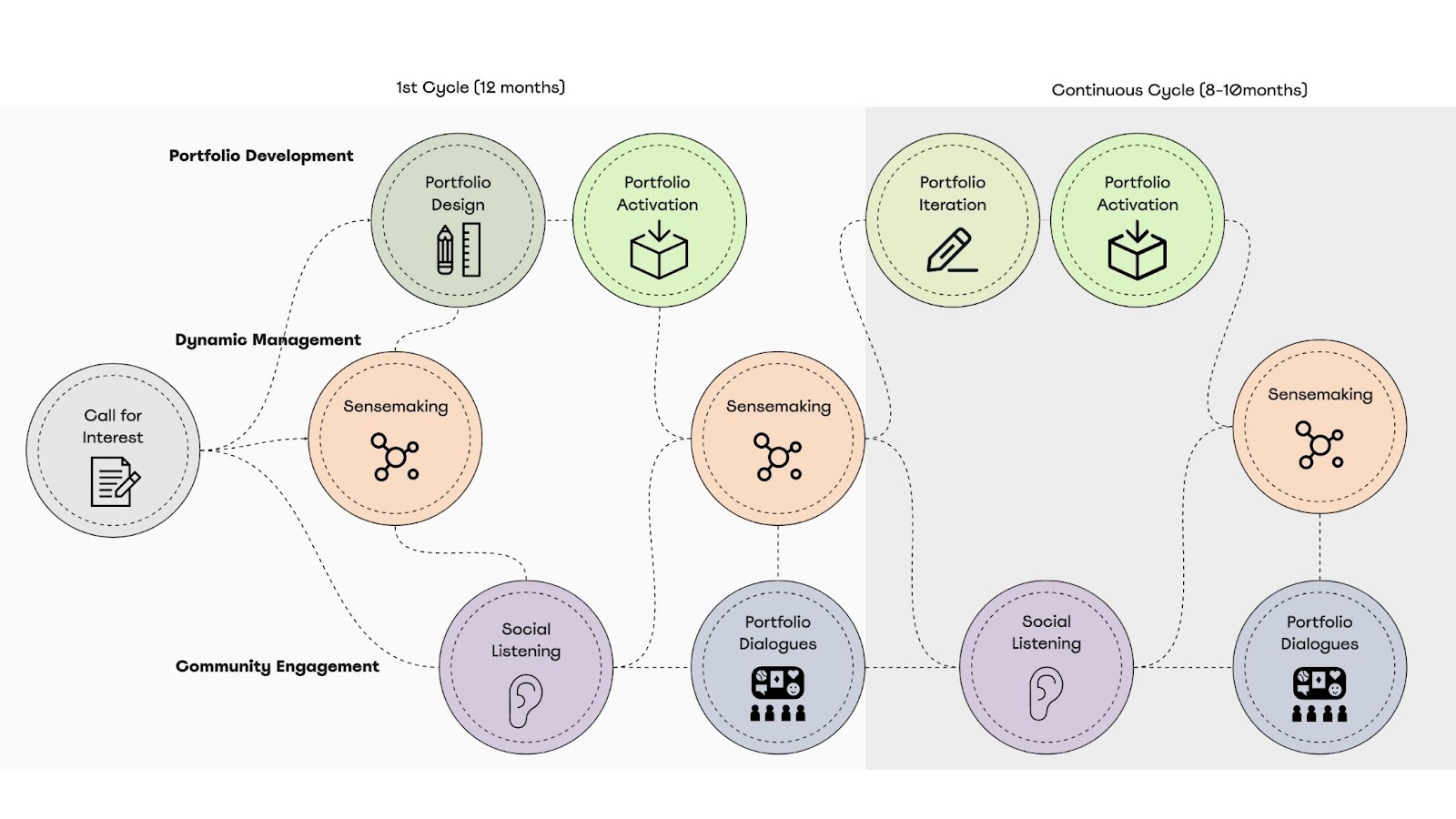
Our six-week portfolio induction journey has ended, yet a more exciting one now awaits. As the Mayors for Economic Growth project will launch its very first cohort on applying a portfolio of strategic options this fall, we will start utilizing the learnings from the course and applying sensemaking and dynamic management to our portfolios. We will continue sharing our experiences in applying a portfolio approach across cities in our region, because a learning journey never ends.
What’s in a name?
5 July, 2021 | Aditi Soni and Andreas Pawelke
Session 4 was all about portfolios: what is a portfolio, why having one in the first place and how to design and manage portfolios.
In the development sector, there is a growing interest in portfolio approaches and a lot of ongoing learning of what portfolios are and how they could address some of the weaknesses in the way development interventions are designed, financed and implemented.
In this session we experimented with a slightly unusual learning format. Instead of running presentations and exercises on the why, what and how of portfolios and the way we commonly apply them in the development sector, we reached out to people who work with portfolios in areas very different from ours: finance, art and policy.
We recorded interviews with experts from each of these three domains and asked them the same set of questions:
- Why have a portfolio?
- What is a portfolio?
- How do you design a portfolio?
- How do you manage a portfolio?
During the session, we split the group into three teams with each of the teams being asked to extract the relevant information from the interview recordings in order to respond to the four questions on a shared table displayed on a Miro board (see the image above for a summarised version of the table). As the teams reported back to the entire group, we built a collective understanding of the different definitions, objectives and approaches to portfolios. We’ve highlighted some of the relevant insights below:
Why have a portfolio?
While an investor’s portfolio is all about minimising risks and maximising return on investments through exposure to different sectors and businesses, artists use portfolios to showcase their work as their visual résumé, demonstrate their skills and get public recognition and interest from potential clients. In the context of policy, portfolios are used to overcome the challenges of project-based approaches, e.g. short term thinking, and as a way to recognise interconnectivity and allow for collaboration and scaling while simultaneously working on it.
What is a portfolio?
In the case of finance, a portfolio is a collection of assets – and in the case of private equity, it is defined as a collection of investments (in different companies, across different sectors etc.). In the world of art, a portfolio is the “collection of the works of the artist” that help them position themselves and their expertise and interest areas. And finally, in public policy, a portfolio is a set of interrelated programmes, projects and activities linked to a strategic goal.
How do you design a portfolio?
For finance, guidelines exist to design a portfolio based on what returns must be achieved on investment. Financial portfolios are also about risk mitigation and achieving set goals on profitability and returns. In the context of art, the designer of the portfolio gets to decide what goes into the portfolio based on aspects such as client needs, and how might they best communicate their skill sets through process and their identity as an artist. For policy, designing a portfolio is a result of formulating a mission shared by multiple stakeholders in the system and its context.
How do you manage a portfolio?
For a finance portfolio, investing in a portfolio is the start of a long journey, which means it is important to dynamically manage the portfolio after investing, via assessments around the value generated. For an artist’s portfolio, it is important to focus on a topic of interest in detail instead of going too broad and wide with the range of work that can be offered. Over time an artist’s portfolio can be expanded to add different ‘views’. Finally, for policy, it is important to take a deep dive into the set of mechanisms around the portfolios like support for collboation, emerging practices and any new support mechanisms in the system, followed by continuous learning and analysing of the outcomes. The policy portfolio expert we interviewed uses a learning history approach to collect, share and analyse what can be learned from the process of portfolio implementation.
This session also helped us tie a link between various external outlooks toward the what, why and how of portfolios and relate them to the context of M4EG in the upcoming sessions, using examples and drawing parallels across sectors.
We only know what we make
22 June 2021 | Gaia Bellavista
We kicked off our third session of UNDP’s portfolio development course by introducing an exercise consisting of a simulated conversation between a portfolio expert and the mayor of a city. Having previously explored the “why” of the portfolio process, this role play gave a safe space for participants to actively reflect on the newly acquired knowledge and make sense of new concepts by applying portfolio thinking to an upcoming initiative in their municipality. Inspired by Edgard Dale’s cone of learning, recreating a hypothetical conversation with a high-level decision maker outside the EU/UNDP sphere to discuss the value of portfolio thinking becomes a way to incorporate a direct and purposeful experience into the learning process. In the spirit of the philosopher Giambattista Vico: We only know what we make.
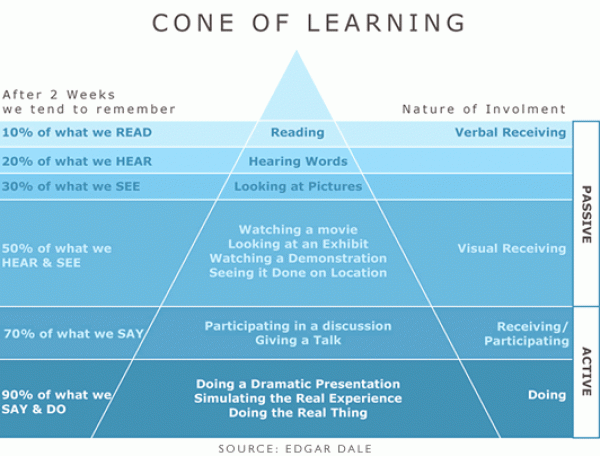
The discussion we had with the participants on the outcomes of the exercise sparked my reflection on the learning journey that organizations such as UNDP and the EU need to undertake to be able to embrace complexity in their work, and on how this effort should be met by a shift in mindset on the demand side. First, it is important that, as change agents, we acknowledge that innovation starts with us: with the way we rethink our roles, our identity as an organization, but especially, by the way we make sense of complex concepts ourselves and are able to deliver meaningful purpose. Are we able to fully embrace this new thinking in our work and reflect its value to external stakeholders? And to what extent can we integrate this new logic in our programming and operations so as to make them coherent with our ambition to tackle complex developmental challenges?
Second, and strictly linked to the first point, is the ability of organizations working with portfolio thinking to identify and work with decision-makers, who are willing to embrace a transformational approach, learn from each other and embrace a long-term perspective. However, contrary to the mayor in our group exercise, while positive attitude is not a constant, skepticism tends to be the most common response to innovation. The need to build a new type of demand to embrace the change in the way we manage complexity is thus paramount, and it all starts from the ability to codify emerging transformation approaches into practice to build credibility and encourage adoption.
Our learning journey has just begun, but the progress and shifting mindset are already remarkable. We are thrilled that we will be able to discover and discuss, together with our participants, the “what” and the “how” of portfolio thinking in the next few weeks, and hopefully, start building a learning path towards the next four years!
Easy to grasp, hard to do
16 June, 2021 | Tina Stoum
In the second session of the UNDP and EU portfolio development course, we began discussing the mindset shifts needed for embracing complexity. It was my first introduction to Indy Johar, Co-founder and Executive Director of Dark Matter Labs, and his focus on learning and humility struck a chord. Two aspects keep coming up for me during these last two sessions: moving from expert/solution provider to ‘listener in learning mode’, and moving from a command and control approach to ‘let’s see where this takes us (within the system) and adapt and manage risks as we go along’. Easy to grasp, hard to do.
First, on the ‘taking off the expert hat’, we are socialized to present our organisation as an advisory and (signature) solutions provider. We hear that our core resources are shrinking and that our member states (rightfully) keep questioning our ‘value addition’. How many talking points to senior management do we write for them to meet governmental counterparts, starting with the ‘why choose us’, i.e. we bring you value through our network, reach, and ‘best practices’ and lessons from around the world. It seems counterproductive to start the conversation with: ‘well, we do not know what the solution(s) are or what transformative change will look like, but we have some decent tools and can walk the path with you’. It’s intriguing, applying that humility, but we might need to work on a new pitch and narrative with regard to our relevance and legitimacy, to convince ourselves and sit more comfortably (as we listen and take less space), not to mention for those talking points. (And the possible gender lens and dynamics here would be interesting to explore.)
Second, the command and control approach, which as many things, including our logframes, was taken from the military then integrated in leadership and (people and project) management, allows us to believe that we can make the world ‘complicated’ (rather than ‘complex’) and nicely arranged in boxes of predictability and hence easier to measure (i.e. control). This is a more comfortable approach for many (and me included), as we like to ‘structure’ things, often in a linear or roadmap kind of way (e.g. work plan with clear results & indicators). As we (hopefully) move further toward learning and adapting instead of trying to control through predicting, I am curious to see what our new tools and resources might look like. How do we showcase that we can indeed be kept accountable (delivering results with public funds) even when that logframe is (finally) tossed out? No single point solution or pathway here.
Indy Johar on relevance, identities and mindsets
14 June, 2021 | Lejla Sadiku
We spoke to Indy Johar, from Dark Matter Labs, about how the role of international organizations is changing and what he anticipates is coming beyond the bend. In his view, the focus needs to shift towards decentralizing capabilities for system transformation, engaging in long-termism for the descendants we cannot imagine, and working on transnational value-creation. Besides listening to Indy, we recommend you also read Ministry for the Future by Kim Stanley Robinson, that Indy references, and The Good Ancestor: How to Think Long Term in a Short-Term World by Roman Krznaric.
Launching our portfolio induction course
7 June, 2021 | Andreas Pawelke
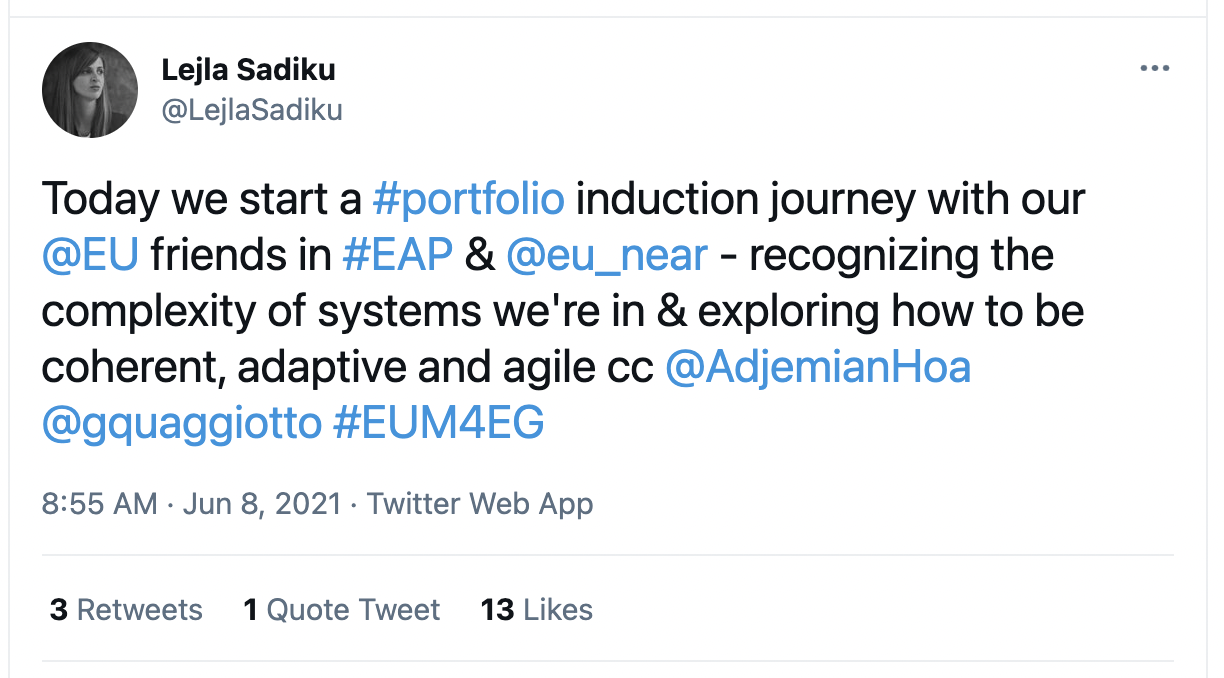
We’re kicking off an online course on portfolio thinking that we’re jointly running with and for colleagues from UNDP and the EU who are part of the recently launched Mayors for Economic Growth initiative.
Through the course we want to support those colleagues in applying a portfolio approach in the development and implementation of local economic plans with municipalities in the Europe and Central Asia region. By incorporating a systems lens through which local governments can address challenges from multiple angles to build initiatives that are coherent and connected, we’re hoping to move away from single-point solutions to a portfolio of strategic learning options.
Working in and with complexity is not something that can easily be taught in a classroom, much less so when the classroom is virtual. While we acknowledge the limitations of teaching the concepts, methods and tools rather than experiencing them, we’re trying to provide a learning environment that makes it easy (and fun) for everyone in the course to learn about working with complexity through the design and management of portfolios following several simple principles*, two of which we describe below:
Adopting a beginner’s mindset: Having a certain degree of expertise in a particular field can make it extremely difficult to teach the very basics of a topic. The speakers in our course know things the audience doesn’t – they’ve learnt from testing different ways of applying the methods and tools they teach and they have developed mental models that are new to the participants. In every session, we try to break down concepts into key components, use analogies and provide anchors that we find helpful in our own learning journeys.
Facilitating active learning: Anyone who’s ever run a fully online course, workshop or training knows how difficult it is to provide an environment for active learning. As course designers and facilitators, it’s our responsibility to capture the attention of participants, activate any prior knowledge they might have and create opportunities for students to learn through individual and collective reflection exercises. We’re trying to achieve this through a combination of teaching formats ranging from pre-recorded videos to live inputs and group discussions, collaborative tools such as Miro and Menti, and by using examples from sectors where portfolio approaches are being applied ranging from the future of work to depopulation and governance.
*Some of our learning principles are inspired by these and other online teaching resources. Feel free to get in touch if you want to learn more about how we go about designing and teaching the course as a whole or individual modules.
We are excited to announce that the United Nations Development Programme (UNDP) has started the implementation of the EU & UNDP Mayors for Economic Growth (M4EG) Facility (2021-2024). UNDP has country offices in 19 countries and territories in the Europe and Central Asia region, and close to 170 globally.
The Mayors Facility will focus on intermediate cities in the Eastern Partnership countries. We intend to work closely with local authorities in the region to explore and discover innovative ways to sustainable development, and expand the network.
Please see here a brief overview of the Mayors Facility 2021-2024.
Cities in the network will benefit from training and capability development as well as knowledge exchange activities focused around development of innovative growth strategies, that are highly contextualized and build on local ecosystems. This will entail support in developing a new generation of local economic development plans (LEDPs), strategic thinking and building urban resilience. Local authorities will benefit from new capabilities and access to funding addressing issues related to green recovery after the pandemic crisis – by integrating urban planning, gender responsiveness and innovation at the local level.
To support the implementation of local economic plans, together with the EU, we will introduce an approach that is currently piloting within UNDP itself on portfolio design and management. This method builds on the assumption that the world is complex and operates through systems (e.g. the market, climate change, inequalities, and so on). These systems that we operate within consist of a myriad of agents with different ambitions, interests and values, and hence we cannot fully predict behaviors nor are there any ‘right’ solutions waiting to be discovered. With this mindset, the proposed method will support municipalities in building programs that incorporate a systems lens – addressing challenges from multiple angles, designing initiatives that are coherent and connected, and practice agile and adaptive management.
Learning materials on innovative methods to local development will be made available to all members of the network through a new Urban Learning Center. Cities with developed LEDPs will gain access to EUR14 million in diverse funding opportunities, combined through EU and EU&UNDP M4EG funding calls. These calls are:
- EU M4EG Call for Proposals, closed on 6 April 2021, evaluation of proposals are ongoing, with a total of EUR 10m. For more information, see here.
- Annual Portfolio Call for Interests (estimated June-July 2021), followed by an Annual Call for Proposals. These are expected to be held on an annual basis. Estimated total of EUR 2.8m
- Annual Innovation Call for Proposals (estimated fall 2021). Estimated total of EUR 1.2m.
More details on the above components of the new phase will be communicated to all members of the network in due time.
We plan to invite all members of the network to interactive Country Launches in early summer 2021.
We are looking forward to continuing the wonderful work that has already been underway in Eastern Partnership countries.
**********
Media enquiries
Anton Sydorenko, M4EG Communications Lead, anton.sydorenko@undp.org
For other enquiries, please contact us through eu.m4eg@undp.org
Background
The Mayors for Economic Growth Facility is a follow up of the Mayors for Economic Growth (M4EG) initiative, launched by the European Union (EU) in 2017 to support Mayors and municipalities of the Eastern Partnership (EaP) countries to become active facilitators for sustainable economic growth and job creation.
On 30 April 2021, the EU and UNDP held an internal launch where Professor John Kay, one of Britain’s leading economists, gave a keynote presentation around his latest book “Radical Uncertainty” focusing on decision-making in a complex world.
About UNDP
As the United Nations lead agency on international development, UNDP works in 170 countries and territories to eradicate poverty and reduce inequality. UNDP helps countries to develop policies, leadership skills, partnering abilities, institutional capabilities, and to build resilience to achieve the Sustainable Development Goals. Our work is concentrated in three focus areas; sustainable development, democratic governance and peace building, and climate and disaster resilience. Read more about UNDP here.
The following piece was first published on the UNDP Eurasia and was originally published on March 22, 2021.
It’s 2021. People and ideas are traveling faster than ever before, social and political movements are quickly self-organizing, and decision-making has accelerated due in part to the heightened pressure of reacting quickly to a fast-changing environment.
In ancient Greek cities, an agora was an open public space serving as a gathering or assembly area. It is the best representation of the city-state’s response at the time to accommodate the social and political order of the polis and bring different areas of city life together. For the innovation team at UNDP’s Istanbul Regional Hub, Agorà is a City Transformation Portfolio — a template that can be applied in any city system for designing and managing pandemic response and renewal plans aiming for urban transformation.
In our current situation, there is a lot of uncertainty about what will happen “next”, making it much harder to make strategic decisions and predict the outcomes of planned interventions. The Covid-19 pandemic made the systemic effects across all sectors all to clear.
This is also becoming more visible in the development sector, where challenges are multi-faceted and cannot be tackled through linear thinking and single-point solutions.
Too large a proportion of recent “mathematical” economics are mere concoctions, as imprecise as the initial assumptions they rest on, which allow the author to lose sight of the complexities and interdependencies of the real world in a maze of pretentious and unhelpful symbols.
— J.M. Keynes, Economist and Author of General Theory of Employment, Interest and Money
As both arenas of disease outbreaks and major socio-economic engines, cities are at the centre of the crisis and responses to it. But all social systems, such as cities, are complex in nature. Complexity as such is not the issue at hand. Our way of responding to it is.
Our current responses and organizational cultures are often ill-equipped to take on the uncertainty and the systemic challenges we face. We have a tendency towards saying that we know what the problem is and how to solve it. In this linear thinking, we too often oversimplify the problems and their evolving dynamics, hampering us from addressing the deeply rooted, systemic issues.
“No particular games should be expected to predict the future…Good simulations are not about coming up with a solution to put on a shelf. At best, they inform a continuing process…iterative learning is part of a healthy policy process, and policymakers may pay closer attention to replicated findings.”
— Reid Pauly, Assistant Professor of Nuclear Security and Policy at Brown University
Designing responses with a systems approach takes time and new types of capabilities and funding modalities, which may be difficult during a pandemic where the urgency to respond leaves little room to explore, learn and adapt.
Since the start of the pandemic, our team has been working with the Chora Foundation to think through how we can better support UNDP country offices and their urban partners to tackle the uncertainties; to move away from single projects into more systemic approaches. Cities are tackling global SDG challenges on a local level. Poverty, inequalities, unemployment and air pollution are all outcomes of interconnected systems, which require new types of policy design and implementation.
We started with a set of questions:
- What are the characteristics of cities and pandemics?
- How can we identify and visualize the system that we are working with?
- Are there general elements that are common to urban systems?
- What are common interactions and ‘attractors’ in urban systems?
- How to contextualize the template in local contexts?
- How can we identify our role in the system?
- How is portfolio design different from project design?
- How could we better enable learning in the portfolio process?

And our solution to these was a set of design tools and service offers to help country offices and their urban partners to integrate a more systemic lens into their work through the portfolio design and management practices, and help cities build their urban transformation portfolios.
This set gives cities a unique decision-making approach to design actions and take decisions concerning pressing issues, acknowledging their complexities and fast-evolving dynamics. To look beyond the surface of seeing “events” into identifying patterns, structures and values of the system.

In short, Agorá’s tools and processes enable cities to get access to the spatial representation of the urban system, which can be contextualized, build understanding of common urban system attractors, guide them in identifying interactions and relationships in their local system, support in mapping and making sense of the current interventions and provide new entry points for their urban programming, where connected interventions and constant learning and adaptation create the value.

As Donella Meadows has wisely put it: “Systems can’t be controlled, but they can be designed and redesigned. We can’t impose our will upon a system. We can listen to what the system tells us and discover how its properties and our values can work together to bring forth something much better than could ever be produced by our will alone. We can’t control systems or figure them out. But we can dance with them!”
So we welcome you to the dance floor and invite you to follow us on our journey to develop tools and capabilities for urban transformation and apply them in practice with our country offices and partners.
This article is the first in our Agora series that will follow our work on urban transformation and portfolio design and management. The next articles will dive deeper into the Agorá process insights and learnings, introducing the design tools and processes in detail.