
Category: Systems and portfolios
UNDP Europe and Central Asia launched a new videocast series on using systems thinking to solve development challenges. In this opening episode of the series on agorà, a novel initiative to design a portfolio of development options and new development response capabilities in urban settings, Nora Bateson, president of the International Bateson Institute, and Luca Gatti, founder and the chair of Chôra Foundation, discuss how we unpack complexity in societies and demonstrate its relevance through new ways of working in development. The discussion is moderated by Gerd Trogemann, Manager of the UNDP Regional Bureau for Europe and Central Asia.
While the COVID-19 pandemic has exposed vulnerabilities in our health, economic, social, political, and environmental systems, it has also forced a shift in the way we conceptualize complexity in society. Nora Bateson and Luca Gatti explore the impact of the pandemic on systems thinking, its implications for development paradigms and discuss how we can imagine a different future in which complexity and uncertainty are embraced as defining features of our society.
Reflecting on how the pandemic has fundamentally changed the way we conceptualize society, Nora explains that prior to the pandemic, speaking about intrasystemic fragility would have been far too abstract. After months into the pandemic, however, society has come to recognize that health is very much connected to education, technology and many other facets of our social system. This attitudinal shift in how we comprehend complexity and interconnectedness in society, Nora hopes, can open possibilities for new ways of thinking about how we address complex social issues, going beyond looking for simple solutions.
Explaining the importance of warm data and its implications for thinking through complexity, Nora defines the concept as the data of complex systems, of seeing the relationships between complex social processes via an analogy of learning to play the violin:
“Where is the learning around how you learn to play violin? Is it in your muscles? Is it in your relationship with your teacher, or …in the written notes of the music itself? … It’s in the relationship between all of those things!”
The way in which we have developed our response system to even describe what a problem is has blinded us to the complex conditions that created it in the first place. When the stakes are high, we tend to focus on reductionist thinking to measure and solve problems quickly, but this way of thinking doesn’t tell us about important interactions and relationships between multiple existing contexts. We need to think about information in a new way – moving away from problem-oriented approaches and into understanding the conditions and relationships to build solutions.
Emphasizing the necessity of systems thinking and the productive shift that has occurred against the backdrop of the pandemic, Nora argues that those communities that have been left behind by society, that are in the worst conditions, are the fastest at picking up and using complexity thinking to lift themselves up. They know what a systemic problem is because they live it.
Moving to the importance of using systems thinking and a portfolio approach to enabling various options for development, Luca explains that portfolios of options work on two levels:
- First, we need to look at the role of relationships and experiences in influencing the system. Apart from the various informational assets that you have at your disposal, the portfolio approach enables us to be on the ground to learn and discover.
- Second, against the backdrop of the old paradigm of prescriptive experts presenting problems and solutions, options create relationships with communities to say: here is a capabilibility that you hold and that you can use to make decisions about yourselves.
“A portfolio of strategic options is that noble gift where you are literally bringing a capability and saying: this is how you could do it… Nothing is more precious to the resilience of a system than the capability it has to make decisions about itself.”
– Luca Gatti
Concluding the conversation with a discussion on the concept of ecological flexibility1, Nora underlines the crucial need for another kind of flexibility. We need to think about ecological flexibility in terms of our ways of perceiving and thinking – to go beyond pragmatic, solution-bound thinking that seeks to measure impact narrowly. We need to be able to meet the complexity on the ground in the communities and cities. “There is no KPI that you can fit systemic work into because it’s moving through multiple contexts.”
“And I would say this is probably one of the most important issues of our time. How do we actually start to talk about the living, difficult, blurry processes that we live within in a way that matches or meets that complexity.”
– Nora Bateson
Speakers:
- Nora Bateson is an award-winning filmmaker, writer and educator, as well as President of the International Bateson Institute, based in Sweden. Her work asks the question: “How can we improve our perception of the complexity we live within, so we may improve our interaction with the world?”. As an international lecturer, researcher and writer, her work brings the fields of biology, cognition, art, anthropology, psychology, and information technology together into a study of the patterns in ecology of living systems. She is founder of the Warm Data Lab and author of Small Arcs of Larger Circles.
- Luca Gatti is a founder and the chair of Chôra Foundation. He has extensive experience in the articulation of policy and the facilitation of governance, and a deep understanding of the leadership and operational implications of Strategic Innovation processes. He has previously worked in both public and private sectors across the globe in bringing conceptual architecture of decision-making centred around resilience and renewal. He is currently working with UNDP on the Agora project to design a portfolio of development options for cities in the region.
Moderator:
- Gerd Trogemann, Manager of the UNDP Regional Bureau for Europe and Central Asia Istanbul Regional Hub
1.The concept of “ecological flexibility” emerges from Gregory Bateson’s “Reconstructing the Ecology of a Great City,” originally prepared for a symposium of city planning in October 1970. Ecology and Flexibility in Urban Civilization, Steps to an Ecology of Mind by Gregory Bateson
Seriously… “strategic” innovation?
So yes, the rumor is true: UNDP recently set up a Strategic Innovation Unit. And yes, we know what you are thinking…
We explained part of the rationale behind this new chapter in our innovation journey in a previous post. The emergence of the need for a renewed focus on strategy at this particular juncture is perhaps better understood (with another nod to Yuen Yuen Ang!) as a result of co-evolution. In the last couple of years, UNDP launched a number of bold initiatives in the innovation space, such as the Accelerator Labs (which recently grew to 90 globally) and the Digital Strategy, aimed at “splicing digital into UNDP’s corporate DNA”. And this on top of a number of ongoing activities at the corporate and the regional level: from digital finance to NextGenGov Asia, from the “deep demonstrations” to Boost (just to name a few).
More importantly, the external context has also changed significantly. The COVID crisis has deepened pre-existing structural inequalities, bringing skeptics to question whether the SDGs framework is still relevant or indeed achievable. Against this backdrop, being able to demonstrate that a different mode of innovation is possible — a mode that is transformational, can dramatically change trajectories and embraces uncertainty — has acquired a new sense of urgency.
The shifting ground around us, a different type of demand from our counterparts and the availability of new organisational assets has gradually shifted the needle for UNDP, creating a new awareness of the potential of innovation for development but also generating important questions as to how those assets can be leveraged in a more systematic, transformational way. After all, as Rowan Conway reminded us, fast is not a direction.
Perhaps one way of visualizing the current organizational zeitgeist is through the Steinberg’s funnel (see below): the flurry of tactical innovation activities on the right end of the funnel (from hackathons to solutions festivals, from challenges to “nudges”) has generated the need for a new conversation focused on decisions that are taken on the left end of the funnel, which are more big picture and foundational: why are we doing this in the first place; are we perpetuating existing power imbalances; are our interventions coherent with the nature of the complex challenges we are facing (from depopulation to plastic pollution); can we orient our efforts toward system transformation.
Working out loud, colleagues surfaced questions like how do we go beyond the let a thousand flowers bloom and accelerate the effects of development portfolios; what does success really look like; how do we promote alternative innovation narratives to the predominant Silicon Valley paradigm; and, how do we shift from funding projects to funding system transformations.
These questions shift the focus away from tools and methods (design thinking, blockchain, etc.) to mindsets and organisational culture (e.g. embracing uncertainty, working with emergence, taking a long term view). They direct our attention to program/policy formulation as the entry point for a strategic conversation on innovation rather than individual projects or experiments. Whole of office conversations rather than a few isolated champions. What is at stake increasingly is programmatic coherence: quick fixes and single point solutions will not lead us to tackle issues such as COVID recovery or decarbonisation effectively.
As aspiring change agents, we need to acknowledge that change starts with us: revisiting our identity, going beyond the “rebel” DNA of the early days (want change? ‘be the calmest and most helpful person in the room” advised us Pia Andrews) and embracing a role of orchestrator of talent and facilitator of movements. How can we infuse system perspectives and portfolio logics into the dark matter that drives our work, deep into the heart of the mothership. To do so, we need to develop new capabilities to “see” systems (starting from our own) and their arrangements (e.g. why is this waste or employment system “stuck” in its current state?) to induce transformational effects and create appetite and institutional capacity for renewal (there are currently 20 UNDP teams around the world developing & applying the new capabilities in a range of policy spaces).
What kind of questions can we explore together?
In any bureaucracy, new units are in danger of being tempted by the “tabula rasa” mindset. From the above, it is obvious that the mandate we were given points to the exact opposite: we know that there is lots of innovation already happening at all levels across our system, but we need to get better at answering the question of what does this all add up to.
Another danger is the “black or white” syndrome. Putting a greater emphasis on strategy does not mean diminishing the role of more tactical interventions: this is not an “either/or” scenario and if anything the COVID emergency has reminded us of the importance of quickly deploying solutions to those in need.
The dreaded “strategic” in our unit name then signals the intent at this point in our organisational journey to look at the many, existing innovation assets across the organisation (and our partners) and interrogate them from a new perspective, directing their use to meet that sense of urgency for deeper transformations needed to achieve the SDGs.
In practice, we are interested in exploring with our country offices and our partners this initial set of questions (expecting that these will evolve over time):
1. How do we orient our efforts more purposefully from small experiments and single point solutions to system transformation?
-
How do we position innovation strategically in our country programs, ensuring that assets such as labs, deep demonstrations, etc. are leveraged towards system transformation, while still delivering tactical wins?
-
How do we shape demand away from single point solutions and “quick fixes” so that we direct it towards more systemic effects? How do you engage, for example, a city planner who wants a “smart city” solution right here, right now in a conversation about its long term effects on equity and sustainability (and possible negative consequences?)
-
How do we ensure that our program’s logic is coherent with the complexity of the challenges faced by our government counterparts and the communities we serve?
-
How do we move beyond a projectised view of the world to develop portfolios of development options? This ultimately implies taking a long term view, rethinking our implementing and financing modalities and challenging our identity as “solution providers”
2. How do we generate actionable intelligence from our portfolios and build institutional capacity for adaptation?
-
How do we create robust mechanisms for collective learning and reflection from our portfolios with our partners (alongside mechanisms for accountability and reporting)?
-
How do we build institutional will, political space and capacity for adaptation based on the insights from our portfolio — as we expect to face increasing levels of uncertainty?
-
How do we make the most of existing assets in our portfolio and leverage them to greater effects? How do we become more aware of our blindspots?
3. A number of donors and governments are also exploring portfolio approaches and system perspectives to get better results from their investments. How can we engage with them?
-
How do we engage with donors and governments who are exploring system and portfolio approaches (from food systems to health) in a joint journey of discovery of what comes after logframes and projectised interventions?
-
What new financial mechanism do we need to develop if we want to fund system transformations rather than individual projects?
-
What are the “deep demonstrations” that are needed to prove that we can organise ourselves differently and explore new intervention logics to deliver better results?
4. How can we develop new capabilities for system transformation and become better orchestrators of talent?
-
How do we develop new capabilities for system transformation for ourselves and our partners? What do we need to change in ourselves?
-
How do we become better at working with emergence (rather than planning), dealing with uncertainty and recognising unbalances in power dynamics?
-
How do we become better at leveraging competencies that are already existing within the organisation and within our partners and create opportunities that aggregate their impact over time?
The journey has just begun, and we certainly have more questions than answers at this point. If these issues resonate with you and you are interested in exploring these questions, we’d love to hear from you.
Source: UNDP Innovation
Never has the interdependence of our world been experienced so starkly by so many at the same time. Covid-19 and the response to it has shown us the realities of the interconnectedness of our system, with one action leading to secondary and tertiary consequences across the globe. Leaders and decision-makers are being urged to shed non-systemic thinking and embrace a broader and deeper understanding of causation and consequence. It has also given us at UNDP a period of intense reflection on how we can reshape our approach to tackling development challenges.
In the last few years there has been a growing interest from the public, private and development sectors in adopting a systems lens to develop portfolios, capable of addressing complex issues, and thus moving away from linear planning, short-term interventions or one-off projects. To support transformation and build more resilience, we need to catapult strategic innovation to the center of the way we work. This approach helps us make sense of complex environments and uncover the dynamics that have the greatest potential for impact.
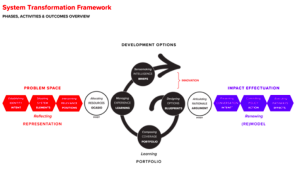
The pandemic has accelerated this process by forcing us to apply a systems lens to our work immediately. We at UNDP North Macedonia, with support from the UNDP Istanbul Regional Hub, decided to apply the Systems Transformation Framework, developed by the CHÔRA Foundation, to our strategic planning process and our response to Covid-19. We utilized this framework which envisages several key modules – (1) problem space design, which is a tool to examine and analyze the root causes of development issues; (2) portfolio design (programs, projects, etc.) to be put into motion; (3) sensemaking, a tool to extract intelligence that will help us to consistently adapt and recalibrate our portfolio. Such an approach to planning builds in flexibility and learning, allowing us to respond effectively when facing various types of shocks, including public health and economic crises, and natural disasters.
We pioneered the design and implementation of the first fully digital workshop and the first one to focus on applying systems thinking in support of strategic country programme planning. As this is a nascent process, we learned along the way, constantly adjusting and refining the methodology to fit our needs on a country level and at UNDP.
Having identified migration, climate change, pandemics and governance as key development challenges, we were introduced to this approach and worked online in groups to represent each challenge as three-dimensional problem spaces. Imagine a problem as a landscape with three distinguishing geographical features, each representing a single dimension of that problem and each interacting with the other dimensions, as well as a lateral dimension. By the end of the workshop we formulated an intelligence brief, a strategic argument and our intent for the four challenges we selected, to serve as the foundation on which to eventually build both UNDP’s and the government’s capability to design a dynamic portfolio that will facilitate informed policy action.
Our four key insights on the process thus far:
-
Defining the problem: To successfully address complex issues, it is essential to take the time to unpack the problem. This approach encourages the separation of problems and solutions, steering us away from an over-reliance on unexamined assumptions and a tendency to jump to conclusions about what is the best solution to the problem. For example, it helped us to understand that if we want to tackle out-migration then we should focus directly on its root causes: the low quality of life, jobs, education, healthcare and the high levels of pollution.
-
System transformation: We were and are aiming at transformational change, and that is linked to our integrator role. There was no clear framework for how to best accelerate such a transformation. In that sense, this approach can serve as an instrument to break the silos, both in our minds and in the way we do programming. Our ultimate goal is to support systemic change in the countries in which we operate. But to succeed in that, UNDP will need to lead the way by first showing that we can transform our own system. If we want to be credible and persuasive, we will have to walk the talk.
-
Shifting mindsets: When defining problem spaces and the strategic intent, the framework pushed us further to think beyond the UNDP practice areas and into visualizing problems in all their complexity, along with our role in addressing them. It revealed both the strong and weak points of our current programme, while guiding our understanding of where more action is needed to instigate and/or accelerate the desired change. The consistent application of this approach by us, accompanied by building government capabilities, will support elevating our thinking beyond individual projects and siloed policymaking and help us develop portfolios that will generate the learning needed to drive transformation and build system resilience.
-
Leadership: Developing this leadership capability requires internalizing the approach, which takes time, organizational adjustments and a mind-shift. One workshop is not enough. It is a marathon, not a sprint. It requires leadership at UNDP country offices to build the capability to dynamically manage development portfolios, constantly adapting and informing policy and decision-making processes based on insights. Such strategic leadership requires a profound understanding of complex system dynamics and the implementation of transformative policies and interventions. Hence, for this framework to be effectively applied and yield results, these capabilities will need to be a part of the core competencies of UNDP leadership at all levels and of the key champions in government institutions leading the transformative efforts.
The Way Forward
For us at UNDP North Macedonia, the next steps involve taking this work to the next level of portfolio development by going through the full process – problem space design for selected issues, mapping existing projects and identifying areas where new options can be designed, including in our response to Covid-19. This will help us distribute risk and ensure we are on a path for systems change.
We will continue to work out loud and to exchange insights with partners, other UNDP country offices and the regional hub that are keen to explore and address uncertainty. To weather future shocks, both UNDP and governments need to build resilient and flexible systems capable of addressing complex challenges.
With many thanks to Luca Gatti, Founder and Chair of the Managing Board of the CHÔRA Foundation, for his input, mentorship and inspiration.