
Artificial intelligence (AI) is increasingly shaping how cities deliver services, manage infrastructure, and make decisions. For many municipalities across Europe and Central Asia, the challenge is not simply adopting AI, but understanding where it genuinely fits their institutional context, what it demands in terms of readiness, and how to engage with it in a way that is grounded, responsible, and connected to their existing priorities.
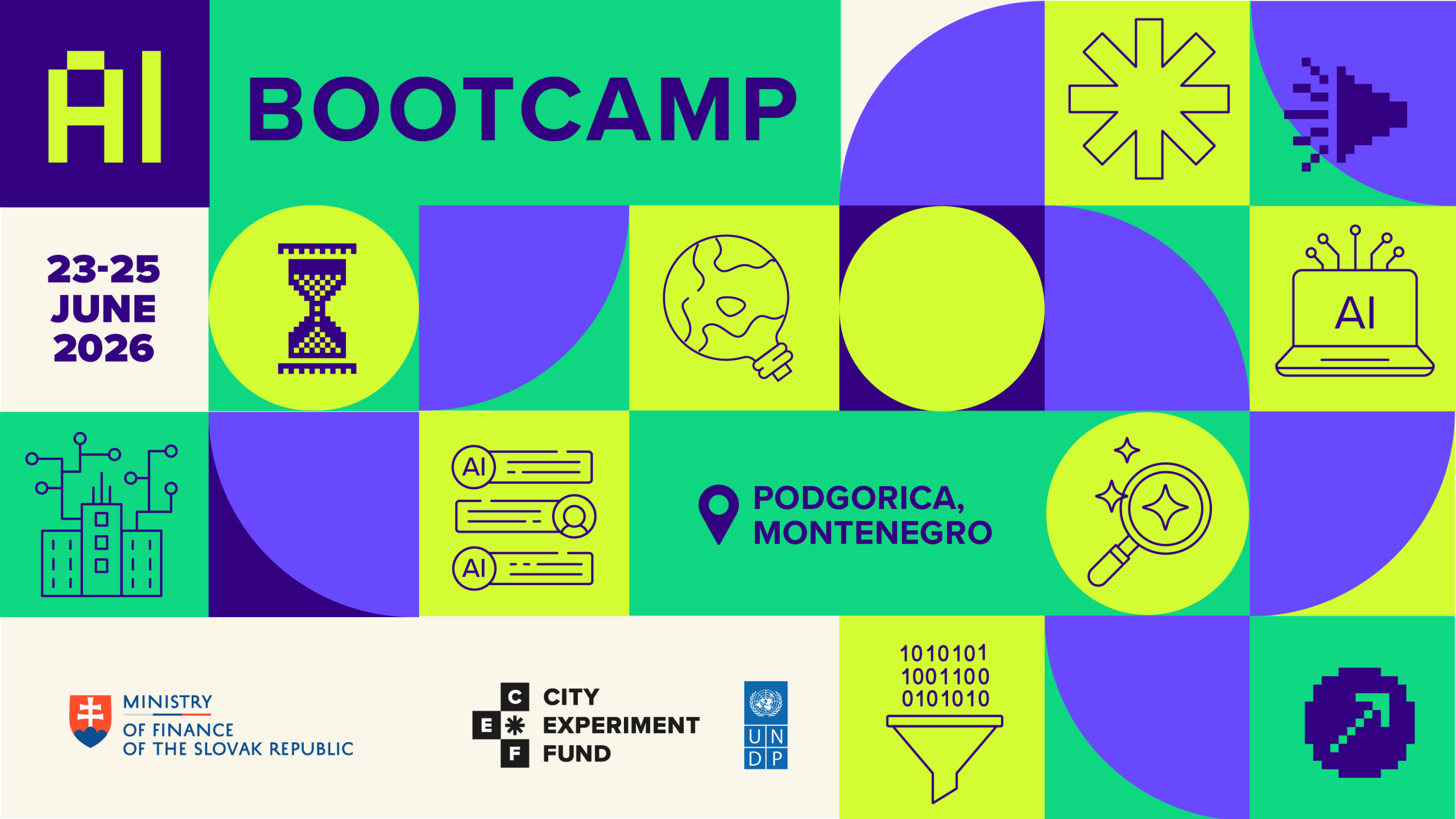
To support this work, the United Nations Development Programme (UNDP) in Europe and Central Asia is convening the CEF × AI Bootcamp in Podgorica, Montenegro, from 23 to 25 June 2026.
The bootcamp marks the first milestone of the newly launched CEF × AI programme, part of the City Experiment Fund (CEF), bringing together municipalities from the region to explore how AI can support their green and digital priorities. Over three days, city teams will work through their own challenges, assess their readiness for AI, and identify practical opportunities for experimentation and implementation.
Selected municipalities have been invited to the bootcamp following an Expression of Interest process and completion of an online AI Foundations for Municipalities course to help public servants build a shared understanding of AI, its applications in urban contexts, and what responsible engagement with it looks like in practice.
The following municipalities have been selected to participate in the CEF x AI Bootcamp in Podgorica: Yerevan, Armenia; Kavadarci, North Macedonia; Skopje, North Macedonia; Podgorica, Montenegro; Pluzine, Montenegro; Rivne, Ukraine; Mykolaiv, Ukraine; Kharkiv, Ukraine; Pristina, Kosovo [1].
What cities will work on
Participating municipalities will work through a structured process designed to take them from a broad understanding of AI to clear, actionable directions grounded in their specific contexts.
Cities will begin by mapping their AI ecosystem, examining what data, infrastructure, governance structures, and actor networks they already have, what is missing, and what is already in motion. Building on this, they will move into problem framing, identifying which challenges are most worth pursuing and how AI could meaningfully support their twin transition priorities. Cities will then assess the feasibility of their proposed directions and examine questions of responsibility: who could be affected, where accountability gaps exist, and what governance would be needed.
By the end of the bootcamp, each participating city will have developed its own AI pathway, identifying at least two concrete directions for exploring how AI could support its work. These pathways will also consider the surrounding building blocks required for responsible adoption, including governance, ethics, privacy, partnerships, and institutional capacity, informed by what cities have mapped and learned throughout the three days.
Throughout the sessions, cities will hear from experts and practitioners working at the intersection of AI and urban transformation, exchange perspectives with peers from across the region, and receive structured guidance and one-to-one mentorship from the facilitation team.
Cities as active participants, not passive adopters
A core principle of the bootcamp is that cities engage as active shapers of how AI is integrated into municipal services and processes. Rather than promoting AI as a solution in every situation, the programme encourages cities to critically assess where it can create meaningful value and where other approaches may be more appropriate. The bootcamp is therefore designed around the cities’ own priorities, submissions, and questions.
The bootcamp also addresses the conditions that make AI engagement sustainable over time: institutional readiness, coordination across teams, data and infrastructure requirements, and the governance frameworks that responsible AI adoption demands.
What’s next
Following the bootcamp, cities will be invited submit proposals to continue into one of two supported pathways: the CEF × AI Demonstrator track, focused on building longer-term institutional AI capacity, or the GenAI Challenge track, which matches cities with external innovation teams to co-design and pilot targeted AI solutions.
The programme is implemented by UNDP through the City Experiment Fund (CEF) with the financial support of the Ministry of Finance of the Slovak Republic. CEF collaborates with cities across Europe and Central Asia to tackle complex urban challenges through strategic innovation and experimentation.
[1] References to Kosovo shall be understood to be in the context of United Nations Security Council resolution 1244 (1999).