
Tag: Blockchain
The following piece was first published on the AltFinLab blog and was originally published on November 3, 2017.
Technology can both empower and disempower. At a recent workshop on blockchain, we landed a challenge: how can we use it to facilitate refugee integration?
I am an immediate misfit in the dynamic multiverse of people speaking in code. But at this USAID event led by the UNDP Alternative Finance Lab and AID:Tech, I wasn’t the only one.
My team, half tree-huggers and half tech gurus, started our brainstorming with this question: what do we have in common? The answer was a strong sense of identity. That fragile sense of self, inflated when our boss pats us on the back and shattered when somebody “swipes left”.
Displaced people often struggle with identity loss. It isn’t just about that “blood and soil” sense of belongingness that disappears when houses, families and an entire mosaic of memories are left behind. It is also the more abstract notion of dignity that ebbs and flows as you knock on doors that don’t open or file asylum and job applications without success.
After ten minutes of philosophizing, we identified our target group: refugee families in transit. More specifically, in camps or settlements. How do they get by? Some may have their own means, savings or earnings. But most rely on vouchers, cash transfers and the like, handed over by humanitarians, development banks, municipalities or governments.
There are many ways to use and abuse that system – most notably if one family member thinks that he/she knows best, but their best isn’t in everyone’s best interest. While a mother may need health services, her 17-year old son might want to learn the local language to be able to start a -business one day.
And of course, this is assuming that all family members’ wants and needs are underpinned by rational choices that would maximize their income and well-being. In reality, though, not all of them want to fight. Some of them just want to forget.
Can blockchain help those of them that want to pursue happiness to do so? Can it help organizations managing camps or settlements keep better track of the aid that they distribute and the demand for different services?
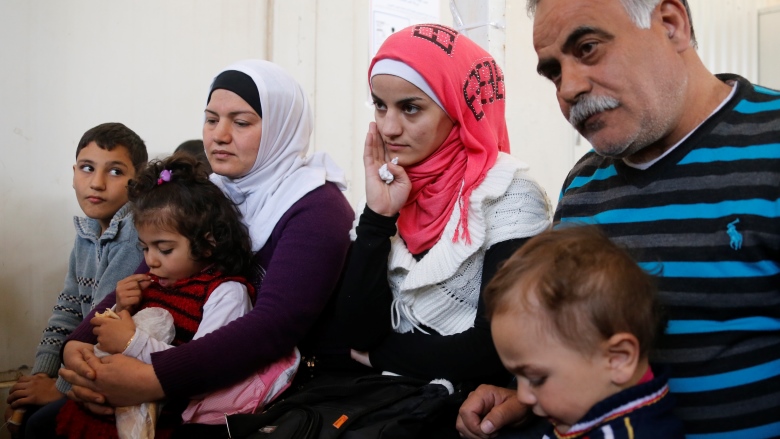
In comes our tradeable token system! Think of it as creating a refugee micro-economy: every individual aged 16+ could register for a personalized blockchain profile and start receiving a monthly package of tokens. The use would be limited to a set of services, which could include food, education and training, healthcare, and so on. Using their mobile phones, refugees could then start exchanging tokens based on what they need at that moment.
Having the digital footprint of blockchain would also help those of us in the humanitarian arena to get a better sense of what displaced people want. This way, we could get better at tailoring our toolkits to assist them. Then, refugee communities could transition from survival to making choices about their present and investing in their future. They could, perhaps, regain a sense of self, of their new identity.
In the end, our team won the workshop challenge. We were excited: Could this actually work? Where do we find someone mad enough to pilot it? That remains to be seen.
Coming up with innovative solutions to development challenges is the easier part. What we need to figure out now is how to integrate them into our day-to-day operations at UNDP.
The following piece was first published on the AltFinLab blog and was originally published on September 19, 2016.
Ten months ago we had an eclectic group of people introduce a slew of new financial mechanisms- blockchain based cash transfers and impact bonds for reducing recidivism to forecast based finance for disasters and peer to peer lending for SMEs- emerging into what the ODI calls a new ‘age of choice’ for the development finance.
We tackle this topic not just because there is a $2.5 billion gap in funding the current SDG agenda (even though ODA flows to developing countries continue to increase year on year). We are more tickled by the sheer explosion of money coming from other sources of funding that aren’t high on the priority list of either development organizations or governments (admittedly this is fast changing)- the European alternative finance market grew by 144% in 2015, the global impact investment market is projected to grow over $3 trillion in the coming years, and crowdfunding investments reached $37 billion in 2015 (by way of comparison, this is about ⅓ of total ODA totaling $131 billion in 2015).
This tickle gave birth to a sort of an Alternative Finance Labwe’ve (unintentionally) began running out of Istanbul. What skills do our clients need to tap into some of these new sources of funding? Is the effort worth it given the experimental nature of some instruments and the fact that they are way ahead of existing legislation in most countries we work in (think blockchain based remittance transfer)? Many of the mechanisms are preventative in nature and require a shift to costing future liabilities (think of a financial value on the cost society bears from youth unemployment- what does a ‘log frame’ for that type of a project look like?
In tackling some of these questions since the beginning of the year, we mobilized over EUR 3 million across a series of experiments with these new financial mechanisms:
Blockchain and development
In Serbia, we’re working with superstars from AidTech (check out their prize winning prototype on reducing fraud in cash transfers for refugees in Lebanon) to design a proof of concept for remittance transfers over blockchain that would be cheaper (in looking to cut out an intermediary a la Western Union) and targeted toward specific needs (think using remittances to pay energy or phone bills and purchase food). There are several similar initiatives ongoing (check out these Tunisian start-ups redefining remittances transfers with blockchain) but for us this is a first. In Moldova, we’re testing whether blockchain can provide a more effective way of managing the UN car fleet together with EmerCoinandDeePlace. We’ve been inspired by a decentralized ride-sharing outfit in Israel, Lazooz and driver-owned car sharing start up Arcade City. When it comes to UNDP’s emergency response in employment,we have a hunch that blockchain could provide a more effective way of transferring and tracking funds, and shifting our strategy in line with what is happening in the field– this is a work in progress though but one we’re excited about.
We’re cooperating with the Joint Research Center of the European Commission (check out an impressive line up of people they’ve had for a discussion on distributed ledger technologies a few months back) on design of a challenge prize for social applications of blockchain that would (hopefully) incentivize use cases that go beyond financial sector. The speed of progress in this field has been staggering with new use casespopping up across just about all priority sectors for our client governments- for example, the UK government just published research showing how digital currency based on the distributed ledger could up the GDP by as much as 3%. Others include blockchain based micro energy grids, land registries (Georgia) and election platforms (Ukraine’s Parliament), defrauding distribution of natural disaster relief funds (Italy) and philanthropic donations, managing and tracking the cross border SME trade, boosting girls education and storage of cultural heritage in political conflicts to name a few.
Preventative finance: social impact bonds and forecast based finance
In Serbia, we’re working with the Finnish Innovation Fund Sitra on designing a social impact bond on youth unemployment. We were inspired by their work on using this financial mechanism for public sector absenteeismand migrants and employment both of which have flipped the concept of welfare from being considered a cost to being the government’s investment in social outcomes. We will have some fresh data on this in the coming weeks, but accounting only for wages and taxes foregone and cost of social transfers avoided the cost exceeds EUR 1.5 billion a year (and this does not include other costs such as likelihood that unemployed youth may be more likely to suffer from depression and alcoholism, engage in violence). In Belarus, the European Commission has invested in our team to design an Outcome Buying facility(where impact bonds will be one of many instruments to include a mix of grants, impact investment, and others). The results of SIBs globally have been mixed at best, but we believe there is a lot to be gained from calculating future liabilities, attracting new sources of funding and holding pay-outs contingent on achieving the results (as opposed to fulfilling activities). Apparently so do others with thegovernment of Netherlands issuing its fifth SIB on employment, transitioning of youth from Out of Home facilities (drug and alcohol abuse) in Australia, and a massive $30 million first humanitarian impact bond launched by the International Red Cross and the Belgian government.
When it comes to the forecast-based finance, we’re learning from the best! Together with the Red Cross/Crescent Climate Center,our team in Bosnia and Hercegovina is designing the FbF mechanisms for the Vrbas basin. Ultimately our intention is not only to minimize the risk and secure funds before a disaster has received sufficient media support but also to test the feasibility of attracting new sources of funding (think insurance companies) for community resilience.
Crowdfunding in development
Since we launched UNDP’s 1st Global Crowdfunding Academy in December (followed by a succesfull Crowdfunding Academy in Croatia), we’ve worked on 13 crowdfunding campaigns that mobilized over $200,000 across a range of sectors including health, inclusion, energy and entrepreneurship- Kyrgyzstan raised funds for a more inclusive and energy efficient retirement home in a rural area, Indonesia got resources forrenewable energy in rural areas, Moldova mobilized funds for healthy food in public schools, and Yemen for a range of community projects unique to the conflict contextof the country. Currently, we’re preparing the launch of a campaign in Bangladesh on youth employment and Lebanon who already raised $116,000 for traffic management and control around public schools.
All of these were donation based campaigns where one of our main take aways has been their ability to link us up to interesting new partners and help us with advocacy. For example, our Tajik campaign attracted the country’s diaspora in Australia not only to donate funds but also explore investment in a similar new project in the eastern region. Famous chef, Jamie Oliver, supported our fresh fruit campaign for public schools in Moldovaand Bangladesh cricket national team captain Mashrafe endorsed the campaign for building employment skills for the youth. The Balkan rock star Rambo Amadeus got behind a campaign to build solar power sail boats on the Adriatic, andYahoo picked up on our efforts to invest in refugee-driven pop up restaurants. The Croatian Ministry of Construction prepared a pilot project for refurbishment of 30+ schools (and an energy agency designed a dedicated platform) to replicate our success with building the first Energy Independent school in the country.
Moving forward with this line of work, we’d like to put more emphasis on equity crowdfunding (example on investment in renewable energy community project) and peer to peer lending (check out this investment for SME on furniture design in Tajikistan) as our hunch is that these mechanisms can help us redirect vast diaspora funds more closely to bottom up, entrepreneurial projects in communities across the development work. We will have a chance to experiment with this approach together with the UNFCC with who we are currently designing a system by which crowdfunding can be utilised for renewable energy programs alone.
What’s next?
We’d love to see Open Bank initiative functioning in one of our projects (think a crowdfunding campaign where a single donor can track her investment through the point of a purchase) and we’d love to tinker with the GrowFundand Fund Club-like idea where we’d combine crowdfunding with corporate investment and peer to peer donations. Mobile money hasn’t taken off in Europe and CIS (which is where most of our time is invested at the moment), so we’d like to explore why and how to change that. We also haven’t yet but would like to troublemake with Disberseteam who seem to have put together a number of puzzles that for us are still up in the air- social cash transfers, impact bonds and payment for results, blockchain and transparency- all under the chapeau of future of development finance. We’ve also got a few things cooking with AlliedCrowds and Cambridge Alternative Finance Lab but more on that soon.
Ps. We would like to acknowledge the very first investor in our Alternative Finance Lab- the Ministry of Finance of Slovakia.
She is in her 30-ies, borderless, decentralised and the Master-Mind of “Governance 2.0”, the BitNation. Her name is Susanne Tarkowski Tempelhof and she shook the minds of #UNDPCrowd yesterday, as the Sun set down over Bosporus and the room was getting hot, powered by each person emitting 100 Watts worth of heat. 100×70=7kW heat. It is so hot I can’t think.
What the hack is BitNation?
I’ll quote them as that is the zest of their existence: „BitNation does not care where in the world you are from, where you live, or what passport you hold. Everyone has the right to enjoy high-end, competitive governance services.” And that is the point behind a gal who left school when she was fifteen and is self-thought since. She did quite well with self-education as she managed to crack-down and understand all the complexities and the opportunities of new technologies and she came-up with a borderless, decentralised, voluntary platform that is able to provide services in an alternative way. She did it so well that just recently the Estonian government approached her and now they work in partnership to provide public notary services to Estonia E-residency Programme!
The Internet of the 21st century
What technology I am talking about? The blockchain. A new database that will make us to re-write everything. For developers, the blockchain concept represents a paradigm shift in how software engineers will write software applications in the future, and it is one of the key concepts that needs to be well understood. Watching a short video “The Bitcoin and Blockchain Technology Explained” would be a good starting point to try to understand it. The next step of understanding would be reading my colleagues recent blog on Talking in tongues: From crypto currencies to breaking blockchains.
And do not even think you’ll understand it afterwards. You’ll only have more questions but that is fine – we need to start searching for the answers and we need to do it fast! Why?
We need SHIFTs
The same as for software developers, we, development professionals, need a paradigm shift in how we do work, how that work gets financed and how we assist governments to better do their jobs – to provide services in more efficient way to more citizens with less of those excluded from services for whatever reason. The blockchain technology brings the opportunities, besides cryptocurrencies, to do much more in less time, with less costs and through distributed networks. Distributed means more resilient, less controlled but transparent and secure as it is verified in such a way that is impossible to cheat. You can issue birth certificates, travel documents, credit cards, cryptocredit cards, land ownership certificates… by using blockchain technology. It is fast, efficient and cheap(er) then how it is done now.
The key message I was hearing yesterday (and today!) was “We need to change”.
We need to re-think the institutional architecture and to create the right institutional infrastructure that would make this innovative governance and funding models to work. The change needs to be systemic as only in that way we can solve systemic development problems the world is facing. There is no one, single “silver bullet” solution. Solutions are decentralised and borderless, people are part of solutions, technologies such as blockchain can be the backbone of it. But we need to understand it. We need to try it, we need to be able to fail, failing is a part of the process when you need to create a change in the system. It takes 10 years to change a system, said Paul Currion known for have been working in immediate response and relief to disasters and for re-thinking how that relief can be rapid, trackable, with low transaction costs and can give people what they need when they need it.
Do we want to be able to give people what they need, do it fast and efficient? Then we need to urgently set-up an alternative finance research unit and start trying how this works in real time with real people. We need to be THE new kid on the block!
The following piece was first published on the AltFinLab blog and was originally published on November 22, 2015.
From equity-based crowfunding and person-to-person lending, to crypto currencies and mobile money; entirely new players are disrupting the field of financing for development and public policy.
So, what does this alternative finance space look like? Who are the new players and what are they up to?
Crowd-power
According to the World Bank, the crowdfunding market is expected to grow to US $100 billion by 2025.
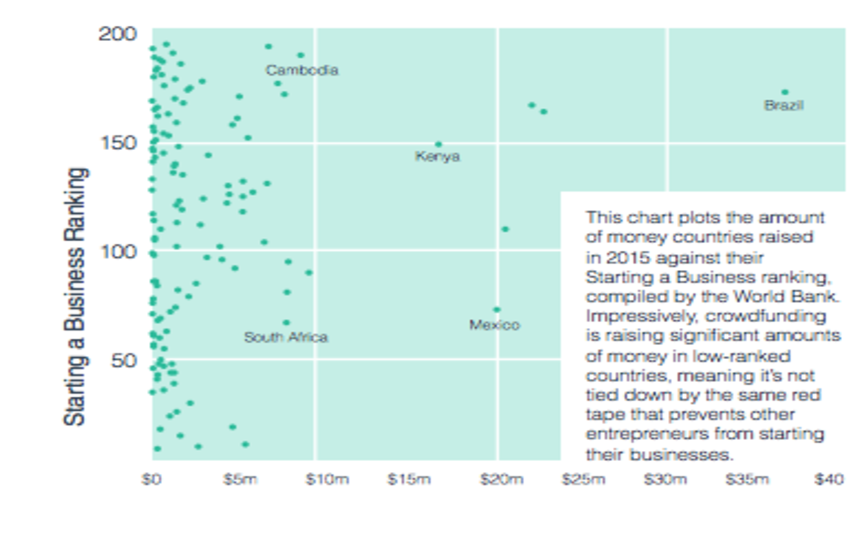
Recent research shows that – despite living in countries where the cost of doing business is quite high – entrepreneurs are successfully raising money by crowdfunding, and bypassing loads of red tape in the process.
And it’s not just money.
New platforms are springing up focusing on everything from expertise and volunteering hours toremittances for social good. The Danish government is leveraging crowdfunding for supporting startups, while Kenya is the first government in the world to enable crowd investment in an infrastructure bond. Neighborly launched a civic-micro bond project allowing citizens to invest directly in local public projects.
Research shows that if it is able to capture just ten percent of the global remittance market over the next decade, diaspora crowdfunding can grow to $58 billion.
Alternative and digital currencies
In response to the 2008 financial crisis, five friends with no finance background set up Sardex, an alternative currency for Sardinian businesses to continue trading and operating. This year trades of Sardex exceeded 32 million euros, and the model is now being replicated on the Italian mainland. Where traditional financing systems failed small business owners back in 2008, Sardex provided an ability to continue their operations and grow.
What potential might similar types of community currencies hold for rural and impoverished regions where we work?
Blockchain has been identified by the World Economic Forum as one of the six mega-trends likely to impact our increasingly connected world.
Blockchain is the technology behind bitcoin, it allows people to transfer money without a bank and write enforceable contracts without a lawyer.
International banks are setting up blockchain labs to incentivize startups, foundations, and citizens to collaborate on designing a new generation of services. MIT has launched the Digital Currencies Initiative to explore its potential for social impact (as did the University of Nicosia, which is the first accredited university in the world to accept tuition payments in bitcoin).
A non-profit, Stellar, is investing in financial literacy of the poor to tap into digital currencies, while early experiments using blockchain to reduce costs of transferring remittances and enable low-cost, rapid disbursement of funds in humanitarian emergencies are ongoing.
In October, BitNation registered the first refugees entering Europe via blockchain and provided anonymous bitcoin debit cards that can be used at any cash point on the continent. Just this month, another start up, Cubits, launched an instant no-fee crypto donation service for refugees arriving in Germany.
Here is an entirely new set of players in the sandbox traditionally occupied by governments and the development sector, looking at the same puzzles and coming up with new ways of solving them.
Is 21st century development about financing not giving?
A recent New York Times article argues, “financial success and social impact are becoming ever more linked, with the lines blurring between the business and nonprofit sectors.”
By thinking about welfare as an investment as opposed to a cost, we can unlock a new universe of opportunities.
The social impact investment market is projected to grow to $3 trillion in the coming years.
One variation of this is the social impact bond (SIB) wherein a government repays the investor only if agreed-upon outcomes are achieved. The first development impact bond was launched in 2014 to improve educational outcomes among girls in India.
Variations on this principle are taking many forms including a landscape-based investment currently being tested, and a revolutionary forecast-based financing that the Red Cross hopes may unlock necessary investment to increase resilience and reduce risks of upcoming disasters.
None of these methods will be an easy fix for development (as this recent Guardian piece argues) and there are many of those who are examining impact investment with a critical eye; but, it does provide a fascinating, complementary approach to address some of the stubborn issues we’re working on.
So:
- What does this mean for development and policy-making?
- What do we need to understand and tap into these new methods and financial technologies for social good?
- What about financial literacy of the poor and the sick, the elderly and those disconnected from the internet?
WE WILL BE EXPLORING THESE AND MANY OTHER QUESTIONS IN ISTANBUL ON 7-8 DECEMBER. STAY TUNED! **THIS INITIATIVE IS SUPPORTED BY THE UNDP INNOVATION FACILITY AND THE GOVERNMENT OF DENMARK**