
Category: Urban futures
Together with the EU, we are kicking off an online course on portfolio thinking. We will be updating this blog with weekly live entries, snippets and insights from the course designers, facilitators, speakers and participants following each session. The goal is to open a space outside the online classroom to speak about portfolio thinking, the challenges in applying it, the course creation and journey, and link up with other practitioners working to apply this approach. Check back to this article to see the latest updates.
The journey ahead of us
9 August | Yaera Chung
As we wrapped up our portfolio induction course with our colleagues from the EU and UNDP, who are part of the Mayors for Economic Growth initiative, our very last session specifically focused on what we mean by operationalizing the portfolios through dynamic management and how we pitch our thinking to our partners. We were joined by Luca Gatti from the Chora foundation, who explained the overall principles of how we dynamically manage portfolios through sensemaking, and Agnes Chimbiri from UNDP Malawi, who shared the country office’s experience on dynamically managing their governance portfolio. Here are several key takeaways from the session.
Dynamic management of portfolios occurs through iterative sensemaking. As we have repeatedly highlighted, the importance of having “learning portfolios” means that we are not implementing a basket of solutions to a problem, but rather embedding a strategic decision-making mechanism to understand the relationships and intervene. The dynamic management of portfolios requires an iterative sensemaking process that supplies constant learning. A well-designed learning portfolio will be constantly in need of knowledge and resources, and the iterative sensemaking of a portfolio will enable such knowledge creations and resource allocations through a constant flow of extracting data and information. Therefore, the sensemaking mechanism serves as part of the portfolio ‘brain’, whereby the thinking occurs across the activities and stakeholders, and recommendations are formulated to inform decision-makers.
Provide baseline conditions and build capabilities for dynamic portfolio management. Sensemaking of a portfolio is not an easy task, especially for the newcomers to the portfolio process and systems thinking. The example from Malawi could help us find an entry point for system change – identify baseline indicators of the system that would trigger the need for change and then, keep track of these changes in order to further expand our knowledge throughout the process. When UNDP Malawi initiated dynamic portfolio management, the very first step was to build such conditions and capabilities within the team and to engage relevant stakeholders (governments and development partners) in their learning journey. Iterative sensemaking, with clear baseline indicators, has helped the country office to build a repository of insights and actions for the portfolio. What’s more, the partners were also invited to join their sensemaking sessions to learn together and make strategic decisions accordingly.
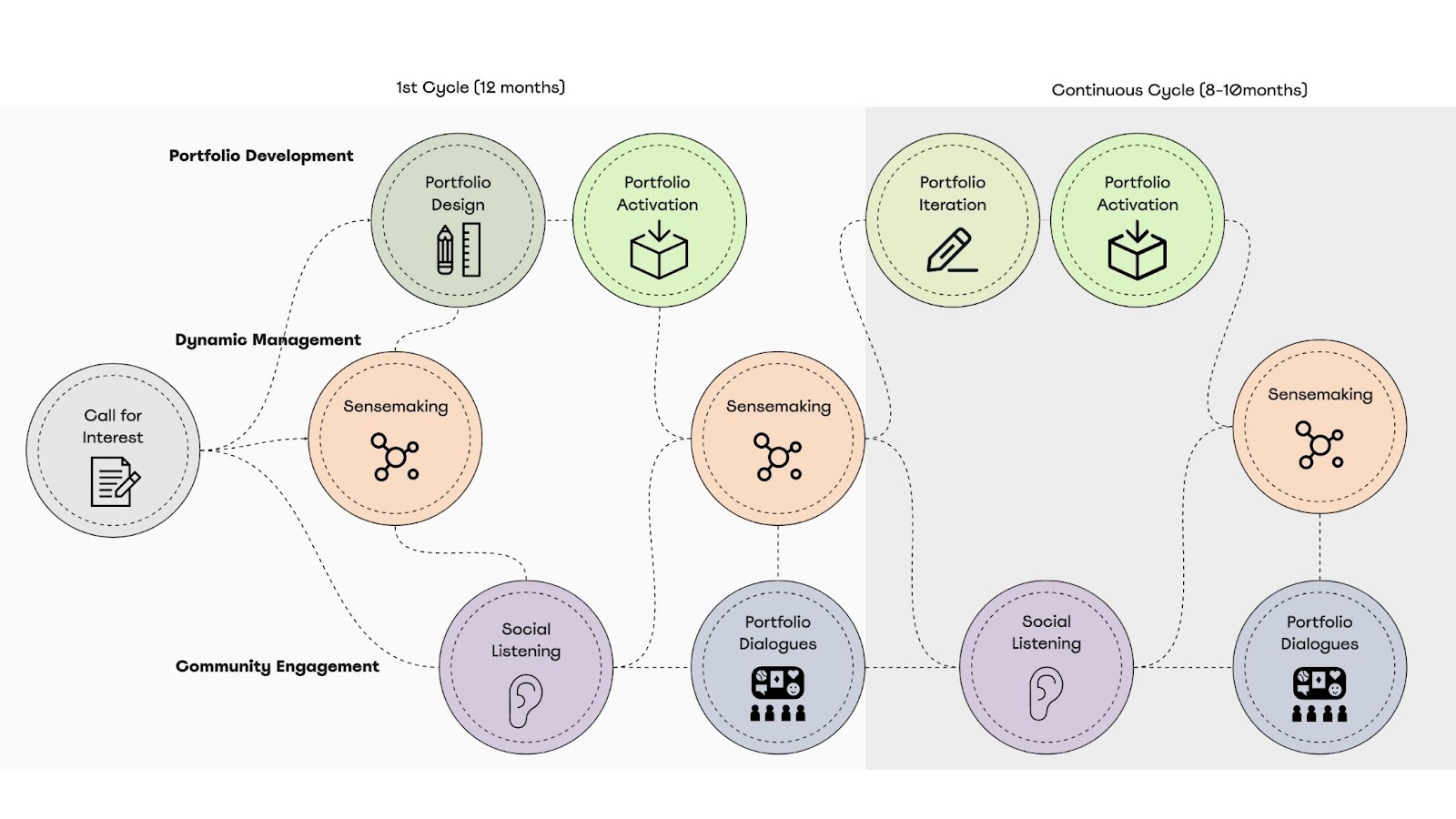
Our six-week portfolio induction journey has ended, yet a more exciting one now awaits. As the Mayors for Economic Growth project will launch its very first cohort on applying a portfolio of strategic options this fall, we will start utilizing the learnings from the course and applying sensemaking and dynamic management to our portfolios. We will continue sharing our experiences in applying a portfolio approach across cities in our region, because a learning journey never ends.
What’s in a name?
5 July, 2021 | Aditi Soni and Andreas Pawelke
Session 4 was all about portfolios: what is a portfolio, why having one in the first place and how to design and manage portfolios.
In the development sector, there is a growing interest in portfolio approaches and a lot of ongoing learning of what portfolios are and how they could address some of the weaknesses in the way development interventions are designed, financed and implemented.
In this session we experimented with a slightly unusual learning format. Instead of running presentations and exercises on the why, what and how of portfolios and the way we commonly apply them in the development sector, we reached out to people who work with portfolios in areas very different from ours: finance, art and policy.
We recorded interviews with experts from each of these three domains and asked them the same set of questions:
- Why have a portfolio?
- What is a portfolio?
- How do you design a portfolio?
- How do you manage a portfolio?
During the session, we split the group into three teams with each of the teams being asked to extract the relevant information from the interview recordings in order to respond to the four questions on a shared table displayed on a Miro board (see the image above for a summarised version of the table). As the teams reported back to the entire group, we built a collective understanding of the different definitions, objectives and approaches to portfolios. We’ve highlighted some of the relevant insights below:
Why have a portfolio?
While an investor’s portfolio is all about minimising risks and maximising return on investments through exposure to different sectors and businesses, artists use portfolios to showcase their work as their visual résumé, demonstrate their skills and get public recognition and interest from potential clients. In the context of policy, portfolios are used to overcome the challenges of project-based approaches, e.g. short term thinking, and as a way to recognise interconnectivity and allow for collaboration and scaling while simultaneously working on it.
What is a portfolio?
In the case of finance, a portfolio is a collection of assets – and in the case of private equity, it is defined as a collection of investments (in different companies, across different sectors etc.). In the world of art, a portfolio is the “collection of the works of the artist” that help them position themselves and their expertise and interest areas. And finally, in public policy, a portfolio is a set of interrelated programmes, projects and activities linked to a strategic goal.
How do you design a portfolio?
For finance, guidelines exist to design a portfolio based on what returns must be achieved on investment. Financial portfolios are also about risk mitigation and achieving set goals on profitability and returns. In the context of art, the designer of the portfolio gets to decide what goes into the portfolio based on aspects such as client needs, and how might they best communicate their skill sets through process and their identity as an artist. For policy, designing a portfolio is a result of formulating a mission shared by multiple stakeholders in the system and its context.
How do you manage a portfolio?
For a finance portfolio, investing in a portfolio is the start of a long journey, which means it is important to dynamically manage the portfolio after investing, via assessments around the value generated. For an artist’s portfolio, it is important to focus on a topic of interest in detail instead of going too broad and wide with the range of work that can be offered. Over time an artist’s portfolio can be expanded to add different ‘views’. Finally, for policy, it is important to take a deep dive into the set of mechanisms around the portfolios like support for collboation, emerging practices and any new support mechanisms in the system, followed by continuous learning and analysing of the outcomes. The policy portfolio expert we interviewed uses a learning history approach to collect, share and analyse what can be learned from the process of portfolio implementation.
This session also helped us tie a link between various external outlooks toward the what, why and how of portfolios and relate them to the context of M4EG in the upcoming sessions, using examples and drawing parallels across sectors.
We only know what we make
22 June 2021 | Gaia Bellavista
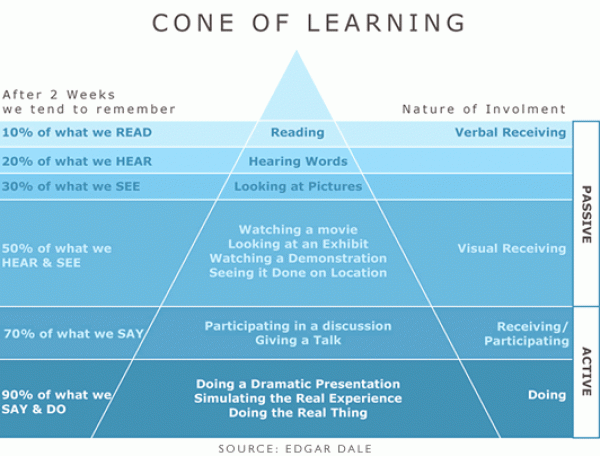
We kicked off our third session of UNDP’s portfolio development course by introducing an exercise consisting of a simulated conversation between a portfolio expert and the mayor of a city. Having previously explored the “why” of the portfolio process, this role play gave a safe space for participants to actively reflect on the newly acquired knowledge and make sense of new concepts by applying portfolio thinking to an upcoming initiative in their municipality. Inspired by Edgard Dale’s cone of learning, recreating a hypothetical conversation with a high-level decision maker outside the EU/UNDP sphere to discuss the value of portfolio thinking becomes a way to incorporate a direct and purposeful experience into the learning process. In the spirit of the philosopher Giambattista Vico: We only know what we make.
The discussion we had with the participants on the outcomes of the exercise sparked my reflection on the learning journey that organizations such as UNDP and the EU need to undertake to be able to embrace complexity in their work, and on how this effort should be met by a shift in mindset on the demand side. First, it is important that, as change agents, we acknowledge that innovation starts with us: with the way we rethink our roles, our identity as an organization, but especially, by the way we make sense of complex concepts ourselves and are able to deliver meaningful purpose. Are we able to fully embrace this new thinking in our work and reflect its value to external stakeholders? And to what extent can we integrate this new logic in our programming and operations so as to make them coherent with our ambition to tackle complex developmental challenges?
Second, and strictly linked to the first point, is the ability of organizations working with portfolio thinking to identify and work with decision-makers, who are willing to embrace a transformational approach, learn from each other and embrace a long-term perspective. However, contrary to the mayor in our group exercise, while positive attitude is not a constant, skepticism tends to be the most common response to innovation. The need to build a new type of demand to embrace the change in the way we manage complexity is thus paramount, and it all starts from the ability to codify emerging transformation approaches into practice to build credibility and encourage adoption.
Our learning journey has just begun, but the progress and shifting mindset are already remarkable. We are thrilled that we will be able to discover and discuss, together with our participants, the “what” and the “how” of portfolio thinking in the next few weeks, and hopefully, start building a learning path towards the next four years!
Easy to grasp, hard to do
16 June, 2021 | Tina Stoum
In the second session of the UNDP and EU portfolio development course, we began discussing the mindset shifts needed for embracing complexity. It was my first introduction to Indy Johar, Co-founder and Executive Director of Dark Matter Labs, and his focus on learning and humility struck a chord. Two aspects keep coming up for me during these last two sessions: moving from expert/solution provider to ‘listener in learning mode’, and moving from a command and control approach to ‘let’s see where this takes us (within the system) and adapt and manage risks as we go along’. Easy to grasp, hard to do.
First, on the ‘taking off the expert hat’, we are socialized to present our organisation as an advisory and (signature) solutions provider. We hear that our core resources are shrinking and that our member states (rightfully) keep questioning our ‘value addition’. How many talking points to senior management do we write for them to meet governmental counterparts, starting with the ‘why choose us’, i.e. we bring you value through our network, reach, and ‘best practices’ and lessons from around the world. It seems counterproductive to start the conversation with: ‘well, we do not know what the solution(s) are or what transformative change will look like, but we have some decent tools and can walk the path with you’. It’s intriguing, applying that humility, but we might need to work on a new pitch and narrative with regard to our relevance and legitimacy, to convince ourselves and sit more comfortably (as we listen and take less space), not to mention for those talking points. (And the possible gender lens and dynamics here would be interesting to explore.)
Second, the command and control approach, which as many things, including our logframes, was taken from the military then integrated in leadership and (people and project) management, allows us to believe that we can make the world ‘complicated’ (rather than ‘complex’) and nicely arranged in boxes of predictability and hence easier to measure (i.e. control). This is a more comfortable approach for many (and me included), as we like to ‘structure’ things, often in a linear or roadmap kind of way (e.g. work plan with clear results & indicators). As we (hopefully) move further toward learning and adapting instead of trying to control through predicting, I am curious to see what our new tools and resources might look like. How do we showcase that we can indeed be kept accountable (delivering results with public funds) even when that logframe is (finally) tossed out? No single point solution or pathway here.
Indy Johar on relevance, identities and mindsets
14 June, 2021 | Lejla Sadiku
We spoke to Indy Johar, from Dark Matter Labs, about how the role of international organizations is changing and what he anticipates is coming beyond the bend. In his view, the focus needs to shift towards decentralizing capabilities for system transformation, engaging in long-termism for the descendants we cannot imagine, and working on transnational value-creation. Besides listening to Indy, we recommend you also read Ministry for the Future by Kim Stanley Robinson, that Indy references, and The Good Ancestor: How to Think Long Term in a Short-Term World by Roman Krznaric.
Launching our portfolio induction course
7 June, 2021 | Andreas Pawelke
We’re kicking off an online course on portfolio thinking that we’re jointly running with and for colleagues from UNDP and the EU who are part of the recently launched Mayors for Economic Growth initiative.
Through the course we want to support those colleagues in applying a portfolio approach in the development and implementation of local economic plans with municipalities in the Europe and Central Asia region. By incorporating a systems lens through which local governments can address challenges from multiple angles to build initiatives that are coherent and connected, we’re hoping to move away from single-point solutions to a portfolio of strategic learning options.
Working in and with complexity is not something that can easily be taught in a classroom, much less so when the classroom is virtual. While we acknowledge the limitations of teaching the concepts, methods and tools rather than experiencing them, we’re trying to provide a learning environment that makes it easy (and fun) for everyone in the course to learn about working with complexity through the design and management of portfolios following several simple principles*, two of which we describe below:
Adopting a beginner’s mindset: Having a certain degree of expertise in a particular field can make it extremely difficult to teach the very basics of a topic. The speakers in our course know things the audience doesn’t – they’ve learnt from testing different ways of applying the methods and tools they teach and they have developed mental models that are new to the participants. In every session, we try to break down concepts into key components, use analogies and provide anchors that we find helpful in our own learning journeys.
Facilitating active learning: Anyone who’s ever run a fully online course, workshop or training knows how difficult it is to provide an environment for active learning. As course designers and facilitators, it’s our responsibility to capture the attention of participants, activate any prior knowledge they might have and create opportunities for students to learn through individual and collective reflection exercises. We’re trying to achieve this through a combination of teaching formats ranging from pre-recorded videos to live inputs and group discussions, collaborative tools such as Miro and Menti, and by using examples from sectors where portfolio approaches are being applied ranging from the future of work to depopulation and governance.
*Some of our learning principles are inspired by these and other online teaching resources. Feel free to get in touch if you want to learn more about how we go about designing and teaching the course as a whole or individual modules.
We are excited to announce that the United Nations Development Programme (UNDP) has started the implementation of the EU & UNDP Mayors for Economic Growth (M4EG) Facility (2021-2024). UNDP has country offices in 19 countries and territories in the Europe and Central Asia region, and close to 170 globally.
The Mayors Facility will focus on intermediate cities in the Eastern Partnership countries. We intend to work closely with local authorities in the region to explore and discover innovative ways to sustainable development, and expand the network.
Please see here a brief overview of the Mayors Facility 2021-2024.
Cities in the network will benefit from training and capability development as well as knowledge exchange activities focused around development of innovative growth strategies, that are highly contextualized and build on local ecosystems. This will entail support in developing a new generation of local economic development plans (LEDPs), strategic thinking and building urban resilience. Local authorities will benefit from new capabilities and access to funding addressing issues related to green recovery after the pandemic crisis – by integrating urban planning, gender responsiveness and innovation at the local level.
To support the implementation of local economic plans, together with the EU, we will introduce an approach that is currently piloting within UNDP itself on portfolio design and management. This method builds on the assumption that the world is complex and operates through systems (e.g. the market, climate change, inequalities, and so on). These systems that we operate within consist of a myriad of agents with different ambitions, interests and values, and hence we cannot fully predict behaviors nor are there any ‘right’ solutions waiting to be discovered. With this mindset, the proposed method will support municipalities in building programs that incorporate a systems lens – addressing challenges from multiple angles, designing initiatives that are coherent and connected, and practice agile and adaptive management.
Learning materials on innovative methods to local development will be made available to all members of the network through a new Urban Learning Center. Cities with developed LEDPs will gain access to EUR14 million in diverse funding opportunities, combined through EU and EU&UNDP M4EG funding calls. These calls are:
- EU M4EG Call for Proposals, closed on 6 April 2021, evaluation of proposals are ongoing, with a total of EUR 10m. For more information, see here.
- Annual Portfolio Call for Interests (estimated June-July 2021), followed by an Annual Call for Proposals. These are expected to be held on an annual basis. Estimated total of EUR 2.8m
- Annual Innovation Call for Proposals (estimated fall 2021). Estimated total of EUR 1.2m.
More details on the above components of the new phase will be communicated to all members of the network in due time.
We plan to invite all members of the network to interactive Country Launches in early summer 2021.
We are looking forward to continuing the wonderful work that has already been underway in Eastern Partnership countries.
**********
Media enquiries
Anton Sydorenko, M4EG Communications Lead, anton.sydorenko@undp.org
For other enquiries, please contact us through eu.m4eg@undp.org
Background
The Mayors for Economic Growth Facility is a follow up of the Mayors for Economic Growth (M4EG) initiative, launched by the European Union (EU) in 2017 to support Mayors and municipalities of the Eastern Partnership (EaP) countries to become active facilitators for sustainable economic growth and job creation.
On 30 April 2021, the EU and UNDP held an internal launch where Professor John Kay, one of Britain’s leading economists, gave a keynote presentation around his latest book “Radical Uncertainty” focusing on decision-making in a complex world.
About UNDP
As the United Nations lead agency on international development, UNDP works in 170 countries and territories to eradicate poverty and reduce inequality. UNDP helps countries to develop policies, leadership skills, partnering abilities, institutional capabilities, and to build resilience to achieve the Sustainable Development Goals. Our work is concentrated in three focus areas; sustainable development, democratic governance and peace building, and climate and disaster resilience. Read more about UNDP here.
The following piece was first published on the UNDP Eurasia and was originally published on March 22, 2021.
It’s 2021. People and ideas are traveling faster than ever before, social and political movements are quickly self-organizing, and decision-making has accelerated due in part to the heightened pressure of reacting quickly to a fast-changing environment.
In ancient Greek cities, an agora was an open public space serving as a gathering or assembly area. It is the best representation of the city-state’s response at the time to accommodate the social and political order of the polis and bring different areas of city life together. For the innovation team at UNDP’s Istanbul Regional Hub, Agorà is a City Transformation Portfolio — a template that can be applied in any city system for designing and managing pandemic response and renewal plans aiming for urban transformation.
In our current situation, there is a lot of uncertainty about what will happen “next”, making it much harder to make strategic decisions and predict the outcomes of planned interventions. The Covid-19 pandemic made the systemic effects across all sectors all to clear.
This is also becoming more visible in the development sector, where challenges are multi-faceted and cannot be tackled through linear thinking and single-point solutions.
Too large a proportion of recent “mathematical” economics are mere concoctions, as imprecise as the initial assumptions they rest on, which allow the author to lose sight of the complexities and interdependencies of the real world in a maze of pretentious and unhelpful symbols.
— J.M. Keynes, Economist and Author of General Theory of Employment, Interest and Money
As both arenas of disease outbreaks and major socio-economic engines, cities are at the centre of the crisis and responses to it. But all social systems, such as cities, are complex in nature. Complexity as such is not the issue at hand. Our way of responding to it is.
Our current responses and organizational cultures are often ill-equipped to take on the uncertainty and the systemic challenges we face. We have a tendency towards saying that we know what the problem is and how to solve it. In this linear thinking, we too often oversimplify the problems and their evolving dynamics, hampering us from addressing the deeply rooted, systemic issues.
“No particular games should be expected to predict the future…Good simulations are not about coming up with a solution to put on a shelf. At best, they inform a continuing process…iterative learning is part of a healthy policy process, and policymakers may pay closer attention to replicated findings.”
— Reid Pauly, Assistant Professor of Nuclear Security and Policy at Brown University
Designing responses with a systems approach takes time and new types of capabilities and funding modalities, which may be difficult during a pandemic where the urgency to respond leaves little room to explore, learn and adapt.
Since the start of the pandemic, our team has been working with the Chora Foundation to think through how we can better support UNDP country offices and their urban partners to tackle the uncertainties; to move away from single projects into more systemic approaches. Cities are tackling global SDG challenges on a local level. Poverty, inequalities, unemployment and air pollution are all outcomes of interconnected systems, which require new types of policy design and implementation.
We started with a set of questions:
- What are the characteristics of cities and pandemics?
- How can we identify and visualize the system that we are working with?
- Are there general elements that are common to urban systems?
- What are common interactions and ‘attractors’ in urban systems?
- How to contextualize the template in local contexts?
- How can we identify our role in the system?
- How is portfolio design different from project design?
- How could we better enable learning in the portfolio process?

And our solution to these was a set of design tools and service offers to help country offices and their urban partners to integrate a more systemic lens into their work through the portfolio design and management practices, and help cities build their urban transformation portfolios.
This set gives cities a unique decision-making approach to design actions and take decisions concerning pressing issues, acknowledging their complexities and fast-evolving dynamics. To look beyond the surface of seeing “events” into identifying patterns, structures and values of the system.

In short, Agorá’s tools and processes enable cities to get access to the spatial representation of the urban system, which can be contextualized, build understanding of common urban system attractors, guide them in identifying interactions and relationships in their local system, support in mapping and making sense of the current interventions and provide new entry points for their urban programming, where connected interventions and constant learning and adaptation create the value.

As Donella Meadows has wisely put it: “Systems can’t be controlled, but they can be designed and redesigned. We can’t impose our will upon a system. We can listen to what the system tells us and discover how its properties and our values can work together to bring forth something much better than could ever be produced by our will alone. We can’t control systems or figure them out. But we can dance with them!”
So we welcome you to the dance floor and invite you to follow us on our journey to develop tools and capabilities for urban transformation and apply them in practice with our country offices and partners.
This article is the first in our Agora series that will follow our work on urban transformation and portfolio design and management. The next articles will dive deeper into the Agorá process insights and learnings, introducing the design tools and processes in detail.
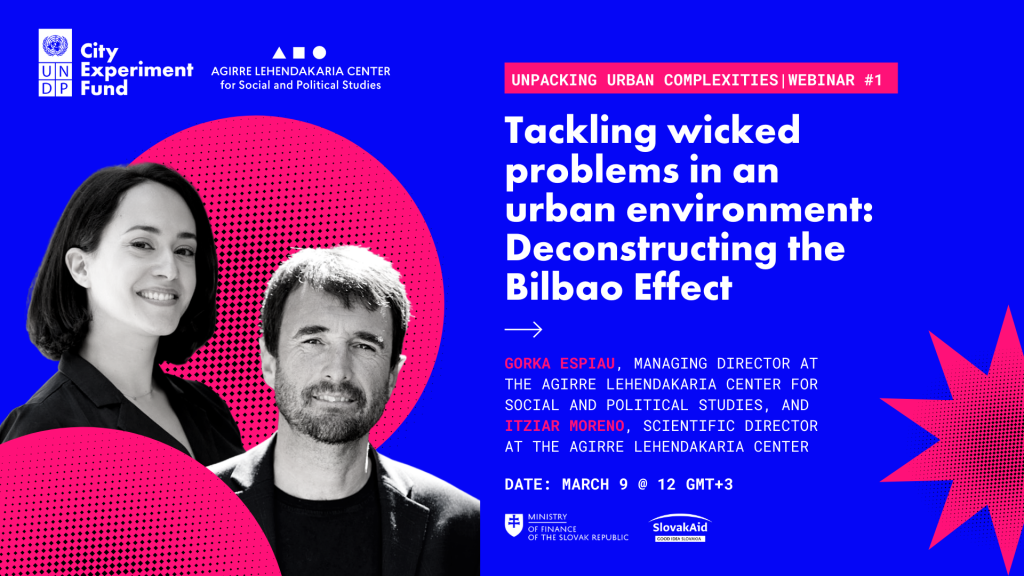
“The Guggenheim is not a unicorn, it is part of a large portfolio” said Itziar Moreno from the Agirre Lehendakaria Centre (ALC) during the “Deconstructing the Bilbao Effect” webinar. With this session, we kicked off the Unpacking Urban Complexities webinar series to better understand what is needed to generate lasting and sustainable urban transformation.
Urban complexity
In an increasingly urbanized planet, understanding cities has never been so high on the agenda. The uniqueness of each city as complex sociotechnical systems is the result of intricate networks where phenomena from a variety of domains like psychology, physics, sociology, culture, politics or biology intersect differently.
This may seem obvious, and yet when we design urban solutions we tend to be overly reductive in our approach, looking for a silver bullet to address complex issues. Not only that, these solutions are often designed based on an insufficient understanding of the local context, narratives and perceptions—information that can make or break the adoption of any new intervention.
In the words of Charles Landry, an international authority on city making and author of “The Art of City Making”, there is a fundamental misunderstanding between hard science and reality when it comes to developing urban initiatives: rather than operating under a simplistic business logic, cities, which are probably our most complex creations, do not follow linear rules. This is because every city has a set of unique yet often elusive characteristics and conditions. What functions perfectly well in Yerevan, might not be appropriate for Almaty. Adhering to methodologies is inappropriate; predictability is out of place.
Deconstructing the Bilbao Effect
A good example of this is the case of Bilbao. Who hasn’t heard about the Guggenheim Museum singlehandedly transforming the entire city? And yet, as Itziar Moreno and Gorka Espiau from the Agirre Lehendakaria Centre explain, “the Guggenheim is not a unicorn, it is part of a portfolio approach.”
In the 1980s the city was experiencing all sorts of crises—economic, social and political. The unemployment rate rose to 25% and the infrastructure had become obsolete. Violence was commonplace and there were seemingly more challenges than any city could handle. And yet, 20 years later, in the first decade of the 21st century, Bilbao was bragging about having an income per capita that was above the EU average, unemployment had diminished and many social challenges were only a (not so distant) memory.
This did not happen by chance, and undoubtedly it did not all happen because of the Guggenheim Museum. As ALC experts explain, “the transformation was possible due to a comprehensive strategy based on public/private partnerships, an endogenous reactivation of the economy and a social innovation movement.” How exactly this came about and what we can learn from the Bilbao case is the focus of the first Unpacking Urban Complexities webinar, which you can rewatch here.
What’s next?
In an attempt to make sense of this and other complex questions around city making, the City Experiment Fund takes inspiration from our current moment of reconfiguration and uncertainty to launch our Unpacking Urban Complexities webinar series. By selecting insightful case studies from the Eastern Europe-Central Asia region and beyond, the series of webinars aims to introduce participants to the common challenges and misconceptions around city transformation. We won’t provide one-size-fits-all solutions, but a way to reflect on the past and be ready to explore the uncertainties of the future.
Stay tuned for what’s next in our webinar series and explore past episodes gathered on this board.
The components of urban systems, from waste management to transport and parks, are interconnected and dynamic. Intervening to create change in any one of these components may impact others, creating systemic change. Designing solutions that take these interconnections into account is critical to sustainable development. UNDP Armenia aims to invest in the quality of urban life and change citizens’ behaviour towards one of these components, namely public spaces, and introduce new approaches in participatory green urban development. UNDP’s “Placemaking: urban co-design as a catalyst for change” project include the development of (by “Strelka KB”) the methodology for architectural assessment, Geographic Information System (GIS) analysis and anthropological studies with further studies, placemaking concept development and renovation of at least one identified area.
At this stage, the project has already received the methodology from “Strelka KB”, a Russian urban consulting agency, conducted the architectural assessment, carried out GIS-related data collection and anthropological studies, and is currently waiting for the final analysis of submitted documents by “Strelka KB”, accompanied with the methodology of placemaking concept development.
By providing a detailed analysis of people, communities, and spaces, anthropology makes an essential contribution to the social mission of the project to form a perspective for sustainable use of emerging public spaces and lay the groundwork for the development of loyal communities around them. Urban anthropology employs a range of qualitative methods within a “classical” field approach, alongside several innovative tools (chatbots, crowdsourced media analysis, machine learning algorithms), provided by digital anthropology. Within the framework of the anthropological study, the project team collected data on residents’ perceptions towards the project pilot park, the Yerevan youth park (former Circular garden.) Study findings illustrated the perception gap between local authorities and citizens towards the park which led us to the understanding that public space design in Yerevan does not always meet the user demand. Not to mention that the current pandemic created the momentum for analyzing city-scale change in the demands towards the urban landscape: before, during COVID-19 and after quarantine.
The project’s other key partner is the SpinUnit lab, which is responsible for GIS analysis aimed to capture, analyze, manage, and present all types of geographical data. It can be used as a tool in both the problem-solving and decision-making processes, as well as for the visualization of data in a spatial environment. It helps to determine the location of features and relationships to other features, the density of features, indoor-outdoor activity inside the area of interest, and provide information on how the specific area has changed over time and in what way. Despite comprehensive analysis of the park, the team is also responsible for land-use mapping and functional reading of other public spaces in the city. Not only is it important to map the spaces, but also compare and rank them.
Through this pathway, UNDP pursues processes and patterns that the natural and built environment in and around cities improves liveability and safety, promotes human health and mitigates disease. Social distancing does not mean social isolation: people need to get outside, especially during COVID-19, to run essential errands or for physical and mental health—It has been proven that being in green spaces can significantly reduce cortisol hormones (stress hormone) and raise endorphin levels and dopamine production (both of which may promote “happiness”); green spaces also promote doing physical activity, which can give your brain a boost, improve your self-esteem, reduce stress, and generally improve your quality of life.
Seems like COVID-19 is relentlessly praying on this, it is anti-urban. It not only runs up against our fundamental desires to interact, but also against the logic of public and semi-public spaces: they are all designed to be occupied. For many urban systems the density is even vital. Can we break the ice and enjoy public spaces again? That’s the question!
Currently, more than half of the world’s population lives in cities and the urban population is expected to double by 2050. Intense urbanization has led us to rethink human socio-economic development on a global scale with particular emphasis on the relationship between human beings, their footprint and the environment.
Cities and city regions today are at the forefront in both feeling the effects and fighting to offset the potentially catastrophic effects of climate change.
The Challenge
Cities are the biggest CO2 emitters globally, and therefore it is necessary to redesign their infrastructure, rethink consumption patterns and circularity.
In other words, the question we pose here is there a way to convert what they now expel, as waste or pollution, into raw material to feed new processes of production, and how can we make visible what is now invisible and informal in cities?
This entails innovative strategies of waste management, water conservation and recycling, renewable energy production and trading. It also involves implementing technologies for the filtration and re-metabolisation of air pollution. At the same time, we recognize that in each urban space there are layers of informality which supplement and complement existing public services – whether it is in water catchment, individual waste recycling, or in other forms – like decentralized construction. These dynamics, while an essential part of the tapestry of life in cities, are not always recognized. Yet, effective ways of addressing vulnerabilities demand utilization of the entire human and environmental systems in cities.
The Solution
We can design resilient cities that use their size and collective energy to create refuge for both humans and displaced wildlife, that promote the emergence of positive microclimate, that replenish depleted water sources and that restore degraded terrains, pushing back on processes such as desertification, land erosion and contamination. This entails innovative strategies of urban re-greening and re-wilding as well as of urban agriculture.
A critical quality of urban planning today it to mobilize collective agency and intelligence to face the challenges ahead. In this way local solutions can be evolved in response to the given challenge.
In this recent collaboration with UNDP, ecoLogicStudio has been testing the potential of Artificial Intelligence to develop a new green planning interface. This planning solution combines the scalability of a sophisticated planning application to the design sensibility and intuitive accessibility of its design interface. This enables a high degree of customisation and evolution to each specific urban application, or urban design solution.
At its core, this application uses sophisticated algorithms to analyse hi-resolution data on urban landscape and infrastructure (mostly available open source) to produce simulated scenarios of sustainable urban development and a new way of urban planning – one that is dynamics, iterative and comprehensive.
These simulations have three key characteristics:
-
They are open to multiple external input, that is, all urban stakeholders can interact with several layers of data and see the effects of their actions on the proposed planning scenarios – and what we have used here is satellite imagery and open street maps.
-
They are time based and non-linear, and in that sense they enable all stakeholders to appreciate the effects of new policies and strategies systemically, across disciplines and planning regimes, being able to look at urban planning, at the same time as re-greening as well as mitigation of climate impacts.
-
They have a powerful visual and morphological output, thus enabling all stakeholders to visually appreciate the simulated urban form across several orders of scale.
As demonstrated by our test run with early adopter cities, such as Aarhus, Tallinn, Barcelona, Caracas, which were then applied in our joint project Vranje, Guatemala and Mogadishu, our design scenarios simulate the evolution of restorative urban networks.
This process questions traditional planning concepts such as zone, boundary, scale, typology and program. Such outdated notions actually constrain the emergence of a truly systemic approach to urbanisation, one that recognises the true nature of contemporary cities as complex dynamical systems – where built environment, and human systems interact regularly with green spaces.
This issue is most evident in the case of Guatemala City.
Applications – Case studies
Guatemala City is situated on a complex and highly unstable terrain surrounded by mountains and volcanoes, some of which are still active. Its ecosystems, originally very rich in biodiversity, are now made fragile by unchecked urbanisation and, given its climatic zone, the effects of climate change.
In Guatemala City this scenario is exacerbated by a serious lack of waste management. The Guatemala city garbage dump is the biggest landfill in Central America containing over a third of the total garbage in the country. 99% of Guatemala’s 2,240 garbage sites have no environmental systems and are classified as “illegal.”
Only a new design methodology powered by big data gathering and the production of ad hoc algorithmic design scenarios can deal with such complexity and level of informality.
Our approach creates an interface between bottom up processes of self-organisation, such as the many local waste recycling activities that are emerging out of necessity in the areas closer to the dumping sites, and the strategic decision making that occurs at municipal, national and international level.
Read full article at Photo Synthetica.
Forum for the Future opened the first week of educational webinars for the UNDP City Experiment Fund. Anna Simpson, curator of the Futures Centre, and George Harding-Rolls, senior strategist at the Forum for the Future, hosted the workshop with a series of interactive exercises aimed at introducing new methods of understanding the complexity in systemic change in policy-making.
“The future is complex and uncertain […] exploring it can be uncomfortable” – this is how Anna Simpson introduced the topic of the webinar. Climate change, malnutrition, poverty: the world faces many interrelated challenges, and it is clear that the responses from policymakers are very superficial and merely mitigate the problems.
[blockquote author=”” link=”” target=”_blank”]The future is complex and uncertain […] exploring it can be uncomfortable[/blockquote]
The scale and complexity of global challenges today are tricky and developing a system to understand the bigger picture is ever more essential. Learning to be open to futures that can be radically different to today’s world, is what policymakers should aim at achieving. Simpson referred to this practice as “understanding the signals of change”: small but important ideas and innovations that raise questions about future challenges and opportunities, and their implications for sustainability.
Throughout the interactive exercises, the audience was asked to explore through real-world examples and their own experience what can constitute a signal of change and what are the direct implications of events that they categorized as such. Throughout the discussion, the Forum for the Future introduced the concept of system thinking to understand the web of interrelations behind complex problems, to explore the long-term impact of today’s changes, and to inform design for sustainable futures.
The Forum for the Future is a leading global sustainability non-profit, working in partnership with business, governments and civil society to accelerate the shift towards a sustainable future. The Futures Centre is a dynamic online community under the Forum for the Future for people to scan and share signals of change. With more than 30.000 users, they contribute to inform people and organisations about the complex interplay of dynamic trends around us and grapple the opportunities and risks emerging from them.
Cities occupy only about 2% of Earth’s land area, but house between 60–85% of the world population. At a time of accelerated change — and with complex issues such as climate change, migration and inequalities challenging our ability to respond, cities are emerging as leaders. Because cities concentrate development challenges — access to services, participation in decisions, distribution of water and electricity — they also become a laboratory on how these can be addressed.
This blog marks the launch of our City Experiment Fund (CEF) — an initiative of UNDP and the Slovak Ministry of Finance, to support cities in the application of innovative approaches. We look at behavioral insights, new data and systems thinking, and horizon technologies such as artificial intelligence or blockchain. We hypothesize that this will make our cities more future-ready, and to do so, we are seeking to answer the following questions:

- What are the emerging risks that our cities are blind to?
- Can we understand how climate change, inequality and migration interact with each other?
- Where are the strategic points of intervention within complex systems that help us fundamentally address ‘wicked’ challenges as they play out in our cities?
- How can we employ tools of inclusive innovation to meaningfully address them?
How is it to live in a city in Europe and Central Asia?
Around the world, this region included, we see trust in public, private and civic sectors decrease and existing governance mechanisms unable to respond to the complexity of current challenges.
2017 World Health Organization report found that of the 10 most polluted cities in Europe, 5 were based in the Western Balkans — 3 in the former Yugoslav Republic of Macedonia, and 2 in Bosnia and Herzegovina. Besides the physical health related impacts, studies show that the impact of exposure to high levels of toxicity is equal to losing one year of education while also affecting mental health. Our work in the city of Skopje found that exposure to toxic air and the associated health risks disproportionately affect poorer neighbourhoods.
At the same time, skyrocketing regional use of electricity for bitcoin mining outstrips national power consumption by 1000% in places like Kosovo* and Montenegro. These signals do not only raise issues about balancing development with well-being, but also the necessity to understand complexity and drive systems change — whether how to regulate emerging technologies or ensure just distribution of resources.
A World Bank analysis found that 61% of the cities in the region were in decline, losing on average 11% of their population, while population growth was increasingly concentrating in a fewer number of cities. In many of these cities, infrastructure is crumbling. Illegal construction is already suffering more severe damages from climate change related disasters and public services for the poorest groups are stretched thin.

Can infrastructure help us combat pollution (and other things)?
To address the urgent nature of these issues, combined with our exploratory work on #NextGenGov during the Istanbul Innovation Days, our flagship event which this year focused on Next Generation Governance, we’ve identified 6 Zones of Experimentation (ZoX).
- Municipal back office functions: Reimagining how the public sector functions and governs. For instance, how can we help governments look beyond budget categories and focus on solving broader issues, such as improving school readiness?
- Well-being: Cities are like living organism that require a diversity of disciplines. For instance, making sure everyone is in good health implies looking at nutrition, pollution, access to public spaces and managing public health hazards to name but a few.
- Arts, science and power: Can art and science help us translate the impacts of climate change into understandable and relatable issues? For instance, can dancers traveling along congested parts of cities, with costumes wired to a breathing and air pollution data sensors, influence behavioural change among residents?
- Digital and platform economy: Disrupting traditional labor, redefining work and the workplace, and driving a new generation of opportunities across borders and digital divides. Research on digital economies shows that existing inequalities are likely to be replicated and exacerbated in the fourth industrial revolution, unless early interventions take place.
- New Urban Infrastructure: Formalizing informal structures and systems in cities to do more with less and unlock investment in multi-use infrastructure. Physical infrastructure, like buildings, roads or water pipes, can actually be used for a multiplicity of purposes. An “urban curtain”, using micro-algae, placed at the Climate Summit in Dublin in 2018, captured CO2 from the atmosphere and stored it in real-time: approximately one kilo of CO2 per day, equivalent to that of 20 large trees.
- Redefining and Restructuring the Commons — New definitions place the commons (water, air and land) in social and political context which then add data, education and cultural heritage and the internet to be understood also as commons. These require new governance mechanisms and engagement models. For instance how is our information managed when public goods are distributed by new actors we’re not so familiar with?
How will we drive systems transformation in cities?
With our City Experiment Fund, we want to address the gap that is appearing between emerging challenges and business-as usual by i) de-risking investment in innovation with catalytic funding, and ii) supporting cities with the tools and processes they need to prepare for the future. The fund will support interventions that cut across Zones of Experimentation and four domains where life in cities happens: public space, public administration, resident life and digital infrastructure.

Unpacking complexity: Cities are often compared to living organisms in their interconnectedness and evolutionary drive to evolve. At the same time, we can now understand cities through the use of sensors, the Internet of Things, and satellite imagery. This enables us to start to identify non-obvious connections (i.e. how electricity patterns impact traffic) that illuminate emerging risks and opportunities and drive real-time governance of our cities.
New models of engagement: Residents’ engagement is at the heart of how problems are understood and can inform which solutions are designed. We do so by building on our experience, on working with largely decentralized, leaderless and agile civic actors, having engaged over 1500 young people in our regional data challenge, Ministry of Data, among others. We will be taking these lessons learned, and exploring cutting edge methods, like how AI can empower more engagement and more rational conversations, and virtual reality can power inclusive urban planning.
Alternative Finance: The SDG financing gap is 2.5$ trillion annually, and $1 trillion in infrastructure alone — the majority of which is in emerging markets. Since 2015, UNDP’s AltFin Lab has lead 35 crowdfunding campaigns at across 5 regions, mobilizing US$1.2 million, and catalyzing $7 million worth of ongoing campaigns.. We are currently designing 6 Social Impact Bonds in the Europe and Central Asia region. Whether we work on air pollution, or financial inclusion, designing adequate financial mechanisms is key in unlocking long-term change.
CEF is our call to action for exploration and learning, to navigate uncertainty and imagine a different future in our cities — more open, transparent and inclusive, where the benefits are more equitably distributed, and where we can live healthier and longer lives. This does not happen in isolation, but in conversation and through working together. Join us in this journey and follow what we learn on cityexperimentfund.com.
[blockquote author=”” link=”” target=”_blank”]“We are called to be the architects of the future, not its victims.” — Buckminster Fuller[/blockquote]
[divider height=”30″ style=”default” line=”default” color=””themecolor=”0″]
We welcome your ideas and feedback as we share emerging practices and insights. Let us know. Jump in. Connect.
- Milica (milica.begovic@undp.org or @ElaMi5)
- Lejla (lejla.sadiku@undp.org or @LejlaSadiku )
- Ray (ray.boyle@undp.org or @CA_Ray)
The City Experiment Fund is a part of the Transformative Governance and Finance Facility II, which is funded by the the Slovak Ministry of Finance. The Project seeks to test out emerging technologies, financial mechanisms and innovative approaches in accelerating meeting the SDGs.