
Category: Urban futures
The United Nations Development Programme (UNDP) has selected four municipalities – Skopje, North Macedonia; Rivne, Ukraine; Yerevan, Armenia; and Pristina, Kosovo[1] – for the first phase of the CEF x AI programme, following an application and assessment process.
The City Experiment Fund (CEF) works with municipalities across Europe and Central Asia to tackle complex urban challenges through strategic innovation and experimentation. It helps cities develop portfolios of connected actions that can be tested and adapted over time. CEF x AI extends this approach into the field of artificial intelligence (AI). AI is developing rapidly, while many municipalities are still building the policies, governance, skills and safeguards needed to guide its use in public services. The programme will help cities test, adopt, govern and benefit from AI in ways that are practical, inclusive and aligned with the public interest.
The programme runs along two complementary tracks:
- The CEF x AI Demonstrator supports municipalities that want to build longer-term institutional capacity to work with AI. Cities in this track will test and apply AI across different areas of city administration while strengthening internal systems, coordination, governance, and practical capabilities over time.
- The GenAI Challenge, delivered through UNDP’s BOOST impact acceleration programme, in partnership with IEEE Humanitarian Technologies, matches cities with external innovation teams to co-design open-source GenAI solutions for city-defined challenges within a shorter implementation period. The challenge brings IEEE’s network of engineers and technical experts together with UNDP’s experience working with municipalities, while city teams define the problems and help shape the solutions.
Together, the four cities’ work spans water and urban greenery, energy modernisation, air quality and transport planning.
- Skopje, North Macedonia: water and urban greenery – Skopje will explore how AI could strengthen the city’s stewardship of water and urban greenery through AI4Water and Green Cadastre, through the Demonstrator and BOOST tracks. These initiatives offer opportunities to learn how new evidence changes professional judgement, cooperation between municipal teams and public enterprises, and decisions about the city’s natural resources.
- Rivne, Ukraine: energy modernisation – Rivne will connect its wider energy-modernization agenda with a focused energy-efficiency calculator through the Demonstrator and BOOST tracks. The work will explore how AI could help homeowners, municipal teams and experts make informed choices about building improvements – and what changes in advice, coordination and municipal support are needed to turn those choices into action.
- Yerevan, Armenia: air quality and environmental governance – Yerevan will use air quality as a starting point for exploring AI’s role in environmental governance through the Demonstrator track. By bringing environmental evidence and residents’ perspectives into municipal decisions, the city will investigate how AI could support cooperation across departments, strengthen public participation and help translate information into more responsive environmental action.
- Pristina, Kosovo: transport planning – Pristina will explore how generative AI could support municipal transport planning through the BOOST track. A focused pilot will help planners bring relevant evidence together when reviewing transport routes and changing neighbourhood needs. The work will examine what makes AI useful and trustworthy in everyday planning, while keeping professional judgement and responsibility with municipal staff.
How the cities were selected
Ten applications were assessed by a selection panel comprising representatives of the Ministry of Finance of the Slovak Republic, the City of Bratislava, and UNDP. The panel reviewed them against published criteria covering strategic relevance, institutional ownership and delivery capacity, data and technical feasibility including responsible AI safeguards, implementation and sustainability, learning value, and fit with each track. Consultations with city teams followed before final recommendations were made.
What happens next
This autumn, the four cities will work with UNDP to turn their proposals into concrete plans and identify the first steps in each city. The programme aims to help cities shape responsible AI adoption around their own priorities. City teams and UNDP will test ideas, examine what changes in everyday municipal practice, and learn where AI creates public value and where its limits lie. What these four cities learn, including what does not work, will feed into wider regional learning about how cities can navigate AI-driven transformation in responsible way.
The programme is implemented by UNDP through the City Experiment Fund with the financial support of the Ministry of Finance of the Slovak Republic.
[1] References to Kosovo shall be understood to be in the context of United Nations Security Council resolution 1244 (1999).
The United Nations Development Programme (UNDP) in Europe and Central Asia has published the 2025 Annual Report for the Slovak Transformation Fund (STF), highlighting how cities across the region are strengthening their capacity to manage complex urban transitions and connect local priorities with innovation and emerging pathways to finance.
Funded by the Ministry of Finance of the Slovak Republic, the STF entered the first year of its new 2025–2028 phase by moving the strategic direction established in 2024 into municipal practice. Its two core initiatives – the City Experiment Fund (CEF) and the BOOST impact acceleration programme – also became more closely connected, linking challenges identified by cities with potential solutions, partners and financing opportunities.
Through CEF, which supports municipalities in addressing complex urban challenges through strategic innovation and experimentation, ten cities in Armenia, Kosovo[1], Montenegro, North Macedonia and Ukraine completed a shared process of community listening, sensemaking, portfolio development and early option design. This helped them understand how challenges such as energy resilience, air pollution, waste, land use and economic transition intersect, and identify portfolios of interventions that could address them.
Across the ten cities, 319 residents and local stakeholders shared their experiences and priorities, helping municipal teams ground their work in local realities. More than half of those consulted were women, while over a third were from groups identified locally as facing greater vulnerability.
In Stepanavan, Armenia, a circular-transition portfolio moved into early operation: reusable sorting bags were distributed to 100 households, 30 public bins were installed and around two tons of sorted waste were collected. In Podgorica, UNDP and the city signed a memorandum of understanding, prepared a Disaster Risk Reduction Strategy and Action Plan, and designed a heat-island mitigation pilot with the University of Montenegro. In Pljevlja, more than 50 young people took part in a summer school and ideation labs linked to the city’s just transition, while agreements were prepared to take forward studies for a Green Jobs Training Centre and more energy-efficient public lighting. In Kovel and Nizhyn, city teams continued developing energy-resilience portfolios despite continued effects of the war in Ukraine.
BOOST complemented the city-level work by identifying and preparing potential responses to urban and green transition challenges. The Urban Future Finance Challenge graduated 16 ventures, brought 11 to Demo Day and awarded three US$10,000 innovation prizes. Green Urban Tech attracted 262 applications from more than 30 countries and selected 15 organizations for its sprint phase, building a pipeline of solutions spanning air-quality monitoring, urban management, emissions tracking, circularity, biodiversity and citizen participation.
The report also captures the knowledge generated through this work. The Twin Transition Stencil and related tools provide a practical way for cities and development practitioners to connect green and digital change with systems thinking, portfolio development, innovation and finance readiness.
At the same time, the report reflects on political change, limited municipal capacity and the effects of war. The experience of 2025 reinforced the importance of senior leadership, institutional ownership, flexible support and realistic implementation pathways tailored to each city’s circumstances.
For the next years, the report recommends deepening engagement with mayors and senior officials, converting existing portfolios and financing pipelines into more clearly sequenced activities, and strengthening cities’ ability to assess and engage with artificial intelligence through the newly launched CEF × AI cohort.
[1] References to Kosovo shall be understood in the context of United Nations Security Council resolution 1244 (1999).
Originally posted at M4EG’s website, read the full article here.
When familiar maps no longer work and the compass starts to spin, leadership is about learning to navigate the unknown. Tools alone are not the answer; if anything, cities have no shortage of frameworks, strategies, and pilot projects. The more uncomfortable question is whether the way cities are led is keeping pace with the problems they are meant to solve. That is the premise behind the Mayors Leading Transformational Change Programme under the Mayors for Economic Growth (M4EG) Facility and the City Experiment Fund (CEF).
When the old toolbox no longer works
Cities today are no longer just delivering standard services, they are managing complex, overlapping transitions from green and digital transformations to building socio-economic resilience. This new reality makes the demand for an adaptive approach to local leadership more evident than ever. Following an initial kick-off in December 2025, mayors, deputy mayors, senior leadership, and heads of departments from 20 cities across the Western Balkans and Eastern Partnership countries convened in February for a two-day leadership workshop. Gathering in person across four virtually connected venues, the participants dived into the programme built around adaptive leadership and shared experiences from their respective cities.
To ensure these insights translate into lasting local impact, the workshop is being followed up by dedicated mentorship sessions and peer clinics designed to help navigate implementation challenges specific for each city.
Leading within a portfolio
Reflecting on his experience, Mayor Oleksandr Kodola notes: “Taking part in the Programme has changed my view of the role of a city leader: it is not just an administrator, but a facilitator of change who brings together the community, business and partners around a shared mission for development. What stuck with me most was the idea of ‘mission-to-solution’ thinking and the importance of cross-sectoral cooperation as the foundation for effective policies. For me, the key lessons in adaptiv
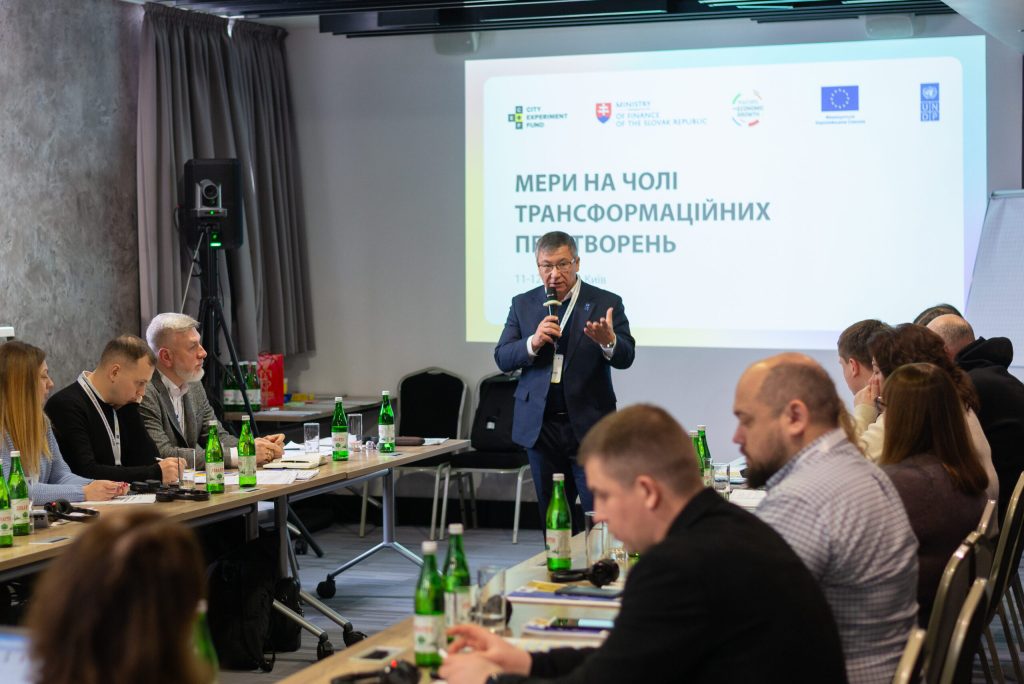
Bringing together participants from North Macedonia, Armenia, Moldova, Ukraine, Montenegro, and Kosovo1, the Mayors Leading Transformational Change Programme provides a structured space for city leaders to move beyond the exchange of best practices towards a more systemic understanding of change.
By building city portfolios, a set of connected initiatives designed to tackle a municipality’s key challenge based on a series of interconnected activities, they learn to see how different pieces of a city connect, to listen more closely to residents, and to make sense of what is shifting around them, so they can steer long-term change rather than simply react to it.
In Aparan, Armenia, the mission to create an “Equitable Tourism-Driven Economy” combines community mobilization around a shared local identity with cultural events and the development of local tourism offerings into new products and services. To ensure residents captialize on the increased inflow of visitors, these interventions are coupled with capacity-building programmes for local actors. This approach ensures that branding, infrastructure, product development, and human capital initiatives are all reinforcing one another to build a more connected and resilient local economy.
How does adaptive leadership work in practice?
Recognizing that systemic change requires strong human capital, initiatives like CEF and M4EG have expanded their focus to directly support the people shaping their municipalities’ futures. Effective leadership is rarely just about making the ‘right’ choice, it is about navigating constant change. It requires anticipating unpredictable factors, uniting diverse perspectives and fostering a portfolio of evolving initiatives rather than relying on a silver-bullet solution. To meet this need, the Mayors Leading Transformational Change Programme was designed to equip city leaders to manage complexities with confidence, scale, and collaboration.

Marat Kyurchevsky, Programme Manager for the EU Integration-Public Administration Reform Programme of the European Delegation to Ukraine: “In Ukraine, city leaders today operate in an extremely fluid, fast-changing environment, often facing unprecedented situations that require rapid decisions without a clear blueprint. I strongly believe that adaptive leadership is highly relevant in this context, as it closely reflects the realities in which Ukrainian cities are currently functioning. Moreover, Ukraine’s experience offers a unique and valuable source of practical insights, case studies, and lessons learned that can further enrich and evolve this leadership approach.”
A key practical tool in this approach is learning how to manage the ‘temperature’ or pace of a transition so that a community remains in the productive zone of learning. For instance, if a community like Leova, Moldova, is pursuing its mission to develop an integrated and competitive local economic ecosystem, and progress stalls due to a reluctance to shift away from familiar economic models, local leaders might need to ‘raise the heat.’ They can do this by inviting diverse stakeholders to the same room and creating a space to openly discuss competing demands and trade-offs. Conversely, if tensions and emotions run high during discussions, leaders can “lower the heat” by focusing on the stakeholder’s shared needs and values while addressing the technical part of the problem first, such as revitalizing the village center.
Anatoli Talmaci, Vice-mayor of Copceac, Moldova: “One of the most valuable lessons from the Adaptive Leadership framework is the importance of diagnosing complex challenges before acting and understanding the perspectives and motivations of different stakeholders. This approach helps leaders address not only technical problems but also deeper systemic issues. I will continue applying key principles such as working both “on the balcony and on the dance floor”, managing expectations and maintaining the right pace of change. These insights will help us strengthen cooperation in Copceac and implement more inclusive and sustainable solutions for our community.”
The Mayors Leading Transformational Change programme builds on Ronald Heifetz’s model from Harvard Kennedy School, treating leadership as a collective practice. In practice, this means experimenting, adjusting as you go, and managing the human side of change, where progress rarely follows a straight line.
Yurii Fomichev, Mayor of Slavutych, Ukraine: “Such leadership programmes are always beneficial for city officials. They provide an opportunity to view their work from a different perspective and rethink approaches to tackling complex challenges.”
The Mayors Leading Transformational Change Programme is implemented under the EU-funded Mayors for Economic Growth Facility and the City Experiment Fund (CEF), funded by the Ministry of Finance of the Slovak Republic.
Originally posted at M4EG’s website, read the full article here.
Cities rarely move in straight lines. A tourism problem is also a skills problem, a public-service problem, a business-confidence problem and often a community-belief problem. A weak local economy is rarely only about investment; it is also shaped by institutions, trust, identity, infrastructure and the ability of people to imagine a future where they are.
This is particularly true for smaller cities. Their challenges are often described in simple terms: too few visitors, too few jobs, too few services, too little money. Beneath these shortages, however, usually sits a more complex system of relationships, habits, assumptions and missed connections.
Aparan, Goris and Noyemberyan in Armenia began their mission-oriented journey from different starting points. Aparan looked at how tourism could become more equitable and economically meaningful. Goris explored how cultural tourism could become more innovative and better connected to local life. Noyemberyan asked how it could become more than a place people pass through on the way to somewhere else.
Different cities and different ambitions, yet their experience points to one shared lesson: local transformation does not begin with a project, but with a municipality learning to see differently.
Start with the system
In many municipalities, development still begins with a familiar sequence: identify a problem, prepare a proposal, find funding, and implement an activity. This logic is useful when the problem is simple, but many local challenges are not simple. They are interconnected, shaped by people’s behaviour, institutional habits, business confide
The mission-oriented approach used in Aparan, Goris and Noyemberyan asked municipalities to slow down before rushing to solutions. The sequence was deliberate: understand the challenge, listen to the community, map the actors involved, make sense of what has been heard, and only then design a portfolio of connected interventions that can be tested, adjusted and scaled.
The first change was internal
Each municipality formed a mission team led by the mayor or deputy mayor and composed of decision-makers from different municipal departments. The mission team created a space where these separate issues could be seen as part of one bigger picture. It brought together people with authority, practical knowledge and different institutional perspectives. Through training and capacity building, the teams worked with tools for stakeholder mapping, engagement, deep community listening and shared visioning. The most important outcome, however, was behavioural rather than technical.
Municipal teams began practising horizontal collaboration. They were asked to look beyond their own departments and understand how different parts of the city system influence one another. For other municipalities, this may be the first useful lesson: a city does not become more adaptive simply because it approves a new strategy; it becomes more adaptive when the people responsible for change start working differently.
Become the convener
The next step was to build a more honest picture of each city. Aparan, Goris and Noyemberyan developed city profiles, but this was not only a data exercise. It was a process of shared awareness. What assets already exist? Which actors are active but under-engaged? Where is information missing? Which assumptions have become so familiar that nobody questions them anymore?
This process also changed how the municipality appeared to local actors. When local government approaches businesses, investors and community groups not only to inform them, but to listen and involve them, the relationship begins to change. The municipality moves from being seen mainly as an administrator or service provider to becoming a convener of local development.
In Aparan, a leading mountain ski resort became part of the conversation about the city’s future. In Noyemberyan, agricultural businesses, including those cultivating olive gardens, were brought closer to the city’s development process. In Goris, local hotels became part of the emerging local mission around cultural tourism.
These examples show that many local assets are not absent; they are disconnected. Businesses may operate separately from municipal priorities, community groups may have energy but little access to decision-making, while public institutions may run activities that overlap or fail to reinforce one another. A municipality that can connect these pieces creates value before a single new project begins.
See the hidden links
The cognitive shift came next. Through sessions on systems thinking, complexity and portfolios, mission teams were introduced to a different way of understanding local problems. Instead of treating challenges as isolated issues, they began to see them as interconnected and evolving.
This can be difficult for public institutions, which are often expected to provide clear answers. Yet many urban challenges do not have one clear answer. A city may want more tourism, but tourism depends on services, infrastructure, skills, public spaces, private investment, local identity and the willingness of residents to see themselves as hosts. A city may want more economic activity, but economic activity depends on confidence, coordination, access to opportunity and the ability to turn local assets into something visible and usable.
Seeing the system does not make the problem smaller; it makes action smarter.
Ecosystem mapping turned this new perspective into practice. The teams identified public institutions, businesses, civil society groups, community actors and ongoing initiatives. They looked not only at who existed, but at how these actors related to one another.
This helped reveal overlooked stakeholders and connections. It also challenged the natural bias of municipal work. Officials often see familiar problems, familiar actors and familiar solutions. That is understandable, as institutions are built around routine, but transformation requires looking beyond the usual circle.
By reformulating problems together with stakeholders, the mission teams began to see different entry points for change. New actors emerged not because they had suddenly appeared, but because the municipality had started looking differently.
Listen before designing
Then came the stage that gave the process its human depth: community listening.
In many local development processes, residents enter late. They are asked to react to proposals, validate priorities or attend consultations. In Aparan, Goris and Noyemberyan, residents were brought in earlier. Mission teams conducted around 25 to 40 interviews per city, with attention to gender balance and the representation of vulnerable groups.
The purpose was to understand how residents experience the city: what they need, what they value, what they worry about, what they hope for and what role they imagine for themselves in the city’s future.
This required municipal teams to suspend the comfort of ready-made answers. They went out with open-ended questions and listened before designing. Although that may sound simple, it changes the balance of knowledge. Residents are not only beneficiaries of services; they are experts in the lived reality of the city.
Turn voices into direction
The insights gathered through listening then fed into sensemaking and foresight workshops. These sessions brought diverse stakeholders together to identify patterns, compare perspectives and imagine possible futures for each city. They also helped reduce duplication by showing what different actors were already doing.
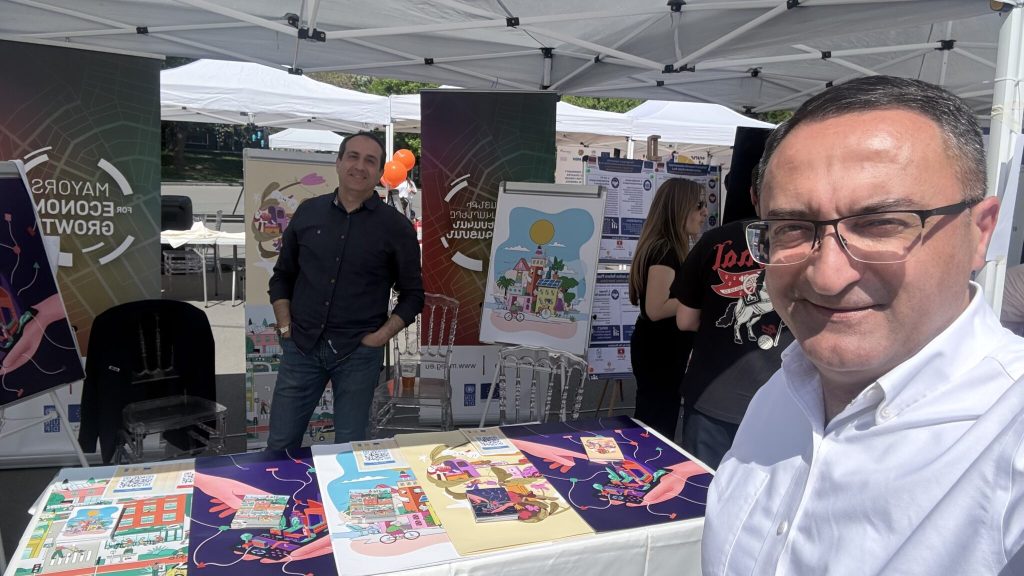
This stage matters because participation without sensemaking can become a list of complaints, while foresight without evidence can become wishful thinking. The value of the process was in combining both: listening to people’s lived realities and then using those insights to shape a collective direction.
It also changed the quality of engagement. When people are asked not only what is wrong, but what future they want and what role they might play in building it, the conversation becomes more productive. A sense of belonging becomes a development asset. People begin to see themselves not only as residents of a municipality, but as participants in its future.
Build a portfolio, not a wishlist
The portfolio bootcamp marked the move from exploration to strategy. Aparan, Goris and Noyemberyan translated their insights into mission portfolios: a clear mission statement, the shifts that need to happen, the expected effects of change and strategic positions within the local system.
- Aparan defined its mission around an equitable tourism-driven economy, with the aim of becoming a more economically active and attractive municipality by strengthening local economic development, improving service provision and making better use of existing assets and institutional capacity.
- Goris focused on innovative cultural tourism, seeking to strengthen the city as a more dynamic and attractive municipality by improving economic activity, enhancing public services and better leveraging its cultural, social and institutional assets.
- Noyemberyan chose the mission of becoming a hospitable transit hub, aiming to transform itself from a municipality people pass through into a recognized and attractive destination by activating its tourism, service and local economic potential.
What other cities can learn
For other municipalities, the message is both practical and demanding. The journey begins with the team: breaking internal silos and creating a shared way of working before trying to solve problems outside the municipality.
It also requires a deeper understanding of the system. Familiar actors, old assumptions and fragmented data are rarely enough to explain why local challenges persist. Municipalities need to look more widely, listen more carefully and involve residents, businesses and vulnerable groups before priorities are already fixed.
Mapping the ecosystem can reveal that many resources are already present but disconnected. A mission becomes useful when it helps bring those resources into a more coherent portfolio of action, where vision is translated into connected initiatives rather than isolated projects.
The real change is a habit
Aparan, Goris and Noyemberyan are now moving into implementation, where the mission-oriented approach will be tested in practice. The next phase will be about trying out interventions, learning from what happens, adjusting where needed and scaling the ideas that prove useful. Some actions may show results quickly, while others may need to be refined or redesigned along the way. This process of adaptation is central to the journey.
For municipalities preparing to join the M4EG network, this may be the most useful lesson. The starting point is not only to ask what project is needed, but who should be part of the conversation, what remains poorly understood and what the municipality is ready to learn together with its residents and partners.
Cities that thrive are unlikely to be those with a single ready-made answer. They are more likely to be those that build the capacity to ask better questions, connect the right actors and keep learning as conditions change.
The experience of Aparan, Goris and Noyemberyan is taking place under the EU-funded Mayors for Economic Growth initiative.
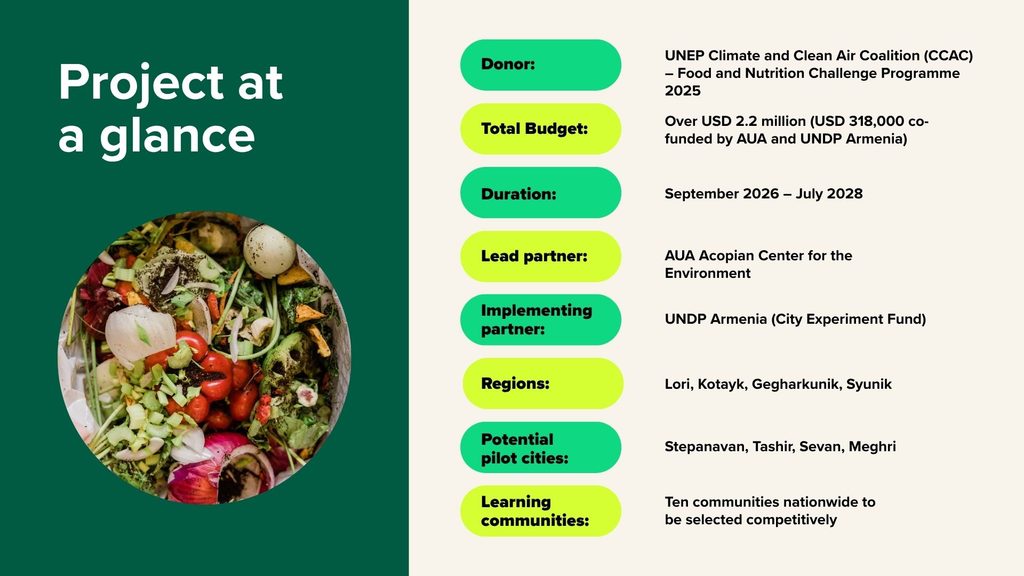
The United Nations Environment Programme (UNEP), through its Climate and Clean Air Coalition (CCAC), has approved over US$2.2 million in funding to accelerate Armenia’s transition towards a circular bioeconomy – strengthening municipal systems, reducing organic waste, and cutting methane emissions. UNEP funds US$1.95 million toward this project with US$318 thousand co-financed by the implementing partners. the implementing partners.
The project titled “Organics Mobilized: Accelerating Social Transformation towards a Circular Bioeconomy,” will be implemented between September 2026 and July 2028 by the American University of Armenia (AUA) Acopian Center for the Environment and UNDP Armenia, building on the municipal transformation model developed through UNDP’s City Experiment Fund (CEF).
From open dumping to circular systems
Armenia’s organic waste challenge is both environmental and economic. Nearly half of municipal solid waste consists of food and green material, much of which is currently openly dumped in unmanaged sites instead of properly treated. This releases methane – a potent short-lived climate pollutant (SLCP) and a priority target for the CCAC – while wasting organic nutrients that could regenerate soil and support local food production. At the same time, limited refrigerated storage and transport for agricultural products contribute to post-harvest food loss, particularly in rural areas. Without adequate cooling infrastructure, farmers are often forced to sell produce prematurely or at lower value, reducing incomes and increasing waste across the food system.
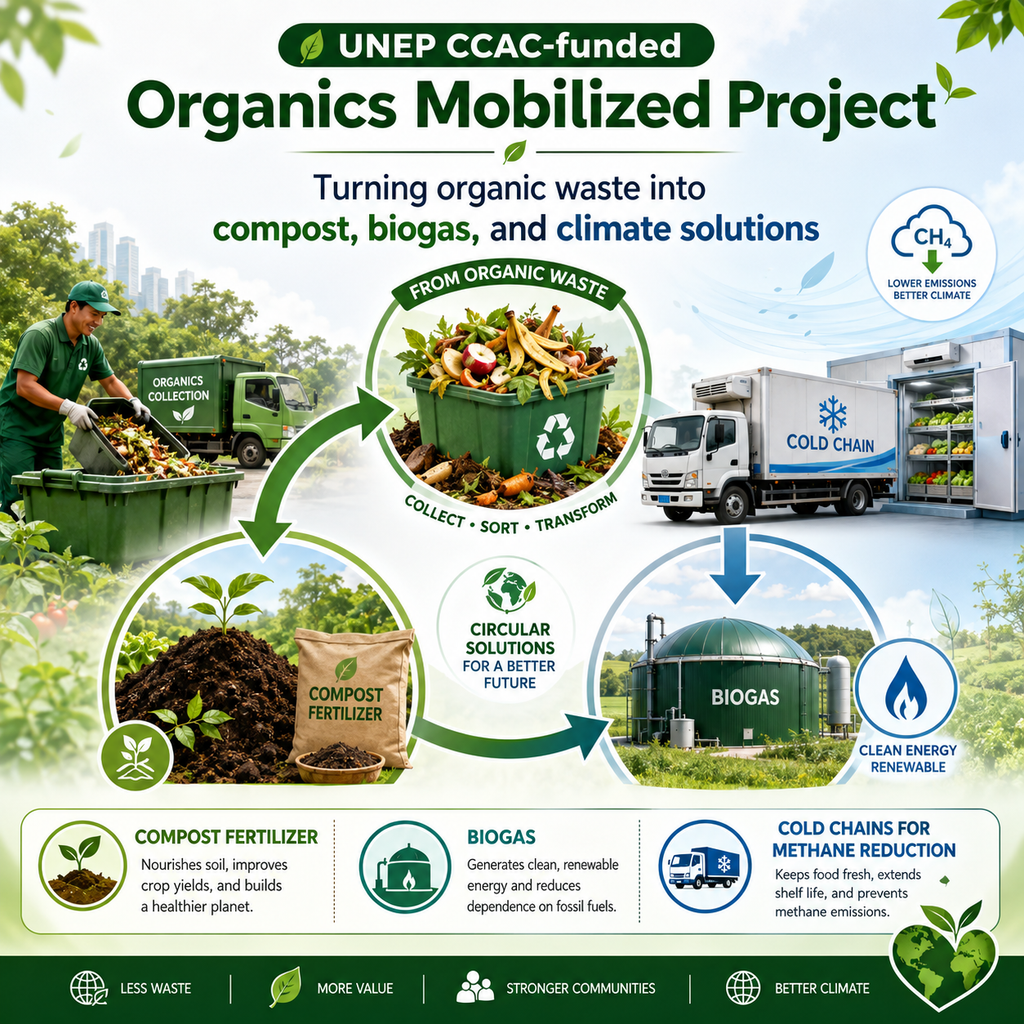
The initiative will be implemented in four regions – Lori, Kotayk, Gegharkunik and Syunik – with pilot activities starting in the cities of Stepanavan, Tashir, Sevan, and Meghri. In Lori, Kotayk and Gegharkunik, the pilot cities will introduce or strengthen source separation and decentralized treatment of organic waste, including composting and anaerobic digestion solutions aligned with local operational capacity. In Syunik, the project will pilot shared refrigerated storage and transport systems using climate-friendly cooling technologies, aiming to reduce post-harvest food loss by 5–10 percent while lowering emissions across the food supply chain.
In each pilot city, Living Labs will serve as the core delivery mechanism – testing environments where municipalities, researchers, businesses and residents work together to design, operate and improve circular organics solutions. These Labs will generate evidence, build municipal governance capacity, mobilize local actors, and unlock new financing pathways. In parallel, ten additional municipalities from across Armenia will participate as “learning communities” – observing, assessing and preparing to adjust solutions to their own contexts.
Crucially, implementation will be accompanied by institutional reform. Lessons from the pilot cities will be translated into municipal bylaws, service standards, operational contracts, and dedicated budget lines – ensuring solutions are embedded within public systems and can be adopted by municipalities nationwide.
A scale-up built on what works
This project builds directly on the work of CEF – a UNDP regional initiative, funded by the Ministry of Finance of the Slovak Republic, that brings cities together to reimagine sustainable urban development through strategic innovation and transformative solutions. In Stepanavan and Tashir, CEF-supported municipalities have co-designed Circular Economy Portfolios – place-based strategies integrating green transition goals with governance reform, citizen engagement, and adaptive delivery.
“The UNEP funding gives Armenia an opportunity to accelerate the green transition at national scale by embedding circular bioeconomy solutions into municipal systems, while keeping them flexible and responsive to local needs and a rapidly changing environment,” said Natia Natsvlishvili, Resident Representative, UNDP Armenia. “By scaling the City Experiment Fund’s portfolio approach nationally and introducing experimental living labs, we are creating opportunities to combine environmental sustainability with economic value, stronger local economies and more resilient governance.”
The project also draws on AUA Acopian Center’s expertise and applied national work in biowaste systems, waste source separation, and circular economy policy, including through its Sweden-funded Waste Policy Armenia program, which is strengthening sector capacity for more environmentally sound waste management and the introduction of Extended Producer Responsibility (EPR). “Armenia is at an inflection point on green transition. There is great momentum in modernizing and growing the economy, with increasing appreciation of doing this green. The Organics Mobilized project supports this development by creating space to experiment, learn, and institutionalize change,” says Alen G. Amirkhanian, Director of the AUA Acopian Center for the Environment.
The partnerships, models, and institutional readiness developed through this combined work created the conditions for Armenia to mobilize external climate finance – scaling twin transition goals from city-level experimentation to national investment.
Impact across multiple dimensions
The initiative is designed not simply to improve waste management, but to reshape how cities and food systems manage organic resources. By addressing both organic waste and post-harvest food loss across multiple regions, the project links SLCP reduction with economic resilience and more efficient municipal services.
Through implementation in the pilot cities, Armenia will generate tested service models and governance tools that other municipalities will actively observe and can adopt. These lessons will feed into national guidance and policy frameworks, helping translate local experimentation into wider systemic change.
Ultimately, the project supports the acceleration of a circular bioeconomy approach in Armenia – where organic waste becomes a resource, food systems become more resilient, and cities play a central role in driving sustainable transformation.
On 30 July, the Green Economy Hub was opened in Nizhyn – a new space where residents, local authorities, businesses and academia can work together around a shared goal: to make the community more energy-resilient and economically stronger.
The Nizhyn community, like hundreds of others across Ukraine, is facing the consequences of a full-scale invasion. These challenges are particularly acute in the energy sector. Outdated infrastructure, low energy efficiency in municipal buildings and a high dependence on centralised energy sources leave towns vulnerable to supply disruptions and rising costs. At the same time, Nizhyn has a clear vision of how to move towards a green transition – but it lacked the resources, technical expertise, and a platform to carry out systematic work to address this issue.
“The green economy is not just about solar panels. It is a new culture of decision-making, responsibility for the future, the efficient use of resources and the whole community working together,” emphasise officials at Nizhyn City Council. The community already has 11 solar power stations in operation, half of which were installed thanks to grant funding, and the rest through an energy-service contract. They supply electricity to schools, the town hospital and other municipal facilities, and this year alone, this model has saved US$62,000 in local budget funds.
This practical experience is the foundation of the Green Economy Hub – a space housed within the Town Hall. It is a place where local government officials, entrepreneurs, academics, representatives of community initiatives and educational institutions can learn, seek advice, develop joint projects and share practical solutions in the fields of energy efficiency and the green economy.
The Hub’s work is based on specific steps: the project team carried out a comprehensive assessment of three municipal buildings to identify where and how energy is being wasted, and to develop tailored plans to improve resource efficiency for each of them.
The project also brought together a newly established cross-sectoral working group comprising representatives of the city council, municipal utilities, businesses, educational institutions and civil society. This group is currently developing the “Roadmap for the Development of the Green Economy Hub for 2026–2030.” It will define the Hub’s long-term priorities and clarify the roles of the stakeholders involved. . As well as disseminating knowledge, this will help to forge a sustainable partnership centred on the theme of energy independence – a partnership that will continue to operate even after the project has ended.
The Hub was established by the NGO “Misto N” at the initiative of the Nizhyn City Council under the City Experiment Fund (CEF), financed by the Ministry of Finance of the Slovak Republic and implemented by UNDP.
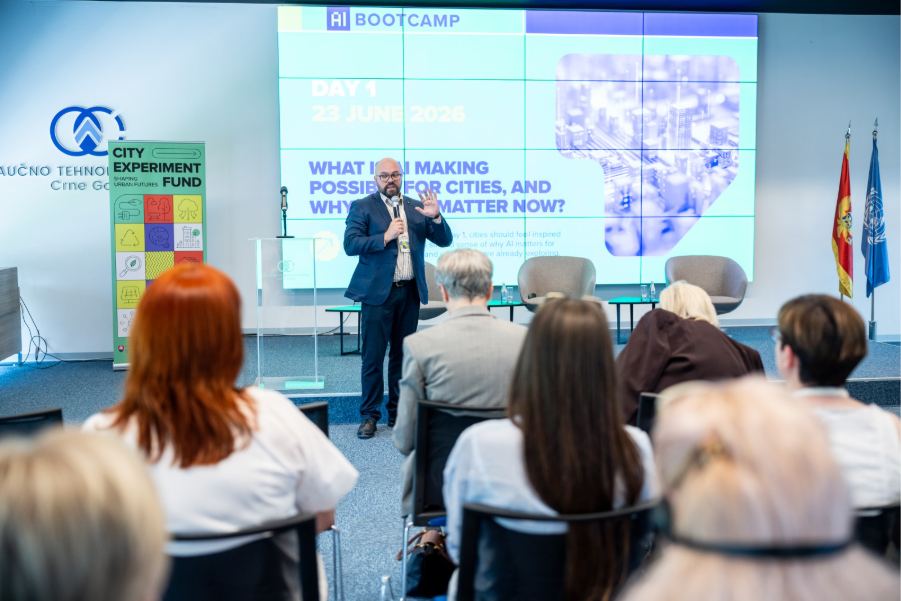
The CEF x AI Bootcamp, held on 23–25 June under UNDP’s City Experiment Fund (CEF) with the support of the Ministry of Finance of the Slovak Republic, brought together some thirty participants from ten municipalities – from capital cities to small towns, some of them rebuilding through crisis. In the course of three days, cities from Armenia, Kosovo1, Montenegro, North Macedonia and Ukraine worked on exploring where – and whether – AI belongs in their city.
Their starting points differed widely, but the challenges they brought clustered around a handful of shared themes: energy resilience and resource monitoring; water management; waste collection and recycling; air quality and environmental prediction; making sense of citizen requests and complaints; and planning – from circular economy to sustainable tourism. Several teams are also grappling with the underlying data challenge: fragmented systems, scattered records, and information that exists but cannot yet be used.
Why a bootcamp, and why now
Cities are already encountering AI whether they choose to or not – it is reshaping how services are delivered and decisions are made, while the capacity gap between what the technology demands and what most municipalities have kept widening. Cities that engage early get to shape how AI is adopted: which problems it solves, and which safeguards are built in.
Yet most AI training for governments stays abstract – a tour of the technology, disconnected from any decision a city actually has to make. CEF takes a different starting point: AI is not a tool to procure but a capability to build. The bootcamp was designed as the pivotal middle step of a longer journey that runs from foundational learning to funded experimentation as part of the new CEF x AI programme.
How we designed it
Three design choices shaped the experience.
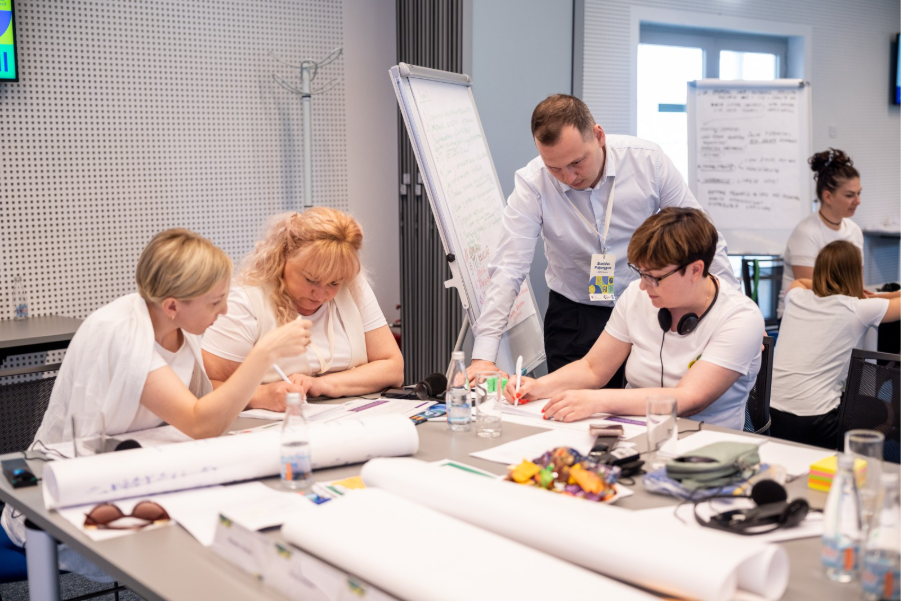
Fundamentals moved online, before the event. All participants completed a self-paced AI Foundations course and a set of preparatory canvases in advance. That freed the three days in Podgorica for the only thing that cannot be done remotely: teams working through the challenges facing their own cities alongside peers and experts in the room.
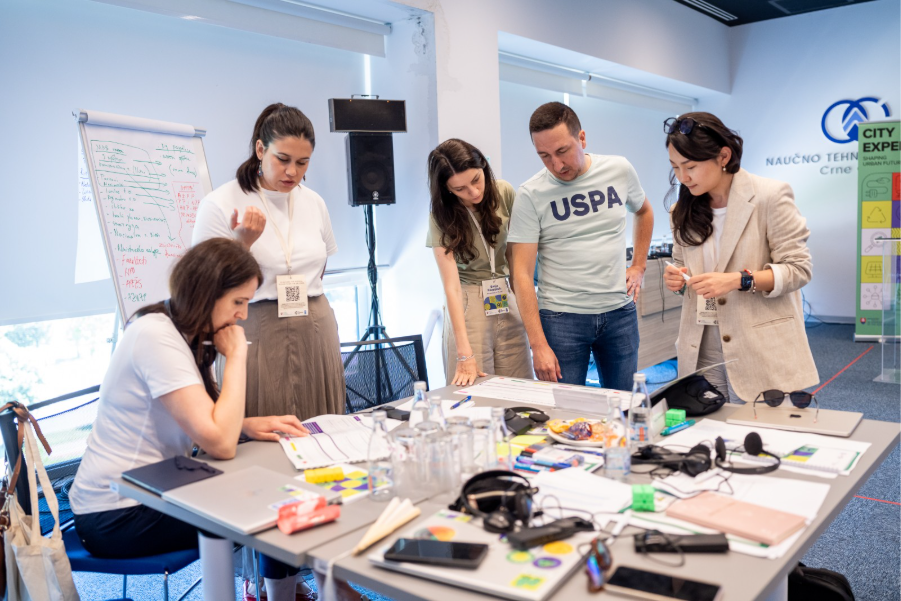
A workbook, not a lecture series. The heart of the bootcamp was a single workbook of seven canvases, each producing one concrete output that feeds the next: an ecosystem map, a problem statement, a responsibility check, a feasibility check, peer feedback, entry points, and reflections. By the final afternoon, every city had at least two concrete AI entry points – the substrate of their funding proposal. One instruction was printed into the method itself: “‘AI is not the answer’ is a valid finding.”
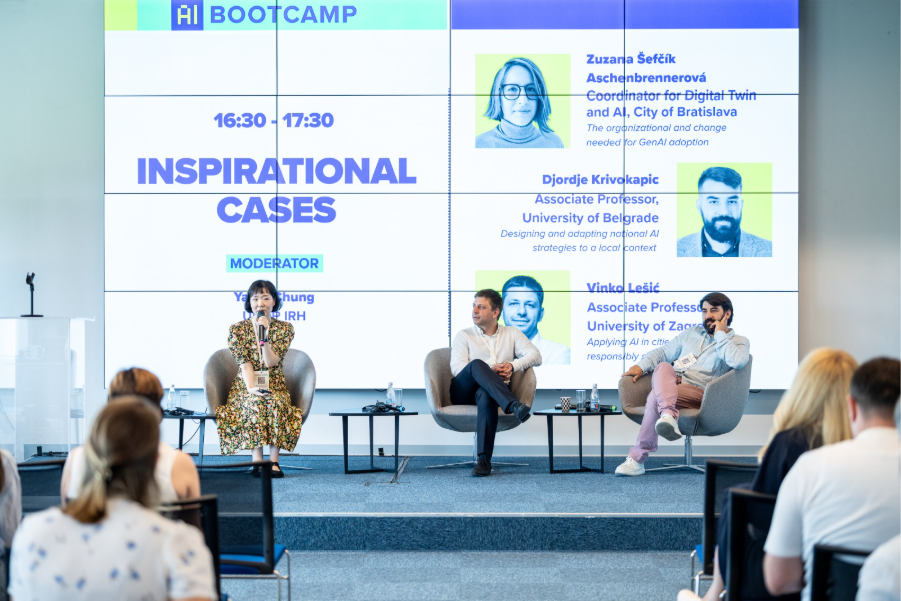
Three days, three questions. Day 1 asked what AI is making possible for cities and why it matters now – inspiration, provocations, and real cases from Bratislava, Montenegro’s national AI strategy and the IEEE’s GenAI for Good work. Day 2 asked what each city’s AI landscape looks like, and which challenge is most worth pursuing. Day 3 focused on implementation: do we have what it takes, and where do we begin?
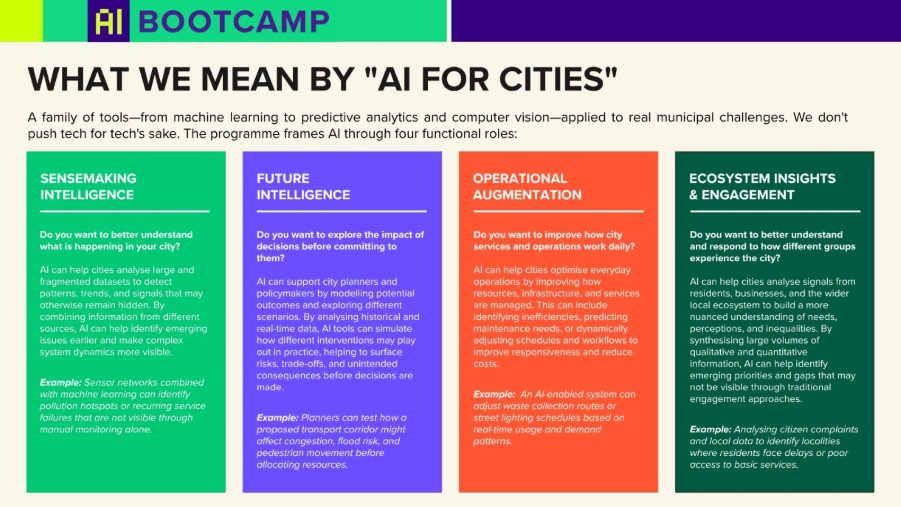
Instead of a taxonomy of algorithms, cities worked with four functional pathways, each phrased as a question a public servant can answer: Do you want to understand what is happening in your city (sensemaking intelligence)? How to explore the impact of decisions before committing them (future intelligence)? Improve daily operations (operational augmentation)? How to better understand how different groups experience the city (ecosystem insights and engagement)?
What we learned
Problem framing is the hardest and most valuable step. Cities tend to arrive with solutions, rather than problems. Many of the biggest breakthroughs came from refining the “How might we” statement. Teams were challenged to clearly define who is affected, what needs to change for them, and why it matters – without jumping to a solution or embedding a technology in the question.
Permission to say no to AI builds trust. Making “AI may not be the answer” an explicitly valid outcome changed the tone of the room. Teams became more candid about fragmented data, missing skills and weak enabling conditions, which is exactly the honesty a credible proposal needs.
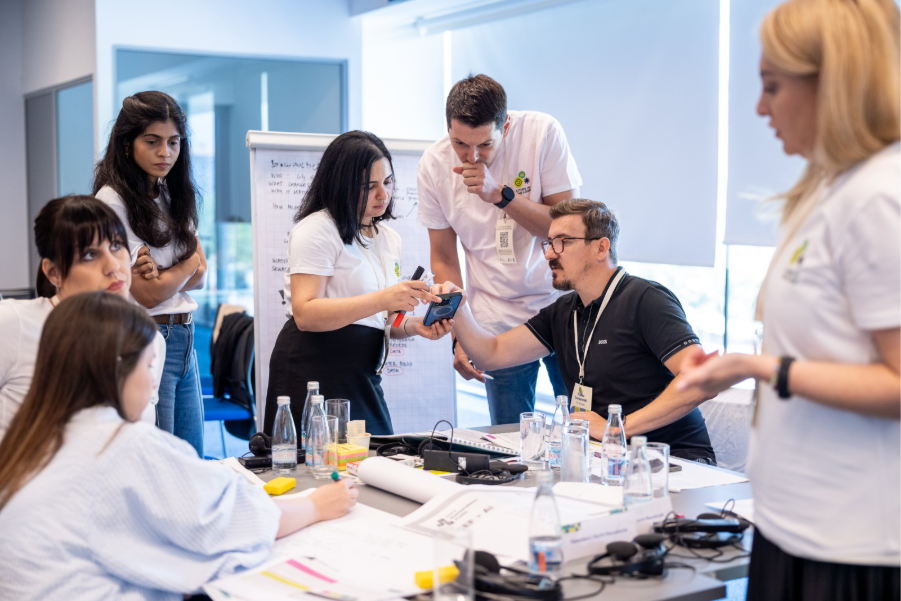
Peers are the real curriculum. One participant named their key takeaway from Day 1 simply as a “feeling of alignment.” Whether rebuilding through crisis or planning for long-term transformation, small towns and capital cities found themselves asking many of the same questions. Structured peer feedback in country groups helped teams refine those shared challenges into sharper problem statements.
Responsibility works as a design step, not a lecture. Rather than an ethics session bolted at the end, every team worked through a responsibility canvas while their AI direction was still taking shape – asking who could be harmed or excluded, whose privacy and rights are at stake, and what safeguards would need to be in place. While the cities are still exploring how AI might be applied, it also makes the right moment for cities to reflect on ethics, privacy and rights from the very beginning – where the responsibility becomes part of the design rather than an afterthought.
Real-time sentiment is a facilitation tool, and occasionally a mirror. The daily Menti meter pulse lets the team adjust pacing and energy between sessions. It also gave participants a place to leave the harder, anonymous questions. A room that steps back from process to ask about purpose is a room that has understood the assignment.
What happens next
The bootcamp is a beginning, not an end. Cities are now refining their entry points into proposals along two tracks for CEF x AI Programme. Track 1 – the CEF x AI Demonstrator – will support selected cities with US$200,000 over roughly two years to build and test AI pathways embedded in their ongoing portfolios. Track 2 – the BOOST x GenAI for Good Challenge – will match city-owned use cases with global innovator teams to co-design responsible, open-source GenAI solutions, with cities staying owners of the problem throughout. Selection will take place over the summer; and the activation begins in September 2026.
The question these ten municipalities are taking home is no longer: “What can AI do?” It is the one that emerged during the bootcamp: Will this actually benefit the citizens of our town? The fact that teams are asking this before a single line of code is written may be the bootcamp’s most important outcome.
[1] References to Kosovo shall be understood to be in the context of United Nations Security Council resolution 1244 (1999).
While information about AI is abundant, space to make sense of what it means in practice is not. That gap between the global AI conversation and where cities in our region actually stand is the focus of the first session of the AI in Development Practice series. Hosted by the United Nations Development Programme’s (UNDP) Regional Bureau for Europe and Central Asia, the series aims to create space for practitioners, researchers, and policymakers to work through how AI is reshaping development work.
Urban governance is one of the places where AI’s effects are most concrete and most uneven, and where the stakes of getting it wrong are hardest to ignore. Two speakers anchored the conversation, each approaching the same problem from a different angle: Gesa Ziemer, Academic Lead at UNITAC and Director of the City Science Lab in Hamburg, and Yoonjin Yoon, Founder and Director of the Urban AI Institute and Chair Professor at KAIST in South Korea.
Gesa Zeimer: Leveraging existing ecosystems in cities to enable AI and digital transformation
Gesa pointed out that there is a widening gap between how fast urban AI is developing and how ready cities actually are to use it. Data is often outdated, fragmented across authorities, civil society, and private companies, and rarely interoperable enough to feed into an AI system.
Most cities her team works with lack a centralized data management system altogether, and where one exists, it’s often built on a single proprietary platform leaving the city dependent on that company rather than in control of its own data.
On where cities should start, her clearest answer was prioritization: connect civil society and government first. Activists, artists, and community groups are doing real work that’s disconnected from government, and government holds laws and strategies disconnected from what’s happening on the ground.
Her example of an ecosystem approach in practice came from Windhoek, Namibia. The national statistics agency had a solid centralized data platform, but the column for informal settlements was essentially empty, left blank for political reasons. Rather than build a new tool, her team’s actual work focused on relationship-building connecting local NGOs who already held the data, building enough trust to get it included.
Yoonjin Yoon: How cities could apply AI – what the KAIST Urban AI Lab has been testing in cities
Yoonjin opened with a conceptual distinction that anchored her entire talk:
- AI of Cities – how can AI help cities work better?
- Cities of AI – how will cities evolve because of AI?
The purpose of urban AI is not technology. It is to enable better decisions, improve day-to-day operations and services, strengthen engagement with communities, and help cities achieve more with fewer resources, less budget, less staff. Every city, regardless of wealth or geography, is wrestling with the same three challenges: how people move, how the city responds to external stress, and how it manages growth. AI doesn’t resolve those challenges. It helps leaders see them more clearly, understand them more deeply, and act more confidently. This is what decision support actually means, not automation, not replacing planners or policymakers, but giving them better tools to understand what is actually happening in their city.
Two Seoul projects illustrated what using AI looks like in practice and what it can reveal unexpectedly. In the first, using daily credit card data across all 422 Seoul neighbourhoods, the team found that 80% of neighbourhoods see retail sales decline on extreme heat days. Commercial centres drawing commuters and visitors saw the sharpest drops simply because those people stopped coming, while residential neighbourhoods serving local daily needs were largely unaffected. Neighbourhoods that looked identical in official statistics functioned completely differently in reality – invisible in aggregate data but made visible through AI. A second Seoul project used an AI agent built on the open-source SUMO traffic simulator to let non-expert city officials test scheduling decisions – such as the best 30-minute window for road maintenance – using plain-language prompts that anyone can understand.
For cities that find themselves earlier in this journey, her advice was to flip the usual instinct: define the real problem first, rather than starting from what AI can do. She pointed to her institute’s current project near Ho Chi Minh City, where data exists but is scattered, as a close parallel to where many cities in our region are starting from, and noted that a small or imperfect dataset is still worth using, since working with what’s available tends to reveal what the next data investment should be. Asked separately about open datasets, she pointed to satellite imagery as the most universal starting point regardless of income level, alongside anonymized mobile movement data for understanding human dynamics that built-environment data alone can’t capture.
Both speakers, in different ways, pointed to the same underlying urgency. The window for shaping AI adoption is now. Cities that engage with AI early (even if modestly) can shape how it is introduced: which problems it addresses, whose interests it serves, and what safeguards are built in.
Putting AI to work in cities: The CEF × AI programme
The webinar coincides with the launch of the AI Foundations course for municipalities and the launching of CEF x AI, a new programme, part of the City Experiment Fund, focused on helping cities build the capability to work with AI in practice.
CEF × AI frames AI not as a technology agenda but as a set of functional capabilities cities can put to work. The programme organizes these around four pathways:
- Sensemaking Intelligence: AI can help cities analyze large and fragmented datasets to detect patterns, trends, and signals that may otherwise remain hidden;
- Future Intelligence: AI can support city planners and policymakers by modelling potential outcomes and exploring different scenarios;
- Operational Augmentation: AI can help cities optimize everyday operations by improving how resources, infrastructure, and services are managed;
- Ecosystem Insights & Engagement: AI can help cities analyze signals from residents, businesses, and the wider local ecosystem to build a more nuanced understanding of needs, perceptions, and inequalities.
Together, these four pathways reflect a single underlying idea: AI is most useful when it starts from a real municipal problem, not from the technology itself. To support this work, UNDP organized a CEF × AI Bootcamp in Podgorica, Montenegro in June 2026 bringing together municipalities from the region to explore how AI can support their green and digital priorities. Over three days, city teams worked through their own challenges, assessed their readiness for AI, and identified practical opportunities for experimentation and implementation.
Stay tuned for our next webinar sessions!
Artificial intelligence (AI) is increasingly shaping how cities deliver services, manage infrastructure, and make decisions. For many municipalities across Europe and Central Asia, the challenge is not simply adopting AI, but understanding where it genuinely fits their institutional context, what it demands in terms of readiness, and how to engage with it in a way that is grounded, responsible, and connected to their existing priorities.
To support this work, the United Nations Development Programme (UNDP) in Europe and Central Asia is convening the CEF × AI Bootcamp in Podgorica, Montenegro, from 23 to 25 June 2026.
The bootcamp marks the first milestone of the newly launched CEF × AI programme, part of the City Experiment Fund (CEF), bringing together municipalities from the region to explore how AI can support their green and digital priorities. Over three days, city teams will work through their own challenges, assess their readiness for AI, and identify practical opportunities for experimentation and implementation.
Selected municipalities have been invited to the bootcamp following an Expression of Interest process and completion of an online AI Foundations for Municipalities course to help public servants build a shared understanding of AI, its applications in urban contexts, and what responsible engagement with it looks like in practice.
The following municipalities have been selected to participate in the CEF x AI Bootcamp in Podgorica: Yerevan, Armenia; Kavadarci, North Macedonia; Skopje, North Macedonia; Podgorica, Montenegro; Pluzine, Montenegro; Rivne, Ukraine; Mykolaiv, Ukraine; Kharkiv, Ukraine; Pristina, Kosovo [1].
What cities will work on
Participating municipalities will work through a structured process designed to take them from a broad understanding of AI to clear, actionable directions grounded in their specific contexts.
Cities will begin by mapping their AI ecosystem, examining what data, infrastructure, governance structures, and actor networks they already have, what is missing, and what is already in motion. Building on this, they will move into problem framing, identifying which challenges are most worth pursuing and how AI could meaningfully support their twin transition priorities. Cities will then assess the feasibility of their proposed directions and examine questions of responsibility: who could be affected, where accountability gaps exist, and what governance would be needed.
By the end of the bootcamp, each participating city will have developed its own AI pathway, identifying at least two concrete directions for exploring how AI could support its work. These pathways will also consider the surrounding building blocks required for responsible adoption, including governance, ethics, privacy, partnerships, and institutional capacity, informed by what cities have mapped and learned throughout the three days.
Throughout the sessions, cities will hear from experts and practitioners working at the intersection of AI and urban transformation, exchange perspectives with peers from across the region, and receive structured guidance and one-to-one mentorship from the facilitation team.
Cities as active participants, not passive adopters
A core principle of the bootcamp is that cities engage as active shapers of how AI is integrated into municipal services and processes. Rather than promoting AI as a solution in every situation, the programme encourages cities to critically assess where it can create meaningful value and where other approaches may be more appropriate. The bootcamp is therefore designed around the cities’ own priorities, submissions, and questions.
The bootcamp also addresses the conditions that make AI engagement sustainable over time: institutional readiness, coordination across teams, data and infrastructure requirements, and the governance frameworks that responsible AI adoption demands.
What’s next
Following the bootcamp, cities will be invited submit proposals to continue into one of two supported pathways: the CEF × AI Demonstrator track, focused on building longer-term institutional AI capacity, or the GenAI Challenge track, which matches cities with external innovation teams to co-design and pilot targeted AI solutions.
The programme is implemented by UNDP through the City Experiment Fund (CEF) with the financial support of the Ministry of Finance of the Slovak Republic. CEF collaborates with cities across Europe and Central Asia to tackle complex urban challenges through strategic innovation and experimentation.
[1] References to Kosovo shall be understood to be in the context of United Nations Security Council resolution 1244 (1999).
Artificial intelligence (AI) is opening new possibilities for how cities deliver services, make decisions, and manage complex systems. For municipalities, the question is no longer whether AI will play a role, but how to engage with it in a way that is useful, responsible, and aligned with their existing priorities.
To support this shift, the United Nations Development Programme (UNDP) in Europe and Central Asia is launching CEF x AI, a new programme, part of the City Experiment Fund, focused on helping cities build the capability to work with AI in practice.
The City Experiment Fund (CEF) collaborates with cities across Europe and Central Asia to tackle complex urban challenges through strategic innovation and experimentation. Rather than supporting isolated projects, it helps cities develop portfolios – sets of connected actions and interventions that can be tested, adapted, and improved over time.
CEF x AI extends this approach into the field of AI. The programme is designed to help municipalities integrate AI into their ongoing green and digital priorities through practical exploration, experimentation, and capability building.
Building foundations for municipalities
The programme begins with AI Foundations for Municipalities, an online course developed by CEF and the EU-funded Mayors for Economic Growth (M4EG) initiative. The course was co-created with the City of Bratislava and experts in AI and urban transformation to help municipalities build a foundational understanding of artificial intelligence, governance, risks, and practical urban applications.
The course will be made publicly available and is designed for public servants and city teams who are increasingly engaging with AI-related systems and decisions, regardless of technical background.
From learning to experimentation
Following an Expression of Interest process among municipalities in the CEF network, selected municipalities are invited to join the CEF x AI programme and participate in an intensive in-person bootcamp in Podgorica, Montenegro, in June 2026.
The bootcamp is designed as a working space for cities to explore how AI could support their priorities in areas such as service delivery, planning, operations, participation, and urban management. Working alongside UNDP, experts, and partners, municipalities will identify practical pathways for how AI could support municipal priorities, while mapping the institutional, technical, and ecosystem conditions needed to work with AI effectively.
Cities will also examine questions around feasibility, governance, institutional readiness, inclusion, and long-term sustainability – including where AI may not be the right tool and where simpler approaches may be more effective.
The following municipalities have been selected to participate in the CEF x AI Bootcamp in Podgorica: Yerevan, Armenia; Kavadarci, North Macedonia; Skopje, North Macedonia; Podgorica, Montenegro; Pluzine, Montenegro; Rivne, Ukraine; Mykolaiv, Ukraine; Kharkiv, Ukraine; Prishtina, Kosovo [1].
Two pathways for continued support
Following the bootcamp and an application process, a selected cohort of municipalities will continue into two supported pathways focused on experimentation, capability building, and piloting AI interventions.
- The first pathway, CEF × AI Demonstrator, supports municipalities that want to build longer-term institutional capacity to work with AI. These cities will test and apply AI across different areas of city administration while strengthening internal systems, coordination, governance, and practical capabilities over time.
- The second pathway, GenAI Challenge, is designed for municipalities with a specific, well-defined urban challenge. Implemented through UNDP’s BOOST impact acceleration programme, the challenge will match cities with external innovation teams to co-design and pilot targeted AI solutions within a shorter implementation period.
Across both pathways, the programme combines technical expertise, structured methodologies, peer learning, and funding support, while requiring active involvement from municipal teams throughout the process.
The programme is implemented by UNDP through the City Experiment Fund with the financial support of the Ministry of Finance of the Slovak Republic.
[1] References to Kosovo shall be understood to be in the context of United Nations Security Council resolution 1244 (1999).
UNDP’s City Experiment Fund has released the Twin Transition Stencil Report, presenting a structured framework that was designed to support cities in designing and managing integrated green and digital transformation portfolios.
It responds to a common challenge faced by municipalities: translating high-level green and digital policy goals into coherent, actionable strategies, practical pathways and investable interventions that reflect local realities.
The report synthesizes learnings from the City Experiment Fund’s 2025 Twin Transition cohort, drawing on practical experience from ten cities across Armenia, Kosovo [1], North Macedonia, Montenegro, and Ukraine. It documents how municipal teams approached complex, interconnected challenges by moving beyond isolated projects and toward adaptive portfolios grounded in local priorities and community input.
Rather than offering a step-by-step toolkit, the report, prepared by the City Experiment Team, offers a structured yet flexible methodology for urban transformation portfolio design. Portfolios refer to a set of connected initiatives and experiments that are designed and managed together, allowing cities to test different approaches in parallel, learn what works, and steer long-term transformation rather than relying on isolated projects.
It introduces key concepts such as portfolio intent, areas of interest, strategic positions, and options, and shows how cities can use practices such as experimentation, community listening, and sensemaking to navigate complexity, manage uncertainty, and build evidence for long-term transformation.
Aimed at municipal leaders, policymakers, development practitioners, and urban innovators, the report offers practical insights for cities seeking to connect green and digital priorities in ways that are locally relevant, inclusive, and resilient. It reflects UNDP’s ongoing efforts to support adaptive governance through systems thinking, and experimentation as foundations for sustainable urban development.
Find the report on UNDP Europe and Central Asia’s website.
The City Experiment Fund is a UNDP-led initiative that collaborates with cities across Europe and Central Asia to tackle complex urban challenges through strategic innovation and experimentation, with financial support from the Ministry of Finance of the Slovak Republic.
[1] References to Kosovo shall be understood to be in the context of United Nations Security Council resolution 1244 (1999).
How do cities understand the needs of their citizens – and turn those insights into meaningful action?
As part of the 2025 cycle of the City Experiment Fund (CEF), ten cities across Europe and Central Asia embarked on a community listening journey to explore how cities can meaningfully engage communities.
The CEF is a UNDP-led initiative that works with cities in the Europe and Central Asia region to tackle complex urban challenges through strategic innovation and experimentation. CEF is made possible with the financial support of the Ministry of Finance of the Slovak Republic.
Over the course of several weeks, representatives from local authorities in Armenia, Kosovo[1], Montenegro, North Macedonia, and Ukraine took part in a community listening training, followed by a month-long engagement phase. Over four weeks, city teams conducted 300+ conversations with residents, community leaders, public officials, entrepreneurs, and activists to understand how urban challenges are experienced across different groups and what kind of future citizens want to see for their cities.
This process revealed a wealth of perspectives, concerns, and ideas that will help shape each city’s Twin Transition Portfolio – a set of experiments and initiatives at the intersection of green and digital transformation.
What Cities Heard
Despite their diversity, many cities voiced similar concerns. Across the region, people spoke about the need for cleaner air, better waste management, reliable transport systems, and inclusive urban spaces. They highlighted the urgency of addressing youth migration, employment insecurity, and weak infrastructure, while also envisioning cities that are greener, more connected, and full of opportunities.
Residents consistently expressed pride in their local identity, community spirit, and natural surroundings. From Stepanavan’s “small Switzerland” image in Armenia to the lively rhythm of Pristina, the listening process uncovered how deeply citizens value nature, culture, and safety as foundations for a good life. Gender and inclusion also emerged as cross-cutting themes: in many cities, women remain underrepresented in decision-making, yet are often at the forefront of community life, education, and civic engagement.
A Shared Aspiration: Greener, More Livable, and Inclusive Cities
Across the ten participating cities, one vision stood out – to build cleaner, greener, and more inclusive communities where people want to stay and thrive. Whether through circular economy models in North Macedonia, green energy transitions in Montenegro, or digital innovation and governance in Ukraine, each city identified pathways toward sustainable urban transformation. The insights collected through the listening process will now help teams design local portfolios that respond directly to people’s lived realities – turning listening into action.
“Community listening is more than a data exercise. It’s about empathy, curiosity, and reimagining development from the citizen’s perspective,” said the CEF team. “It helps cities not only identify problems but also uncover opportunities for innovation rooted in people’s daily experiences.”
The Community Listening Report consolidates key findings and themes emerging across the cohort, serving as a shared resource for cities, partners, and practitioners interested in community-centered approaches to urban innovation.
Acknowledgements: Special thanks to Vid Stimac from the UNDP Serbia Country Office, for supporting the transcription and translation of 300+ interviews with AI tools to enable the synthesis of insights.
[1] References to Kosovo shall be understood to be in the context of United Nations Security Council resolution 1244 (1999)