
Category: Digital transformation and emerging tech
What do Marvel comic book, technology and people have in common? They all ask the question “What if…?” and they all can be superheroes or supervillains.
People move. Cars, planes and trams move. Planet moves. Rivers and animals move. Cities move. People go from one place to another; taxis and buses roll along the roads, while bicycles and scooters jostle for space. Everyone has somewhere to go and somewhere to be. And we all move in different directions. However, oftentimes the right to free movement is not equally granted to all.
But what if… it can be?
Accessibility isn’t a feature. It’s a fundamental human right. According to the World Health Organisation, around 80 million people in the world have some form of motor disability. That number reaches almost 175,000 in Bosnia and Herzegovina and 30,000 in Sarajevo. At the same time, they all face an identical problem. Life on the planet hasn’t been designed with the needs of different body or ability types in mind.
I, for one, know that really well, because I’m just one of 80 million. Over half of my life I’ve spent in a wheelchair and looking at the world from a lower perspective. I grew up in Sarajevo – a war affected, developing city in Bosnia and Herzegovina – and my life here was challenged by the difficult, almost unbeatable barriers in the built environment.
In 2019 I had the chance to go to Slovenia to study entrepreneurship & technology and for the first time in 25 years I was living and traveling by myself. I felt like Superman or Professor X, being able to fly across countries and visit cities on my own. All the experiences I had during that time opened some new worlds and opportunities for me and broadened my lower perspectives. However, I also realized that in many parts of the world, like, for example in Bosnia and Herzegovina – people are systematically discriminated against and excluded based on physical ability.
Through my own experience and tapping into innovation and technology, I have discovered how to connect business and social purpose. This is how the WeMapp idea was born! WeMapp is imagined as a community-based digital platform that enables people with mobility difficulties to move safely and independently by providing personalized routes based on motor ability for them through a map that contains route obstacle and accessibility detection powered by Artificial Intelligence. Such a tool offering precious information about the specifics of the outdoor environment and helping barrier-free navigation can be a game-changer in the daily life of persons with motor disabilities. WeMapp disguised in a mobile app is actually a social entrepreneurship at the service of people’s and urban mobility.
What if…I’m not alone?
Addressing the issue of accessibility of the built living environment requires joint forces of communities, institutions and businesses. 2020 was the pilot year for this idea – it was just the beginning of trying to set change in motion. 2021 came with many challenges, including the COVID-19 crisis. But at the same time, my enthusiasm around the idea only kept generating more networks and supporters ready to work with me on it.
Amongst them, the UNDP Accelerator Lab recognized the importance of the idea and the impact it could have on people’s quality of life. We embarked on an exciting and playful journey that included ideating on possible solutions, creating a network of stakeholders, launching the first urban walks & rolls in Vilsonovo šetaliste to gathering opinions and insights on the accessibility of the urban spaces in the city of Sarajevo. These are just some of the initiatives we’ve undertaken alongside our partners over the last 10 months, all blazing a trail for new ways to address the existing challenges of inaccessible living.
To make the WeMapp solution customised to the people’s needs, together with the Lab team we have developed a survey to help collect the voice and hear the needs of persons with motor disabilities. Do you want to be part of the change and join us in this endeavor? All it takes to be one of the superheroes (not all superheros wear capes!) is to fill out our survey (5 minutes).
What if… all of it works?
Given the far-reaching effects that inaccessibility has on people’s lives, being a society, economy and global community that cares for all people has to be a norm. In such a society, a person with a disability is then simply another individual with unique experiences and life stories. And technology will be a powerful engine for a thriving and inclusive future. Because technology without the right intention serves no purpose. Through WeMapp, a tech-supported community information sharing and crowdsourcing of accessibility data, every citizen can help make a more inclusive, accessible and happier society.
Much like the story of creation of the new universe in the popular Marvel Comic What If…? thatinspired this blog, what if all of these efforts work and we do create an inclusive space for everyone? What if we all move in the same direction and create smarter, more human-centred cities? I often imagine alternate universes I would like to live in. From barrier-free accessibility in buildings, streets and natural spaces to education, work, leisure, health services, public transport networks and easy-to-understand information. What if WeMapp and alike purpose-driven tech is our point of divergence and the consequences are a fully accessible, marvelous universe for all? What if…?
Republished from UNDP Bosnia and Herzegovina.
The following piece was first published on the Proofing Future and was originally published on February 21, 2021.
“We are using distributed ledger technology to help the cooperatives better market and differentiate their products on the back of their sustainability certifications, creating products with provable certification claims and traceability back to their origin. This traceability is then being leveraged to sell “proof packages” containing all this information to downstream buyers, driving more value directly back to a cooperative similar to how impact credits work in other industries,” says Erik Zvaigzne of Convergence.tech as we talk with him, as well as Marina Petrović and Robert Pašičko of UNDP Alt Fin Lab, about their project collaboration in the DLT4EU accelerator programme.
The DLT4EU accelerator programme identifies and connects distributed ledger technology (DLT) entrepreneurs with leading public and private sector organisations for social and public good.
DLT4EU is led by a consortium comprised of Metabolic, Digital Catapult and Ideas for Change, with direct support and advice of the European Commission’s Joint Research Center.
Erik Zvaigzne is VP of Product Innovation at Convergence.tech, a digital transformation and technology development company specialized in digital identity and traceability solutions, with a keen interest in how technologies like blockchain can be leveraged to create sustainability. He leads product development efforts for the company, as well as works with governments and international development organizations globally to help solve problems using emerging technologies. Erik is the venture team lead on the DLT4EU project.
Marina Petrović is the Innovative Finance and Technology Expert at UNDP Istanbul Regional Hub as well as Cofounder of the Alternative Finance Lab (Alt Fin Lab), which is an internal startup, run out of UNDP Istanbul Regional Hub for Europe and CIS. The Alt Fin Lab is exploring how to revolutionize development finance, through innovation, digitalization and technology. Since the Alt Fin Lab launched in 2016, Marina Petrović has been working to provide hands-on technical expertise, advisory support and market intelligence to over 45 UNDP offices, national partners and governments around the world.
Robert Pašičko is the Cofounder of the UNDP Alternative Finance Lab (Alt Fin Lab). He supports innovation in alternative finance mechanisms and in low carbon development in over 40 countries globally. He focuses on finding ways to make green energy affordable through blockchain, crowdfunding and community financing. Robert Pašičko also cofounded the UNDP Crowdfunding Academy, a training program for crowdfunding which has been implemented in over 20 countries worldwide and has created over successful 50 campaigns. He is an evaluator of blockchain projects funded by the European Commission.
Sebastian Klemm: Which deep economic reforms do we need to tackle, in order to arrive at regenerative & intragenerationally just societies that manage to live within planetary boundaries?
Erik Zvaigzne: I think a lot of it has to do with culture and awareness. We are increasingly becoming aware of the actions and impacts we have as people on the planet thanks just to our greater interconnectedness online and discussion of some of the issues in the media, which already feels like it is starting to change the mentality and consumer preferences of the younger generations as they look at things more holistically.
Crisis can spur innovation, and to some extent on the environmental sustainability front. I think, we are starting to see the results of that in some early things like clean energy. Circularity feels like it is up next, given the potential for digital platforms to do the hard work of connecting industries and supply chains together at various levels.
Everyone of course is at a different level of awareness and maturity in that sense globally, and it will take a long time for everyone to get onboard to achieve long and lasting effect. Balanced against the sometimes added cost of “doing the right thing”, if anything needs to change in terms of economic reforms, I would say we need to shift our regulatory landscape to create situations where it becomes more expensive to do the wrong thing and people fall into alignment regardless of their motive. The cost of the impact our products have on our health and our planet should factor into their prices so that people will fall in line regardless of their reasons or motives. Easier said than done, this is a very delicate thing to balance against overall prosperity and economic development in emerging economies for sure, but that is where I think some deregulation of technology innovations and proliferating better technology access can help create new and more sustainable communities.
Marina Petrović & Robert Pašičko: The market is driving producers to adopt unsustainable practices, creating a series of economic, social and environmental problems. The market does not incentivize producers to become sustainable. Brands pledging to be sustainable need to expand sustainable sourcing in order to meet their commitments. In absence of a clear solution, most companies are unable to achieve their target for a sustainable supply chain.
The UNDP United Nations Development Programme is working globally with a wide number of value chains and related commodities. However, more can be done to support the matching between demand and offer. For example, governments could prioritize economic mechanisms that promote the generation of livelihoods and decent and sustainable entrepreneurship. This could be done by introducing smart technologies, like blockchain, and creating decentralized markets which are transparent and efficient and can potentially increase the efficiency of supply chains and positively impact and improve inclusion within the value chain.
Sebastian Klemm: Speaking of the necessary shifts in the regulatory landscape: In a previous interview, David Franquesa elaborates on the EU legislation on Ecodesign – which claims to “further enhance the reparability and recyclability of appliances”.
What enhanced regulatory initiatives do you see already that may nudge both corporate and consumer behavior towards sustainable practices?
Erik Zvaigzne: The European Parliamentary resolution of 22 October 2020 furthering work on the EU legal framework to halt and reverse EU-driven global deforestation is an interesting one in how it will encourage greater accountability, action and transparency in commercial supply chains. By putting the onus on companies to provide proof of compliance with claims such as “deforestation-free”, new levels of traceability and international cooperation will be required to better monitor, track, and prove such assurances using tool sets similar to the one we developed as part of DLT4EU. The emphasis it places on sustainability, production processes and carbon footprint, human rights, and land tenure all require good practices to be followed in the countries of origin, and should naturally create investment in sustainability and development programs in the target countries to help achieve this.
Sebastian Klemm: What particular qualities of the DLT4EU accelerator distinguish this programme in your opinion?
Erik Zvaigzne: The problem-first emphasis. Many accelerators help commercialize an idea but don’t touch the design aspect too much, but DLT4EU left the solution space wide open for ideas on how technology could be adapted and applied to help solve the use cases. Creating a commercial model on the back of it is challenging in this way, but ideation with subject matter experts like this around a problem feels like a strong way to create social innovation and come up with new ideas.
Marina Petrović & Robert Pašičko: The vertical top down support by the European Commission, which is for us at the UNDP a game changer. As we work with and for governments, the solutions that we bring to them need to be more than just a good idea, or solution developed through a hackathon. They also need to be “implementable”, which in a lot of cases is impossible, as solution developers have only covered the “innovation or tech” part, and have not worked in parallel on policies or “restriction” elements.
Sebastian Klemm: Why do you participate in the DLT4EU programme?
Erik Zvaigzne: One of our core focuses at Convergence.tech is on projects that explore the application of technology to create positive social or environmental impact. Sustainable supply chains fit that profile. DLT4EU provided us the opportunity to explore the idea of how traceability can empower smallholder producers in agriculture and others in cooperation with the UNDP AltFin Labs.
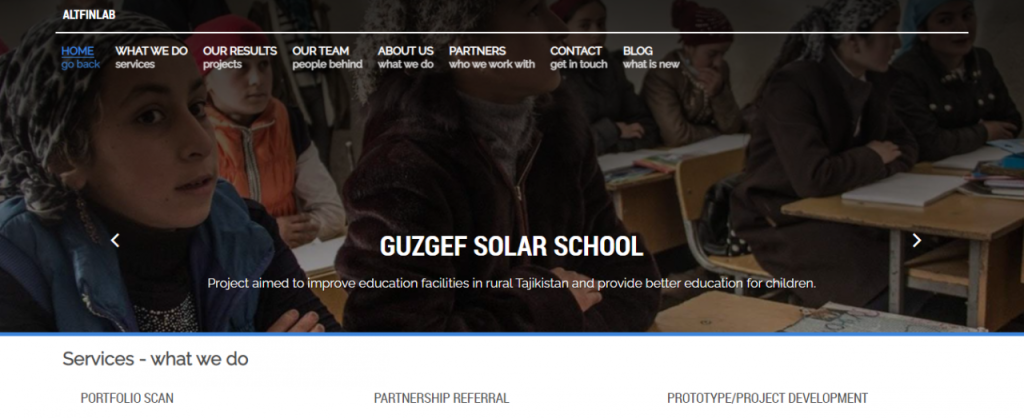
Marina Petrović & Robert Pašičko: The United Nations Development Programme (UNDP) is working on “big things”. We are trying to reduce the impacts of climate change, help communities, cities, governments in creating a better world. We call these challenges, 17 in total, the SDGs or Sustainable Development Goals. To fund these and address them, we have a gap: We need around $2.5 trillion per year. To fill this gap, governments and development organisations are trying to rethink their approach, as “business as usual” solutions are not enough anymore. And here comes the innovation part, technology and development. As we live in a digital world, maybe more than ever, development needs disruptive solutions to change the way people live today. From banking for 2 billion people who don’t have access to a bank account, to providing an identity for 1,5 billion people who do not have it, to speeding up access to electricity for 1,2 billion people who live without it. These people don’t have time to wait, and neither do development and the SDGs.
The UNDP mandate is “leave no one behind” and as the SDGs are so ambitious and comprehensive, they require multi-sectoral methods, innovative technologies and financial instruments that can leverage resources from different actors and account for the complexity of the development agenda.
It is the innovation team within UNDP’s Bureau for Programme & Policy Support, specifically its lead regional bureau, Europe and CIS, that has played a key role in accelerating organisational learning on emerging approaches to development. In this context, it has built a portfolio of innovative business offerings that includes:
- Building policy innovation labs within governments as an alternative mechanism for tapping into citizen expertise and assets for policy design and delivery.
- Leveraging alternative financial mechanisms and technologies, such as blockchain, to support entrepreneurship and strengthen competitiveness, as well as promoting understanding of the impact these mechanisms and technologies have on existing regulation and institutional frameworks (regulatory innovation). This service line has given rise to the Alternative Finance Lab, run out of UNDP Istanbul Regional Hub, which has led the design of three challenges under DLT4EU: Digital Impact Currencies, P2P Energy and Track-and-Trace.
- Advising governments on the use of new sources of data for timelier policy response.
- Strategic foresight and R&D aimed at continued market intelligence for new approaches and methods to tackle ‘sticky’ or stubborn development issues.
Sebastian Klemm: What are the societal and environmental challenges that your particular project “Track-and-Trace: Creating Fairer and More Transparent Supply Chains for Women-Owned Cooperatives in Morocco” addresses?
Erik Zvaigzne: Argan oil is a very high value commodity that can be worth over €250 / litre in the EU cosmetics market and is of great economic importance to the rural Moroccan communities that produce it. The primary producers are small, women-owned cooperatives who make less than €25 / litre from the oil that is pretty much ready for sale to the cosmetics market when it leaves their hands. For the coops and their members, the argan oil trade is sometimes the only opportunity for income and employment available to them.
Environmentally, good work is being done around certifications and ecosystem payment schemes that command premium prices and help preserve and grow the argan forests that are so critical to this industry. Proving and marketing these certifications to find interesting buyers willing to pay premium prices remains a challenge.
Despite being so critical to the industry as a whole, the coops who are in fact producing sustainably see a disproportionately small portion of the market value in return for their efforts since they lack broader market access and the ability to differentiate their products among others in the industry.
Marina Petrović & Robert Pašičko: Our project improves the socio-economic inclusion of small and medium-scale female farmer cooperatives, inserting them into a value chain in which their contribution is made visible and fair commercial conditions are guaranteed. On top of that, our project provides a user-friendly mechanism for responsible consumer applications in national and international markets.
Sebastian Klemm: The DLT4EU programme focuses the application of DLTs to the areas of “Circular Economy” and “Digital Citizenship”. How do you apply distributed ledger technologies in your project to help solve these challenges for the public good?
Marina Petrović & Robert Pašičko: We are using it to create a blockchain shared – value ecosystem and platform. End buyers will be able to trace argan oil production and ensure it has been sourced fairly and sustainably. The price will reflect the impact on the ecosystem and the real costs of production and export, with farmers receiving a significantly greater share than through any other method.
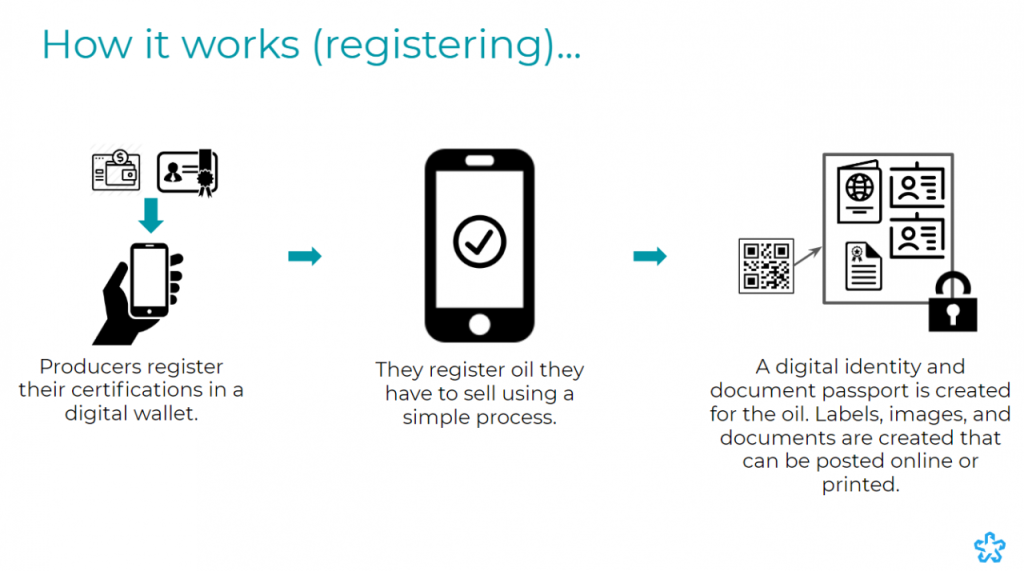
Erik Zvaigzne: We are using distributed ledger technology to help the cooperatives better market and differentiate their products on the back of their sustainability certifications, creating products with provable certification claims and traceability back to their origin.
This traceability is then being leveraged to sell “proof packages” containing all this information to downstream buyers, driving more value directly back to a cooperative similar to how impact credits work in other industries. This is all being done on the back of privacy protecting digital identity wallets and open standard W3C-compliant verifiable credentials, to build an ecosystem around certification-based traceability.
By open sourcing core parts of the platform and basing it on verifiable credentials as a data format, our hope is that this pattern can also be applied to other industries where smallholders have similar challenges that can in turn create fairer and more transparent supply chains in other commodities industries.
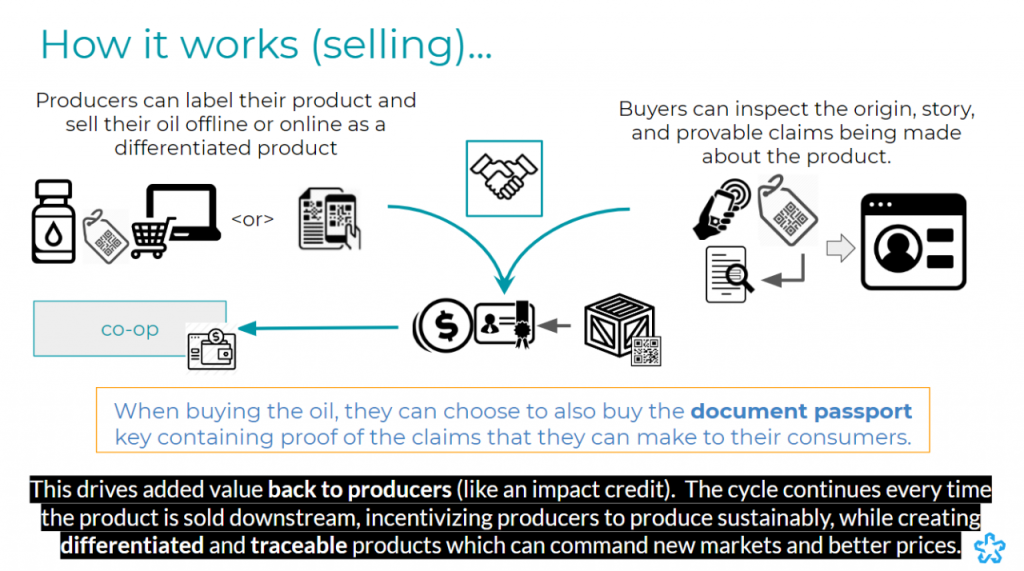
Sebastian Klemm: Track and trace may possibly be distinguished according to direction & point in time. Whereas tracing is about following the completed path backwards from its current point to where it began, tracking is about following the emerging path forwards from your starting point to wherever an economic resource currently is.
Could you further elaborate on the interplay of tracking to support the value creation in your application?
Erik Zvaigzne: We are collecting data points that provide both. Registration of the oil by the coop solidifies point of origin information and the beginning of the data record, associated with a cooperative profile, branding information, and any certifications they have. This is traceable by anyone who wishes to inspect the provenance of the oil that is being sold to them, and is a key data point that weigh into purchasing decisions made by commercial buyers, who have specific sourcing standards, certification and information requirements for the oil they purchase.
The present back-and-forth exchange of unverifiable paper documents is something that is made much easier, with high assurance data that can be validated as authentic in real-time by use of our technology.
To end consumers interested in sustainable and ethical purchasing, it also provides an opportunity to transparently see where their goods are coming from and under what conditions and certifications they were produced. We are working on also creating a channel here where consumers can choose to support the cooperatives directly financially as a part of this and looking at meaningful methods in which they can benefit the women and their families.
When the oil is sold to a new buyer, that information, and changes of custody thereafter, is where tracking comes into play as new data is added to the registered oil which enriches the traceability data. Recording this information on a shared digital data platform enables this. Incentive to do this comes by way of purchasable data passports that contain the proovable certification and claims information, which they in turn can use as proof of sustainable sourcing or as a marketing tool to incentivize their buyers and their branding. Branding is the element of importance we are trying to build for these cooperatives as well by equipping them with data and tools to help tell their story and reach new markets. They need to differentiate and promote their product and their certifications to open up new markets and commercial opportunities, and data passports are one way of doing that.
Sebastian Klemm: Can you elaborate on the aforementioned W3C World Wide Web Consortium and what specific relevance its standards compliance for your project development has? Perhaps, how does the application of these standards support your solution in terms of the public good?
Erik Zvaigzne: W3C is one of the leading internet standards organizations in the world. Their Verifiable Credentials (VC) and privacy-protecting Decentralized Identifiers (DID) standards in particular have been very influential in the decentralized identity world as of the last few years in this space, which create the pathways for interoperable cryptographically signed data packages (VCs) and identifiers (DIDs). For instance, both have been used to good effect in the European Blockchain Services Infrastructure (EBSI) project supported by the EU Commission.
What this creates are pathways for interoperability with data systems between vendors, between industry participants, and increasingly between government infrastructure globally so they can all speak the same language and make sense of the signed data packages and identifiers being used in the solution since all these data formats are non-proprietary. This is how basing our solutions on standards like these is beneficial. Others, not just us, can participate in this ecosystem and bring DID-compliant identities or issue certifications and credentials into this traceability platform, which reduces the barrier to participation significantly since we as Convergence.tech are then not a barrier to platform participation to create new data.
Anyone who complies with these standards will know how to create and validate the information that flows into and out of our platform. People can also leverage existing user-owned digital identities and signing functions that will increasingly be in place on the buyer side thanks to broader initiatives like EBSI and some of the digital signing work they are doing.
Sebastian Klemm: Throughout the DLT4EU programme and along the bootcamps with mentoring therein: What have you been developing so far?
Erik Zvaigzne: We have been developing refinements to our existing digital traceability technology and tooling to work for some of the specific needs in the argan oil value chain, as well as exploring what B2C market channels can be created on the back of this to help the cooperatives sell more directly to end consumers and benefit from the high prices the oil commands in international markets.
We see some other opportunities to be able to help with the administration and digitization of some of the underlying certifications programs, which we feel is another opportunity to get more people participating on the platform we are creating.
Marina Petrović & Robert Pašičko: Based on the tech part that Erik explained, we on the UNDP side have been working on the concept of a responsible value chain with the potential to expand its benefits not only in the agroindustry sector, but also to other sectors.
Our DLT4EU project is the first project of its kind in the UNDP Morocco Country Office and will expand UNDP’s expertise in the application of technologies in development. In line with ongoing discussions about UNDP’s role as a key player in innovation for development, as well as with the private sector, this initiative will have a catalytic effect as it will position the organisation in an evolving niche.
Sebastian Klemm: So far, money has been a fundamental building block of the traditional economic paradigm, where economic actors are incentivised to extract natural and social capital in exchange for money.
In a previous interview, Lynn Foster elaborates on the use of tokens as rewards within their DLT4EU project, where spending the tokens in neighborhood businesses encourages local awareness and more cycles of local economic activity, an ‘economic multiplier’ which increases local resilience.
Could you elaborate on realized solutions in other projects you conducted at Alt Fin Lab as well as at Convergence.tech where you applied alternative finance & currencies, impact credits or token to foster socio-ecological regeneration and resilience?
Erik Zvaigzne: We have not done too much work with alternative currencies as of yet in our projects since the regulatory environment needs to be favorable to be permissible at scale, which we are finding to be a very country-specific situation. Even for the Morocco use case, we are likely starting by way of the commerce angle to buy the data passports as being something happening in fiat currency outside of the system and included in the purchase of the oil itself to simplify the situation since the ecosystem to spend any credits accumulated as a digital currency do not really exist in this case since not much goes into the supply side of argan oil beyond purchasing of the seeds for those who do not harvest them themselves.
We are at present designing a project in Ecuador around deforestation-free livestock production where we are exploring the impact credits earned from proovable production, monitored via geospatial data and satellite photos, to take the form of an alternative currency, enabling the purchase of agriculture inputs and supplies from local suppliers as one potential avenue for the value to take. We are exploring this to be backed up initially by REDD+ credit funding and government incentives for good agricultural practices, before then transitioning into a “price premium” model for sustainable production once the market is ready. Keeping the price gap for sustainable production high enough to change behaviour is the balance we are trying to find with this without introducing pathways where the model can be exploited in some way.
In general, tying benefits of some kind to sustainable production, be it on the sell side or buy side, is one element of great interest as a tool to shift markets to sustainable production. Behavioural economics can be powerful. Some of us at Convergence.tech have done work in carbon credit and cap-and-trade markets internationally as well, which is an interesting dynamic we would like to explore building into sustainable agriculture as well. Some of the patterns that appear in those markets, like well intentioned people buying up a supply of credits simply to make things more expensive for heavy polluters, is one thing we have not been able to trial yet in these types of supply chain systems but is compelling to think about. We have some ideas floating around on what we can do here.
Sebastian Klemm: In our preceding interview about DLT4EU, Alice MacNeil says: “One of my favourite experiences was with the Venture Teams as part of a Storytelling Masterclass by Hayley Bagnall of Altus Impact, as part of the Barcelona Bootcamp in November. It was rewarding to see how the teams shifted their narrative about what they were doing, from a technology-first perspective to a more social, impact-driven focus. Not only was it fun, but we learned a lot about how to tell the story of your project and the power of storytelling. DLT can be quite niche, and this kind of approach allows us to tell a better story to a wider audience, to connect DLT4EU to a more public and democratic space.“
What have been inspiring moments to you personally during both your work together as a team & the overall DLT4EU programme so far?
Erik Zvaigzne: Getting to learn more about the intricacies of the argan oil in Morocco and some of the challenges that the cooperatives face by engaging and speaking with some of them directly has been inspiring, both in confirming the realities of the problem and the excitement and potential that exists in helping to solve it through the use of digital technologies. We have met a lot of people in the UNDP Country Office and in the industry who are passionate about social good and making a difference, and the support we have gotten for some of the ideas has been really encouraging.
Marina Petrović & Robert Pašičko: Working with passionate, creative and proactive people the from UNDP Morocco Country Office, Convergence.tech and DLT4EU who have a new mindset that is needed to rethink economics and tackle the 21st-century challenges, namely re-distributing wealth and respecting our planetary boundaries.
Sebastian Klemm: Were there any particular developments in other Virtual Field Lab teams that also helped you?
Erik Zvaigzne: Though, no specific instances are jumping to mind, I can say it has been great in general to be able to share our experience and progress with the other teams to compare, contrast, and learn as we all try to address similar challenges and issues in the realm of deploying technology for social impact. Many creative solutions have come up that make me hopeful for the future of DLT technologies in the post-cryptocurrency boom era of the industry.
Marina Petrović & Robert Pašičko: To understand the context of DLT4EU’s progress and outcomes, it was really helpful to share with other teams and hear their experiences, how they dealt with challenges and what they learned on their journey.
Sebastian Klemm: Following your participation and insights so far: What evidence of positive impact and benefits of the DLT4EU accelerator do you see already?
Erik Zvaigzne: For us, it has made us rethink our approach to traceability in certain use cases to models that don’t require entire consortiums or industries on board to make a difference. It has also connected us with a great team at UNDP Morocco who are committed to making a difference and exploring the potential of our concept and technology in the industry.
Marina Petrović & Robert Pašičko: We see positive impacts internally, where we have new UNDP Country Offices around the world that are interested to work with us and explore blockchain and track and trace, and externally working with the Convergence team on creating a Track-and-Trace platform that could be applicable not only for Argan Oil and Morocco, but also for other commodities, farmers and Country Offices.
Sebastian Klemm: How will you sustain your engagement and project development beyond the final presentations at the European Commission in March 2021?
Erik Zvaigzne: We are aiming to continue our weekly sync-ups and conversations as we progress our idea in an effort to pilot our technology in the field in Morocco and gain further support for our project.
There are a few complementary initiatives happening in Morocco around a new ecolabel payments program and an export promotion platform which have complementary goals to what we are trying to achieve with our project. We hope our technology can be a unifying factor and will be seeking support and further grant or impact funding to help us scale up and extend our technology.
Marina Petrović & Robert Pašičko: We plan to link the DLT4EU Track-and-Trace project with the Tadamon project, where we are working with and empowering Civil Society Organisations (CSOs), including cooperatives and NGOs from 57 OIC Member Countries. Morocco is one of our first pilots.
Now, the idea is to see how to sign up new Country Offices, their local partners in Civil Society Organisations and their products on the Track-and-Trace platform.
How do we collaborate and communicate effectively online? How can we enable informed decision making in this new distributed reality? How can we ensure that everyone is connected?
COVID-19 pandemic revealed the fragility of the networks linking the world together and challenged us to reimagine how we work together and maintain those connections. At the same time, it has presented us with a complex problem that reaches beyond borders and raises economic, political, and social questions as well as medical ones. We need to enable experts across multiple disciplines to collaborate effectively and marshal enormous amounts of information as we formulate the best ways to limit the spread of the disease and to identify and protect the people most vulnerable to its effects.
UNDP PAA team wanted to be very clear about what we as an organization want to achieve and how would our future look like? And then retrace our steps to figure out if we want to achieve that at all, what would we need to change, and what are the pieces along the way that will get us there? Who are the people? What are the levels of change? What are the possible barriers? What is the resourcing behind that? How would we need to change our culture? How do we actually get there?
The pandemic has also accelerated changes in a world that is becoming more digitally connected. With smart cities and the Internet of Things, we are building digital infrastructure in which energy, sanitation, health services and other systems are part of the same connected system. We have new sources of information about the world, through social media, crowd-sourced observation and open data repositories. Organizations are working, thinking and connecting differently. If we don’t spend time, energy, and manpower exploring and co-developing pilots and prototypes then we are likely to be left behind and this will impact our (UNDP) competitiveness, and our ability to grow.
With these questions and issues in mind, we carried out a series of short-term, results-focused projects . We looked for the biggest opportunities, the places where spatial computing can contribute the most in the short term.
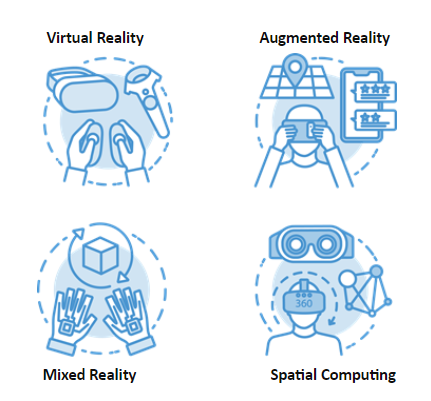
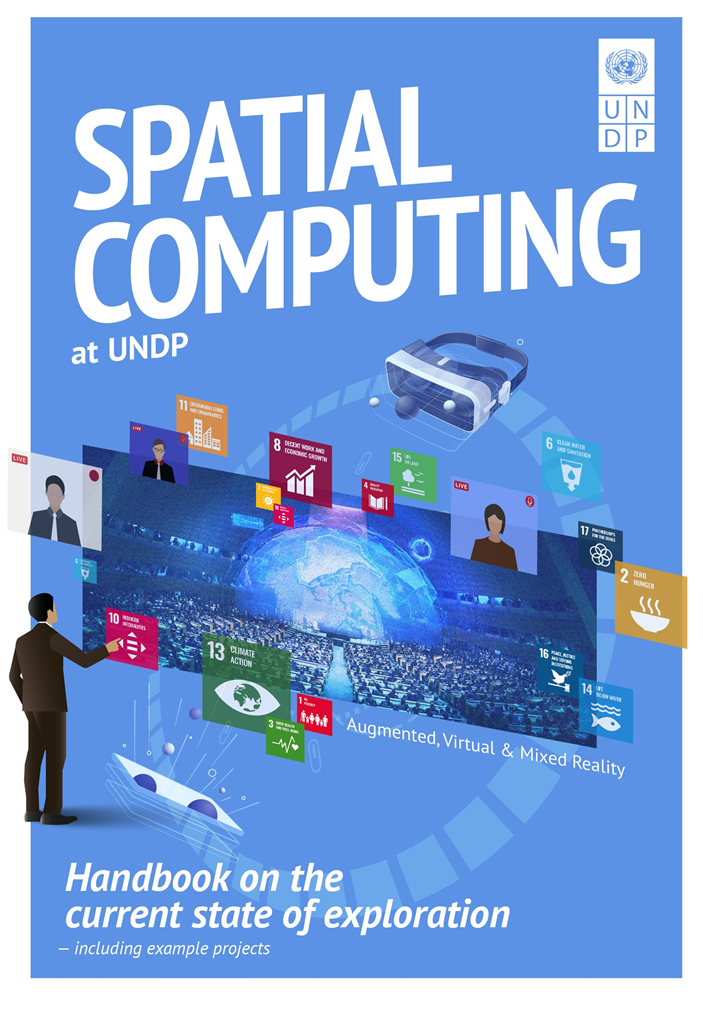
Spatial computing is broadly synonymous with extended reality (XR) – itself an umbrella term for virtual, augmented, and mixed reality. These are all visually impressive technologies, but for UNDP and our development work, we needed to identify use-cases where they could provide useful results, and understand in practical terms what it takes to implement them effectively.
When you hear Pokemon GO – you know it is Augmented Reality. As a response to development challenges, the United Nations Virtual Reality (UNVR) series uses Virtual Reality immersive storytelling to inspire greater empathy and understanding around today’s major humanitarian challenges. For Spatial Computing (extended reality), think of the film The Matrix (minus killer robots!). The headset creates a full 360-degree environment that entirely replaces the real world. You can be standing in your office, and seem to be on a tropical seashore or the top of a skyscraper. It’s powerfully immersive. The disadvantage is, your sight is entirely blocked; you can’t see or hear the real world and the people around you (so watch your steps).
All these technologies are visually spectacular and entertaining, but what are the practical applications? We identified two initial problems that these technologies can address.
We have explored telepresence and remote collaboration
Even before the pandemic, UNDP has been actively working on reducing its environmental footprint and set itself ambitious targets. Curbing travel is one of the key levers for us to do so. We need to be able to collaborate and connect with people far away, and bring expert knowledge to places where it is needed.
UNDP’s Moonshot initiative aims to reduce greenhouse emissions from operations and facilities 25 percent by 2025 and half by 2030, while ensuring that programming and operations are socially and environmentally sustainable.
Current solutions haven’t entirely met our needs. Video conferencing, chat and document sharing can’t offer the faster communication, ease of rapport, spontaneity and sense of connection that in-person meetings do – let’s not forget ZOOM fatigue: National Geographic, APRIL 24, 2020 ‘Zoom fatigue’ is taxing the brain. Here’s why that happens). Like other experiences associated with the coronavirus (COVID-19) pandemic, Zoom fatigue is widely prevalent, intense, and completely new. Why do we find video calls so draining? We need to focus more intently on conversations in order to absorb information, while staring for a long time at the screen directly without any visual or mental break, which is tiring.
Scientists are still puzzling out why in-person communication is superior. Spatial computing can be used for telepresence: allowing people in different locations to work together in a shared virtual space, almost as if they were in the same room, preserving the body language and spontaneity that come with face-to-face contact.
“People trust one another more when they share a communal meal off of the same plate instead of eating from individual plates, and the brain becomes unstable with solitary confinement.”
Video conferencing tools, can’t replicate the same experience, and are creating sort of a “socially distance” feeling.“ It doesn’t feel like a conversation at times. It’s people lecturing at people, which can be tiring,” says psychotherapist Jeffrey B. Rubin, Ph.D.
UNDP PAA is working exploring how spatial technologies can help UNDP to improve its work and collaborative experiences. Our mission is to understand better how “crazy technologies” can amplify the work of all UNDP employees not the other way around.
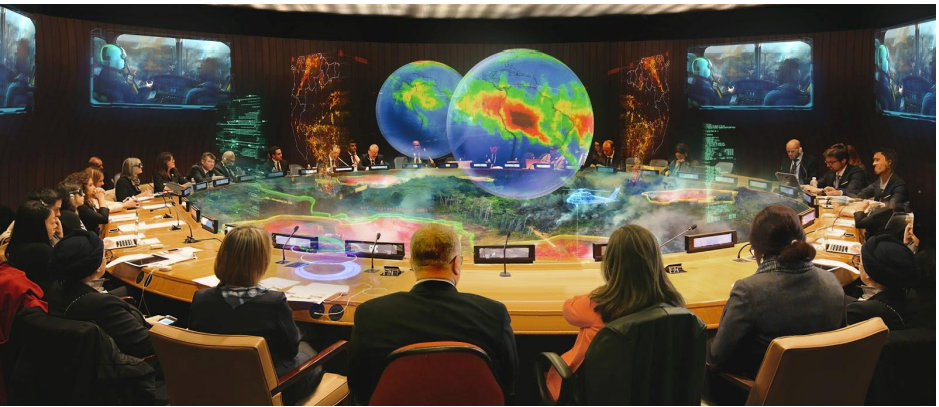
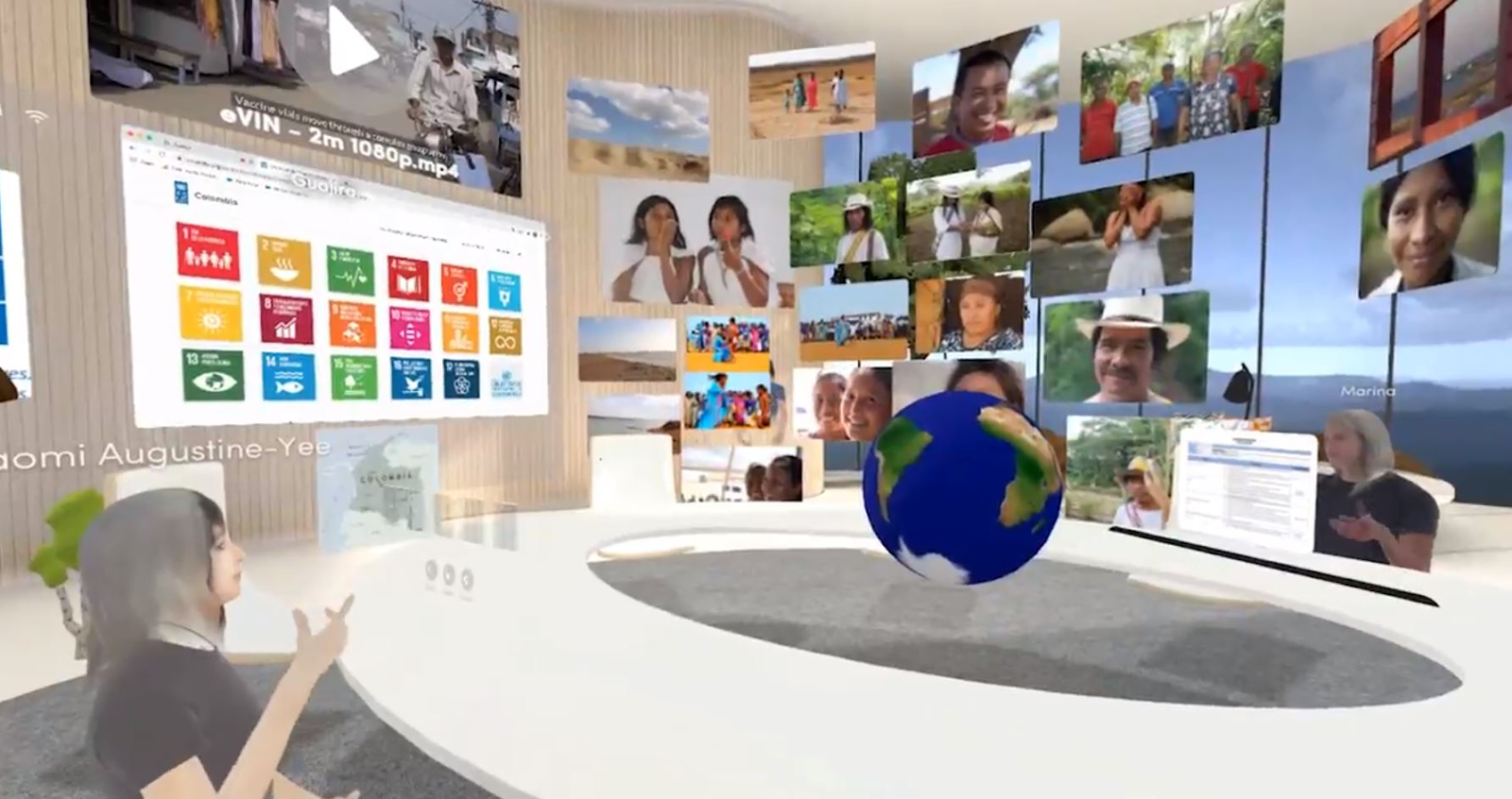
We explored remote collaboration – remote missions with our UNDP Colombia country office by partnering with Spatial to create a shared meeting room, equipped with three-dimensional displays and interactive collaboration tools to allow policy-makers in remote locations to meet in a shared virtual work-space, to communicate and experience an immersive presentation about the development challenges and potential crisis management solutions surrounding the Amazon forest.
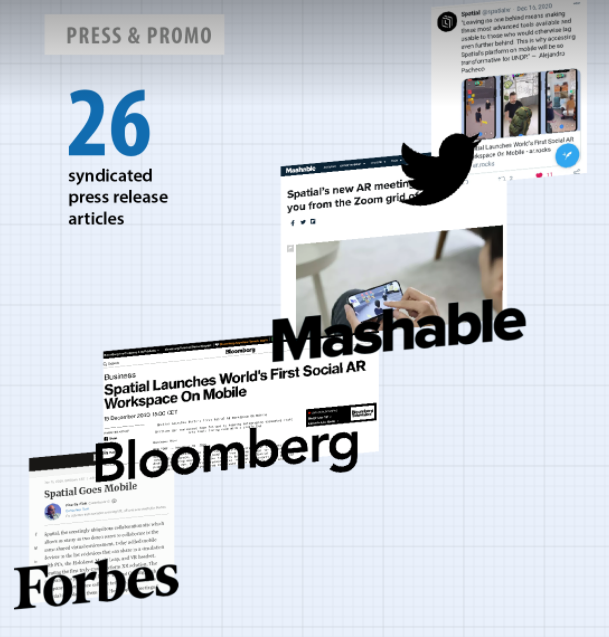
UNDP PAA work was promoted in numerous media, like Bloomberg and Forbes.
A video record of PAA UNDP Colombia virtual space may be found here.
Travel also incurs risk, now more than ever. The danger of infection from COVID-19 has drastically limited the amount of travel we can do and has forced the cancellation of meetings and conferences such as Innovation Days and UNDP’s global meetings. Even without the coronavirus, political situations, emergent crises and other safety-related issues regularly cause mission delays and cancellations.
3D Content Creation: spatial computing happens in three dimensions, so making it effective requires the specialized work of 3D modellers and animators. Any spatial computing project needs to allow for the need to find specialized providers, and the time and expense involved.
Changing the Culture: Even when a new product works better than the old, there are always inconveniences and cultural resistance to making changes. We worked with our colleagues at remote offices to understand what they need from those technologies, and to identify the obstacles to adopting new solutions.
What We’ve Learned
This work is only the beginning! The real potential of spatial computing is much greater and is part of a growing paradigm shift in our digital lives: how we work, how we live and connect to each other. The PAA project is devoted to using spatial computing to facilitate that change, not only within UNDP but outside it – to make UNDP a leader in the adoption and application of these technologies.
Do you want to know more? Or pilot with us — write to: marina.petrovic@undp.org
The COVID-19 pandemic has revealed the fragility of the networks linking the world together and challenged us to reimagine how we work together and maintain those connections. At the same time, it has presented us with a complex problem that crosses borders and raises economic, political, and social questions as well as medical ones. We need to enable experts to collaborate effectively and marshal enormous amounts of information as we formulate the best ways to limit the spread of the disease and to identify and protect the people most vulnerable to its effects.
We wanted to be very clear about what we as an organization want to achieve, how would our different future look like? And then walking it back in terms of if we want to achieve that, what do we need to change, and what are the steps that will get us there? Who are the people? What are the levels of change? What are the possible barriers? What is the resourcing behind that? How would we need to change our culture?
The pandemic has also accelerated changes in a world that is becoming more digitally connected. With smart cities and the Internet of Things, we are building digital infrastructure in which energy, sanitation, and health services are part of the same connected system. We have new sources of information about the world, through social media, crowd-sourced observation and open data repositories. Organizations are working, thinking and connecting differently. If we don’t spend time, energy and manpower exploring and co-developing pilots and prototypes then we are likely to be left behind and this will impact our competitiveness, and our ability to grow.
With these questions and issues in mind, we carried out a series of short-term, results-focused projects. We looked for the biggest opportunities, the places where spatial computing can contribute the most in the short term.
Virtual reality and spatial computing are visually impressive technologies, but we needed to identify use-cases where it could provide useful results, and understand in practical terms what it takes to implement them effectively.
When you hear Pokemon GO you know it’s Augmented Reality.
For virtual reality, think of the film The Matrix (minus killer robots!). The headset creates a full 360-degree environment that entirely replaces the real world. You can be standing in your office and seem to be on a tropical seashore or the top of a skyscraper. It’s powerfully immersive. The disadvantage is that, your sight is entirely blocked; you can’t see or hear the real world and the people around you (so watch your steps).
All these technologies are visually spectacular and entertaining, but what are the practical applications? We identified two initial problems that these technologies can address.
Telepresence and remote collaboration
Even before the pandemic, travel was one of UNDP’s challenges. It’s a significant part of our budget, and it has a large environmental impact. The pandemic introduces more difficulties, most importantly the risks posed to travellers. However, we need to be able to collaborate and connect with people far away, and bring expert knowledge to places where it is needed.
Current solutions haven’t entirely met our needs. Video conferencing, chat and document sharing can’t offer the faster communication, ease of rapport, spontaneity and sense of connection that in-person meetings do, and we’ve all experienced the fatigue and frustration of prolonged teleconferencing.
Spatial computing can be used for telepresence: allowing people in different locations to work together in a shared virtual space, almost as if they were in the same room, preserving the body language and spontaneity that come with face-to-face contact.
We explored this application with our Colombia country office by partnering with Spatial to create a shared meeting room, equipped with three-dimensional displays and interactive collaboration tools to allow policy-makers in remote locations to meet in a shared virtual work-space, to communicate and experience an immersive presentation about the development challenges and potential crisis management solutions surrounding the Amazon forest.
Travel also incurs risk, now more than ever. The danger of infection from COVID-19 has drastically limited the amount of travel we can do and has forced the cancelation of meetings and conferences such as Innovation Days and UNDP’s global RR meeting. Even without the coronavirus, political situations, emergent crises and other safety related issues regularly cause mission delays and cancelations.
Video conferencing, chat and document sharing can’t offer the faster communication, ease of rapport, spontaneity and sense of connection that in-person meetings do. Let’s not forget ZOOM fatigue.
What we’ve learned
We also learned valuable lessons about what it takes to implement these solutions effectively.
- 3D Content Creation: spatial computing happens in three dimensions, so making it effective requires the specialized work of 3D modelers and animators. Any spatial computing project needs allow for the need to find specialized providers, and the time and expense involved.
- Changing the Culture: Even when a new product works better than the old, there are always inconveniences and cultural resistance to making changes. We worked with our colleagues at remote offices to understand what they need from those technologies, and to identify the obstacles to adopting new solutions.
This work is only the beginning! The real potential of spatial computing is much greater, and is part of a growing paradigm shift in our digital lives; how we work, how we live and connect to each other. The PAA project is devoted to using spatial computing to facilitate that change, not only within UNDP but outside it – to make UNDP a leader in the adoption and application of these technologies.
By Marina Petrovic, Innovative Finance and Technology Expert, UNDP Istanbul Regional Hub; Lejla Sadiku, Innovation team leader, UNDP Istanbul Regional Hub; Naomi Augustine-Yee, Technology Innovation Specialist, UNDP Istanbul Regional Hub; Austin Grossman, Interactive Augmented Reality Narrative Writer; UNDP Istanbul Regional Hub; Carolin Frankenhauser, Digital Analyst, UNDP, CDO; Frederic Repond, Senior Consultant, Monitor Deloitte
Zimbabwe’s informal food economy is the second largest in the world and some of the most vulnerable people depend on it for their livelihoods. It’s important to know how that economy works, and especially how it is being affected by the 2020 pandemic.
We took a data-driven approach to this challenge. We began by asking ourselves two questions. What are the factors determining the price of goods? Second, how has the COVID-19 pandemic changed those systems, and how has it stressed the economy’s weak points?
Like any informal economy, Zimbabwe’s is complicated — the price and availability of basic produce is determined by many intertwined social, economic and environmental factors. The amount of data collected can be overwhelming, and hard to interpret.
The Presence Anytime Anywhere (PAA) project is exploring solutions to this problem, using a new technology called spatial computing that supports 3D data visualization.
Remember the film Iron Man, and Tony Stark’s workshop? He uses holographic computer displays to work with information. He walks around it, moves it with his hands, makes it bigger or smaller. You can see how much easier it is to work with data when it’s something you can see in three dimensions.
That’s exactly what spatial computing helps us do. It uses computerized goggles to create a three-dimensional version of the digital world. Their display can take any digital information and display it in the room with you as a three-dimensional, interactive object made of light.
Edward Tufte, one of the pioneering scientists on data visualization, wrote that: “It is not how much information there is, but rather how effectively it is arranged.” A better visual representation of a dataset makes it easier to see the story that information contains. You might say, it eases the cognitive load of processing that information for your brain and lets your eyes do it much faster and more easily.

UNDP is working with Flow Immersive (flow.gl) to create three-dimensional, immersive presentations. Unlike in a simple presentation, data can be charted along three different axes and viewed from all sides in a shared online space.
The Zimbabwe project is one of several pilot programmes being run by the PAA project to learn how to utilize spatial computing for UNDP’s digital initiatives. Additional applications of PAA storytelling with Flow were featured at the UN General Assembly, including as part of the SDG Moment with UNDP Administrator, Achim Steiner.
These pilot projects are part of PAA’s broader exploration of spatial computing’s potential as a tool for UNDP’s digital strategy, “the first of its kind in the UN system. We’re learning how data-driven storytelling can combine with the ability of people in different locations to work together as if they were in the same room.
As UNDP shifts to an integrated, data-driven approach (SparkBlue), new challenges will arise. Spatial computing can be a powerful tool as we take this next step, to help us see the data clearly, to see the patterns and correlations within it and to convey those lessons to the people who need them to make decisions.

What we have learned:
- Cool is a scientific term — It’s fun to watch, and that’s part of helping people to understand what’s clearly a very complex undertaking.
- Visualizing data on a greater scale — UNDP is using huge amounts of data, which makes it hard to visualize the impact and the real depth and complexity of what is happening. With many sensory modalities — visual, auditory, haptic, somatosensory and olfactory, 3D visualizations are creating perceptually enriched experiences and can help reveal hidden patterns and relationships that can be hard to recognize in complex data systems.
- Empathic experience — 3D visualizations grab people’s attention in a similar way to a movie, TV show or a YouTube video does. They are more engaging than reports which are often ignored or fail to grab one’s attention.
- The future of storytelling — 3D visualizations allow you to communicate much more data in a more compelling and interaction manner. They combat ‘Zoom fatigue.’
- Recognizing new patterns — Immersing participants in the new 3D data reality can help to identify new patterns and perspectives. With new tools and techniques there is the potential to see connections that could not have been seen before, and chart an entirely new, more sustainable future.
Do you want to know more? Or create your own PAA 3D immersive storytelling — write to us: marina.petrovic@undp.org.
By Marina Petrovic, Innovative Finance and Technology Expert, UNDP Istanbul Regional Hub; Lejla Sadiku, Innovation team leader, UNDP Istanbul Regional Hub; Naomi Augustine-Yee, Technology Innovation Specialist, UNDP Istanbul Regional Hub; Austin Grossman, Interactive Augmented Reality Narrative Writer; UNDP Istanbul Regional Hub; Carolin Frankenhauser, Digital Analyst, UNDP, CDO; Babatunde Abidoye, Global Policy Advisor, UNDP; Frederic Repond, Senior Consultant, Monitor Deloitte
Reposted from UNDP’s Medium page.
The following piece was first published on the UN Development Programme and was originally published on September 30, 2019.
In the blockbuster science fiction movie ‘The Matrix’, after Neo takes the red pill offered by Morpheus, he not only learns the truth about reality, he also discovers how an ecological disaster has led to humans being harvested and enslaved by machines. At UNDP we wondered, what if we ‘matrix’ our way into tackling climate change, using emerging technologies to create urgency and kick start political action. After all, we’re in uncharted territory, or as writer James Bridle in ‘The New Dark Age’ calls it ‘peak knowledge.’
We went straight to the source — to Magic Leap, whose Senior Vice President for Creative Strategy, John Gaeta, created all the special effects in ‘The Matrix’. What did we learn?
Several studies indicate that being able to experience the impact of climate change allows people to connect emotionally with the problems and make them more likely to act on that feeling. We deployed this strategy when we were thinking through what the future of development might look like (check out our imaginary future of development organization — Mantis Systems — that we built with Nesta, SuperFlux and Bond). Our colleagues in the United Arab Emirates government went with similar tactics to create a visceral experience of air pollution by getting staff to breathe in air from 2050 that contained pollutants that would build in over 30+ years in case of business as usual development scenario. Imagine what breathing that air felt like, and what you might want to do to avoid it!
Spatial computing takes this one — well maybe several hundred — steps further. So what is it? Combine virtual, mixed and augmented reality and voila! you get emerging technology that brings information from 2D screens into a 3D space allowing you to interact directly with the digital world. It is a little bit like having an x-ray view into our world with the ability to play with it. On some level, it is the purest form to date of blending technology into the world.
If the definition sounds too techy, maybe a few examples might help. In some cases, this allows farmers to manipulate their physical environment (their farms) as they are affected by weather in real time in order to increase crop yields and reduce costs. Or consider the Hydrous project that gave public servants from Palau a visceral experience of the effects of climate change on the underwater world, which prompted them to do more to protect its coral reef.
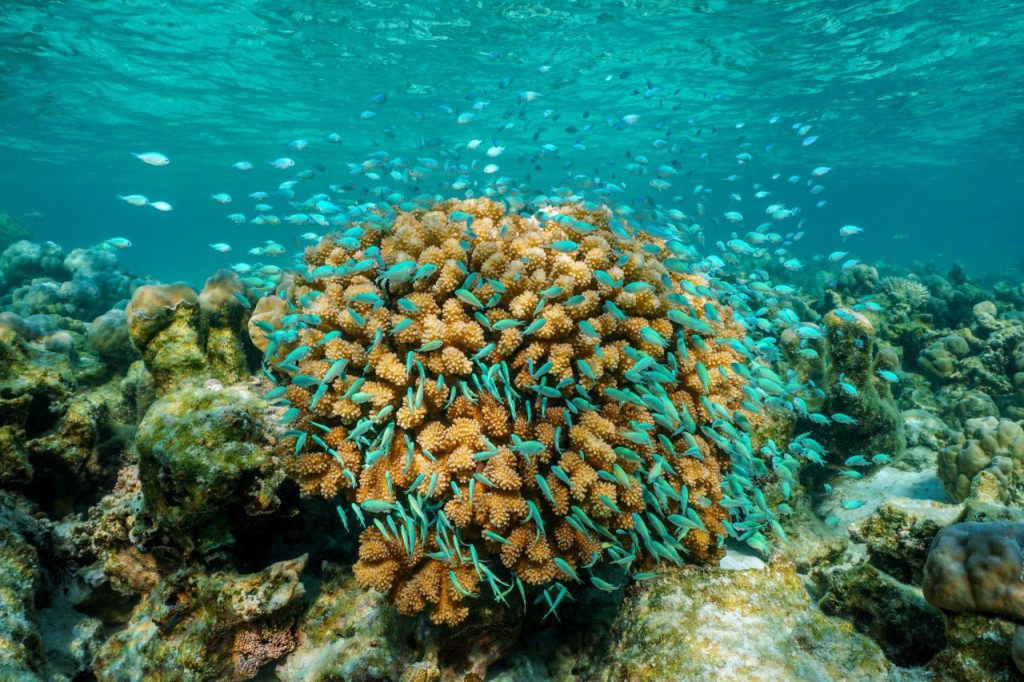
Spatial computing can help reduce skill gap and errors in production by applying mixed reality to training employees without advanced technical experience or specialized equipment. It could also increase perception, engagement and overall experience of the world for the children with autism. And for one of our more favorite non-development applications of the technology, check out the experience of the speech from William Shakespeare’s ‘As You Like’ — as if you’re in the same room.
Working with Magic Leap, the German Space Agency and BadVR, we created an experiential visualization, Climate Change Spares No One, that brings to life visceral implications of the changing climate on the delta cities. Our intention is to enable anyone to feel, sense and see what life in +2 celsius world is like. The interactive experience was showcased during the 2019 Social Good Summit and during the UN General Assembly UN Action Zone.
We hope this is just a start of our partnership with emerging technology companies whose work can potentially increase the urgency of the scale and scope of climate emergency into our day to day lives, and inspire bold action to forestall the catastrophy the world is likely to experience if we don’t act.
This blog was co-written by UNDP’s Milica Begovic, Lejla Sadiku, Marina Petrovic, Robert Pasicko and Cassie Flynn, and from Magic Leap’s Andy Lanning, Prudence Fenton, Jad Madouchy, Suzanne Borders, Austin Grossman, Naomi Augustine-Yee, Graeme Devine and Quiddale O’Sullivan.
©Valery Brozhinsky/Shutterstock.com