Category: Digital transformation and emerging tech
The following piece was first published on the AltFinLab blog and was originally published on November 22, 2015.
From equity-based crowfunding and person-to-person lending, to crypto currencies and mobile money; entirely new players are disrupting the field of financing for development and public policy.
So, what does this alternative finance space look like? Who are the new players and what are they up to?
Crowd-power
According to the World Bank, the crowdfunding market is expected to grow to US $100 billion by 2025.
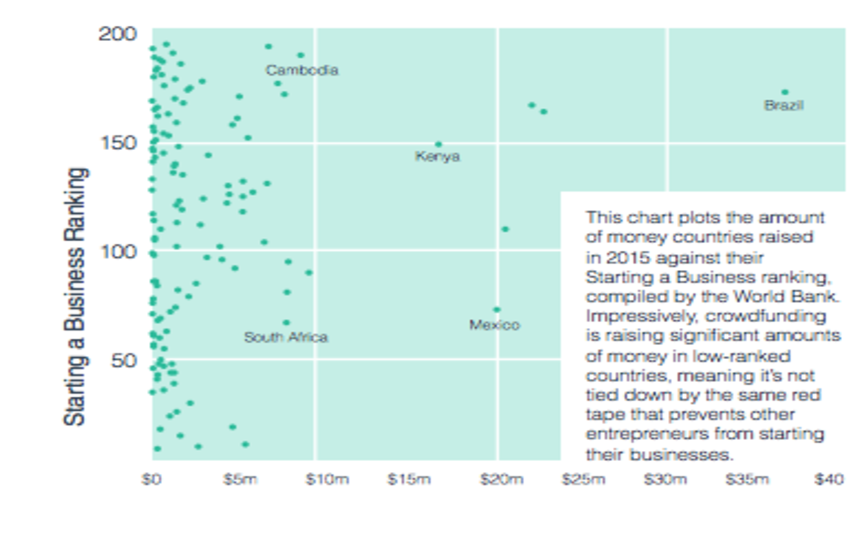
Recent research shows that – despite living in countries where the cost of doing business is quite high – entrepreneurs are successfully raising money by crowdfunding, and bypassing loads of red tape in the process.
And it’s not just money.
New platforms are springing up focusing on everything from expertise and volunteering hours toremittances for social good. The Danish government is leveraging crowdfunding for supporting startups, while Kenya is the first government in the world to enable crowd investment in an infrastructure bond. Neighborly launched a civic-micro bond project allowing citizens to invest directly in local public projects.
Research shows that if it is able to capture just ten percent of the global remittance market over the next decade, diaspora crowdfunding can grow to $58 billion.
Alternative and digital currencies
In response to the 2008 financial crisis, five friends with no finance background set up Sardex, an alternative currency for Sardinian businesses to continue trading and operating. This year trades of Sardex exceeded 32 million euros, and the model is now being replicated on the Italian mainland. Where traditional financing systems failed small business owners back in 2008, Sardex provided an ability to continue their operations and grow.
What potential might similar types of community currencies hold for rural and impoverished regions where we work?
Blockchain has been identified by the World Economic Forum as one of the six mega-trends likely to impact our increasingly connected world.
Blockchain is the technology behind bitcoin, it allows people to transfer money without a bank and write enforceable contracts without a lawyer.
International banks are setting up blockchain labs to incentivize startups, foundations, and citizens to collaborate on designing a new generation of services. MIT has launched the Digital Currencies Initiative to explore its potential for social impact (as did the University of Nicosia, which is the first accredited university in the world to accept tuition payments in bitcoin).
A non-profit, Stellar, is investing in financial literacy of the poor to tap into digital currencies, while early experiments using blockchain to reduce costs of transferring remittances and enable low-cost, rapid disbursement of funds in humanitarian emergencies are ongoing.
In October, BitNation registered the first refugees entering Europe via blockchain and provided anonymous bitcoin debit cards that can be used at any cash point on the continent. Just this month, another start up, Cubits, launched an instant no-fee crypto donation service for refugees arriving in Germany.
Here is an entirely new set of players in the sandbox traditionally occupied by governments and the development sector, looking at the same puzzles and coming up with new ways of solving them.
Is 21st century development about financing not giving?
A recent New York Times article argues, “financial success and social impact are becoming ever more linked, with the lines blurring between the business and nonprofit sectors.”
By thinking about welfare as an investment as opposed to a cost, we can unlock a new universe of opportunities.
The social impact investment market is projected to grow to $3 trillion in the coming years.
One variation of this is the social impact bond (SIB) wherein a government repays the investor only if agreed-upon outcomes are achieved. The first development impact bond was launched in 2014 to improve educational outcomes among girls in India.
Variations on this principle are taking many forms including a landscape-based investment currently being tested, and a revolutionary forecast-based financing that the Red Cross hopes may unlock necessary investment to increase resilience and reduce risks of upcoming disasters.
None of these methods will be an easy fix for development (as this recent Guardian piece argues) and there are many of those who are examining impact investment with a critical eye; but, it does provide a fascinating, complementary approach to address some of the stubborn issues we’re working on.
So:
- What does this mean for development and policy-making?
- What do we need to understand and tap into these new methods and financial technologies for social good?
- What about financial literacy of the poor and the sick, the elderly and those disconnected from the internet?
WE WILL BE EXPLORING THESE AND MANY OTHER QUESTIONS IN ISTANBUL ON 7-8 DECEMBER. STAY TUNED! **THIS INITIATIVE IS SUPPORTED BY THE UNDP INNOVATION FACILITY AND THE GOVERNMENT OF DENMARK**
The following piece was first published on the AltFinLab blog and was originally published on November 13, 2015.
The first Global Crowdfunding Academy organized for and by the UNDP offices around the world had a really strong competition. After a tough selection process, we have chosen 11 teams with most inspiring projects from community green solutions to peacebuilding and poverty reduction.
Interested? Let’s go on a little odyssey around the world, meet the teams and see what they want to change in their community with the help of crowdfunding.
First station: Republic of Macedonia. Project name: Let’s paint Skopje from 50 shades of GREY to 50 shades of GREEN. The main idea of this project is to pick out one prominent building in Skopje, turn it from grey to green and set an example for others to follow. The proposed building is the Skopje City Hospital, located right in the center – the most polluted area of the capital. So refurbishing this tall grey old building with green roof and façades would certainly have a great social impact and could inspire similar undertakings in other polluted areas of the country.
Second station: Bangladesh. Bangladesh team wants to enable digital Future for the Urban Poor. This project will aim to empower urban youth, age 18 to 26, to generate income, through building their capacities to navigate the IT freelance marketplace and facilitate job placement. The team wants to provide tailored training to 40 youngsters in two different batches, to engage community development committees to select the urban youth beneficiaries and to mobilize and build partnerships between local government, community development committees, digital champions and service providers from the private sector. Consequently, the digital divide and poverty in the country will be reduced.
On the third station we are in Columbia, and introducing the Peace Pathways project that is based on eco-friendly sources of energy (i.e. recyclable bottles used as lightbulbs and charged with solar energy). Energy will not only foster access to basic services but also strengthen local governance, thus reducing the recurrences of conflict in areas previously dominated by armed actors.
After Columbia we are traveling to Indonesia to the province of East Nusa Tenggara which is located in the eastern part of Indonesia and is one of Indonesia’s driest and poorest provinces. Here we are getting introduced to the Village Climate Adaptation project, which aims to empower the rural communities in Palanggay Village to access clean water for home-grown production of seaweed that helps generate income for the local community. The Campaign will also help the villagers to improve their access to clean water for household consumption.
The last station on this tour leads us to Tajikistan, where the project Green School in Sorvo intends to provide access to sustainable energy and energy efficiency solutions through covering the roof or the backyard of the school with solar panels.
These are the first five teams. To find out about the others, follow our blog part two.