
Governments around the world are accelerating their digital transformation efforts. As they do, blockchain has gained attention as one of several technologies that can help strengthen public systems, from digital payments and identity to climate finance, supply chains, and public service delivery. Governments are now less focused on proving blockchain can work than on exploring where it can bring the greatest value, integrating it into public systems and sustaining it over time.
These questions shaped Scaling Blockchain for Public Good, a two-day series of events organized by the UNDP Alternative Finance Lab (AltFinLab) alongside Proof of Talk 2026 in Paris. The programme included the launch of the UNDP Blockchain Advisory Group (BAG), a platform for strategic dialogue between UNDP and leaders from across the blockchain ecosystem; a public dialogue co-organized with the Sciences Po Tech & Global Affairs Innovation Hub on the institutional and policy dimensions of blockchain adoption; and the SDG Blockchain Accelerator Impact Showcase, highlighting implementation-ready blockchain solutions developed through UNDP’s global accelerator.
From experimentation to implementation
The discussions reflected a broader shift in how blockchain is being approached. Rather than asking where blockchain can be applied, attention is increasingly turning to how it can help solve concrete public challenges and where it offers a clear advantage over existing approaches. Speakers shared examples from governments and development programmes around the world, including blockchain-verified academic credentials in Dubai and humanitarian payments in fragile contexts. Despite their different contexts, each initiative responded to a clearly defined development challenge rather than starting from the technology and looking for a problem to solve.
Participants also pointed to a common set of barriers. Governance, regulatory clarity, interoperability, institutional capacity, and public trust increasingly determine whether innovative solutions move beyond pilots and become part of long-term public systems.
Building government readiness
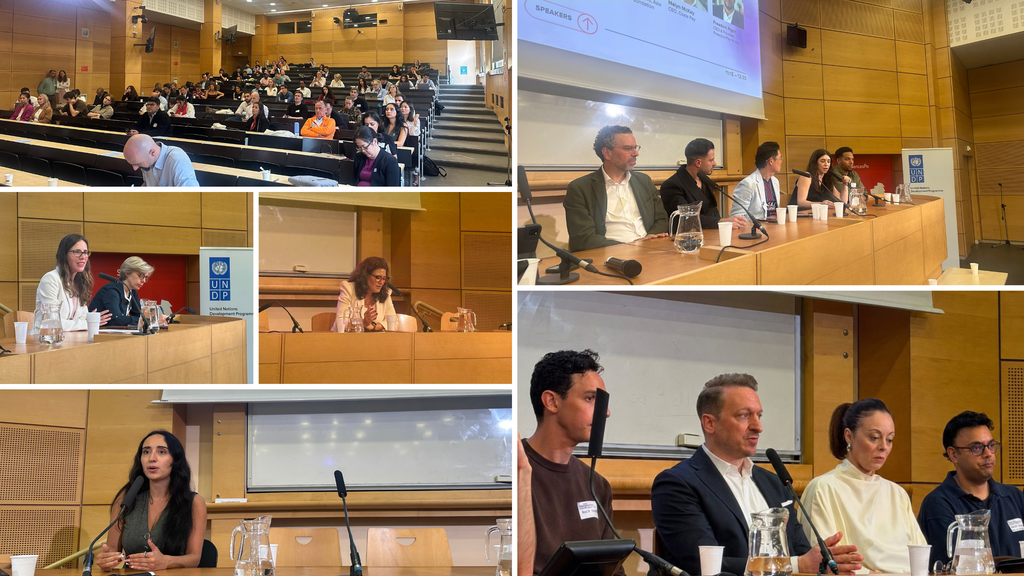
Moving funds through blockchain-based systems can be relatively straightforward. Ensuring that people can access, use, and benefit from those funds is not. The Sciences Po dialogue highlighted the importance of the “last mile” of public service delivery, where digital identity, payment infrastructure, regulatory frameworks, and local institutions all shape whether innovation reaches the people it is intended to serve. The challenge, participants argued, is often less technological than institutional.
The conversations also highlighted the importance of institutional continuity. Successful initiatives need to outlast individual projects, funding cycles, and changes in leadership if they are to become sustainable public systems.
This thinking informed the launch of the Government Blockchain Academy, developed by UNDP in partnership with the Exponential Science Foundation. The Academy will equip government officials with the knowledge, practical skills, and institutional capabilities needed to assess blockchain technologies, identify where they create value, and support their responsible adoption as part of broader digital transformation strategies.
Collaboration for implementation
Scaling blockchain for public good depends on collaboration across governments, development organizations, academia, and the private sector.
More than 30 senior representatives from across the blockchain ecosystem gathered for the inaugural meeting of the UNDP Blockchain Advisory Group, creating a new platform for strategic dialogue on the responsible application of blockchain for sustainable development. Beyond providing strategic advice to UNDP, the Group creates space to exchange knowledge, identify emerging opportunities, and strengthen collaboration around shared development priorities.
Its first discussion focused on digital finance and financial inclusion. Globally, 1.3 billion adults remain without access to formal financial services, and close to one billion lack the digital identity needed to access them. The discussion examined how blockchain-enabled approaches can help address these persistent challenges and what is required to support implementation at scale. Participants emphasized that financial inclusion is not simply about moving money more efficiently. It is about enabling people to participate more fully in the economy by building trusted financial histories, accessing savings and credit, and connecting to formal financial systems. Blockchain can support that transition, but only when it is integrated with existing financial infrastructure and supported by appropriate governance, regulation, and partnerships.
Showcasing implementation-ready solutions

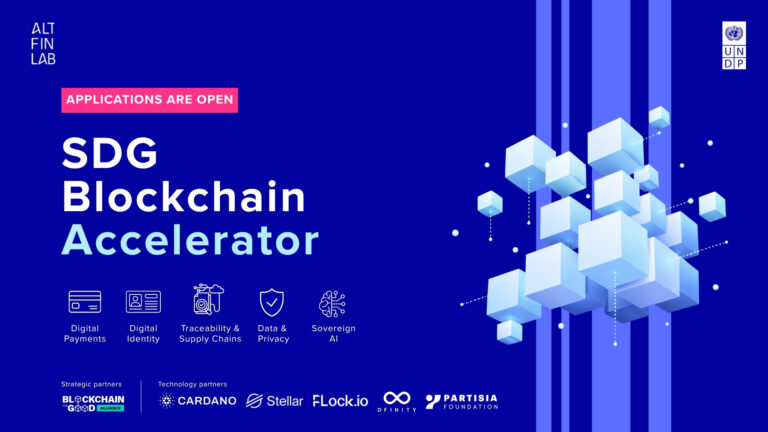
The SDG Blockchain Accelerator Impact Showcase demonstrated how these ideas are already being put into practice through partnerships between UNDP and technology innovators. The Showcase introduced the SDG Blockchain Accelerator to a wider blockchain audience, presenting UNDP’s challenge-led approach to innovation. Rather than starting with technology and searching for a use case, the Accelerator begins with development challenges identified by UNDP Country Offices and institutional partners, then matches them with technology organizations capable of designing and implementing a solution. This helps ensure that innovation responds to real needs while creating practical pathways towards implementation.
Among the projects presented, FreedomPay Wallet is working with UNDP The Gambia to strengthen transparent and accountable digital payments, while Plastiks is partnering with UNDP in Armenia, India, El Salvador, and Zambia to create verifiable records of plastic recovery that support circular economy value chains. Other teams showcased solutions focused on programmable funding, supply chain traceability, and digital finance, showcasing how blockchain can strengthen transparency, efficiency, and accountability when embedded within broader public systems rather than deployed as a standalone technology.
Blockchain for good at scale
“The future of blockchain for development will depend not only on innovation, but on the institutions, partnerships, and public trust needed to apply it responsibly,” said Robert Pasicko, Lead, Alternative Finance Lab (AltFinLab), UNDP Europe and Central Asia.
Putting blockchain to work for sustainable development requires more than technology. It requires capable institutions, trusted partnerships, and the confidence to adopt new approaches responsibly. Achieving this requires new models of collaboration that bring governments, development institutions, and the blockchain ecosystem into sustained, structured dialogue rather than one-off engagement.