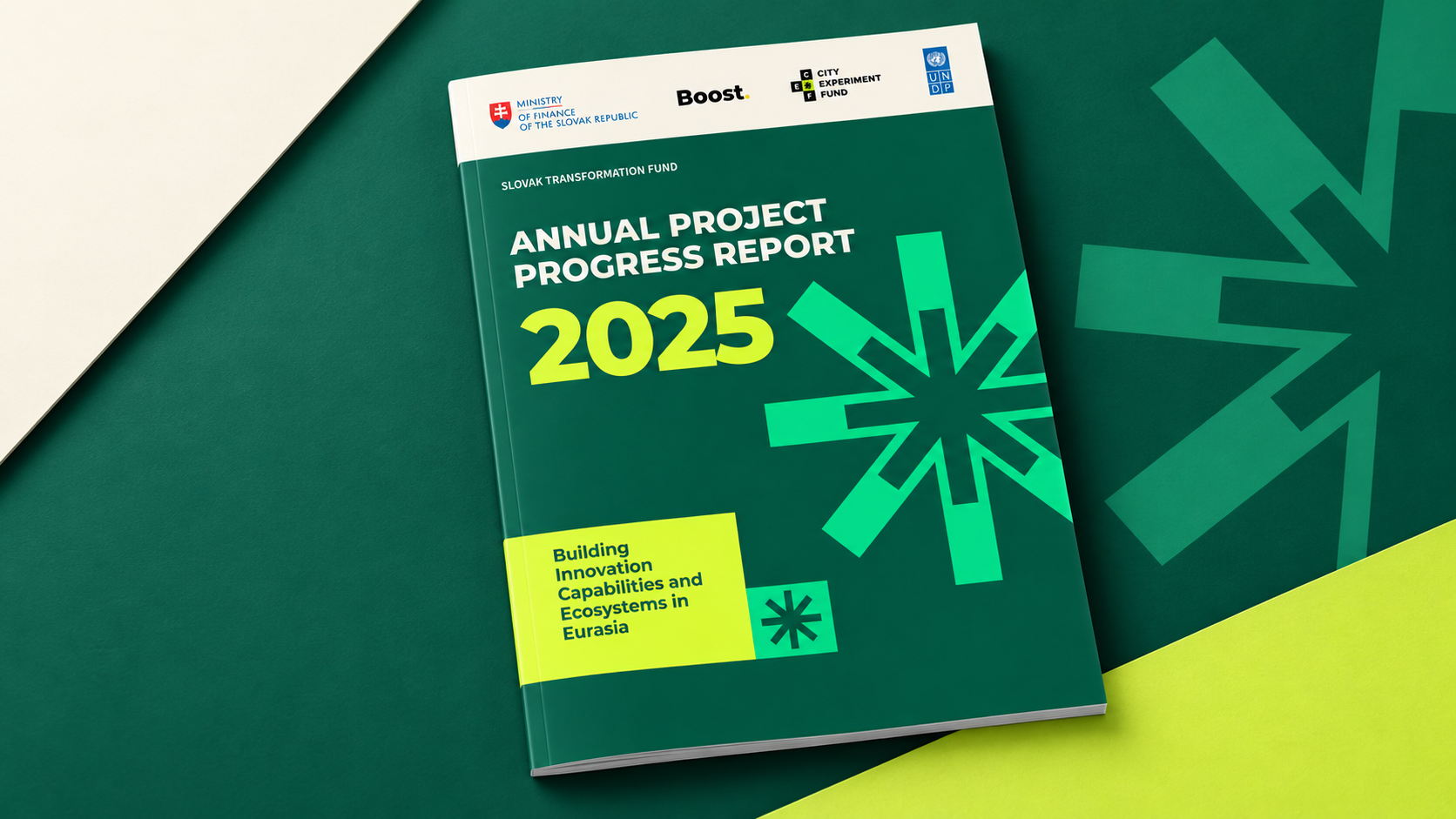
The United Nations Development Programme (UNDP) in Europe and Central Asia has published the 2025 Annual Report for the Slovak Transformation Fund (STF), highlighting how cities across the region are strengthening their capacity to manage complex urban transitions and connect local priorities with innovation and emerging pathways to finance.
Funded by the Ministry of Finance of the Slovak Republic, the STF entered the first year of its new 2025–2028 phase by moving the strategic direction established in 2024 into municipal practice. Its two core initiatives – the City Experiment Fund (CEF) and the BOOST impact acceleration programme – also became more closely connected, linking challenges identified by cities with potential solutions, partners and financing opportunities.
Through CEF, which supports municipalities in addressing complex urban challenges through strategic innovation and experimentation, ten cities in Armenia, Kosovo[1], Montenegro, North Macedonia and Ukraine completed a shared process of community listening, sensemaking, portfolio development and early option design. This helped them understand how challenges such as energy resilience, air pollution, waste, land use and economic transition intersect, and identify portfolios of interventions that could address them.
Across the ten cities, 319 residents and local stakeholders shared their experiences and priorities, helping municipal teams ground their work in local realities. More than half of those consulted were women, while over a third were from groups identified locally as facing greater vulnerability.
In Stepanavan, Armenia, a circular-transition portfolio moved into early operation: reusable sorting bags were distributed to 100 households, 30 public bins were installed and around two tons of sorted waste were collected. In Podgorica, UNDP and the city signed a memorandum of understanding, prepared a Disaster Risk Reduction Strategy and Action Plan, and designed a heat-island mitigation pilot with the University of Montenegro. In Pljevlja, more than 50 young people took part in a summer school and ideation labs linked to the city’s just transition, while agreements were prepared to take forward studies for a Green Jobs Training Centre and more energy-efficient public lighting. In Kovel and Nizhyn, city teams continued developing energy-resilience portfolios despite continued effects of the war in Ukraine.
BOOST complemented the city-level work by identifying and preparing potential responses to urban and green transition challenges. The Urban Future Finance Challenge graduated 16 ventures, brought 11 to Demo Day and awarded three US$10,000 innovation prizes. Green Urban Tech attracted 262 applications from more than 30 countries and selected 15 organizations for its sprint phase, building a pipeline of solutions spanning air-quality monitoring, urban management, emissions tracking, circularity, biodiversity and citizen participation.
The report also captures the knowledge generated through this work. The Twin Transition Stencil and related tools provide a practical way for cities and development practitioners to connect green and digital change with systems thinking, portfolio development, innovation and finance readiness.
At the same time, the report reflects on political change, limited municipal capacity and the effects of war. The experience of 2025 reinforced the importance of senior leadership, institutional ownership, flexible support and realistic implementation pathways tailored to each city’s circumstances.
For the next years, the report recommends deepening engagement with mayors and senior officials, converting existing portfolios and financing pipelines into more clearly sequenced activities, and strengthening cities’ ability to assess and engage with artificial intelligence through the newly launched CEF × AI cohort.
[1] References to Kosovo shall be understood in the context of United Nations Security Council resolution 1244 (1999).