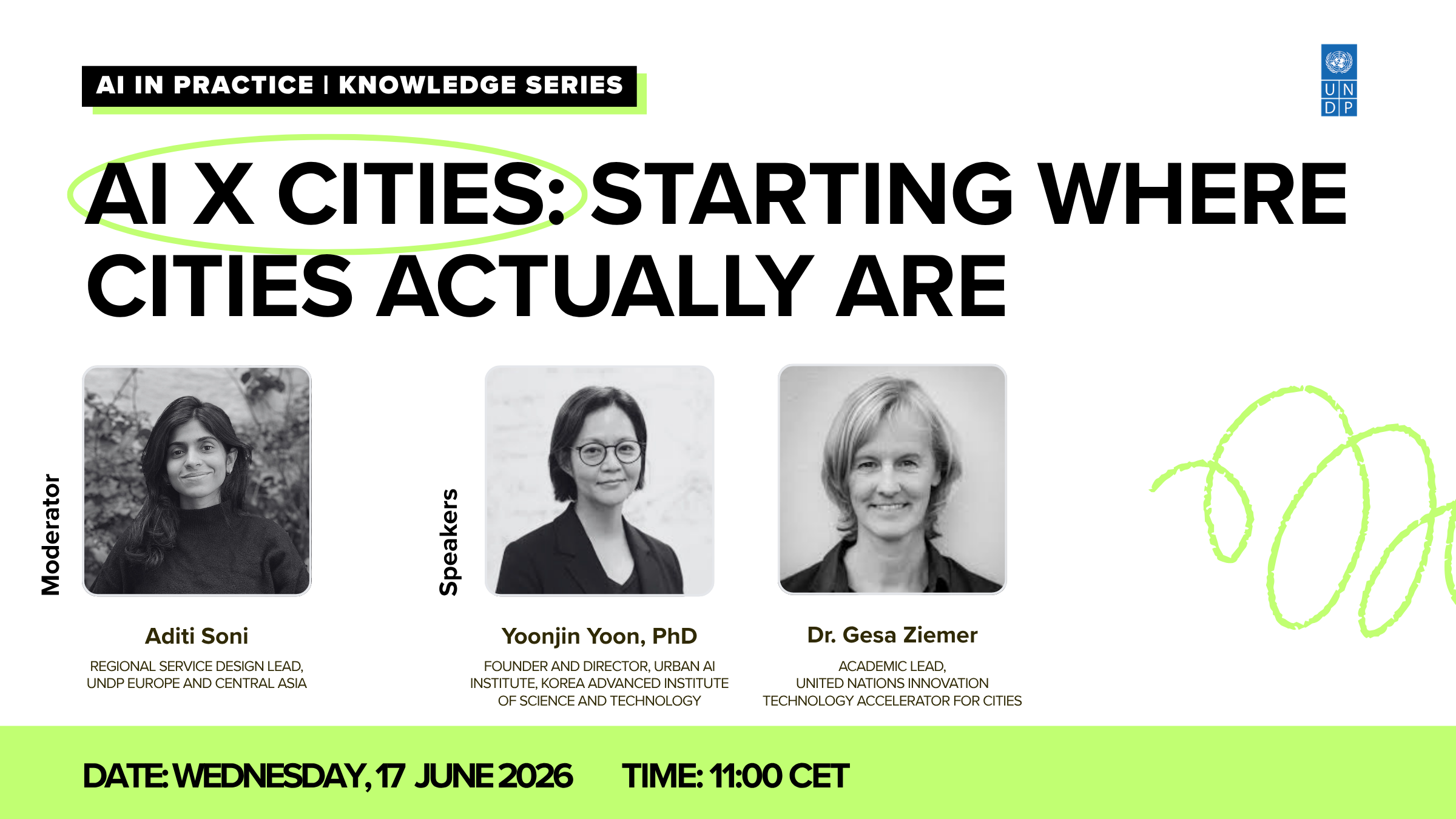
While information about AI is abundant, space to make sense of what it means in practice is not. That gap between the global AI conversation and where cities in our region actually stand is the focus of the first session of the AI in Development Practice series. Hosted by the United Nations Development Programme’s (UNDP) Regional Bureau for Europe and Central Asia, the series aims to create space for practitioners, researchers, and policymakers to work through how AI is reshaping development work.
Urban governance is one of the places where AI’s effects are most concrete and most uneven, and where the stakes of getting it wrong are hardest to ignore. Two speakers anchored the conversation, each approaching the same problem from a different angle: Gesa Ziemer, Academic Lead at UNITAC and Director of the City Science Lab in Hamburg, and Yoonjin Yoon, Founder and Director of the Urban AI Institute and Chair Professor at KAIST in South Korea.
Gesa Zeimer: Leveraging existing ecosystems in cities to enable AI and digital transformation
Gesa pointed out that there is a widening gap between how fast urban AI is developing and how ready cities actually are to use it. Data is often outdated, fragmented across authorities, civil society, and private companies, and rarely interoperable enough to feed into an AI system.
Most cities her team works with lack a centralized data management system altogether, and where one exists, it’s often built on a single proprietary platform leaving the city dependent on that company rather than in control of its own data.
On where cities should start, her clearest answer was prioritization: connect civil society and government first. Activists, artists, and community groups are doing real work that’s disconnected from government, and government holds laws and strategies disconnected from what’s happening on the ground.
Her example of an ecosystem approach in practice came from Windhoek, Namibia. The national statistics agency had a solid centralized data platform, but the column for informal settlements was essentially empty, left blank for political reasons. Rather than build a new tool, her team’s actual work focused on relationship-building connecting local NGOs who already held the data, building enough trust to get it included.
Yoonjin Yoon: How cities could apply AI – what the KAIST Urban AI Lab has been testing in cities
Yoonjin opened with a conceptual distinction that anchored her entire talk:
- AI of Cities – how can AI help cities work better?
- Cities of AI – how will cities evolve because of AI?
The purpose of urban AI is not technology. It is to enable better decisions, improve day-to-day operations and services, strengthen engagement with communities, and help cities achieve more with fewer resources, less budget, less staff. Every city, regardless of wealth or geography, is wrestling with the same three challenges: how people move, how the city responds to external stress, and how it manages growth. AI doesn’t resolve those challenges. It helps leaders see them more clearly, understand them more deeply, and act more confidently. This is what decision support actually means, not automation, not replacing planners or policymakers, but giving them better tools to understand what is actually happening in their city.
Two Seoul projects illustrated what using AI looks like in practice and what it can reveal unexpectedly. In the first, using daily credit card data across all 422 Seoul neighbourhoods, the team found that 80% of neighbourhoods see retail sales decline on extreme heat days. Commercial centres drawing commuters and visitors saw the sharpest drops simply because those people stopped coming, while residential neighbourhoods serving local daily needs were largely unaffected. Neighbourhoods that looked identical in official statistics functioned completely differently in reality – invisible in aggregate data but made visible through AI. A second Seoul project used an AI agent built on the open-source SUMO traffic simulator to let non-expert city officials test scheduling decisions – such as the best 30-minute window for road maintenance – using plain-language prompts that anyone can understand.
For cities that find themselves earlier in this journey, her advice was to flip the usual instinct: define the real problem first, rather than starting from what AI can do. She pointed to her institute’s current project near Ho Chi Minh City, where data exists but is scattered, as a close parallel to where many cities in our region are starting from, and noted that a small or imperfect dataset is still worth using, since working with what’s available tends to reveal what the next data investment should be. Asked separately about open datasets, she pointed to satellite imagery as the most universal starting point regardless of income level, alongside anonymized mobile movement data for understanding human dynamics that built-environment data alone can’t capture.
Both speakers, in different ways, pointed to the same underlying urgency. The window for shaping AI adoption is now. Cities that engage with AI early (even if modestly) can shape how it is introduced: which problems it addresses, whose interests it serves, and what safeguards are built in.
Putting AI to work in cities: The CEF × AI programme
The webinar coincides with the launch of the AI Foundations course for municipalities and the launching of CEF x AI, a new programme, part of the City Experiment Fund, focused on helping cities build the capability to work with AI in practice.
CEF × AI frames AI not as a technology agenda but as a set of functional capabilities cities can put to work. The programme organizes these around four pathways:
- Sensemaking Intelligence: AI can help cities analyze large and fragmented datasets to detect patterns, trends, and signals that may otherwise remain hidden;
- Future Intelligence: AI can support city planners and policymakers by modelling potential outcomes and exploring different scenarios;
- Operational Augmentation: AI can help cities optimize everyday operations by improving how resources, infrastructure, and services are managed;
- Ecosystem Insights & Engagement: AI can help cities analyze signals from residents, businesses, and the wider local ecosystem to build a more nuanced understanding of needs, perceptions, and inequalities.
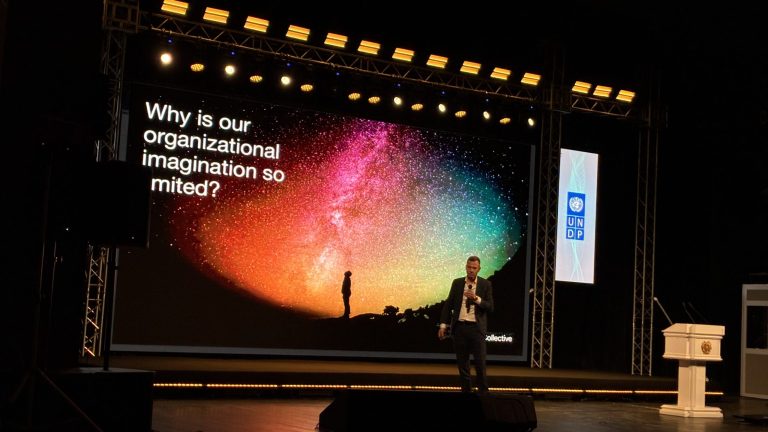
Together, these four pathways reflect a single underlying idea: AI is most useful when it starts from a real municipal problem, not from the technology itself. To support this work, UNDP organized a CEF × AI Bootcamp in Podgorica, Montenegro in June 2026 bringing together municipalities from the region to explore how AI can support their green and digital priorities. Over three days, city teams worked through their own challenges, assessed their readiness for AI, and identified practical opportunities for experimentation and implementation.
Stay tuned for our next webinar sessions!