Digital payments that work under real constraints: Three UNDP SDG Blockchain Accelerator pilots show what last-mile readiness actually looks like
INNOVATIVE FINANCE, NEW TECHNOLOGIES
Ali Al-Zuhairi | Asem Al-Hammadi | Cynthia Khoury | Robert Pasicko
There’s a question that doesn’t get asked enough in digital finance: what does “working” actually mean when you’re operating at the last mile?
Digital payments solve obvious problems on paper: instant settlement, lower fees, and transparency. But the last mile doesn’t operate on paper. It operates with patchy connectivity, cash-based economies where trust is built face-to-face over years, and the weight of someone’s entire month’s survival sitting in a transaction that may or may not go through.
Across Haiti, Guatemala, and The Gambia, three teams from Cohort 2 of the SDG Blockchain Accelerator ran pilots testing whether blockchain-based digital payment flows could function under real operational constraints, not ideal conditions, in partnership with Stellar Development Foundation. What they found was more specific and more useful than a simple yes or no.
What were we actually testing?
For many households and microbusinesses, remittances and small transfers mean survival. Payment friction compounds at every step: transfer fees, currency exchange losses, physical distance to payout locations, and the opportunity cost of a day spent traveling to collect money. When people are forced to cash out immediately because holding digital value feels precarious, there’s no room for saving, building credit, or investing in community. When programmes can’t see where money actually goes, accountability becomes a reporting exercise rather than a feedback loop.
The question these pilots tested wasn’t whether blockchain can handle payments. It was narrower and more practical: can digital rails reduce friction while widening access to financial services in contexts where traditional banking infrastructure doesn’t reach, or doesn’t bother to reach, because the volumes don’t justify the cost?
This is fundamentally a design question, not a technology question.
Each pilot ran an end-to-end flow with bulk payments initiated by partners, received in participating wallets, and used in real economic activities like merchant payments, community fund governance, and informal business recordkeeping. In Haiti and the Gambia, two pilots used the Stellar Disbursement Platform to send bulk payments directly to end user wallets. UNDP Guatemala Country Office collaborated with Amero Exchange to test a community investment feature tied to remittances, with an interoperability roadmap outlined in their product plans.
Proof-of-concept success meant demonstrating three things: funds could be delivered digitally to the last mile, users could transact in ways that reflect daily realities rather than ideal conditions, and partners could view a trustworthy record of what happened. Three different contexts, each on a different platform, revealed a shared signal.
Haiti: When the contingency plan becomes the test
In Haiti, most day-to-day transactions still happen in cash. ‘The Prosperity Loop’ pilot asked whether digital payments could function reliably when infrastructure fails, not just whether they could work in principle.
The pilot enabled households, merchants, microfinance institutions, and nonprofits to receive transfers in digital wallets from Kura and Bousol, make local payments, and build a trusted transaction record. The model combined these wallets with point-of-sale infrastructure designed for low connectivity, and those design choices got tested faster than anyone planned.
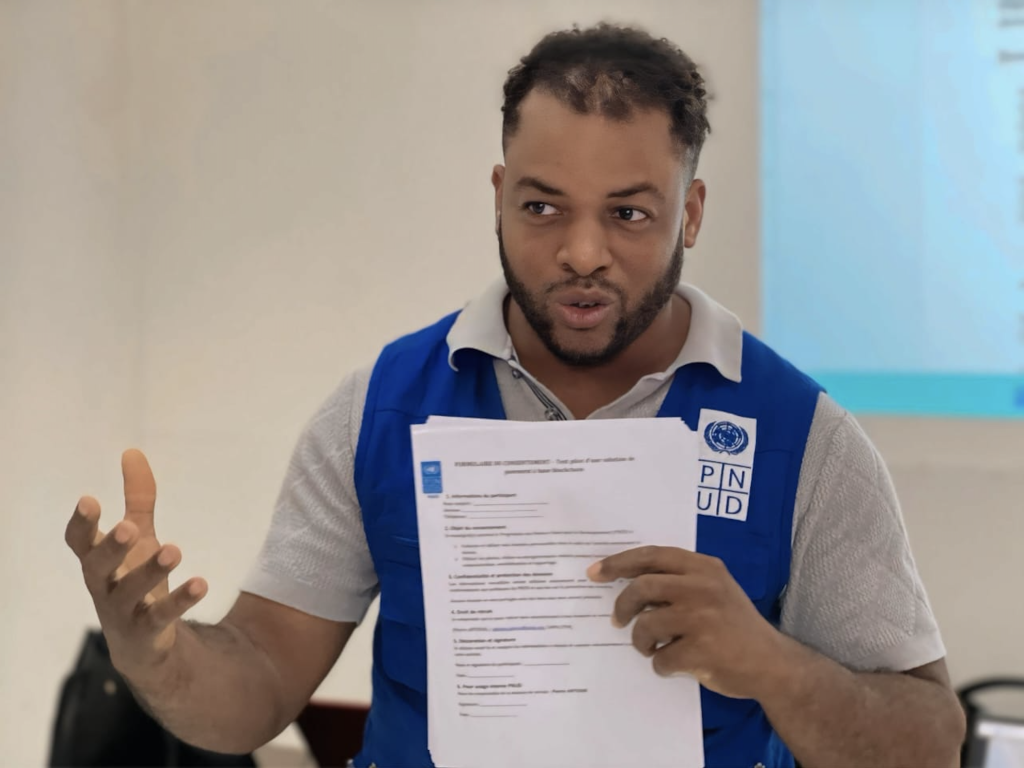
With flights disrupted, the UNDP Haiti team and the solution makers from Kura and Bousol reached Cap-Haïtien by last-minute helicopter. The next day, the cellular network went down completely. A Starlink Mini carried as a contingency plan became the only source of connectivity. What was supposed to be a controlled pilot became a stress test of whether “designed for low connectivity” was more than a feature claim, and the pilot recorded a 100% transaction success rate with near-instant performance across both wallets under the conditions that actually exist.
What made this more than a technical achievement was what happened next. Maxime, a monitoring and evaluation specialist for a national malaria project, initiated a live bulk disbursement through the Stellar Disbursement Platform during the test, sending payments directly to recipients’ wallets. He saw it work under constraint and is now exploring pathways for scale-up in Spring 2026. The signal here isn’t just that blockchain works, but that when you design for the constraints that exist rather than the infrastructure you wish existed, traditional program implementers start seeing how this fits into what they already do.
Guatemala: What gets designed out
In Guatemala, remittances from abroad are a key source of income that’s usually spent immediately, not because people don’t want to save or invest, but because the friction of doing anything else with that money is too high.
Blockchain-based digital payment tools can be laser-focused on specific populations with specific needs. The value isn’t in disrupting the entire financial system but in filling the gaps that the system can’t economically justify serving. When you design for simplicity, instant settlement, and visual clarity, you create pathways for populations that existing infrastructure excludes not by policy, but by design assumptions.
UNDP Guatemala partnered with Amero Exchange, whose platform was specifically created for Spanish speakers. Through the Stellar Development Foundation’s approach of matching solution makers to challenges presented by UNDP Country Offices, Amero’s remittance and community investment capabilities aligned with Guatemala’s particular context. This matching wasn’t accidental but reflected the reality that “the right tool” means linguistic fit, cultural context, and functional alignment, not just technical capability.
The pilot tested whether remittances could support longer-term community priorities without making people choose between immediate needs and collective investment. Families could direct a small percentage of each transfer to a community fund governed by community members back home, where members could propose and vote on local projects with all contributions and payouts recorded transparently.
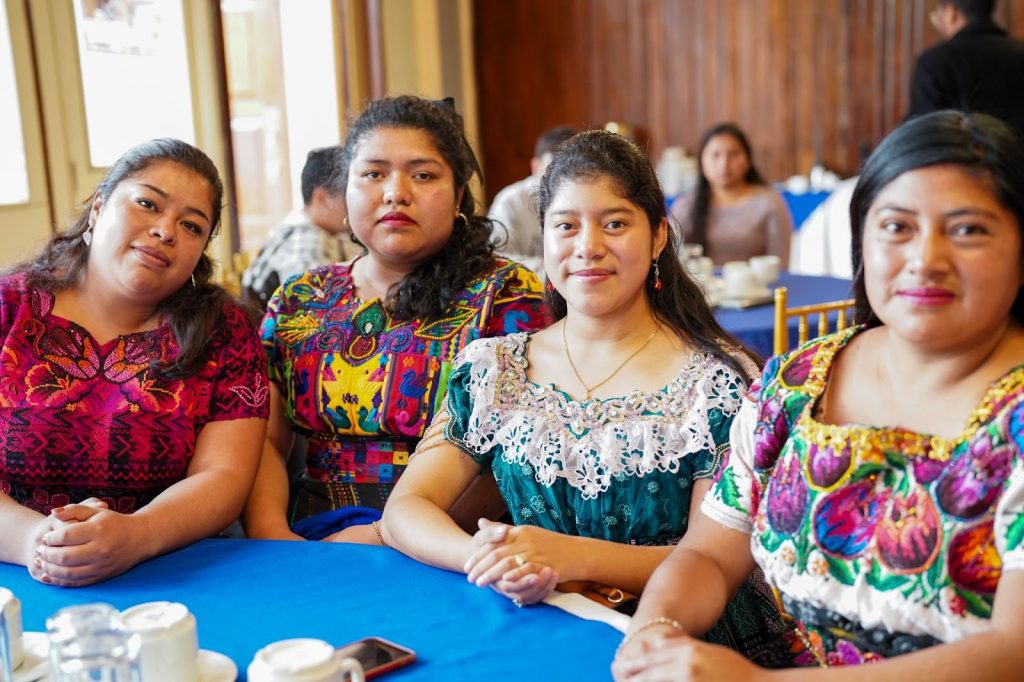
During testing, both diaspora senders and receivers engaged quickly once they understood the model. But one interaction revealed something the team hadn’t explicitly designed for. A woman with a hearing and speaking disability was in the testing group. She’d used banking services before that required extensive verbal communication, follow-up visits to confirm transactions, and waiting periods with unclear resolution times. When she went through Amero‘s onboarding process, the visual interface was clear and the instant settlement meant no ambiguity about whether the money had arrived. She found sending money to loved ones more manageable, with less friction and more confidence.
This wasn’t a special accessibility feature but simply what happened when you designed for simplicity and clarity as defaults. Current banking solutions often overlook populations like women with dependencies in diaspora, people with disabilities, and people whose needs don’t generate sufficient volume to justify traditional banks’ infrastructure costs. Not because the need isn’t there, but because the business case isn’t there under existing models.
The broader value wasn’t just expanding what remittances could do but lowering barriers to participation in household and community-level financial decisions for people, particularly women and young people, who are often excluded from those conversations entirely.
The Gambia: Where flexibility actually lives
In The Gambia, “last mile” isn’t just about geography but about the gap between informal livelihoods and formal financial systems.
Women and youth entrepreneurs keep local markets moving, but many operate outside formal finance with no bank accounts, no collateral, and no credit histories. They track sales in notebooks and remain invisible to services that could help them grow, not because they’re not economically active, but because that activity doesn’t produce the data formal systems recognize.
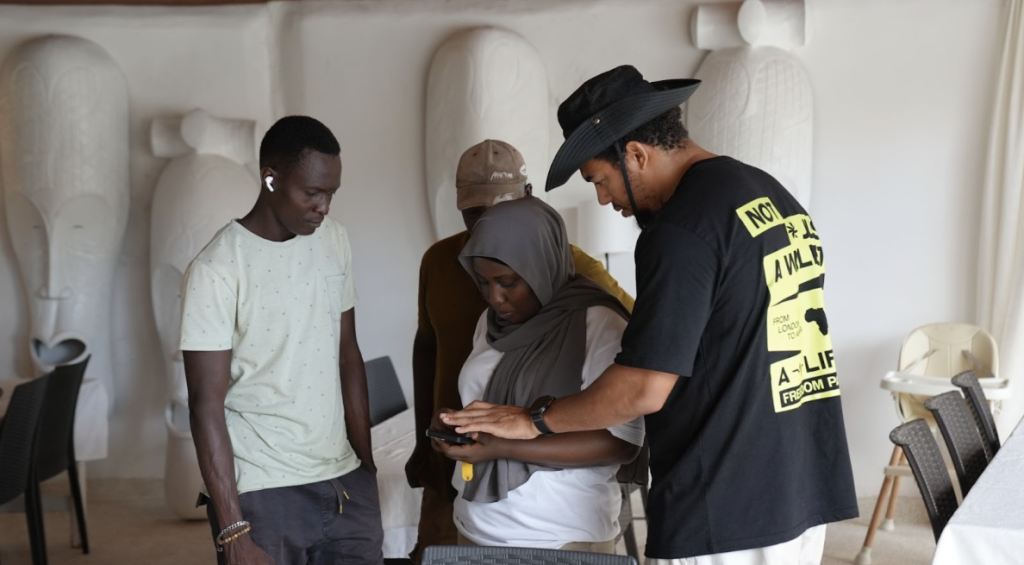
The pilot, led by UNDP staff from the Istanbul Regional Hub working with FreedomPay Wallet, paired a mobile-first wallet with simple digital recordkeeping to help entrepreneurs build usable business profiles and access fair microfinance over time. FreedomPay Wallet leverages Moneygram Access to provide cash-in and out options directly from the app interface, available in over 180 countries worldwide. During testing, something unexpected happened.
A MoneyGram agent noticed unusual, sustained demand for cash-outs in his area. After investigating, he discovered people were using FreedomPay Wallet. Rather than requiring people to travel to his established location, he closed his shop for the day and traveled with the team to a remote community. This wasn’t customer service but a traditional financial services provider recognizing value in an emerging tool and adapting his operations to meet people where they were.
Here’s what matters about that moment. We talk about legacy financial systems as if they’re monolithic and inflexible, but at the last-mile level, individual agents often have more discretion than the systems they represent. The agent’s decision to collaborate with FreedomPay Wallet showed that traditional players are ready to engage with emerging technologies when they see tangible demand from communities they serve.
The constraint isn’t technical compatibility but whether decision-makers higher up the chain will create frameworks that let last-mile providers collaborate across traditional and emerging systems without jeopardizing compliance and AML requirements. The infrastructure for reaching unbanked populations already exists. What’s needed is agile policy that empowers the people already embedded in those communities to use the tools that work. In this case, established cash-based systems and new digital tools worked together, demonstrating how collaboration rather than replacement can expand access for people who need better options.
What matching actually means
These three pilots used different platforms for specific reasons. The Stellar Disbursement Platform, leveraged by implementing organizations in Haiti and The Gambia, offers enterprise-grade ease of use for bulk transactions and provides transaction-level traceability for accountability purposes while limiting access to beneficiary personal data.
Amero, purpose-built for Spanish-speaking users, brought linguistic and cultural fit to Guatemala’s remittance-focused model. Language isn’t just translation but how financial concepts map to lived experience, which makes this choice more significant than it might initially sound.
Through the Stellar Development Foundation’s process of matching solution makers to specific challenges presented by UNDP Country Offices, each platform was aligned with context beyond just technical requirements. The real alignment happened around the actual shape of the problem: Who needs to use this? What literacy can we assume? What connectivity can we rely on? What does trust look like here? What does failure cost?
When those questions get answered honestly, you end up with different tools for different contexts because the people and places demand it, not because the technology does.
Incremental, not disruptive
There’s a narrative about blockchain that needs to be challenged: that it’s disruptive technology. It’s not. It’s incremental technology, and this distinction matters for how we invest and scale.
The value of these pilots isn’t that they replaced existing financial systems but that they filled specific gaps those systems either can’t or won’t address. The woman in Guatemala didn’t stop using other financial services but gained access to one that worked better for her particular need. The MoneyGram agent in The Gambia didn’t abandon his business model but extended it by collaborating with a tool that served demand he was already seeing.
If blockchain is disruptive, the strategy is to build parallel infrastructure, wait for adoption tipping points, and replace incumbents. That’s expensive, slow, and in last-mile contexts it ignores the reality that existing infrastructure, however imperfect, is what people currently rely on. If blockchain is incremental, the strategy changes to identifying specific gaps in existing systems, building focused tools that integrate rather than replace, scaling gradually based on demonstrated demand, and allowing traditional and emerging systems to collaborate.
This requires different expectations: multiple innovation cycles, gradual volume increases, and patience for solutions to prove themselves in real conditions over time. It also requires something harder, which is a unified approach from blockchain partners in digital payments. Right now, not all wallet projects will succeed, and that’s fine because that’s how markets work. But the proliferation of incompatible solutions creates scattered efforts that make it harder for traditional implementers to understand what’s actually viable at scale.
What’s needed is clearer signaling around which use cases have demonstrated traction, what volumes are realistic in year one versus year three versus year five, and how solutions integrate with existing remittance channels, mobile money, and local finance partners. Matching supply to transaction demand matters, and that matching needs to happen incrementally with realistic volume expectations rather than with disruption narratives that promise transformation but deliver fragmentation.
What needs to happen
A successful pilot doesn’t mean the project is complete. The next phase is operational readiness, which involves aligning with financial institutions and program owners, ensuring compatibility with local cash and connectivity conditions, establishing user support and safeguarding, and clarifying how solutions adapt to regulation and market realities.
But operational readiness isn’t just technical. It’s strategic, and these three pilots demonstrated that digital payment rails can reduce friction and open pathways to financial inclusion in last-mile settings when designed around real constraints. The question now isn’t whether this works but whether the investment approach will support the incremental scaling that actually drives adoption.
That means funding multiple innovation cycles rather than expecting immediate scale. It means supporting gradual volume increases that allow solutions to prove viability. It means enabling traditional and emerging systems to collaborate without prohibitive compliance barriers. It means creating frameworks that empower last-mile providers to adopt tools flexibly. And it means measuring success not by disruption metrics but by specific gap-filling outcomes.
These pilots aren’t standalone experiments but build the evidence base for what deployment readiness looks like: tested workflows, defined partner roles, proven performance under constraint. The UNDP SDG Blockchain Accelerator exists to move solutions from proof of concept to real-world adoption, and insights from these pilots feed directly into that mission by turning individual country experiences into transferable patterns other teams can apply.
The infrastructure is emerging and the use cases are clarifying. What’s needed now is an investment strategy that matches the technology’s actual shape: incremental, context-specific, and designed to integrate rather than replace.
At the Western Balkans Digital Summit 2025 in Skopje, we asked six regional experts¹ from across the Western Balkans 6 (WB6) two questions: what works, and what is missing in digital […]
UNDP has released a new publication, “New Tech, New Partners: Transforming development in the digital era – A snapshot of UNDP’s blockchain practice,” offering a […]
The UNDP Alternative Finance Lab (AltFinLab), in partnership with the Algorand Foundation, has launched the second global cohort of the Blockchain Academy, drawing unprecedented interest from across […]