Cleaning the Air and Improving People’s Health in Almaty
URBAN TRANSFORMATION
Valeriya Tyo, Head of Experimentation, Accelerator Lab, UNDP Kazakhstan & Yuwen Gu, Intern at UNDP Kazakhstan Accelerator Lab
What needs to be done to create a prosperous future for people and planet, a future to be realized through the UN 2030 Agenda for Sustainable Development? Here at the UNDP Kazakhstan Accelerator Lab, our portfolio of innovative bottom-up solutions is providing the answer to this question.
As part of the City Experiment Fund programme, we aim to provide the public and local authorities in Almaty with decision-making tools to accelerate sustainable development. Together with our local partners, we provide accurate real-time air quality data and interactive user features on the AirVision.kz platform.
We are developing solutions that target different layers of air pollution in Almaty by using a holistic portfolio approach based on cutting-edge technology.
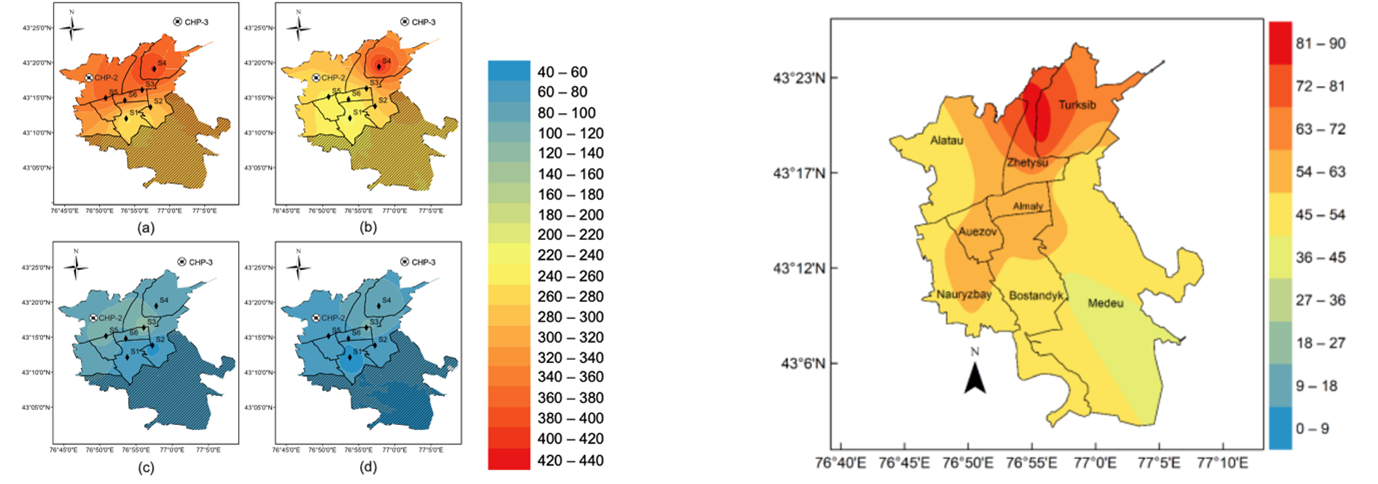
Caption: Almaty’s air pollution: magnitude, harm and costs. Spatial and temporal changes in the total concentration of volatile organic compounds and percentage of days per year with PM2 concentrations above the World Health Organization (WHO) recommended limits
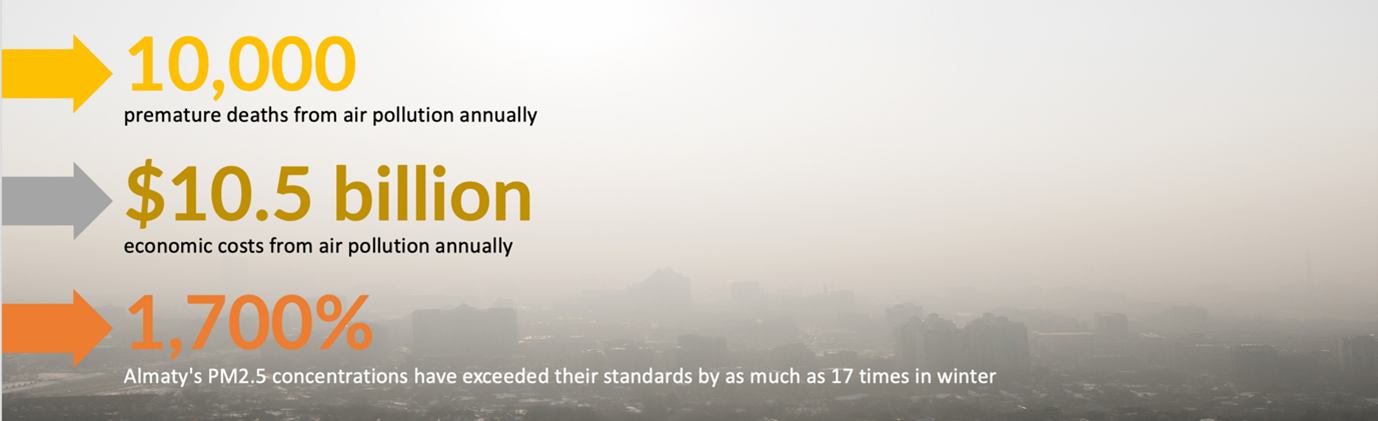
Caption: The economic and health-related costs of air pollution are detrimental for Kazakhstan
The health risks posed by air pollution come at a high economic cost. In 2022, the World Bank estimated that Kazakhstan would experience more than 10,000 annual premature deaths due to air pollution at an economic cost of more than $10.5 billion per year.
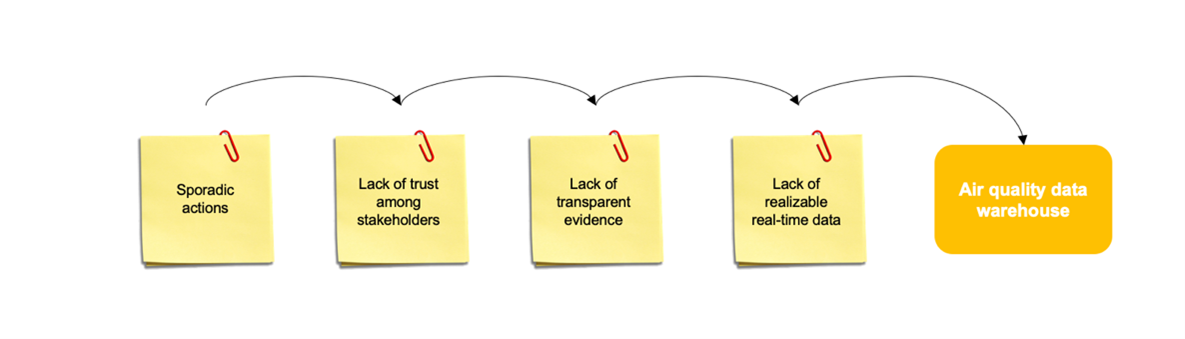
Caption: Cascading risk analysis
Navigating complexity: how to provide holistic solutions to environmental challenges
Our team identified the lack of air quality data as the overarching problem in tackling air pollution in Almaty. The lack of reliable real-time data has resulted in an air quality data warehouse that prevents accurate estimations, analysis and, as a consequence, an evidence-based developmental policy to target air pollution in Almaty.
As part of our efforts to obtain valid air quality data and to support decision-making by members of the Almaty public and the government, we set out to monitor Almaty’s air quality. To that end, we partnered with the public fund, Airvision.kz, which owns the air quality monitoring portal. The portal collects data from local air quality stations installed throughout the city and interprets the data based on the Air Quality Index (AQI), which includes measurements of PM10, PM2.5, NO2, SO2 and CO. The data can be accessed through the airvision.kz web portal and the mobile application.
The portal has an educational and a participatory component. It provides the public with news, educational content and recommendations on how to protect oneself from air pollution – the aim being to raise awareness. The portal also offers the Almaty public a one-stop-shop access to submit complaints, make suggestions and vote for ideas to improve air quality in the city.
Integrated approach
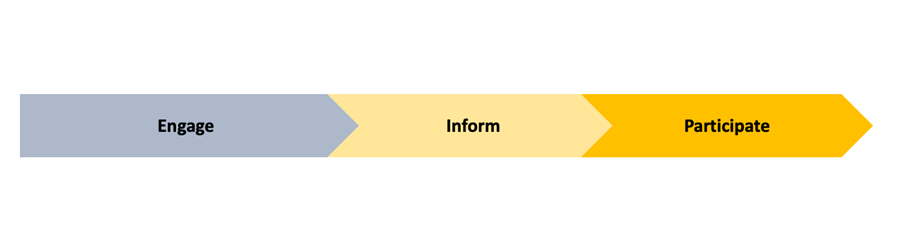
The adoption of an engage-inform-participatory framework meant that innovative solutions could be introduced to enhance its components. We are working to incentivize public engagement and to promote grassroots solutions through gamification. Building on the platform’s existing engagement channels, including social media, offline events and bilateral meetings, we are using game-based activities to incentivize a broader audience to engage. With the goal of educating and promoting public and green transportation, we reward users who take part in sustainable activities and award points in the competition for grand prizes.
To better identify key air pollutants and capture air pollution dynamics, we have supplemented existing air quality data from local sensors with traffic emissions data and analysis of historical air quality data. In that way, we are providing a more informative decision-making tool.
Building a healthier Almaty through improved dynamic air management tool
Our air quality monitoring initiative is a successful start to unravelling the complex problem of air pollution in Almaty. With our integrated air quality analysis and integrative capabilities, we will provide improved support for public participation and for a robust evidence-based policy.
UNDP’s City Experiment Fund has released the Twin Transition Stencil Report, presenting a structured framework that was designed to support cities in designing and managing integrated green and digital transformation […]
On World Cities Day 2025, UNDP in Europe and Central Asia launches the City Imaginarium — a regional creative campaign that invites artists and communities […]