Tag: Tadamon
The Islamic Development Bank (IsDB), the Islamic Solidarity Fund (ISFD), the United Nations Development Programme (UNDP), and the Organisation of Islamic Cooperation (OIC) successfully organized a special side event during the 78th UN General Assembly last week. The event ”Empowering Civil Society: Unleashing Innovation and SDG Finance through the Power of Community“ brought together 200+ participants, including civil society organizations (CSOs) and partners, to explore different ways of leveraging innovation and alternative financial mechanisms to empower CSOs that are addressing a range of critical development issues.
The event was attended by high-level representatives, including Haoliang Xu, the Under-Secretary-General and Associate Administrator of UNDP, Dr. Mansur Muhtar, IsDB Vice President of Operations, and Ambassador Hameed Opeloyeru, OIC Permanent Observer to the UN, and Dr. Hiba Ahmed, Director General of the ISFD. Their inspirational and compelling opening remarks and statements underscored the significant role of civil society and the innovative tools available to strengthen organizations’ work on the ground.
At the heart of the event was a lively discussion, moderated by Syed Husain Quadri, Director, of the Resilience and Climate Action Department at IsDB, that highlighted the importance of innovative finance and cutting-edge technologies in advancing the work of CSOs. It featured key speakers: Edward Bitar, Founder and President of Live Love Lebanon, Nasser Diallo, Founder and CEO of Clinic+O, Chris Blauvelt, Co-founder and CEO of LaunchGood, Dorothee Unger-Lee, Head of Education and Inclusion at the Algorand Foundation, and Gina Lucarelli, Team Leader of UNDP Accelerator Labs.
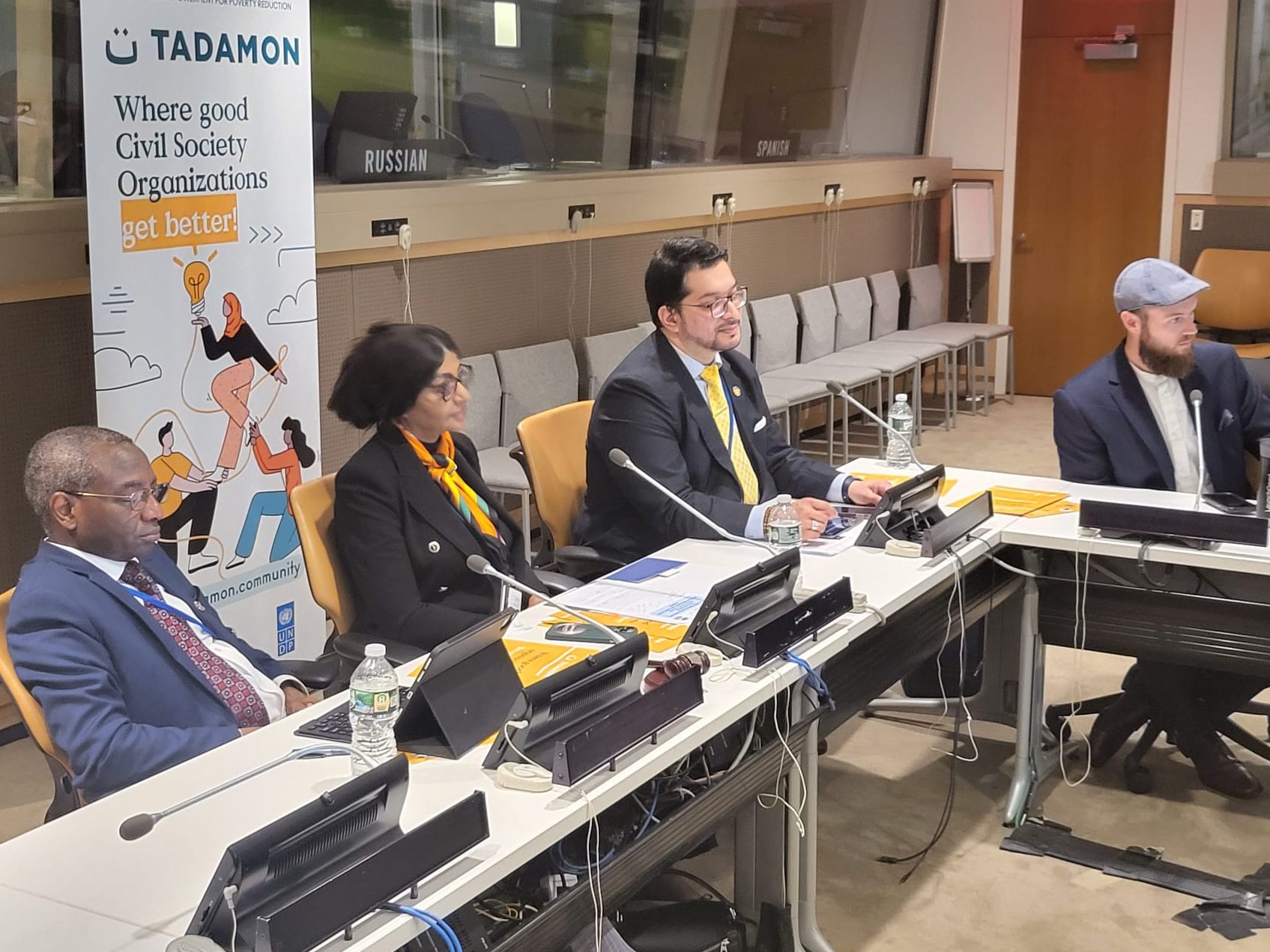
The conversation centered on emphasizing the crucial role of the community in gaining a deep understanding of the challenges and creating solutions that fit the local context. Moreover, it brought attention to alternative funding mechanisms, like crowdfunding for CSO-led projects, and the use of cutting-edge technologies such as blockchain to educate grassroots changemakers in tackling global challenges. These insights underscored the necessity of consistently monitoring and embracing new solutions and technologies to address pressing challenges in our ever-changing world.
In addition, Dr. Robert Pasicko, NGO Empowerment Project Manager, UNDP RBEC, presented the impressive results of Tadamon’s program, four years into the initiative. He shared the progress and impact of contributing not only to civil society development but boosting critical sustainable development financing. As a result of the program, a total value of $2.2 million has been effectively raised by over 80 crowdfunding campaigns powered by CSOs to underpin impactful projects that have changed the lives of over 80,000 people in areas related to education, healthcare, disaster relief, and more. Additionally, 500 CSOs have been trained and have created a $14 million pipeline of innovative projects supporting the SDGs.
The event ended with an exploration of potential partnerships, priority issue areas to address such as climate and youth, and innovative mechanisms to tap into in the next phase of Tadamon in supporting CSOs on the frontline to further drive innovation in development and sustainable financing.
For more information, please see our Tadamon website or contact us via email: team@tadamon.community
The following piece was first published on the Tadamon blog and was originally published on April 12, 2021.
I have never heard of a time when Lebanon was not suffering. The perpetual crises have included endless wars, political and civil unrest, terrorist attacks, financial meltdowns and most recently, a huge explosion in Beirut that killed more than 200 people and left hundreds of thousands homeless and a pandemic that has affected virtually every aspect of life. That’s just the tip of the iceberg. The Lebanese people never got a break, not even when they escaped the country looking for a better future. And many did migrate. Some say the diaspora is twice the size of the population. They’ve gone to almost every corner of the globe.
But crises create opportunities and we created one in October 2009 by bringing citizens, the diaspora and the private sector together to find solutions to the problems we were facing.
Live Lebanon, a UNDP initiative, was born to support the development efforts especially for the most vulnerable communities.
We started out by mapping the needs and asking non-governmental and civil society organizations, municipalities and even individuals for ideas and proposals. Every year we would select up to 15 projects to implement, taking into consideration criteria like need, feasibility, number of beneficiaries and impact. We developed an online crowdfunding platform, allowing every willing individual to contribute. The amount of the donation didn’t matter as long as the collective effort resulted in a success story. Over the span of a decade, we managed to raise $5 million and implement around 70 projects.
We have helped people in Lebanon build irrigation and potable networks and tanks in rural areas, generate electricity and install solar street lights in extremely remote villages, build playgrounds for kids and green spaces for everyone, rehabilitate dozens of schools, equip health centers and hospitals and purchase much needed ambulances, rehabilitate old markets, equip and train cooperatives, and provide waste collection trucks. Browse all of our ongoing and completed projects: http://www.livelebanon.org/project-list.
Live Lebanon’s success motivated us to continue expanding our efforts. We launched a youth volunteering program that has mobilized over 3500 volunteers, donating their time to various causes every other weekend – planting trees, cleaning beaches, waterfalls, rivers and the seafront, providing meals to homeless people, orphans and the elderly, painting schools and organizing activities for people with disabilities. We’ve collected over 39 million hunting cartridges and built recycling machines in collaboration with mechanical engineering students. We’ve raised awareness about environmental and health-related issues by taking action. With our “Bike to Work” initiative 600 people cycled to work reducing air pollution in the city and boosting wellbeing. With each step, we’ve encouraged more and more people to join and act to give back to their community.
Our mission does not end here. There are many things we have learned along the way that can be shared with other communities. Together with UNDP and the Islamic Development Bank (IsDB), we are expanding our work to other countries, using Live Lebanon and key insights to support our new Tadamon platform, developed within the IsDB – ISFD NGO Empowerment for Poverty Reduction project – where our task is to support over 500 civil society organizations within the next five years.
Our work started with Morocco, Indonesia, Kazakhstan and of course, Lebanon; to be followed soon with Tunisia, Somalia and Turkey. Thousands of organizations have already joined our platform.
While there is so much more to do, we have learned throughout our journey to act even when we don’t have the necessary funding. Because it’s people and ideas that build futures.