
Tag: Social impact bonds
The following piece was first published on the Proofing Future and was originally published on April 20, 2021.
“The Social Impact Network is a decentralized ecosystem for impact investments that connects decentralized finance and real-world asset projects to create real social impact and deliver above-average yields to investors. Compared to traditional portfolios, the impact investment offered by our platform is open fund based, easily tradable, transparent, and secure due to the integration of DTL and IoT devices into the funded projects,” says Dr. Nikola Markovic of Social Impact Network as we talk with him, Marina Petrović and Robert Pašičko of UNDP AltFinLab, and Rawad Rizk of UNDP Lebanon about their project collaboration in the DLT4EU accelerator programme.
The DLT4EU accelerator programme identifies and connects distributed ledger technology (DLT) entrepreneurs with leading public and private sector organisations for social and public good.
DLT4EU is led by a consortium comprised of Metabolic, Digital Catapult and Ideas for Change, with direct support and advice of the European Commission’s Joint Research Center.
Dr. Nikola Markovic is the CEO and CoFounder of Social Impact Network, the place where impact investors make a measurable social and environmental impact with their investment. Social Impact Network is a startup that was built during the DLT4EU accelerator program. With his expertises and enthusiasm in innovation and technology pushed the project from idea to realization. He is keen to bring the Social Impact Network further on the market and enable funding for green energy in emerging markets more accessible.
Rawad Rizk is Project Manager at UNDP Lebanon and team member of UNDP Alternative Finance Lab. He has been managing Live Lebanon, a crowdfunding platform aiming at linking the diaspora to the development effort in Lebanon with over 70 projects implemented successfully. As part of the Alternative Finance Lab team, Rawad Rizk supports the implementation of Tadamon, a NGO empowerment for poverty reduction program, which is providing capacity building and funding to CSOs in 57 countries. Rawad Rizk is a member of the digital crowdfunding academy. an online training program, as well as managing the campaign for the Alliance to Fight Avoidable Blindness AFAB, a program that provides treatment to fight avoidable blindness in 13 countries in Africa.
Marina Petrović is the Innovative Finance and Technology Expert at UNDP Istanbul Regional Hub as well as Cofounder of the Alternative Finance Lab (AltFinLab), which is an internal startup, run out of UNDP Istanbul Regional Hub for Europe and CIS. The AltFinLab is exploring how to revolutionize development finance, through innovation, digitalization and technology. Since the AltFinLab launched in 2016, Marina Petrović has been working to provide hands-on technical expertise, advisory support and market intelligence to over 45 UNDP offices, national partners and governments around the world.
Robert Pašičko is the Cofounder of the UNDP Alternative Finance Lab (AltFinLab). He supports innovation in alternative finance mechanisms and in low carbon development in over 40 countries globally. He focuses on finding ways to make green energy affordable through blockchain, crowdfunding and community financing. Robert Pašičko also cofounded the UNDP Crowdfunding Academy, a training program for crowdfunding which has been implemented in over 20 countries worldwide and has created over successful 50 campaigns. He is an evaluator of blockchain projects funded by the European Commission.
Sebastian Klemm: Which deep economic reforms do we need to tackle, in order to arrive at regenerative & intragenerationally just societies that manage to live within planetary boundaries?
Dr. Nikola Markovic: In today’s economy, emerging countries are often left behind, without sustainable and effective solutions for their development. The implementation of the Sustainable Development Goals (SDGs) in these countries is often short-termed and inefficient.
Public innovation projects are proven avenues to increase awareness and accelerate development. However, due to a lack of accessibility and accountability for both citizens and organizations, civic participation is a major drawback for their implementation.
Distributed ledger technologies, in short DLT, can provide decentralized platforms for a collaborative economy and promote digital infrastructure that facilitates increased civic participation and engagement. New financial mechanisms based on DLT would stimulate civic investment in areas such as education, health, energy, agriculture and women smallholders. This innovative type of inclusive and collaborative economy would encourage sustainable development in emerging countries and contribute to equality in societies.
Rawad Rizk: I believe we are reaching an irreversible or a breaking point when it comes to the environmental damage to our planet. Raising awareness to change behavior is not enough. We need tough reforms and regulations that enforce laws to protect nature.
Marina Petrović & Robert Pašičko: With regard to our Digital Impact Coins challenge, necessary reforms could be the regulation of digital technologies, crypto and new banking systems that are citizen led and owned, which could also help with the distribution of power, as we could have more people actively participating in the global economy who were previously unbanked, as well as people living without ID.
Sebastian Klemm: Why do you participate in the DLT4EU programme?
Dr. Nikola Markovic: The DLT4EU programme offered a unique opportunity for accelerating the implementation of the DLT solutions that we propose with the Social Impact Network. Moreover, the challenge proposed at the beginning of the programme by challenge owners, about incentivizing financial contribution of citizens for social and environmental projects, was perfectly aligned with the core solution based on blockchain technology that we are offering for impact investment within our Social Impact Network platform.
Rawad Rizk: The DLT4EU programme is a learning opportunity to gain hands on experience by engaging with experts in the field of distributed ledgers and blockchain. The programme will help us move from traditional donation based projects to impact investment.
Marina Petrović & Robert Pašičko: UNDP ALtFinLab is part of the innovation team led by UNDP Istanbul Regional Hub and has been working with innovative digital technologies for development over the past 5 years.
We understand that the interdependence of our world has been experienced so starkly by so many people at the same time. COVID-19 and the response to it has shown us the realities of the interconnectedness of our system, with one action leading to secondary and tertiary consequences across the globe.
Participating in DLT4EU helps us to reshape and think differently about our approach to tackling development challenges by exploring and leveraging new and novel technologies.
Sebastian Klemm: What have been inspiring moments to you personally during both your work together as a Virtual Field Lab team and within the entire DLT4EU programme so far?
Rawad Rizk: I have been inspired by the collective work and the countless brainstorming sessions we had for overcoming many obstacles. Working with people from different geographical areas, backgrounds and cultures to solve common problems was satisfying.
Dr. Nikola Markovic: During the accelerator programme, we have experienced both dramatic and inspiring moments. However, I would like to highlight one that changed everything.
The day after a dramatic explosion in Beirut, Lebanon, we held our scheduled weekly call within the Virtual Field Lab team and got first hand information from UNDP Lebanon about the situation in Beirut.
It was a very shocking realisation that due to the lack of sustainable energy, doctors were performing surgeries using phone lights. Furthermore, the planned pilot site for our project was destroyed and the implementation of the entire project was uncertain.
But, during this meeting we had one of the most productive brainstorming sessions, built stronger connections and bonded as a team for a common goal. Out of the disaster and hopeless situation came an engine for successful project development.
Could you elaborate as to how your particular project can support the recovery of Lebanon, particularly on site in Beirut following the local explosions and destructions in August 2020?
Dr. Nikola Markovic: The explosion in Beirut combined with COVID-19 amplified the already existing problems in Lebanon, and demonstrated the urgency for our solution. Our Social Impact Network can support the recovery of Lebanon, particularly to provide sustainable energy to facilities such as hospitals and schools, by providing access to funds that would be used to build solar PV plants.
Sebastian Klemm: What social and environmental challenges does your DLT4EU project address exactly?
Rawad Rizk: The goal of our pilot project is to encourage renewable energy solutions and to provide financial means to beneficiaries who need these solutions. Shifting to clean and renewable energy will protect the environment by reducing greenhouse gas emissions. It is a healthier alternative for communities.
Take Lebanon as an example, where citizens rely on expensive and polluting private electricity generators that cause great harm to their health and the environment. Installing solar PVs instead will reduce their bills, protect the environment and improve their well-being.
Marina Petrović & Robert Pašičko: In terms of socio economic recovery from COVID-19, in many countries, such as Lebanon, financial viability is the weakest dimension of sustainability, whether due to shifting donor priorities, new legal obstacles, or the emergence of greater economic challenges. This has occurred since the COVID-19 pandemic began and countries and donors scaled back their funding to address COVID-19. Investments shifted to supporting development efforts in Syria and other war-torn regions and to direct implementation activities, rather than funding local organizations, startups, or companies to do so. Finally, in many places, a deteriorating economy and limited options for domestic funding have increased reliance on foreign funds while intensifying competition among organizations for those funds.
Concerning the COVID-19 socio economic recovery in Lebanon in particular, it shows that the currency devaluation reached a record losing more than 80% of its value which jumped from 1500/$ to 9000/$. Lebanon was also hit hard by the Beirut port blast which is the third largest blast in history. The losses incurred are estimated at 10B$. More than half of the population is below the poverty line and the unemployment rate has reached 40%. The situation is rapidly deteriorating and is reaching a tipping point. Lebanon is now facing a major energy crisis. With the lack of USD the government will not be able to import fuel oil used to operate the power plants and private generators. Power rationing will soon reach its highest level. Currently, the government is supplying less than 12 hours of electricity per day. Citizens are relying on expensive and highly polluting private generators to fill the gap. The power cuts will heavily affect the hospitals and health centers. With an average of 5000 new COVID-19 cases, hospitals have reached their full capacity with only 60 ICU beds remaining. Many of those hospitals were affected by the Beirut port blast which left them hanging in the dark.
Dr. Nikola Markovic: Above all the financial support is the key for enabling citizens of Lebanon and other developing countries to have access to sustainable and renewable energy, as Rawad and Marina have already mentioned. Traditional impact investment could become an approach to generate positive social and environmental impact alongside a financial return. However, low level of trust and transparency, sophistication of impact measurement practice, suitable exit options among others, are still preventing it from scaling.
Sebastian Klemm: How do you apply distributed ledger technologies in your project to help solve these challenges for the public good?
Rawad Rizk: With our pilot project we are building an online solution to connect potential investors with beneficiaries who would like to install solar power systems. Blockchain technology offers a trustworthy solution in this regard, safeguarding the interests of all parties involved.
Marina Petrović & Robert Pašičko: A Digital Impact Coin or SI Token can serve as an economic incentive model mechanism, and thus encourage positive engagement for public benefits. This mechanism also encourages a long-term relationship that can be extended across ecosystem members who share common values, as well as be passed between community generations.
Dr. Nikola Markovic: The Social Impact Network is a decentralized ecosystem for impact investments that connects decentralized finance and real-world asset projects to create real social impact and deliver above-average yields to investors.
The first impact investment fund offered via Social Impact Network is a Renewable Energy Fund. Compared to traditional portfolios, the impact investment offered by our platform is open fund-based, easily tradable, transparent, and secure due to the integration of DTL and IoT devices into the funded projects. The latter enables the measurement and tracking of the energy produced and based on that calculates the return on the investment.
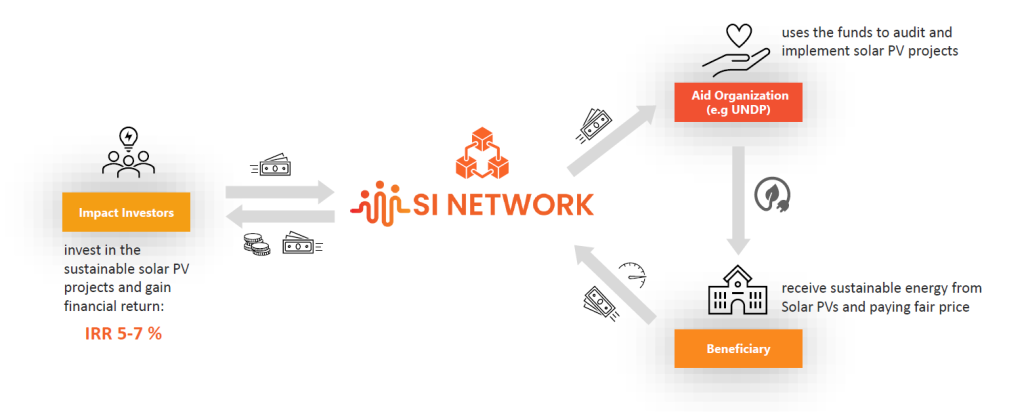
The new impact investment model, called Tokenized Measurable Impact Investment, can engage more people in financing and supporting the social impact project, e.g. electrification with renewable energy, in emerging markets. The interoperability of these tokens with financial institutions such as banks enables its integration into their digital portfolios and provides a wide range of potential for investors.
UNDP Lebanon, as project coordinator, supports vulnerable beneficiaries such as schools and hospitals in Lebanon with site assessment for solar PV plants and by proposing these projects on the platform. The project proposed by UNDP Lebanon is funded by impact investors through SI Tokens, governance tokens of the Social Impact Network. In this way, the project coordinator directly benefits from the sustainable financing model for the solar PV plants and the beneficiaries get easy access to sustainable energy.
This is how it works:
- Step 1. UNDP identifies and makes an assessment plan for renewable energy projects with social impact. The chosen projects are proposed on the Social Impact Network platform.
- Step 2. Impact investors buy the SI Tokens directly through the platform or through banks and become part of Social Impact Network.
- Step 3. Funds are used by UNDP to implement the proposed project. Contractors for the project implementation will be selected through a competitive public tender process managed by UNDP.
- Step 4. The IoT device sends data from the installed solar PV plants via blockchain, and the data is transparently available on the Social Impact Network platform.
- Step 5. The electricity is paid by the beneficiaries to the Social Impact Network, and the payouts are distributed to the impact investors based on the token ownership.
Sebastian Klemm: What have you been developing so far throughout the DLT4EU accelerator programme?
Rawad Rizk: Thanks to the DLT4EU accelerator we have developed a better understanding of tokens and blockchain technologies.
Marina Petrović & Robert Pašičko: As a result of our gain in understanding, we have created a system solution and technical platform together with the Social Impact Network.
Dr. Nikola Markovic: As a result of our weekly meetings with the challenge owners of UNDP & AltFinLab as well as with DLT4EU coaches, we designed a tailored solution, the Social Impact Network, and fully developed it during the DLT4EU accelerator timeline. Early 2021, we will have implemented our solution in an operating environment in Lebanon with real customers.
In addition, we have also created the full legal framework for our Proof of Concept and the next phases. Our Social Impact Network components developed during the timeline of the DLT accelerator include:
- A mobile ready responsive platform tested with end users.
- A fully operational tokenized fund with all functionalities.
- The interconnection of an IoT device placed on the solar PV plants for measuring.
- Blockchain technology for storing impact data like energy produced and the CO2 reduction.
Sebastian Klemm: What particular qualities of the DLT4EU accelerator distinguish this programme in your opinion?
Rawad Rizk: The DLT4EU programme is well organized and structured. The responsible colleagues do a good follow up, which I believe will yield successful results.
Dr. Nikola Markovic: The key quality of the DLT4EU is in an interplay of access to highly skilled mentors, participation in carefully tailored bootcamps, and active contribution in Virtual Field Lab concept. The Virtual Field Labs in particular, as a joint venture between challenge owner and the venture team, is a way to successfully implement cutting-edge technology to overcome a real challenge. In addition, each step during the development was followed and discussed with the mentors so that the Virtual Field Labs were independent in decision making but guided towards successful implementation.
Marina Petrović & Robert Pašičko: One of the particular qualities of DLT4EU is that it is directly supported by the European Commission. Such support is often the biggest shortcoming of similar programmes, which are creative in design but abstract in implementation as they lack the political angle and support on the policy, legal, regulatory and funding fronts.
Sebastian Klemm: Following your participation and insights so far: What evidence of positive impact and benefits of the DLT4EU accelerator do you see already?
Rawad Rizk: I believe the positive impact and benefits will be clear after we finalise the Proof of Concept and implement the first pilot.
Dr. Nikola Markovic: We are in the early stage of the implementation. However, the technical aspect of the PoC is fully tested and it is ready for the market. After realisation of the first pilot project, we are expecting to scale Social Impact Network by including regional UNDP hubs. It is very clear that urgency for new financial inputs in emerging markets can accelerate the whole market of impact investment. Our mission is to further incentivize financial contribution by establishing a new standard for impact investment that guarantees full transparency and inclusiveness. .
Marina Petrović & Robert Pašičko: There may be even potential of scale up for other challenge owners.
Sebastian Klemm: How will you sustain your engagement and project development beyond the final presentations at the European Commission in March 2021?
Rawad Rizk: We are planning to create a partnership with the Social Impact Network team and test our solution within one UNDP country office and later on expand it to other countries.
Marina Petrović & Robert Pašičko: Furthermore, we can see a potential scale up through Tadamon, a NGO empowerment for poverty reduction programme.
Dr. Nikola Markovic: The relation that we have built with UNDP Lebanon during the DLT4EU programme is the foundation for our future cooperation. Our solution has the potential to disrupt the impact investment sector and create tangible social and environmental impact not only in Lebanon but also in other emerging countries. We look forward to seeing this happen.
The following piece was first published on the AltFinLab blog and was originally published on July 10, 2018.
Impact bonds, one of the pay-for-success financial mechanisms bringing impact investors, private, public and third sector organizations together to solve social and development issues, have recently faced some criticism about their complex nature, which can lead to a long design phase and high related transaction costs.
We, at UNDP Istanbul Hub and Finnish Innovation Fund Sitra, put our heads together and thought about the challenges around impact bonds. There was a mutual understanding that what comes to preventing and solving wicked societal problems, the impact is achieved together – the core idea and benefit of impact bonds. Sitra has been using co-creation as a mechanism to boost the design of social impact bonds (SIB) in Finland and we decided to create an impact bond design programme together around the same approach to support more straightforward design of the impact bonds in the region of Europe and CIS countries.
The idea of moving from simple cooperation of different actors to co-creation lies in understanding the societal challenges in a broader way and jointly set and produce mutually valued impact. Impact bond can be one part of the buzzle in realization of the targeted change.
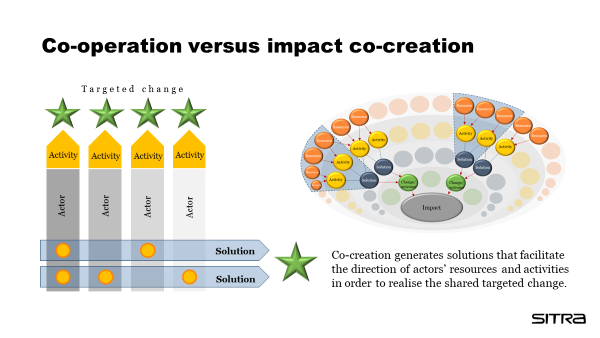
We also acknowledged that both public sector and development sectors are facing similar challenges in their service delivery where the focus is still on procuring activities. Impact bond modality is being used in both sectors: In social impact bond (SIB) the outcome funder is the host government and in development impact bond (DIB) it is a third party, such as a donor government or philanthropy organization. Or like in Colombia employment SIB, the outcome payment is divided between the national government and SECO.
The change from procurement of activities to procurement of outcomes means two radical changes in both sectors, and the relationship between the outcome payors and the service providers should be taken to a new level: 1) Outcome payor becomes an owner instead of determinant and 2) service provider acts as an innovative impact actor instead of mechanical operator. This, however, requires real co-creation between different stakeholders aiming to achieve mutually determined goal and public sector can act there as an enabling platform. We think it is very important to understand that impact bonds are not the goal itself, but a tool for strategic leadership and more effective use of tax payers’ money to achieve sustainable well-being and development.
To help the transition from activity-based procurement into outcome-based procurement by using impact bond mechanism, we launched our Impact Bond Design Programme late January 2018. Five teams of UNDP-government collaborations were selected from the region of Europe and CIS countries. After an introductory into impact bonds, the teams started mapping the social issues to tackle and considering initiatives where an impact bond mechanism might create some change. After mapping and brainstorming, the teams decided to focus on the following themes: road safety in Montenegro, dairy production in Armenia, air pollution in Macedonia, cattle production in Moldova and youth activity in Georgia.
With these topics in mind, we organized a four-days hands-on design workshop in Helsinki early April to create more targeted impact bonds with clear goals and target groups and tools to determine suitable intervention strategy, metrics and indicators for measuring the impact. We brought together different SIB actors, such as investors, service providers and fund managers to highlight their experiences and learnings. We gathered experts and mentors from Sitra and UNDP, sector-specific institutions from Finland, international organizations specialized on impact bonds, such as Strat!gos and Social Finance UK and IFIs, such EIB and EIF to help the teams to refine the details of their impact bonds. The week’s work culminated to a final pitching session.
The work is now continuing in these five countries with stakeholder discussions, data collection and legal analyses. We are looking forward in having more news about the design of these impact bonds early autumn.
Our findings from the first phases of the process are: more work need to be done to make the utilization of the mechanism easier for a bigger number of countries and the support more systematic. Further plans of UNDP for this year include: designing of an online curriculum for impact bonds, an outcome fund to support the outcome payments in the countries and more research on outcome-based budgeting to enable the outcome payments of the host governments. Stay tuned!
The following piece was first published on the AltFinLab blog and was originally published on September 19, 2016.
Ten months ago we had an eclectic group of people introduce a slew of new financial mechanisms- blockchain based cash transfers and impact bonds for reducing recidivism to forecast based finance for disasters and peer to peer lending for SMEs- emerging into what the ODI calls a new ‘age of choice’ for the development finance.
We tackle this topic not just because there is a $2.5 billion gap in funding the current SDG agenda (even though ODA flows to developing countries continue to increase year on year). We are more tickled by the sheer explosion of money coming from other sources of funding that aren’t high on the priority list of either development organizations or governments (admittedly this is fast changing)- the European alternative finance market grew by 144% in 2015, the global impact investment market is projected to grow over $3 trillion in the coming years, and crowdfunding investments reached $37 billion in 2015 (by way of comparison, this is about ⅓ of total ODA totaling $131 billion in 2015).
This tickle gave birth to a sort of an Alternative Finance Labwe’ve (unintentionally) began running out of Istanbul. What skills do our clients need to tap into some of these new sources of funding? Is the effort worth it given the experimental nature of some instruments and the fact that they are way ahead of existing legislation in most countries we work in (think blockchain based remittance transfer)? Many of the mechanisms are preventative in nature and require a shift to costing future liabilities (think of a financial value on the cost society bears from youth unemployment- what does a ‘log frame’ for that type of a project look like?
In tackling some of these questions since the beginning of the year, we mobilized over EUR 3 million across a series of experiments with these new financial mechanisms:
Blockchain and development
In Serbia, we’re working with superstars from AidTech (check out their prize winning prototype on reducing fraud in cash transfers for refugees in Lebanon) to design a proof of concept for remittance transfers over blockchain that would be cheaper (in looking to cut out an intermediary a la Western Union) and targeted toward specific needs (think using remittances to pay energy or phone bills and purchase food). There are several similar initiatives ongoing (check out these Tunisian start-ups redefining remittances transfers with blockchain) but for us this is a first. In Moldova, we’re testing whether blockchain can provide a more effective way of managing the UN car fleet together with EmerCoinandDeePlace. We’ve been inspired by a decentralized ride-sharing outfit in Israel, Lazooz and driver-owned car sharing start up Arcade City. When it comes to UNDP’s emergency response in employment,we have a hunch that blockchain could provide a more effective way of transferring and tracking funds, and shifting our strategy in line with what is happening in the field– this is a work in progress though but one we’re excited about.
We’re cooperating with the Joint Research Center of the European Commission (check out an impressive line up of people they’ve had for a discussion on distributed ledger technologies a few months back) on design of a challenge prize for social applications of blockchain that would (hopefully) incentivize use cases that go beyond financial sector. The speed of progress in this field has been staggering with new use casespopping up across just about all priority sectors for our client governments- for example, the UK government just published research showing how digital currency based on the distributed ledger could up the GDP by as much as 3%. Others include blockchain based micro energy grids, land registries (Georgia) and election platforms (Ukraine’s Parliament), defrauding distribution of natural disaster relief funds (Italy) and philanthropic donations, managing and tracking the cross border SME trade, boosting girls education and storage of cultural heritage in political conflicts to name a few.
Preventative finance: social impact bonds and forecast based finance
In Serbia, we’re working with the Finnish Innovation Fund Sitra on designing a social impact bond on youth unemployment. We were inspired by their work on using this financial mechanism for public sector absenteeismand migrants and employment both of which have flipped the concept of welfare from being considered a cost to being the government’s investment in social outcomes. We will have some fresh data on this in the coming weeks, but accounting only for wages and taxes foregone and cost of social transfers avoided the cost exceeds EUR 1.5 billion a year (and this does not include other costs such as likelihood that unemployed youth may be more likely to suffer from depression and alcoholism, engage in violence). In Belarus, the European Commission has invested in our team to design an Outcome Buying facility(where impact bonds will be one of many instruments to include a mix of grants, impact investment, and others). The results of SIBs globally have been mixed at best, but we believe there is a lot to be gained from calculating future liabilities, attracting new sources of funding and holding pay-outs contingent on achieving the results (as opposed to fulfilling activities). Apparently so do others with thegovernment of Netherlands issuing its fifth SIB on employment, transitioning of youth from Out of Home facilities (drug and alcohol abuse) in Australia, and a massive $30 million first humanitarian impact bond launched by the International Red Cross and the Belgian government.
When it comes to the forecast-based finance, we’re learning from the best! Together with the Red Cross/Crescent Climate Center,our team in Bosnia and Hercegovina is designing the FbF mechanisms for the Vrbas basin. Ultimately our intention is not only to minimize the risk and secure funds before a disaster has received sufficient media support but also to test the feasibility of attracting new sources of funding (think insurance companies) for community resilience.
Crowdfunding in development
Since we launched UNDP’s 1st Global Crowdfunding Academy in December (followed by a succesfull Crowdfunding Academy in Croatia), we’ve worked on 13 crowdfunding campaigns that mobilized over $200,000 across a range of sectors including health, inclusion, energy and entrepreneurship- Kyrgyzstan raised funds for a more inclusive and energy efficient retirement home in a rural area, Indonesia got resources forrenewable energy in rural areas, Moldova mobilized funds for healthy food in public schools, and Yemen for a range of community projects unique to the conflict contextof the country. Currently, we’re preparing the launch of a campaign in Bangladesh on youth employment and Lebanon who already raised $116,000 for traffic management and control around public schools.
All of these were donation based campaigns where one of our main take aways has been their ability to link us up to interesting new partners and help us with advocacy. For example, our Tajik campaign attracted the country’s diaspora in Australia not only to donate funds but also explore investment in a similar new project in the eastern region. Famous chef, Jamie Oliver, supported our fresh fruit campaign for public schools in Moldovaand Bangladesh cricket national team captain Mashrafe endorsed the campaign for building employment skills for the youth. The Balkan rock star Rambo Amadeus got behind a campaign to build solar power sail boats on the Adriatic, andYahoo picked up on our efforts to invest in refugee-driven pop up restaurants. The Croatian Ministry of Construction prepared a pilot project for refurbishment of 30+ schools (and an energy agency designed a dedicated platform) to replicate our success with building the first Energy Independent school in the country.
Moving forward with this line of work, we’d like to put more emphasis on equity crowdfunding (example on investment in renewable energy community project) and peer to peer lending (check out this investment for SME on furniture design in Tajikistan) as our hunch is that these mechanisms can help us redirect vast diaspora funds more closely to bottom up, entrepreneurial projects in communities across the development work. We will have a chance to experiment with this approach together with the UNFCC with who we are currently designing a system by which crowdfunding can be utilised for renewable energy programs alone.
What’s next?
We’d love to see Open Bank initiative functioning in one of our projects (think a crowdfunding campaign where a single donor can track her investment through the point of a purchase) and we’d love to tinker with the GrowFundand Fund Club-like idea where we’d combine crowdfunding with corporate investment and peer to peer donations. Mobile money hasn’t taken off in Europe and CIS (which is where most of our time is invested at the moment), so we’d like to explore why and how to change that. We also haven’t yet but would like to troublemake with Disberseteam who seem to have put together a number of puzzles that for us are still up in the air- social cash transfers, impact bonds and payment for results, blockchain and transparency- all under the chapeau of future of development finance. We’ve also got a few things cooking with AlliedCrowds and Cambridge Alternative Finance Lab but more on that soon.
Ps. We would like to acknowledge the very first investor in our Alternative Finance Lab- the Ministry of Finance of Slovakia.