
Tag: Blockchain
GrantsFund4Aid, an on-chain grant management platform developed by Innofund, has concluded a pilot testing how blockchain technology can support more transparent, traceable and efficient grant management. It successfully disbursed test grants to ten teams participating in a United Nations Development Programme (UNDP) global initiative, the SDG Blockchain Accelerator, that helps develop and scale practical solutions powered by emerging tech to advance the SDGs.
The pilot explored the potential of on-chain grant management to increase visibility over funding flows, strengthen accountability and reduce some of the administrative burden associated with traditional grant processes among international organizations.
Test pilot grants were successfully disbursed to ten participating teams under the EMURGO track of the Accelerator led by UNDP Alternative Finance Lab (AltFinLab), which connects emerging tech, innovation and finance, to explore, test and scale new approaches for sustainable development.
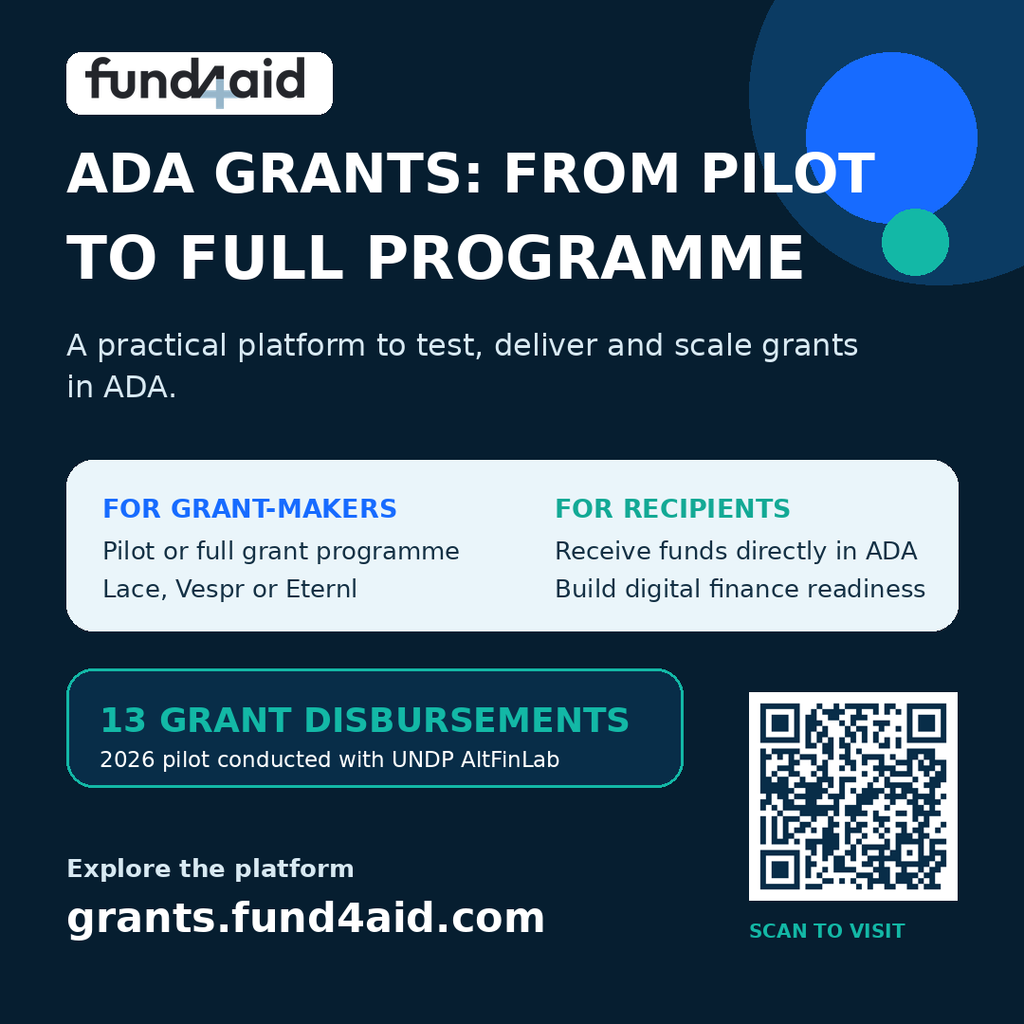
“We were interested in testing whether an on-chain grant management platform could make grants to civil society organizations (CSOs) and solution makers in the SDG Blockchain Accelerator more transparent, efficient and easier to track,” said Teodor Petricevic, Accelerator Lead, UNDP AltFinLab. “The objective was to test whether blockchain could provide better traceability and accountability while simplifying the overall grant management process.”
Alongside the grant disbursements, feedback was also gathered from UNDP AltFinLab teams and participating organizations to assess the pilot and help strengthen the next stage of the GrantsFund4Aid MVP.
The feedback provided encouraging early indications of support for the approach. All surveyed UNDP respondents said they would share their experience with colleagues and encourage others to try GrantsFund4Aid, while all surveyed participating organizations said they would use the platform to apply for grants again and share their experience with peers.
Feedback also identified priorities for the platform’s next phase, including simpler onboarding, improved wallet integration, grant tracking and notifications, and easier fiat off-ramping. Participants also highlighted the potential to connect CSOs with a wider range of funders.
“The platform could evolve beyond grant management into more of a matchmaking platform, connecting CSOs looking for funding with grant givers looking for relevant projects and partners,” added Petricevic.
The findings from the pilot will now inform the next stage of development of GrantsFund4Aid, with a focus on improving the user experience and exploring how on-chain technology can help connect funders, CSOs and solution makers through more transparent and traceable funding mechanisms.
Photo credit: Shubham Dhage / Unsplash
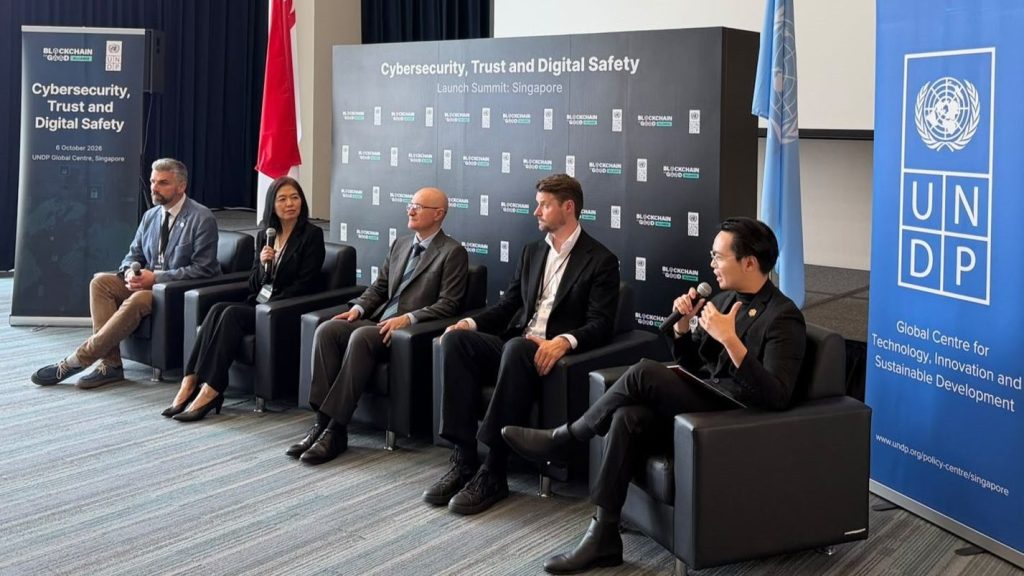
The United Nations Development programme (UNDP) and Blockchain for Good Alliance (BGA), the global non-profit initiative founded by Bybit, dedicated to leveraging blockchain for societal impact, have signed an agreement to launch a two-year programme to strengthen cybersecurity knowledge and capacity for the responsible use of digital technologies in development.
The agreement was signed by Edward Vrkić, UNDP’s Resident Representative to Malaysia, Singapore and Brunei Darussalam, and Helen Liu, Founder of BGA at the Cybersecurity, Trust and Digital Safety Launch Summit in Singapore. The signing was followed by a panel discussion on securing digital trust and the role of public-private partnerships in strengthening cybersecurity.
“The governments we support are facing growing and increasingly complex cybersecurity challenges, driven by ongoing conflicts, AI-enabled fraud, and more sophisticated cyberattacks,” said Robert Pasicko, UNDP Alternative Finance Lab (AltFinLab) Team Lead. “Strengthening cybersecurity capacities and building resilient, trusted digital systems are essential to addressing these risks. We welcome the opportunity to deepen our collaboration with the BGA, drawing on its expertise and experience.”
A critical time for collaboration
As public institutions rely more on digital systems, including blockchain technology, cybersecurity is critical to protecting services, public funds and trust. Rapid advances in artificial intelligence are making cyber threats more sophisticated and systems more complex. The partnership will help public institutions strengthen the technical, governance and response capabilities needed to manage cyber risks and safeguard essential public services.
The programme will be implemented by UNDP’s AltFinLab in collaboration with BGA. Over two years, it will draw on the cybersecurity expertise of BGA’s global ecosystem to provide hands-on learning and advisory support. Capacity-building activities will be delivered through three channels: the SDG Blockchain Accelerator, which supports emerging technology solutions for the Sustainable Development Goals; the Government Blockchain Academy for public officials; and dedicated training sessions for UNDP Country Offices and government partners. The programme will focus on topics such as data protection, secure digital payments and the security of public digital services.
“Prevention, response and recovery are the three pillars of cybersecurity, and public institutions need all three,” said Glenn Tan, Director of Global Affairs at the Blockchain for Good Alliance. “The private sector holds much of the expertise across these areas, yet public institutions and international organizations with pressing needs often lack direct channels to access it and collaborate. This partnership opens that door.”
The partnership builds on BGA’s role as Strategic Partner of the UNDP SDG Blockchain Accelerator, now entering its third cohort, and its participation in the Blockchain Advisory Group (BAG). Convened by UNDP, BAG brings together ecosystem leaders to explore how blockchain can contribute to sustainable development and strengthen digital public systems.
NEW YORK — [September 25, 2026] — Circle Foundation, a philanthropic initiative supported by Circle Internet Group, Inc.’s (NYSE: CRCL) 1% equity commitment, the United Nations Development Programme (UNDP) and the World Food Programme (WFP), today announced two initiatives to improve digital payments for development and humanitarian action.
The initiatives will explore how digital payments and improved digital financial infrastructure can help international organizations move resources, deliver support more efficiently and advance financial resilience and inclusion.
“Around the world, the need for humanitarian aid keeps growing while the resources to meet it are stretched thinner than ever,” said Elisabeth Carpenter, Chief Strategic Engagement Officer, Circle, and Founding Chair, Circle Foundation. “If we can help humanitarian and development institutions move value faster, more transparently, and at lower cost, we can ensure more of every aid dollar actually reaches the people who need it. Circle Foundation’s support for UNDP and WFP is about strengthening the shared infrastructure powering these organizations so that life-saving and life-sustaining aid reaches people in crisis faster, without the delays and costs of outdated systems.”
Enabling UNDP to move from pilots to programme delivery
Circle Foundation’s grant will enable UNDP to establish and operate the Digital Asset Innovation Pool, a new mechanism designed for the responsible use of digital assets via regulated payment stablecoins in development programmes to accelerate delivery.
The work builds on digital payment solutions piloted through UNDP’s Sustainable Development Goals (SDG) Blockchain Accelerator, a global initiative led by the Alternative Finance Lab that develops and scales practical solutions using blockchain, AI and other emerging technologies to advance the SDGs. The pilots tested digital Cash-for-Work payments in Aleppo, Syria; disbursements designed for low-connectivity conditions in Haiti; a remittance-linked community investment model in Guatemala; and mobile wallets connected to existing cash-agent networks in The Gambia. The Digital Asset Innovation Pool will build on these lessons by helping Country Offices move from individual pilots to regular programme delivery, with structured implementation support, regulatory and operational guidance, beneficiary safeguards, and tools to track delivery time, cost and reach.
“Getting resources to people should not be the most difficult or expensive part of delivering a programme. The Digital Asset Innovation Pool will support UNDP in using digital payments responsibly to make last-mile programme payments faster, more affordable and easier to access – especially for people underserved by conventional banking. We want to make sure more of every dollar reaches the people and communities it is meant to support,” said Robert Pasicko, Team Lead, UNDP Alternative Finance Lab.
The Pool is not intended to replace established banking channels. It will provide an additional option for contexts in which conventional payment systems create significant costs, delays or barriers to access.
Supporting WFP’s shared humanitarian payment infrastructure
A separate grant from Circle Foundation to World Food Program USA will support WFP and the WFP Innovation Accelerator in building the institutional infrastructure needed to deploy and scale regulated, stablecoin-enabled payments.
The funding will support the underlying systems that make stablecoin adoption sustainable: governance and risk frameworks, treasury and reconciliation systems, and compliance tools built to hold up across multiple country operations. It will also fund local fintech and mobile money integration, along with independent, sector-wide research on cost, speed and operational feasibility – giving the broader humanitarian sector its first real benchmarks on stablecoin-enabled payments.
Over the next three years, WFP will test two to three country corridors connecting WFP payments with local financial providers and markets, generating evidence on efficiency, transparency and resilience for WFP and the wider humanitarian sector.
“Digital payments have the potential to make humanitarian assistance faster, more efficient, and more resilient, while also fostering greater financial inclusion for the people we serve. Circle Foundation’s support enables us to explore regulated stablecoin-enabled payment solutions in real-world contexts and build the evidence, partnerships, and infrastructure needed to scale responsibly,” said Bernhard Kowatsch, Director, WFP Global Accelerator and Ventures.
The new contributions expand Circle Foundation’s support for digital financial infrastructure across the UN system. In 2021, the Digital Hub of Treasury Solutions (DHoTS) was launched by UNHCR as a shared platform to modernize financial infrastructure across the UN system, bringing together 15 participating organizations, including UNDP and WFP. In January 2026, Circle Foundation announced its first international grant in support of DHoTS to streamline financial transfers, reduce costs and improve transparency.
About Circle Foundation
Established by Circle Internet Group in 2025, Circle Foundation is a donor-advised fund managed by Fidelity Charitable. It advances financial resilience and inclusion through strategic grantmaking and systems-level investments. Seeded by Circle’s Pledge 1% equity commitment, the Foundation directs financial resources and expertise toward creating lasting economic impact.
About the United Nations Development Programme
UNDP is the leading United Nations organisation fighting to end the injustice of poverty, inequality and climate change. Working with our broad network of experts and partners in 170 countries, we help nations to build integrated, lasting solutions for people and the planet. UNDP Alternative Finance Lab is a UNDP initiative that connects finance, innovation, and emerging technologies to explore, test, and scale new approaches for sustainable development.
About the World Food Program USA and the WFP Innovation Accelerator
World Food Program USA, World Food Program USA, a 501(c)(3) organization based in Washington, D.C., proudly supports the mission of the World Food Programme (WFP) by mobilizing American policymakers, businesses and individuals to advance the global movement to end hunger. The WFP Innovation Accelerator was launched by WFP in 2015 to source, implement and scale high-impact innovations. From its base in Munich, Germany, the WFP Innovation Accelerator has grown to become one of the world’s leading social impact startup accelerators. In 2025, the WFP Innovation Accelerator ran 14 programmes addressing a wide range of social impact and sustainability issues. Its portfolio, comprising over 85 innovations and 29 alumni projects, reached 132.5 million individuals across 75 countries and territories. In total, WFP Innovation Accelerator supported ventures have catalysed over USD 383 million in funding since 2015.
New York, Istanbul, Zurich, 25 August — The United Nations Development Programme (UNDP) and the DFINITY Foundation today announced a new partnership to explore the deployment of sovereign cloud infrastructure and decentralized artificial intelligence to support public-purpose digital transformation across governments, civil society organizations, and UNDP initiatives.
Initial activities will span three complementary workstreams in partnership with UNDP Alternative Finance Lab (AltFinLab), a global initiative connecting finance, innovation, and emerging technologies to explore, test, and scale new approaches for sustainable development. They include supporting UNDP Country Offices through the SDG Blockchain Accelerator to pilot sovereign cloud, AI-enabled software development and decentralized AI applications that address specific development and programme challenges; supporting civil society organizations through UNDP’s Future of Work Academy to build their capacity and test their own applications; and working through the Government Blockchain Academy with governments and public institutions to co-design decentralized AI and cloud pilot frameworks tailored to national and local development priorities.
“At UNDP, our focus is on helping countries understand, test, and responsibly adopt emerging technologies in ways that serve people, strengthen public systems, and advance sustainable development,” said Robert Opp, UNDP Chief Digital Officer. Robert Pasicko, who leads UNDP Alternative Finance Lab, added: “Our collaboration with DFINITY gives us an opportunity to explore how decentralized AI and cloud infrastructure can be applied to real development challenges, with appropriate safeguards, governance, and public-purpose outcomes at the center.”
“AI is changing not only how software is built, but how institutions operate, protect data, and deliver services,” said Dominic Williams, Founder and Chief Scientist of the DFINITY Foundation. “Together with UNDP, we have an opportunity to help governments, public institutions, and civil society organizations explore sovereign cloud infrastructure that is secure, resilient, and designed to keep control in the hands of the institutions and communities it serves. By reducing the installation and maintenance of complex software to something as simple as installing a phone app, it also lets institutions in lower-capacity settings stand up their own sovereign digital services without large technical teams, helping countries leapfrog traditional infrastructure constraints.”
The collaboration will focus on practical, responsible adoption of emerging technologies in development settings, including the use of DFINITY’s Cloud Engines and Caffeine AI platform to help different stakeholders and institutions test, build, and maintain applications within secure, interoperable, and locally governed digital environments.
This would support UNDP’s broader work with governments and partners to help countries navigate digital transformation while strengthening public systems, improving trust, and ensuring that technology adoption remains people-centered. UNDP’s recent work in emerging technologies emphasizes responsible adoption, privacy, safeguards, interoperability, and public-purpose value across areas including payments, identity, climate finance, social protection, and transparent production systems.
The parties expect the work to generate practical lessons on how sovereign cloud infrastructure and decentralized AI can be responsibly deployed in development contexts, including how public institutions and civil society organizations can build digital tools, protect sensitive data, improve resilience, and strengthen local capacity.
About UNDP
UNDP is the leading United Nations organization fighting to end the injustice of poverty, inequality, and climate change. Working with its broad network of experts and partners across 170 countries and territories, UNDP helps nations build integrated, lasting solutions for people and the planet.
About DFINITY
DFINITY is a not-for-profit organization dedicated to researching and developing the Internet Computer, a network that transforms the internet into a public sovereign cloud capable of hosting the next generation of software and services. Since 2016, DFINITY has grown into a leading technology R&D organization, employing computer scientists, cryptographers, and engineers in Zurich and San Francisco.
The UNDP Alternative Finance Lab (AltFinLab) has launched an open call for the third edition of the SDG Blockchain Accelerator, inviting UNDP Country Offices and other UN entities to submit development challenges linked to active programmes and portfolios by 30 September 2026.
The global initiative helps develop and scale practical solutions powered by blockchain, AI and other emerging technologies to advance the Sustainable Development Goals (SDGs). It connects UN teams facing concrete development challenges with vetted technology partners who can help them explore, develop and implement practical solutions with the potential for development impact.
AltFinLab leads the Accelerator in strategic partnership with the Blockchain for Good Alliance, alongside leading technology partners across the blockchain and AI ecosystems, including the Cardano Foundation, Stellar Development Foundation, Partisia Foundation, DFINITY Foundation, and FLock.io. Together, they bring expertise from across the blockchain and AI ecosystems and connect participating teams with technical guidance, mentorship and wider partner networks.
The 2026 edition welcomes applications from UNDP Country Offices, global teams and other UN entities that have an active programme, institutional backing and a credible pathway to take a solution forward. Applicants do not need prior blockchain or AI expertise, nor are they expected to identify the type of solution needed before applying.
Applicants should start with a concrete delivery challenge within an active programme, clearly identifying who it affects, what needs to change and why it matters. For examples of how UNDP teams have translated programme challenges into practical solutions, explore New Tech, New Partners: Transforming Development in the Digital Era, which features more than 40 solutions developed through the Accelerator.
The third edition will offer two technology tracks: blockchain, and decentralized AI & cloud. Across both tracks, the Accelerator will support development challenges in four key areas such as digital payments, digital identity, traceability and supply chains, and data and privacy.
The new cohort edition builds on the results of the Accelerator’s first two global cohorts. Fifty teams participated, producing 46 implementation-ready solutions. Seventy percent are now embedded within ongoing national and regional programmes, while 12 progressed into piloting in country contexts. These results have informed a more selective model centred on strong programme ownership and a practical pathway towards implementation.
Once UN teams are matched with technology partners, they will then move through a structured acceleration process combining technical mentorship, solution development, implementation planning, business and communications support, post-acceleration support, and access to international technology ecosystems. They will also receive continued guidance on partnerships, procurement and resource mobilization after the programme.
This model helps teams move viable solutions beyond stand-alone technology concepts and integrate them into ongoing programme delivery, strengthening services and contributing to greater transparency, efficiency, inclusion and accountability.
Learn more about the SDG Blockchain Accelerator and apply by September 30, 2026!
Contact
Ben Thomson Coon
SDG Blockchain Accelerator Lead
ben.thompsoncoon@undp.org
Governments around the world are accelerating their digital transformation efforts. As they do, blockchain has gained attention as one of several technologies that can help strengthen public systems, from digital payments and identity to climate finance, supply chains, and public service delivery. Governments are now less focused on proving blockchain can work than on exploring where it can bring the greatest value, integrating it into public systems and sustaining it over time.
These questions shaped Scaling Blockchain for Public Good, a two-day series of events organized by the UNDP Alternative Finance Lab (AltFinLab) alongside Proof of Talk 2026 in Paris. The programme included the launch of the UNDP Blockchain Advisory Group (BAG), a platform for strategic dialogue between UNDP and leaders from across the blockchain ecosystem; a public dialogue co-organized with the Sciences Po Tech & Global Affairs Innovation Hub on the institutional and policy dimensions of blockchain adoption; and the SDG Blockchain Accelerator Impact Showcase, highlighting implementation-ready blockchain solutions developed through UNDP’s global accelerator.
From experimentation to implementation
The discussions reflected a broader shift in how blockchain is being approached. Rather than asking where blockchain can be applied, attention is increasingly turning to how it can help solve concrete public challenges and where it offers a clear advantage over existing approaches. Speakers shared examples from governments and development programmes around the world, including blockchain-verified academic credentials in Dubai and humanitarian payments in fragile contexts. Despite their different contexts, each initiative responded to a clearly defined development challenge rather than starting from the technology and looking for a problem to solve.
Participants also pointed to a common set of barriers. Governance, regulatory clarity, interoperability, institutional capacity, and public trust increasingly determine whether innovative solutions move beyond pilots and become part of long-term public systems.
Building government readiness
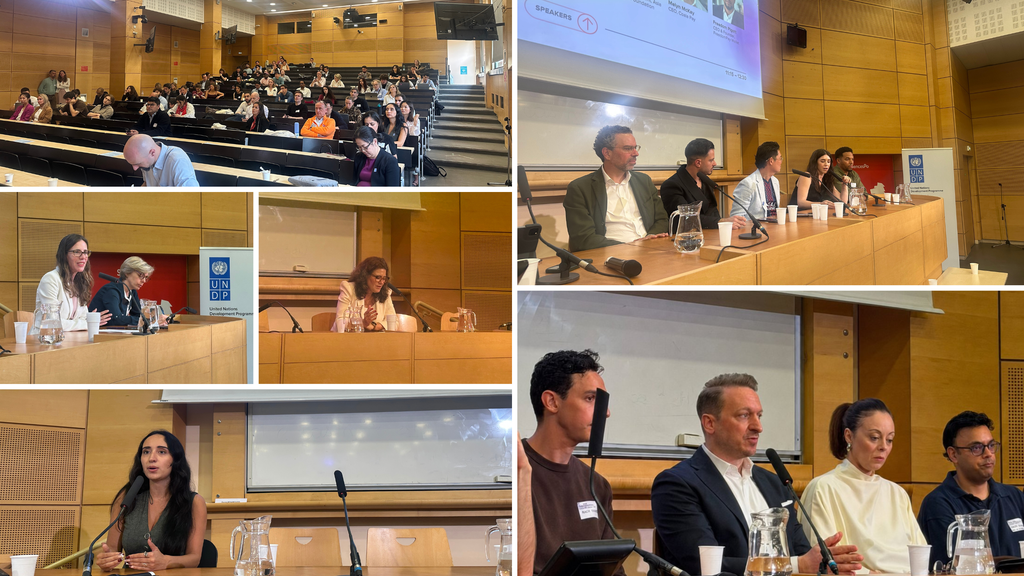
Moving funds through blockchain-based systems can be relatively straightforward. Ensuring that people can access, use, and benefit from those funds is not. The Sciences Po dialogue highlighted the importance of the “last mile” of public service delivery, where digital identity, payment infrastructure, regulatory frameworks, and local institutions all shape whether innovation reaches the people it is intended to serve. The challenge, participants argued, is often less technological than institutional.
The conversations also highlighted the importance of institutional continuity. Successful initiatives need to outlast individual projects, funding cycles, and changes in leadership if they are to become sustainable public systems.
This thinking informed the launch of the Government Blockchain Academy, developed by UNDP in partnership with the Exponential Science Foundation. The Academy will equip government officials with the knowledge, practical skills, and institutional capabilities needed to assess blockchain technologies, identify where they create value, and support their responsible adoption as part of broader digital transformation strategies.
Collaboration for implementation
Scaling blockchain for public good depends on collaboration across governments, development organizations, academia, and the private sector.
More than 30 senior representatives from across the blockchain ecosystem gathered for the inaugural meeting of the UNDP Blockchain Advisory Group, creating a new platform for strategic dialogue on the responsible application of blockchain for sustainable development. Beyond providing strategic advice to UNDP, the Group creates space to exchange knowledge, identify emerging opportunities, and strengthen collaboration around shared development priorities.
Its first discussion focused on digital finance and financial inclusion. Globally, 1.3 billion adults remain without access to formal financial services, and close to one billion lack the digital identity needed to access them. The discussion examined how blockchain-enabled approaches can help address these persistent challenges and what is required to support implementation at scale. Participants emphasized that financial inclusion is not simply about moving money more efficiently. It is about enabling people to participate more fully in the economy by building trusted financial histories, accessing savings and credit, and connecting to formal financial systems. Blockchain can support that transition, but only when it is integrated with existing financial infrastructure and supported by appropriate governance, regulation, and partnerships.
Showcasing implementation-ready solutions

The SDG Blockchain Accelerator Impact Showcase demonstrated how these ideas are already being put into practice through partnerships between UNDP and technology innovators. The Showcase introduced the SDG Blockchain Accelerator to a wider blockchain audience, presenting UNDP’s challenge-led approach to innovation. Rather than starting with technology and searching for a use case, the Accelerator begins with development challenges identified by UNDP Country Offices and institutional partners, then matches them with technology organizations capable of designing and implementing a solution. This helps ensure that innovation responds to real needs while creating practical pathways towards implementation.
Among the projects presented, FreedomPay Wallet is working with UNDP The Gambia to strengthen transparent and accountable digital payments, while Plastiks is partnering with UNDP in Armenia, India, El Salvador, and Zambia to create verifiable records of plastic recovery that support circular economy value chains. Other teams showcased solutions focused on programmable funding, supply chain traceability, and digital finance, showcasing how blockchain can strengthen transparency, efficiency, and accountability when embedded within broader public systems rather than deployed as a standalone technology.
Blockchain for good at scale
“The future of blockchain for development will depend not only on innovation, but on the institutions, partnerships, and public trust needed to apply it responsibly,” said Robert Pasicko, Lead, Alternative Finance Lab (AltFinLab), UNDP Europe and Central Asia.
Putting blockchain to work for sustainable development requires more than technology. It requires capable institutions, trusted partnerships, and the confidence to adopt new approaches responsibly. Achieving this requires new models of collaboration that bring governments, development institutions, and the blockchain ecosystem into sustained, structured dialogue rather than one-off engagement.
Istanbul, 06 July 2026. The United Nations Development Programme and the Stellar Development Foundation have signed a new agreement that carries their joint work on blockchain-based digital payments into its next phase, moving from a set of proven pilots toward a standing capability that UNDP country offices can draw on as a regular part of how they deliver programmes. Coordinated by the UNDP Alternative Finance Lab (AltFinLab) at the Istanbul Regional Hub, the agreement shifts the focus from testing the technology in specific contexts to putting in place the institutional conditions under which it can be used at scale.
The decision to scale follows sixteen months of joint work, during which the two partners researched the use of digital payments across seventeen countries, consulted UNDP country offices and stakeholders, and implemented live pilots in Haiti, Syria, Kenya, Guatemala, and The Gambia, with two further solutions developed to a working prototype in Colombia and Papua New Guinea. In parallel, the Sustainable Development Goals Blockchain Accelerator, strategically led by UNDP AltFinLab, matched a cohort of payment solutions built on the Stellar network with real UNDP programme challenges, producing a portfolio of graduated solutions with documented pathways to scale within existing country office programmes.
These pilots produced concrete evidence rather than promising projections. In Aleppo, UNDP delivered Cash for Work stipends to beneficiaries digitally and recorded every transaction on-chain, which reduced the estimated cost of distribution from about 10 percent of funds under conventional methods to about two percent, with every participant receiving and cashing out their payment. In Haiti, a pilot built for low connectivity continued to function with a 100 percent success rate, even when the cellular network failed entirely during testing, settling payments almost instantly under the conditions that communities actually face. Across all of the pilots, programmes gained something they had not had before, which is a traceable record of where money went.
Earlier in 2026, UNDP featured part of this work in the report New Tech, New Partners: Transforming Development in the Digital Era, which set out why reliable digital payment infrastructure matters for financial inclusion, for remittances, and for reaching people in fragile and conflict-affected settings that traditional financial systems sometimes fail to reach.
The new agreement turns these results into a capability that does not depend on any single project or funding cycle. Over the coming period the two partners will establish the governance, onboarding, and safeguards that allow UNDP to adopt digital payments responsibly, move validated solutions from the existing pipeline into active use, extend the same infrastructure across different categories of UNDP programming – from humanitarian response to social protection and financial inclusion – and consolidate the evidence and operating guidance that the service needs to continue and grow within the development system.
Throughout this phase, the Stellar Development Foundation will provide technical advisory support and coordination across the Stellar ecosystem, including expertise on the network and its protocols, and engagement with the solution providers operating within the UNDP pipeline, while UNDP will retain responsibility for delivery and implementation.
Robert Pasicko, UNDP Alternative Finance Lab, said: “We have shown that digital payments can reach the people that conventional systems miss, and in some of the hardest places to operate. The work now is to make that capability ordinary, so that a country office can use it with confidence as part of how it already works, rather than treating each deployment as an experiment.”
Candace Kelly, Chief Legal Officer, Stellar Development Foundation, said: “These pilots showed what open, public blockchain infrastructure can do when it is built around the realities of the last mile. We are proud to continue this work with UNDP and to help turn a set of successful pilots into a durable part of how development and humanitarian finance is delivered.”
The agreement runs through 2027 and will conclude with a consolidated evidence base, a scaling playbook, and a formal handover, so that the capability outlasts the partnership that created it.
About the United Nations Development Programme
The United Nations Development Programme (UNDP) is the leading United Nations organization fighting to end the injustice of poverty, inequality, and climate change. Working with our broad network of experts and partners in 170 countries and territories, we help nations to build integrated, lasting solutions for people and planet. Learn more at undp.org or follow at @UNDP.
About UNDP Alternative Finance Lab
UNDP Alternative Finance Lab develops new financial approaches, instruments, and partnerships that expand the resources available for sustainable development. Its work on blockchain based digital payments is part of a wider effort to make development and humanitarian finance faster, more transparent, and more inclusive. The Lab is hosted at the UNDP Istanbul Regional Hub.
About the Stellar Development Foundation
The Stellar Development Foundation (SDF) is a non-profit organization that supports the development and growth of Stellar, an open-source network that connects the world’s financial infrastructure. Founded in 2014, the Foundation helps maintain Stellar’s codebase, supports the technical and business communities building on the network, and serves as a voice to regulators and institutions. The Foundation seeks to create equitable access to the global financial system, using the Stellar network to unlock the world’s economic potential through blockchain technology.
UNDP teams are increasingly being asked to make sense of fast-changing digital systems before the institutional playbook is fully written. As part of this shift, blockchain is entering more practical development conversations, and UNDP’s ability to engage well depends on colleagues who can look beyond the technology and assess the operational and public-interest conditions around it.
The Virtual Development Assignment Programme (VDAP) offers a structured approach to build this kind of judgement as a UNDP people-development modality. Hosted by the Talent Development Unit under the Office of Human Resources and accessed through Fuel50, VDAP allows colleagues to take on assignments outside their usual office or bureau and contribute to live areas of work to build skills through applied exposure rather than detached training.
For blockchain, UNDP AltFinLab has been using this modality to bring colleagues closer to active workstreams while drawing on their regional and operational experience. A digital payment system needs liquidity, compliance, reporting and user trust; a credentialing tool needs legal recognition and data protection; a traceability system needs reliable actors across the chain. And through VDAP, AltFinLab brings colleagues into this practical layer, where technical promise is tested against operational reality.
A pathway into live blockchain work
VDAPs have grown alongside AltFinLab’s portfolio as it moved from building internal learning through the Blockchain Academy, to strengthening exchange through the UN Blockchain Community of Practice, to developing a pipeline of use cases through the SDG Blockchain Accelerator, and now to supporting implementation and scale-up. Participants have entered this pathway through practical assignments that help translate the portfolio into usable knowledge and more grounded programme design with stronger country-office links.
The same direction is reflected in New Tech, New Partners, which shows how UNDP’s blockchain practice is moving closer to public systems where payments, records, finance, trust and evidence need to work across many actors.
This is why VDAP is becoming an important channel for strengthening blockchain capacity within UNDP. Participants contribute directly to live work while developing a sharper understanding of how blockchain can be assessed in relation to operations, partnerships, safeguards and country-level delivery. In return, UNDP gains colleagues who can bring knowledge of local systems, institutional constraints and programme realities into portfolio discussions.
What blockchain-linked VDAP opens
For upcoming cohorts, the strongest argument may be the kind of work alumni were able to enter, and the value of this model is visible through the people who have passed through it. Some worked on learning systems; others moved closer to digital payments and pilots, AI, operations, credentials or regional digital work.
Earlier VDAP participants helped shape parts of the foundation that AltFinLab’s blockchain work still draws on. Dzenan Buzadzic, Digital Governance and AI Specialist, brought a digital perspective into early mapping and knowledge work, helping review the Tadamon Web3.0 platform and Blockchain Academy content, and developing an opportunity analysis for blockchain-based certification. Jenny Ensi, then Head of Experimentation at UNDP Accelerator Labs, connected her experience in innovation, acceleration and STEM education to early thinking on blockchain education for girls and women in the RBEC region, while also supporting engagement with learning platforms.
McDonald Nyoni, AI Policy Analyst, brought a strategic and implementation-focused perspective to the VDAP work, helping shape tokenization use cases, explore partnerships, and connect alternative finance with emerging opportunities in artificial intelligence. From UNCDF Tanzania, Country Coordinator Tian Zhang, added a UNCDF perspective to the Academy’s content review and beta testing, which shows us how blockchain learning benefits when it draws on experience beyond one office or function.
These contributions show how VDAP can turn internal expertise into institutional assets that others can build on.
Applied learning that travelled further
The value also appears in what participants were able to carry into later work. For Ana M. Grijalva, then Innovation and Digital Lead with UNDP Ecuador, VDAP created a route into AltFinLab’s blockchain portfolio that later developed into direct coordination of digital payments work. As Coordinator of Blockchain Digital Payments and Digital Institutional Strengthening, Ana coordinated a global team across three regions to support five blockchain-based digital payment pilots.
Her work also included developing an engagement strategy with eight government counterparts, helping position blockchain-based payment approaches around financial inclusion and security in government-to-person transfers. Her story shows how VDAP can move colleagues closer to live portfolio work, where country-office experience, cross-regional coordination and government engagement become part of implementation.
“One of the aspects I appreciated most about the VDAP was how the Innovation Team truly made us feel like part of their team. They fostered a collaborative environment by maintaining a well-structured working routine, actively engaging with us, and transparently sharing ongoing initiatives.” Ana M. Grijalva
Another form of value came through colleagues who connected the assignment to wider digital strategy. Enrique Crespo, Regional Digital Specialist for Latin America and the Caribbean, saw value in connecting blockchain with broader digital transformation and regional digital strategies. For him, working in an environment of AI and blockchain learning opened space to think about how these technologies could inform regional strategies and practical applications.
Closer to delivery, knowledge and operations
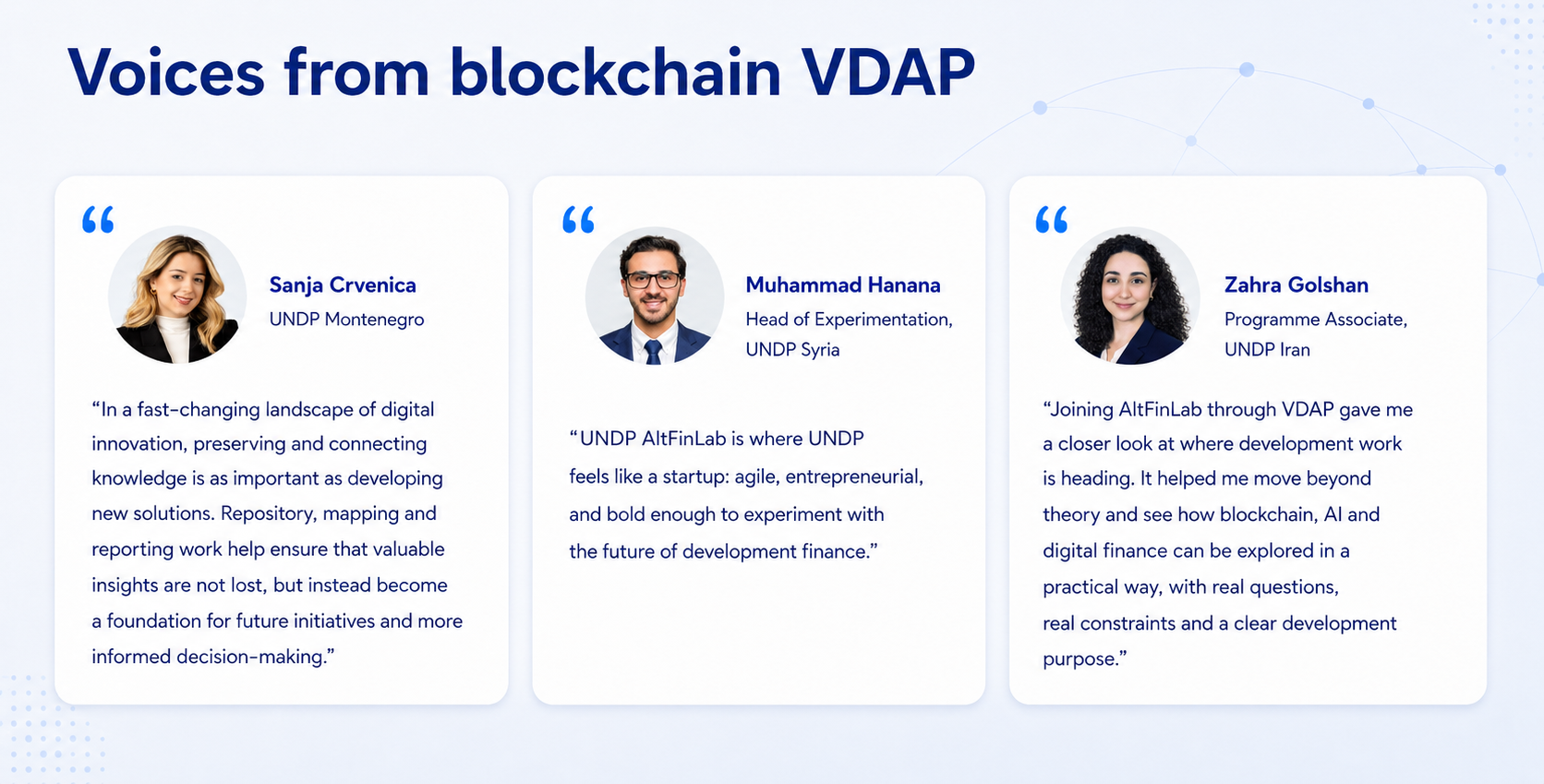
VDAP also helped bring blockchain closer to the systems and operations that make development work possible. Muhammad Hanana, Head of Experimentation in UNDP Syria, brought country-office experience into digital payments work, where the real questions are not limited to the payment rail itself, but include liquidity, regulation, cash-out options, reporting and user trust. Additionally, Sanja Crvenica, a Legal Specialist working with financial institutions at UNDP Montenegro on the development of an EU-ready financial sector, has been involved in knowledge infrastructure work, including repository development, mapping and blockchain reporting, helping turn scattered experience into something the wider system can use.
Marina Storgaard, Human Resources Associate, brought an operational lens to the VDAP experience. Her reflections connected blockchain learning to internal systems, including smart contracts, HR processes, credential verification and tokenization as possible ways to improve transparency and efficiency inside institutional workflows.
“Participating in this VDAP project has significantly enhanced both my technical and interpersonal skills. I developed stronger project management skills, particularly in collaborating across diverse teams and regions, navigating complex decision-making processes, and ensuring smooth communication.” Marina Storgaard
What links them all is the ability to bring their own professional setting into the assignment, and then carry new questions, contacts and practical judgement back into their work.
Why this matters for Country Offices
For Country Offices, this kind of internal capacity changes the starting point of a blockchain conversation. Instead of receiving a proposal and reacting to the technology, colleagues who have worked through VDAP can help ask the earlier questions: what problem is being solved, who needs to be involved, what risks need to be managed, and whether blockchain is actually the right tool.
This is the network effect UNDP AltFinLab is trying to build. VDAP alumni can become connectors inside their offices and teams, linking programme needs with the right expertise and keeping blockchain discussions close to delivery. They can also help maintain relationships between Country Offices and the wider UNDP innovation ecosystem, so emerging ideas are assessed with institutional memory, technical support and a clearer view of public value.
Join the next blockchain VDAP!
The fifth cohort arrives at a time when UNDP is engaging more systematically with the blockchain ecosystem, as evidenced by the recent establishment of the Blockchain Advisory Group in Paris, which is exploring the potential of this technology to support public-purpose digital transformation and financial inclusion.
In light of this, Cohort 5 will adopt a more intentional approach, seeking out colleagues already close to the right ecosystems, countries, functions and thematic areas, and who can help unlock meaningful opportunities for UNDP’s innovation pipeline.
Participants do not need to arrive as emerging tech experts. What matters is curiosity, judgement, initiative and a close understanding of how development work is designed and delivered. The strongest candidates will be those who can bring practical experience into live workstreams, engage with specialists and partners, and return to their offices with sharper questions about where blockchain and AI belong in development practice.
Cohort 5 at a glance
Opportunity title
Scaling Blockchain & AI for Development – SDG Accelerator, Digital Payments & Government Engagement
Available roles
6 positions across 4 roles
Eligibility
UNDP, UNCDF and UNV colleagues
Application channel
Fuel50 >>> search for the opportunity title and indicate which role you are applying for
Deadline
24 July 2026
Contact
Teodor Petricevic, teodor.petricevic@undp.org
The ninth and closing session of the spring UN Blockchain Talks handed the floor to three private-sector builders working at the edge of AI and blockchain, and asked them a blunt question: what do you actually need from an organization like the UN if AI agents, federated learning, and on-chain accountability are going to work at scale?
The conversation brought together Jiahao Sun, founder and CEO of FLock.io and former Director of AI at the Royal Bank of Canada, Patrick Tobler, co-founder of Masumi Network and creator of NMKR, and Gustav Friis, co-founder of NEARWEEK, with moderation by Ben Thompson Coon of the UNDP Alternative Finance Lab.
Your AI is only as good as the data it’s allowed to see
Jiahao Sun opened with the problem federated learning was built to solve. Good models need a lot of data, but in any large organisation, that data sits in silos for good reason. Hospitals, country offices, and banks can’t simply pool everything into one place.
FLock’s answer is to train models locally and only aggregate the learnings – never the raw data – across a network with no single controlling node, federated learning plus blockchain for open coordination. Is it as efficient as centralised training? Not historically, Sun admitted. But the field has moved to a hybrid model by training a strong foundation model centrally, then fine-tune it on sensitive local data in a federated way getting most of the privacy benefit without the old efficiency penalty.
His ask for UNDP heading into Cohort 3 of the SDG Blockchain Accelerator is to keep the country-office “wish list” coming, but push for requests written with an engineering mindset, clear inputs and outputs, so the private sector can match problems to solutions faster.
Giving AI agents a wallet, an ID and a paper trail
Patrick Tobler’s starting point was a thought experiment that Masumi Network was built to answer: if your personal AI agent asks a Booking.com agent to book a flight, and that agent talks to airline agents, and you end up at the airport with no ticket whose fault was it? He laid out four problems that have to be solved before enterprises will trust agents to act on their own:
- How agents pay each other – a wallet, not a credit card.
- How an agent proves it’s really who it claims to be!
- How agents find each other without one company controlling the app store.
- How every decision gets logged immutably so it can be audited later.
Masumi’s approach takes the result of an agent’s action, hashes it, and puts it on-chain so disputes can be traced back to the agent that actually got it wrong. When asked what he’d want from large institutions, Tobler answered, “don’t get locked into one big AI provider’s. Push toward open-source, decentralised infrastructure that no single company can gatekeep or tax.“
What a sovereign AI stack actually looks like
Gustav Friis took the conversation from agent-to-agent plumbing to government strategy. NEAR has been working with small, fast-moving states like Bermuda’s work on confidential AI for public services. A question every public institution now faces: staff want to use tools like OpenAI or Claude, but how do they do that and stay compliant?
His framing for a “sovereign stack” is avoid lock-in to any single technology, keep transparency where it builds trust (budgets, audits) but confidentiality where it’s needed. Above all, verifiable execution like cryptographic proof that a system did what it claims is still missing in most AI deployments, and it’s exactly the gap that caused Patrick’s flight-booking failure.
His last recommendation to the UN is to build on existing frameworks like GovStack and the Blockchain Advisory Group, and create a shared, open, cross-agency knowledge base that multiple AI systems can independently inspect and verify so good practice doesn’t stay locked inside individual pilots.
Is the UN too slow for AI?
Ben put the hardest question to the panel directly: at last month’s Proof of Talk event in Paris, more than one person told him the UN moves too slowly to matter on AI governance. Was that fair?
All three speakers pushed back! Sun pointed out that UNDP’s Blockchain Advisory Group is already moving faster than many national regulators but the gap is internal literacy on how to translate real-world problems into AI-ready requests. Tobler called the panel itself “proof the UN can act,” even if coordination across such a large system is inevitably harder. Friis added, “the UN reflects the average of its member states, and what looks slow from one country looks like real progress from another.”
The session closed on a phrase Sun used to describe what FLock and others are building: a “third species” of AI that is neither closed-source US models nor open-source Chinese ones, but decentralised models nobody fully owns or controls. Whether that third option becomes real, the panel agreed, will depend on exactly the kind of infrastructure like wallets, identity, verifiable logs, federated training that was discussed throughout the session.
Missed our talk? You can check out the recording here.
Get involved
The UN Blockchain Community of Practice (CoP) works best when colleagues bring practical questions, field-tested lessons and cases that challenge easy assumptions. UNDP’s third SDG Blockchain Accelerator cohort is launching soon, if any of the work from FLock, Masumi, or NEAR resonates with a challenge in your office, reach out!
For more details or suggestions, contact Ben Thompson Coon, UN Blockchain CoP Lead; ben.thompsoncoon@undp.org
The United Nations Development Programme (UNDP) will convene Scaling Blockchain for Public Good, a two-day high-level event bringing together blockchain ecosystem leaders, governments, development organizations, and academic institutions to explore the practical pathways through which blockchain technologies can strengthen public systems and support sustainable development. The programme is organized by UNDP’s Alternative Finance Lab (AltFinLab), a flagship initiative focused on exploring and scaling innovative financing and technology solutions for sustainable development.
The programme will take place across two days in Paris. On 3 June, UNDP will participate in Proof of Talk 2026 at the Louvre Palace (Musée des Arts Décoratifs) – one of Europe’s leading blockchain gatherings – to advance the conversation on blockchain for development with ecosystem leaders. On 4 June, the programme will continue at Sciences Po, co-organized with the Sciences Po Tech & Global Affairs Innovation Hub, with a focus on government engagement and responsible blockchain adoption in public systems.
Blockchain technologies are increasingly demonstrating their potential to foster cooperation in low-trust environments, strengthen digital public infrastructure, and expand access to financial and non-financial services for those furthest behind. Yet developing and scaling these solutions where they are most needed remains a challenge. Closing that gap requires new partnership models that connect technical innovation, development experience, and public sector engagement to deliver development outcomes at scale.
3 June | Proof of Talk, Louvre Palace
UNDP will host two sessions at Proof of Talk – one of Europe’s leading gatherings in the blockchain and digital asset space, with approximately 2,500 senior decision-makers from across the ecosystem.
UNDP will formally launch the Blockchain Advisory Group (BAG) – a senior-level advisory mechanism convening leading blockchain organizations to inform how blockchain technologies can support sustainable development and public-purpose digital transformation. The BAG formalizes UNDP’s engagement with the blockchain ecosystem into a structured, ongoing advisory relationship, designed to explore what partnering differently for development at scale can look like in practice. The inaugural, closed session will focus on financial inclusion and digital finance – where the need is most urgent. Despite significant progress, 1.3 billion adults worldwide remain without access to formal financial services, and close to one billion lack the digital identity needed to access them.
The second is the SDG Blockchain Accelerator Impact Showcase – an open session part of the Proof of Talk programme. The SDG Blockchain Accelerator is UNDP’s global initiative to scale blockchain and AI solutions in support of the Sustainable Development Goals. Selected solution teams will present on-the-ground work across financial inclusion, digital identity, climate resilience, and public service delivery, in a demonstration and networking session. The session will also preview the upcoming launch of Cohort 3 of the Accelerator – an opportunity for solution makers, technical partners, and ecosystem actors to explore collaboration with UNDP on scaling blockchain solutions for development.
Registration for the Impact Showcase is available here.
4 June | Sciences Po, Paris
Co-organized by UNDP AltFinLab and the Sciences Po Tech & Global Affairs Innovation Hub, in partnership with Exponential Science Foundations and Stellar Development Foundation, the half-day programme at Sciences Po brings together academics, policymakers, senior government representatives, and practitioners for a focused dialogue on responsible blockchain adoption in public systems.
The programme addresses two interconnected themes: first, how governments are building the institutional capacity, regulatory frameworks, and implementation pathways needed to adopt blockchain-based solutions within public systems – including an introduction to the Government Blockchain Academy, UNDP AltFinLab’s new capacity-building initiative for public-sector blockchain adoption; and second, how blockchain-enabled financial tools are being used to reach people excluded from conventional financial systems, drawing on active deployments in humanitarian and development settings.
The full programme and registration are available here.
About the programme
Across both days, Scaling Blockchain for Public Good is intended to support practical exchange and advance the conversation on where blockchain can deliver public value – what conditions are needed for responsible and inclusive implementation, and how development actors, governments, and the blockchain ecosystem can work together in support of public purpose digital transformation at scale.
The eighth session of the UN Blockchain Talks used the story of Mariama, a fictional trader in The Gambia, to bring the discussion on stablecoins closer to the realities of last-mile financial inclusion. Mariama runs a small business, depends on family remittances, manages customer debts, and needs money to arrive in a form she can use immediately.
Her situation gave the session its practical anchor! A transfer may arrive faster through digital rails, but speed alone does not settle the matter. The real question is whether the money can be converted, spent, trusted, and supported by people and systems nearby.
The discussion brought together Dr. Margie Cheesman of King’s College London, Stephanie Joseph of Citi, and Freedom Pigott of FreedomPay Wallet, with moderation by Ali Al-Zuhairi of UNDP Alternative Finance Lab.
The cost of being financially invisible
At the start of the session, the speakers looked at Mariama’s financial life before any new payment tool entered the picture. She already has a financial system, built through informal savings groups, family support, customer relationships, receipts, WhatsApp records, and daily judgment.
Dr. Margie Cheesman pointed to the structural disadvantages faced by people outside formal banking systems. Their financial lives are often active and complex, yet formal institutions may fail to recognize that activity as proof of reliability. Freedom Pigott brought that point into the experience of small traders, many of whom manage credit, repayments, sales, and supplier relationships with discipline.
At the receiving end, Stephanie Joseph pointed to another gap: a sender may have access to digital payment tools, while the receiver still depends on limited local options!
When money arrives late
As the scenario developed, Mariama needed to restock her business. A relative sends money, but the transfer is slowed by fees, exchange rates, and delays. For a trader, waiting can mean missing stock, losing a customer, or buying less than planned.
This is where stablecoins can help! In corridors where traditional transfers are slow or expensive, digital dollars can move value in minutes and reduce the cost of sending. In Mariama’s case, that speed could help her respond before a business opportunity disappears.
Still, the discussion kept returning to the same practical point: Mariama’s supplier wants dalasi. Her customers pay locally. Her business needs liquidity. A wallet balance is useful only when it can be converted, spent, or accepted nearby.
Where the system is tested
At the last mile, the quality of the system depends on what surrounds the transfer. Agents, merchants, cash-out points, liquidity, user support, and trust determine whether the money becomes part of daily business or stays trapped inside an app.
Freedom shared experience from implementation in The Gambia, including the challenge of building agent networks and maintaining liquidity. For development programmes, this is where design has to be tested honestly. A pilot can record successful transactions while the user still carries the hardest work.
The same issue applies to financial records! Blockchain-based tools may help small traders build a record of activity that can later support credit, microloans, or working capital. Yet that record must be understandable and safe for the person whose activity created it.
Faster rails, slower institutions
The final part of the session turned to institutional adoption. Participants were asked why someone like Mariama may still be waiting for payment when faster technology already exists. The strongest response pointed to slow institutional processes, followed by the lack of local infrastructure.
Compliance, procurement, data protection, and risk management protect people and institutions. In urgent contexts, however, long processes can make support arrive too late. Startups need better internal controls and clearer regulatory pathways. Institutions need safer ways to test payment models without slowing them down until they lose their purpose.
By the end, the session treated stablecoins as one layer in a wider system that still has to earn trust through local use. For Mariama, the value of the transfer depends on what happens after it arrives: whether she can spend it, convert it, understand it, and get help if something goes wrong.
Missed our talk? Watch the recording here.
You can also explore previous Blockchain Talks sessions in our YouTube Playlist.
Get involved
The UN Blockchain Community of Practice (CoP) works best when colleagues bring practical questions, field-tested lessons and cases that challenge easy assumptions.
For more details or suggestions, contact Ben Thompson Coon, UN Blockchain CoP Lead; ben.thompsoncoon@undp.org
Environmental sustainability has become one of blockchain’s favorite talking points. Even so, carbon credits, drought insurance, climate adaptation loans, renewable energy certificates, and biodiversity finance do not usually occupy the same conversation for long. In the seventh Blockchain Talks, they did!
What held them together was neither a shared market nor a shared asset class, but a shared operational problem. In each case, money, claims and decisions depend on records that must be trusted across multiple actors, while the realities behind those records remain difficult to verify or audit. The session, then, was more about where the technology begins to matter once environmental work runs into questions of integrity, coordination and implementation.
Opening the session, Robert Pasicko situated the discussion within UNDP’s own pipeline. Environmental sustainability, he noted, is no longer a side strand in blockchain work. On the contrary, it has become one of the liveliest areas of experimentation, precisely because teams are testing whether the technology can solve something concrete. The real test, as he put it, is not whether blockchain sounds relevant, but “how do we actually make it work?”
That question found its clearest answer in the speakers’ experiences in their projects. In Adam Spiers’ account of Toucan Protocol, blockchain helps where carbon markets need traceability that can survive market activity. Toucan’s work brings carbon credits on-chain in a way that remains verifiable “to guard against double counting,” while also making it easier to build liquid instruments around assets that are otherwise slow and fragmented to manage. In that sense, blockchain is being applied as market infrastructure.
With Etherisc, the technology appeared in a different role. Christoph Mussenbrock showed how blockchain can help coordinate climate insurance across farmers, NGOs, governments, insurers, and reinsurers that do not naturally share a trusted system. When payouts depend on satellite data, sampling, and rapid execution rather than slow claims processing, that shared layer starts to matter. Just as importantly, he made clear where the technology should disappear from view: “No farmer should bother about wallets and private keys and cryptography.”
In the electricity market, the value proposition sharpened further. Gideon Maasz of Fuel Switch focused on renewable energy certification, where the issue is proving in auditable terms how much exported electricity is actually renewable. Once those claims begin carrying tax or trade consequences, credibility ceases to be a reporting preference and becomes a commercial requirement. Hence his insistence that environmental claims need “quantifiable data.”
Elsewhere, the same logic surfaced in climate adaptation finance and nature-based investment. Speaking about Cladfy’s work with UNDP Bangladesh, Ebby Gatamu described a system designed to move climate finance to rural women in ways that are more accessible, more trackable, and more dignified, allowing them to apply “from the comfort of their home.” From a different corner of the field, Juan Pedro Piñeirua showed how blockchain can help structure environmental value so that capital flows and ecological outcomes are easier to follow over time. In his words, the larger question is “How do we bridge the gap between the market and the protection of life-supporting systems?”
Taken together, the session gave a more grounded answer to its own title. Blockchain helped where environmental work needed claims, flows, and records to remain legible across many actors at once. That is a narrower answer than the hype usually offers, but a far more credible one.
Missed our talk? Watch the recording here.
You can also explore previous Blockchain Talks sessions in our YouTube Playlist.
Get involved
The UN Blockchain Community of Practice (CoP) works best when colleagues bring practical questions, field-tested lessons and cases that challenge easy assumptions.
For more details or suggestions, contact Ben Thompson Coon, UN Blockchain CoP Lead; ben.thompsoncoon@undp.org