
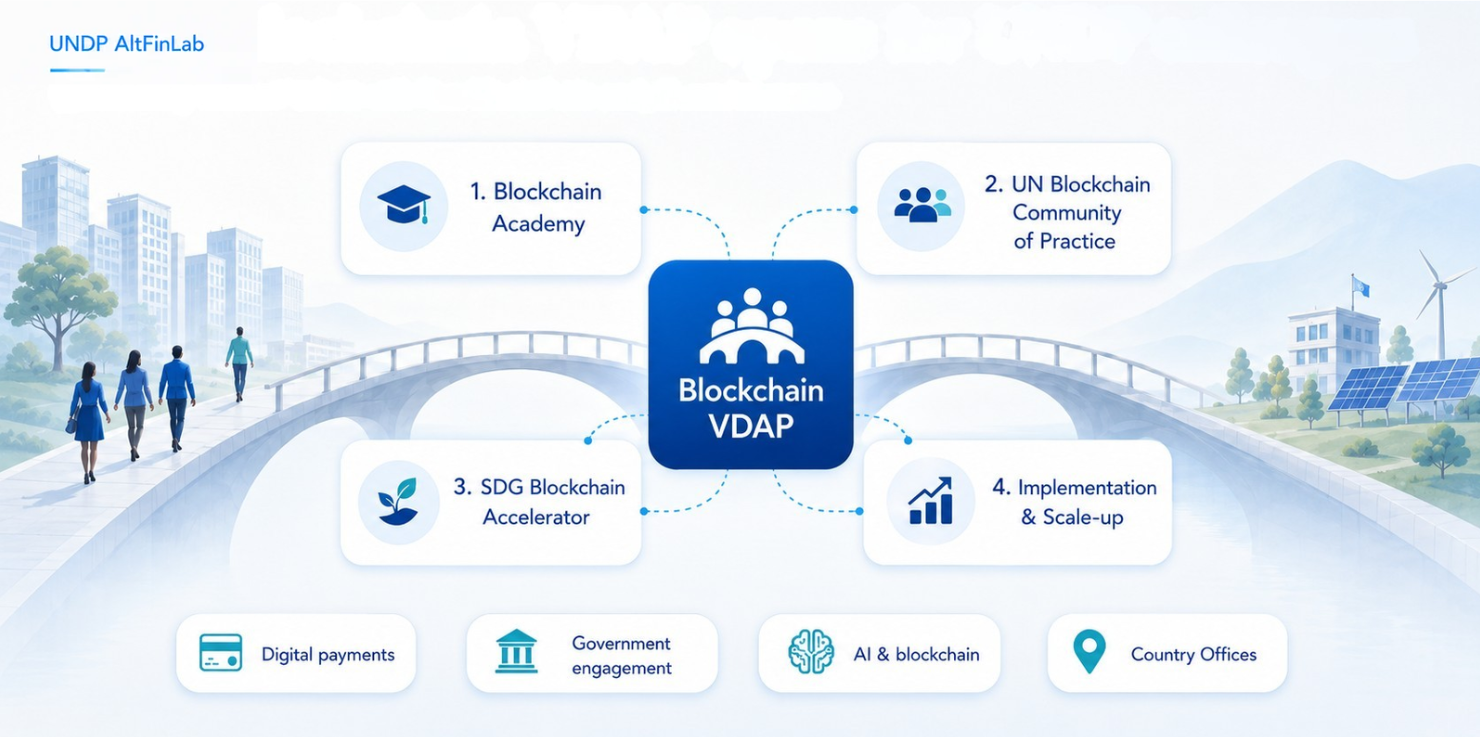
What blockchain VDAP opens for UNDP colleagues
What blockchain VDAP opens for UNDP colleagues Connecting internal talent with live blockchain and AI workstreamsJune 26, 2026 | NEW TECHNOLOGIES, PORTFOLIO DEVELOPMENT UNDP teams […]


Strategic documents set out the foundations and key priorities for organizations. They provide planning and a long-term vision that can then be dissected into more concrete road maps or action plans. These documents require a lot of effort, but once completed they often end up sitting on a shelf or website, waiting for someone to remember them.
One reason that these important documents become obsolete almost immediately is because they’re written for a five or even ten-year period, which is at odds with the realities of a dynamic and fast-changing context. It is crucial to be able to adapt to constant changes and to make sure that suggested avenues for solutions are relevant and timely.
At UNDP Kazakhstan, we decided to experiment with a new approach to organizational strategies and ‘hack’ our own Country Programme Document (CPD), a strategy document that each UNDP country office submits every five years. Our Accelerator Lab team started the hacking process in each of the priority areas identified in the CPD, in order to introduce new ideas for experimentation that are timely, innovative, and impactful.
Whatever strategic document you have, the goal of introducing an experimentation mindset is to breathe new life into strategies, and make a greater impact, by utilizing novel instruments and approaches. This process is applicable to any organization working to stay relevant and accomplish their strategy and vision in a rapidly changing context.
Benefits of hacking your strategy
Strategic documents are often based on robust research, the identification of problems and recommendations for solutions. Experts in the fields contribute to developing strategic documents, using official statistical analysis, global benchmarks and recommendations for actions. Yet despite all the available information, problems may continue to persist, strategies may not be fully implemented or may even be neglected. This is because these documents answer the ‘WHAT’ question – through descriptions of current and desired situations – but they do not tell you HOW to implement these recommendations.
An important part of any strategy is to know how to use the developed analysis and strategies, how to address problems and how to implement solutions in our complex system. To help answer these questions, innovative and relevant instruments can be introduced through creative exercises which will help generate ideas and consultations within and outside the organization.
The hacking process

In the UNDP Kazakhstan Accelerator Lab, we asked ourselves the following guiding questions throughout the hacking process to help us find entry points for innovation in our strategic document:
The hacking process can be explained in three steps:

In summary, the hacking process is an innovative way to identify and add ideas for experimentation in order to achieve more efficient, responsive, and relevant impact. As organizations, we often already have sufficient information. It’s now a matter of tapping into the collective intelligence of our ecosystem to accelerate our progress towards a sustainable future.
RELATED POSTS
What blockchain VDAP opens for UNDP colleagues Connecting internal talent with live blockchain and AI workstreamsJune 26, 2026 | NEW TECHNOLOGIES, PORTFOLIO DEVELOPMENT UNDP teams […]
Artificial intelligence (AI) is increasingly shaping how cities deliver services, manage infrastructure, and make decisions. For many municipalities across Europe and Central Asia, the challenge is not […]
Artificial intelligence (AI) is opening new possibilities for how cities deliver services, make decisions, and manage complex systems. For municipalities, the question is no longer whether AI […]